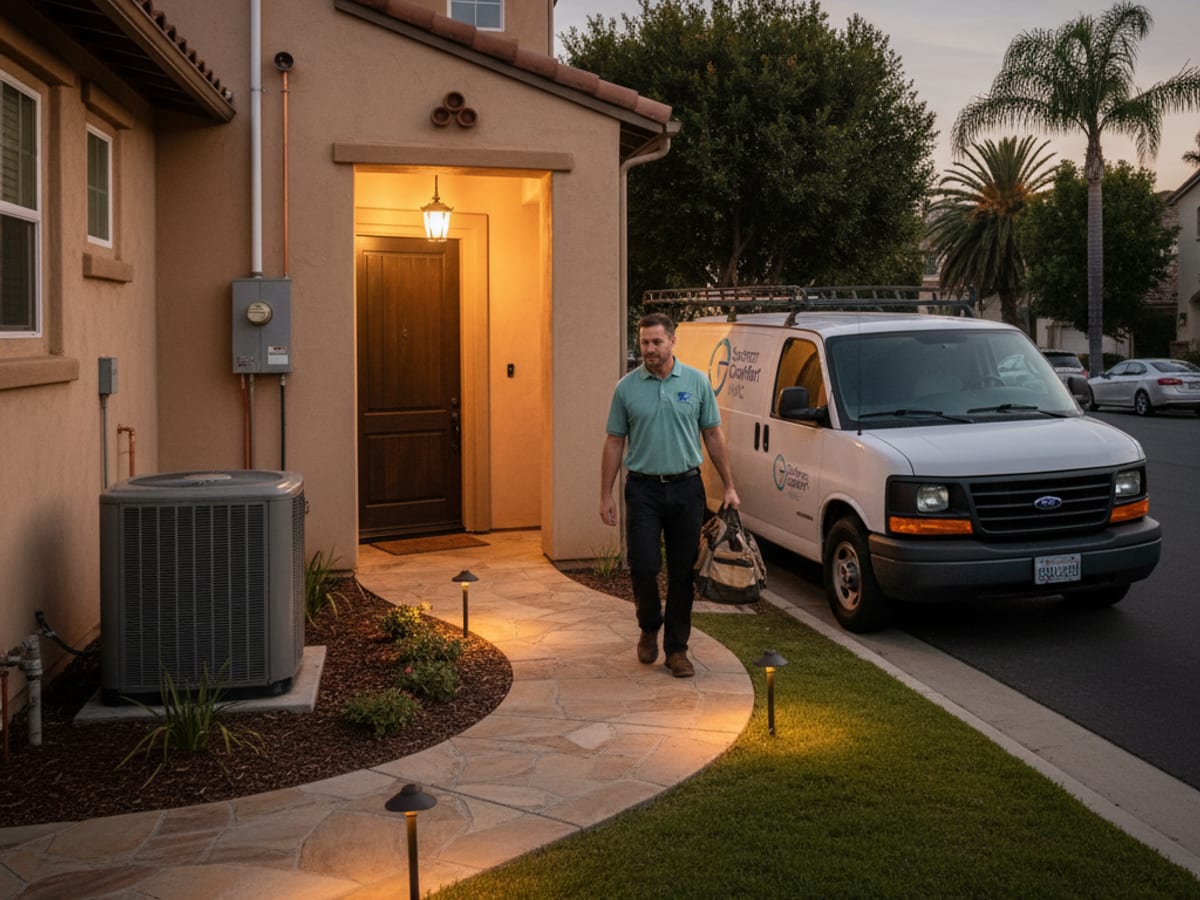
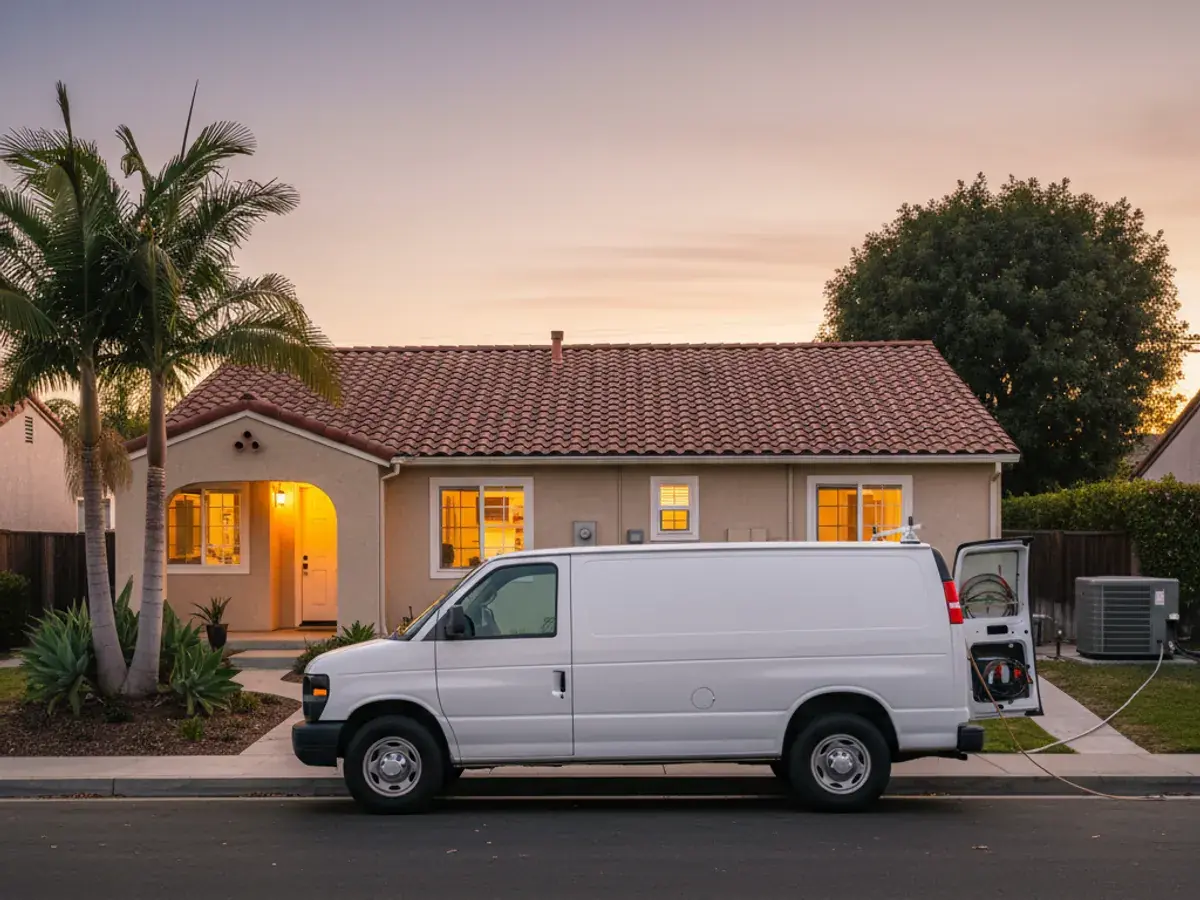
When the AC quits in Spring Valley during a 86 to 89-degree summer stretch, a home built decades ago heats up fast. Leave your details. The matched company confirms whether they can take the job and when they can arrive. Climate Pros SD does not run a dispatch desk.
The Climate Pros SD line for Spring Valley takes a message. Call (442) 777-6440 and leave your address, symptoms, hazards, and a callback number. A licensed company is matched and then confirms whether they can take the job, when they can arrive, and the trip fee. The trip fee and repair cost are set by the company you are matched with and quoted before any work starts.
Spring Valley sits in East County where summer temperatures regularly climb to 86 to 89 degrees through July, August, and September. The area has a high concentration of homes built decades ago, many of them on aging systems that have been running for two or three decades. When that older equipment meets a multi-day heat event, the combination of high load and worn components is what generates emergency calls.
Spring Valley is an unincorporated community, and the mix of housing density, property sizes, and road layouts means travel time can vary by neighborhood. Leave whether anyone is medically vulnerable. The matched company confirms whether they can take the job and should be direct with you about timing. Climate Pros SD does not run a dispatch desk or promise same-day service.
What an emergency HVAC call covers in Spring Valley
An urgent HVAC call is about making the equipment safe, then restoring heat or cooling if the matched company can take the job. Companies we match in Spring Valley handle cooling and heating failures in older East County homes. Ask whether they stock common capacitors, igniters, and flame sensors.
No-cooling calls when the AC quits during a Spring Valley summer heat event
No-heat calls on cold mornings, including pilot, ignitor, and gas valve faults
Aging equipment failures common in homes built decades ago
Weekend or holiday visits only if the matched company offers them and confirms a fee in writing
Gas-smell and burning-smell calls, shut down and diagnosed safely
Water leaking from the air handler into a ceiling or wall
Tripped breakers, blown fuses, and electrical faults that killed the system
Failed capacitors and contactors, a common no-cooling repair
Refrigerant leak triage and emergency recharge to restore cooling
Overheated condensers that shut down under heavy East County heat load
Ask the matched company to put it in writing if they recommend a standard appointment instead of an urgent visit
Emergency HVAC cost in Spring Valley
Urgent visit pricing in Spring Valley depends on the company you are matched with. You should see the trip fee and the repair cost in writing before any work starts, and you approve it. The table below lists common line items. Climate Pros SD does not publish brand prices.
Repair
Typical range
Notes
Urgent trip and diagnostic fee, if offered
Set by the matched company
Only if that company offers outside-hours visits
Business-hours diagnostic
Set by the matched company
Priced at standard business-hours rates
Run capacitor replacement
Priced by the part, quoted upfront
The most common urgent no-cooling fix in Spring Valley
Contactor or relay replacement
Priced by the part, quoted upfront
Often paired with a capacitor on older units
Furnace ignitor or flame sensor
Priced by the part and furnace type
A frequent no-heat call in Spring Valley older homes
Refrigerant recharge (R-410A)
Priced by how much refrigerant the system needs
Depends on how much charge the system lost
Condenser or blower fan motor
Priced by the motor type required
East County heat load wears motors faster on aging units
Gas valve replacement
Priced after a safety inspection
Quoted after a safety check of the heat exchanger
Control board replacement
Priced by the board, brand-dependent
Brand-dependent, some boards must be ordered
Emergency condensate cleanup and repair
Priced by the scope of the clog or repair
Clears the line and resets the float switch
The trip fee is set by the company you are matched with, not by which part of Spring Valley you live in, from the central residential areas to Jamacha and the outlying unincorporated neighborhoods. If a part has to be ordered, the matched company should make the equipment safe and tell you when they can return.
When an emergency means it is time to replace
A breakdown at the worst possible moment is often the system telling you it is done. Repair makes sense when the fix is small and the unit is not near the end of its life. Replacement makes sense when the system is old, runs R-22, or the failed part is expensive. Two rules help you decide on the spot.
The 50% rule
If the emergency repair costs more than half the price of a new system, replacement is the smarter money. A compressor failure on a 15-year-old Spring Valley unit is often a clear case for replacement. A capacitor failure on a 7-year-old system is usually a straightforward repair.
The 5,000 rule and the risk of a repeat failure
Multiply the age of the system by the estimated repair cost. If the result is over 5,000, replacement is the smarter move. A 16-year-old unit needing a moderately priced repair scores high on this test and points to replacement. The same repair on a 6-year-old system scores low and points to repair.
Spring Valley makes this more pressing. The older housing stock means a lot of systems are already well past their expected service life, and a unit that fails once during a peak-summer heat event often fails again that same season. Many older homes still run R-22 systems, and R-22 is no longer produced, so a leak repair gets expensive fast. The matched company should quote the emergency repair number, the replacement number, and an honest read on whether the unit can survive another summer.
Local angle
Emergency HVAC built for Spring Valley homes
Why Spring Valley summers push HVAC systems to their limit
Spring Valley sits inland from the coast in the foothills east of Lemon Grove and La Mesa. The marine layer that keeps coastal communities cooler does not reliably reach this far east, and summer heat events push afternoon temperatures to 95, 100, and sometimes far higher. That range of heat is what separates a system that limps through versus one that simply stops.
The unincorporated character of Spring Valley means the housing mix is dense in some areas and more spread out in others. Pockets of higher-density older housing see some of the highest call volumes during heat events because the homes are smaller, less insulated, and on aging systems that run constantly trying to keep up.
The older housing stock
A large share of Spring Valley homes date from the period between the early 1960s and the late 1980s. That era of construction used building practices and insulation standards that were not designed for the kind of sustained heat East County now sees regularly. The ductwork in many of these homes is original, undersized by modern standards, and often leaking at the joints.
The HVAC systems installed in those homes, even if replaced once or twice, are frequently on their second or third unit with original duct infrastructure underneath. A system working against leaky ductwork in a poorly insulated older home runs harder than the equipment was designed for, and that extra load is what surfaces a weak capacitor or a tired motor on the worst day of the year.
Gas smells and safety calls
If you smell gas, do not flip switches or light anything. Get everyone out of the house, then call 911 or SDG&E from outside. Do not wait for an HVAC match. Once the gas side is safe, the matched company handles the HVAC side: testing the gas valve, inspecting the heat exchanger, and confirming the furnace is safe before it runs again.
A carbon monoxide alarm is a 911 call first. Leave the home immediately. After emergency responders clear the house, the matched company diagnoses the equipment, because a CO alarm often points to a cracked heat exchanger that should never run again until it is replaced.
How a visit is scheduled in Spring Valley
Travel time across Spring Valley vary depending on where the matched technician is coming from. Central addresses along Spring Valley and Jamacha roads tend to be quicker to reach. More spread-out addresses in the unincorporated areas can take longer depending on road access. The matched company confirms outside-hours availability if they offer it. Climate Pros SD does not run a dispatch desk.
What else is emergency hvac service in Spring Valley called?
Homeowners search for this a few different ways. In Spring Valley it also goes by 24 hour HVAC repair in Spring Valley , emergency furnace repair in Spring Valley , emergency AC repair in Spring Valley , emergency air conditioning in Spring Valley , and emergency heating service in Spring Valley . They all reach the same licensed local pros, and the operator who answers will
sort out which one your job actually is.
Spring Valley emergency service questions
How much does emergency HVAC service cost in Spring Valley?
The trip fee and repair cost are set by the company you are matched with, and they are quoted before any work starts. Ask whether they charge more for evenings, weekends, or holidays. Climate Pros SD does not set that fee. You approve the price before the technician starts.
How soon can a matched company reach my Spring Valley home for an emergency?
Travel time across Spring Valley vary depending on where the matched technician is coming from. Central addresses tend to be quicker to reach, and more spread-out unincorporated areas can take longer. Leave hazard details and whether anyone is medically vulnerable. The matched company decides whether they can take the job and when they can arrive.
Do you answer the phone at night in Spring Valley?
No. Climate Pros SD does not staff night phones. Leave a message. The matched company confirms if they offer outside-hours. Climate Pros SD does not run a dispatch desk. Leave your details on the line and say it is an emergency. A match is then made if a licensed company can take it.
My AC quit on a peak-summer day in Spring Valley. Can you help?
Yes. Summer no-cooling calls are a common East County urgent request. Without a reliable marine layer, a Spring Valley home without AC can reach a dangerous indoor temperature within hours. The matched company carries capacitors, contactors, and motors, so many urgent no-cooling calls are fixed in a single visit.
My system is 25 years old and just stopped working. Should I repair or replace?
A system that old failing in a heat event is worth a frank conversation. If the repair is a small part like a capacitor, that is usually a quick fix. If it needs a compressor or is running R-22 refrigerant, replacement is almost always the smarter call. The matched company should quote both numbers and an honest read on the spot.
What counts as an HVAC emergency in Spring Valley?
Loss of cooling during summer heat, loss of heat on a cold morning, water leaking from the equipment into a ceiling, and any burning or gas smell all count. A loud system still needs a safety check. Ask the matched company whether they recommend a standard appointment or an urgent visit, and get the fee in writing.
I smell gas near my furnace. What should I do?
Leave the house right away. Do not flip light switches or use anything with a flame. Once you are outside, call 911 or SDG&E. Do not wait for an HVAC match. After the gas side is confirmed safe, a matched HVAC company can inspect the gas valve and heat exchanger before the furnace runs again.
Water is dripping from my ceiling near the air handler. Can you help?
Yes, that is an urgent call if water is reaching a ceiling, wall, or electrical parts. A clogged condensate line or a stuck float switch can push water into a ceiling and cause real damage. The matched company clears the line, resets the safety switch, and checks the air handler so the leak stops before it spreads.
It is a peak-summer afternoon and my AC is off with an elderly parent at home. What now?
Call us right away at (442) 777-6440. A hot home with an elderly resident, an infant, or someone with a medical condition is something to say when you leave a message. While you wait, close blinds, run fans, and move everyone to the coolest room.
Do you charge extra for unincorporated Spring Valley addresses?
The trip fee is set by the company you are matched with, not by which part of Spring Valley you are in, including unincorporated areas and Jamacha. Ask the matched company to confirm in writing that the approved quote is what you will be billed.
My carbon monoxide alarm went off. Who do I call first?
Call 911 or the gas utility first and leave the home immediately. Do not wait for an HVAC match. A CO alarm is a life-safety issue. Once emergency responders have cleared the house, a matched HVAC company can diagnose the equipment, because a CO alarm often points to a cracked heat exchanger that must not run again.
What HVAC brands do you service on emergency calls in Spring Valley?
Ask the matched company which brands they service. They may service, including Carrier, Trane, Lennox, Goodman, Rheem, American Standard, York, and Bryant. The techs in the companies we match may carry common parts for both modern R-410A systems and the older R-22 units still running in many established Spring Valley homes.
Service area
Where we serve Spring Valley
We cover Spring Valley and the surrounding East County communities, and we match you with a licensed local pro for emergency service.
Serving Spring Valley
Need emergency service in Spring Valley?
We match you with a licensed local HVAC pro for your repair or replacement.