TL;DR
- The most likely cause of warm air is a clogged air filter or thermostat set incorrectly, check those first, before calling anyone.
- Five causes in order of probability: dirty/clogged filter, low refrigerant (leak), frozen evaporator coil, failed capacitor, compressor failure.
- DIY fixes cover the first two checks. Everything else, refrigerant, capacitor, compressor, requires a licensed HVAC technician.
- Climate Pros SD matches you with licensed companies. We do not publish a $0 to $2,800 repair menu.
- Don’t run an AC that’s blowing warm air for days hoping it’ll fix itself. The underlying cause will worsen, and some failure modes (low refrigerant → compressor damage) turn a small repair into a compressor replacement.
Your AC is running. The fan is blowing. But the air coming out of the vents is room temperature or warmer. That’s frustrating, and also a specific enough symptom that it narrows down the cause considerably.
Start with the quick checks. Then work through the five causes below in order.
Quick checks before you do anything else
Do these first. They take three minutes and solve roughly 20% of warm-air calls without a service call.
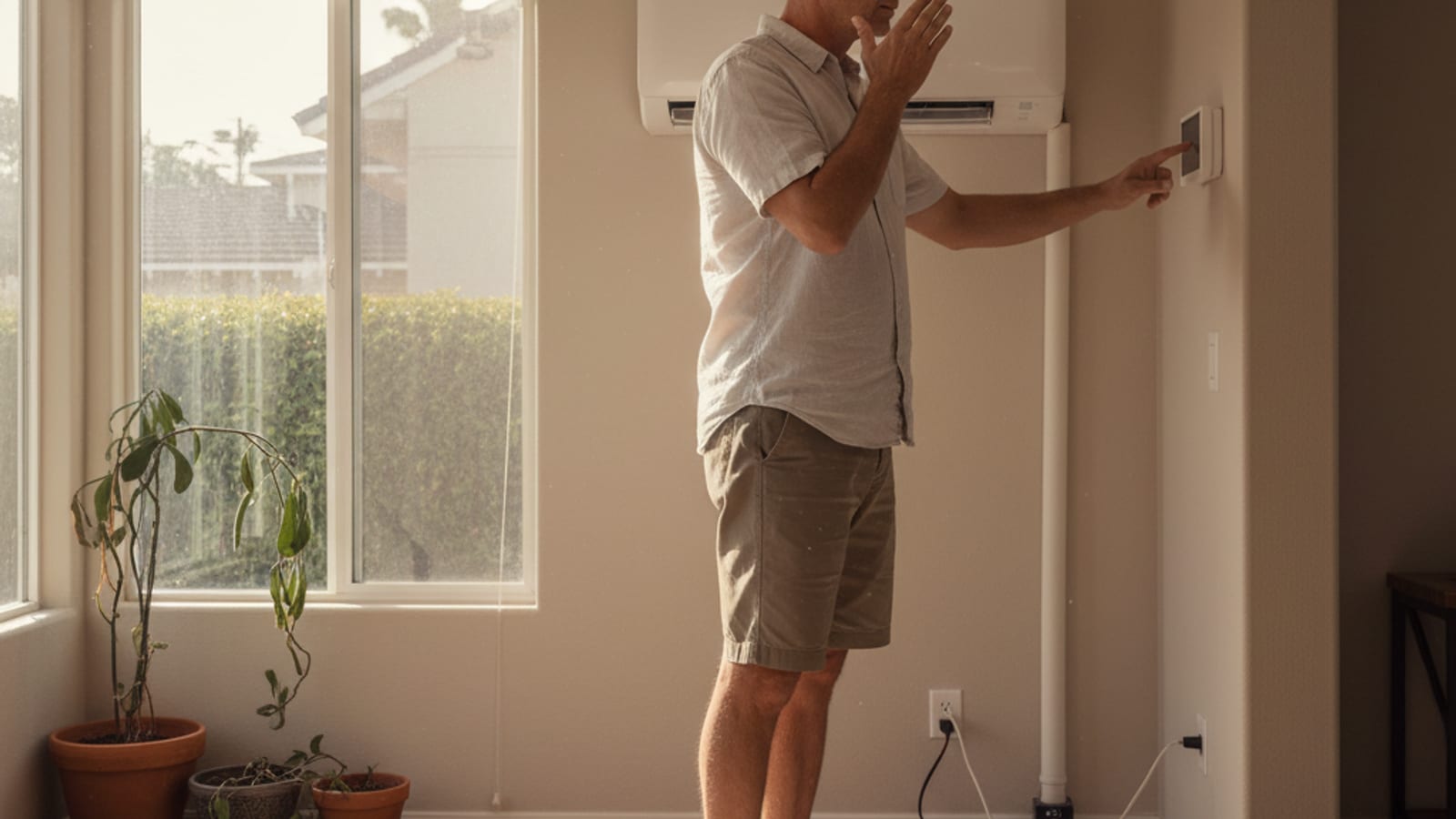
Check 1: Thermostat mode. Is the thermostat set to COOL? It sounds obvious, but thermostats get switched to HEAT or FAN-only, especially after winter or after someone bumps the controls. Set to COOL, setpoint at least 3 degrees below current room temp, fan to AUTO.
Check 2: Thermostat fan setting. If the fan is set to ON (not AUTO), it runs continuously, including when the compressor is off. During the compressor’s off-cycle, the fan blows unconditioned air through the vents. Switch to AUTO and give it 15 minutes.
Check 3: Circuit breaker. Some homes have split electrical feeds for the air handler (indoor unit) and condenser (outdoor unit). If the condenser breaker has tripped, the fan still runs, pushing air across an evaporator coil that isn’t cooling. Check the breaker panel for two AC-labeled breakers, not just one.
If all three check out, work through the five causes below.
Cause 1: Clogged or dirty air filter (probability: high)
This is the most common cause of AC performance problems, including warm air.
A severely clogged filter restricts airflow across the evaporator coil. Without enough airflow, the coil gets too cold, the refrigerant doesn’t absorb heat properly, and the air coming through is barely cooled. In severe cases, the restricted airflow causes the coil to freeze, which cuts cooling further and can progress to a compressor shutdown.
How to check: Pull the air filter out of the air handler or return air grille. If it’s gray, dense, or you can’t see light through it, replace it.
DIY fix: Replace the filter. Run the system for 30–60 minutes after replacement. If the coil froze, shut the system off for 2–3 hours first to let it thaw completely before restarting.
Cost: A quality filter is a hardware-store purchase. No service call needed.
When it’s not the filter: If you replace the filter and the system still blows warm after an hour, the filter wasn’t the root cause, continue to Cause 2.
Cause 2: Low refrigerant (leak) (probability: moderate-high)
Refrigerant is the substance that actually moves heat out of your home. It doesn’t get “used up” like fuel, if the level is low, you have a leak somewhere in the system. Low refrigerant means less heat transfer, which means the air coming out of the vents is warmer than it should be.
A system running with a 10–15% refrigerant deficit will blow noticeably warmer air. A system at 30–40% below the proper charge may barely cool at all.
How to diagnose: You can’t check refrigerant levels without gauges and training. But there are signs:
- The outdoor unit is running but the air isn’t cold
- The copper suction line (the larger insulated pipe going into the outdoor unit) is warm or not cold when the system runs
- You hear a hissing or bubbling sound near the indoor unit or refrigerant lines
- The indoor evaporator coil has ice on it despite no airflow restriction
DIY fix: None. Refrigerant work requires an EPA 608 certification. Attempting to add refrigerant yourself isn’t legal and won’t fix a leak.
What a technician does: Connects gauges to measure suction and liquid line pressures, confirms low charge, performs a leak search (electronic detector, UV dye, or nitrogen pressure test), repairs the leak if accessible, and recharges the system.
What a technician quotes:
- Refrigerant recharge only (no leak found or leak previously repaired)
- Leak search + repair + recharge
- Coil replacement (if the leak is in the evaporator coil), plus labor
Climate Pros SD does not publish those bands.
Cause 3: Frozen evaporator coil (probability: moderate)
A frozen coil is often a downstream consequence of Cause 1 (clogged filter) or Cause 2 (low refrigerant), but it can also result from other airflow restrictions.
When the evaporator coil ices over, the ice acts as insulation between the refrigerant and the air, no heat transfer happens, and the system blows warm or uncooled air. At the same time, a frozen coil can block the evaporator’s face almost entirely, reducing airflow through the system to near zero.
How to check: If you can safely access the air handler, look for ice on the refrigerant lines or on the coil itself through an inspection panel. Ice you can see means the coil is frozen. Even if you can’t see ice, the suction line (large insulated copper pipe) at the outdoor unit will sometimes have ice at the connection point when the coil is frozen.
DIY fix: Shut the system off at the thermostat. Switch the fan to ON to circulate air across the coil and thaw it. This takes 2–4 hours. Once thawed, replace the filter (clogged filter is the most common cause), then restart on COOL.
If the coil refreezes within a few hours of restart, the cause is low refrigerant or another airflow issue, call a technician.
Quote: $0 extra if the cause was a clogged filter. Leak search, leak repair, and recharge are separate lines if the cause was low refrigerant.
Cause 4: Failed capacitor (probability: moderate)
Capacitors are small cylindrical components that provide the electrical boost to start and keep running the compressor and fan motors. They fail frequently, and in San Diego’s inland heat, they fail faster than in cooler climates.
A failed run capacitor on the compressor means the compressor won’t start or won’t stay running. If the compressor is off but the fan is still running, you get warm air at the vents.
How to diagnose: When the system is running, go outside to the condenser unit. You should hear both the fan (spinning on top) and the compressor (a deeper hum coming from the body of the unit). If you hear only the fan but no compressor hum, a failed capacitor is a likely cause. A tech can test it in 90 seconds with a capacitance meter.
DIY fix: Not recommended. Capacitors store a lethal charge even when power is disconnected. Testing and replacement requires discharging the capacitor safely before handling.
Quote: Capacitor replacement is one of the faster HVAC repairs, usually completed in the same service call. Ask for the fee in dollars.
Cause 5: Compressor failure (probability: low, but serious)
The compressor is the heart of the refrigeration cycle, it pressurizes the refrigerant and drives heat out of your home. When it fails, the system blows uncooled air.
Compressor failures are less common than the causes above, but they’re the most expensive repair, and they’re often the result of deferred maintenance (running a system with low refrigerant long enough to overheat the compressor, or running a system with a bad capacitor long enough for the hard-start stress to destroy it).
Signs of compressor failure:
- System has been running with low refrigerant for a season or more
- Hard-start symptoms (compressor tries to start, trips the breaker, and shuts off)
- Loud clanking, grinding, or squealing from the outdoor unit
- No compressor hum at all when the system runs (but fan is running)
Quote: Compressor replacement is a large ticket. At that level, and depending on the system’s age, replacement of the entire outdoor unit is often the more economical path, especially for systems over 10–12 years old.
Do not use a blog “$5,000 rule.” Compare the repair quote to a replacement quote on the same visit.
Probability ranking (no price menu)
| Cause | Probability | DIY check possible? | What to ask |
|---|---|---|---|
| Dirty/clogged filter | High | Yes | Filter size |
| Wrong thermostat setting | High | Yes | Mode and setpoint |
| Low refrigerant (leak) | Moderate-high | No | Leak search vs recharge |
| Frozen evaporator coil | Moderate | Partly | Thaw first, then diagnose |
| Failed capacitor | Moderate | No (safely) | Named part |
| Compressor failure | Low | No | Repair vs outdoor unit |
Related service: AC installation. Local coverage: all 67 cities we cover in San Diego County.
Not sure this is your symptom? Our HVAC symptom finder matches what the system is actually doing to the likely cause.
When to call a technician
Call a technician if:
- You’ve replaced the filter and the problem persists after an hour
- The system is blowing warm air and you hear hissing, bubbling, or grinding from the unit
- The system blows warm, then cold, then shuts off, and won’t stay on
- The outdoor unit fan is running but you hear no compressor hum
- You’ve thawed a frozen coil and it freezes again within a few hours
The diagnostic call (a flat fee) gives you a confirmed diagnosis before you commit to any repair cost. A technician will measure refrigerant pressures, test the capacitor, check the compressor, and identify the real cause, not guess from symptoms.
Frequently asked questions
Why is my AC running but blowing warm air?
The most likely causes, in order: thermostat not set to COOL, clogged air filter restricting airflow, low refrigerant from a slow leak, a failed capacitor preventing the compressor from running, or a frozen evaporator coil. Start with the thermostat and filter, these two causes account for roughly 30–40% of warm-air calls and require no service visit.
Can I add refrigerant to my AC myself?
No. Handling refrigerant requires an EPA 608 certification, and purchasing refrigerant without the certification is illegal for residential use. Beyond the legal issue, adding refrigerant to a leaking system without finding and fixing the leak is a temporary fix, the refrigerant will be gone again in weeks or months. A technician finds the leak, repairs it, and recharges the system correctly.
How much does it cost to fix an AC blowing warm air?
Ask the matched licensed contractor. Climate Pros SD does not publish a warm-air repair menu. A clogged filter is a homeowner replacement. Leak search, recharge, capacitor, and compressor are different tickets.
If the quick checks above didn’t solve it, the next step is a diagnostic. Climate Pros SD covers all of San Diego County and prioritizes no-cool calls over routine scheduling, see our AC repair service page or schedule an HVAC maintenance visit before summer arrives. Call (442) 777-6440 for availability.