Climate Pros SD matches Alpine homeowners with licensed HVAC companies. We do not publish a $150 to $600 repair menu. Capacitors, refrigerant work, blower motors, hard-start kits, and furnace jobs are separate quotes. The matched pro confirms the diagnostic fee with you. Urgent calls in Alpine get matched, not dispatched from this brand.
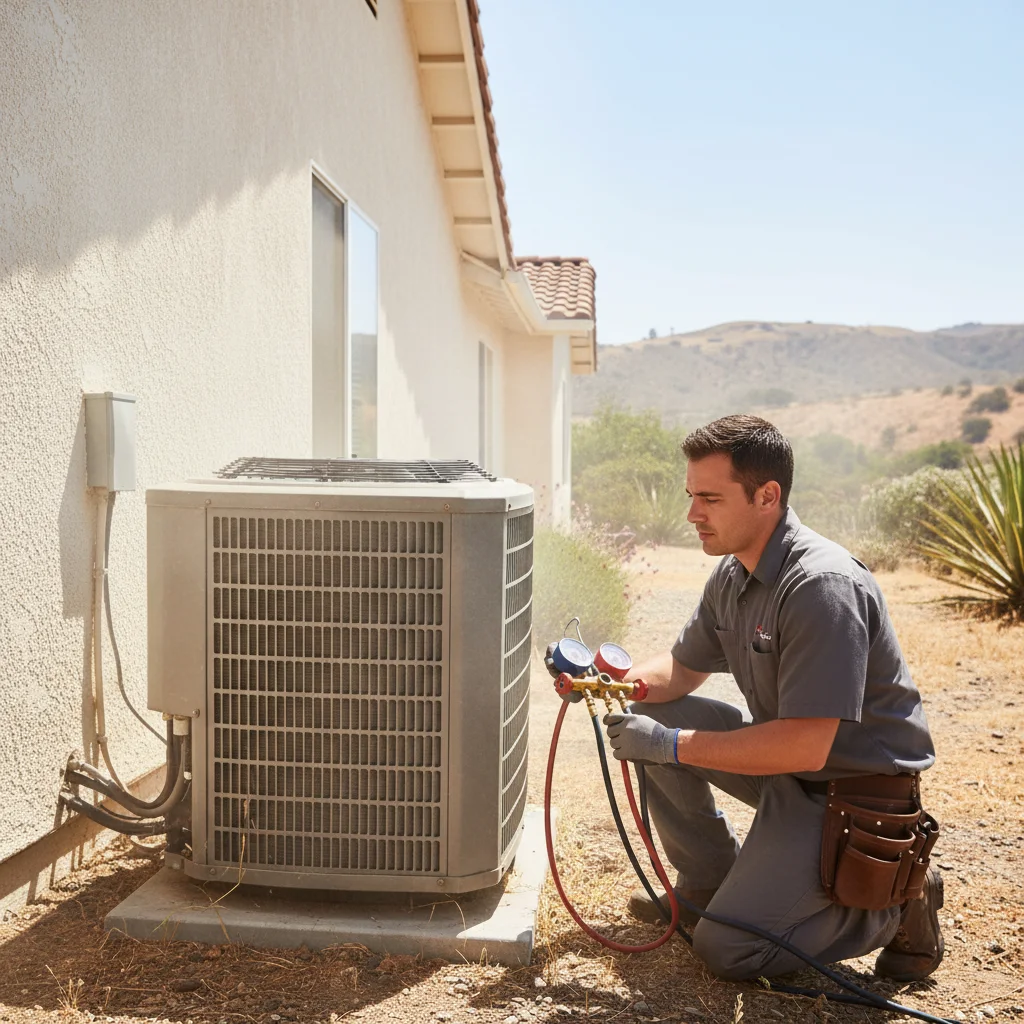
Alpine’s dual-extreme climate: why it breaks AC systems faster
Alpine sits at roughly 2,000 feet on the eastern edge of San Diego County, and that elevation creates something most of the county never deals with: genuine dual-extreme stress. Summers push 87 to 89 degrees along Alpine Boulevard and Tavern Road, with heat waves occasionally hitting 110. Winters drop to overnight lows in the 20s and low 30s on the mountain edge and in the eastern hills toward Rancho Palo Verde and the equestrian properties past Japatul Road.
That combination means your HVAC system works hard at both ends of the calendar. The AC runs near design-limit capacity all summer. The heating system carries a real load all winter. Coastal San Diego equipment might accumulate a few hundred hours of cooling runtime in an average year. An Alpine system can double that over a full season of peak-summer afternoons.
Wear accelerates when a system never gets an easy season. Capacitors degrade faster. Refrigerant lines develop micro-leaks sooner. Compressors operating at continuous high load reach failure earlier than their nameplate life expectancy suggests.
PSPS shutoffs: the Alpine-specific failure that competitors miss
Alpine sits in one of SDG&E’s highest-fire-risk zones. Public Safety Power Shutoff events during red-flag conditions are real here, not theoretical. When power restores after a multi-hour PSPS event, your AC system sees a hard start, a sudden surge as the compressor tries to restart without the run-up sequence a normal start provides.
Hard starts are brutal on capacitors. They’re also a common cause of compressor damage in high-fire-risk areas. A start capacitor that’s already weakened by a summer of peak inland heat is exactly what fails when power slams back on.
If your Alpine home has experienced multiple PSPS events and your AC is more than eight years old, a hard-start kit is worth asking about. It adds a capacitor that smooths the restart surge. Ask for that add-on in dollars on the same ticket as a capacitor replacement. The companies we match often check for existing hard-start protection on Alpine diagnostic calls.
What breaks most often on Alpine AC systems
The dual-extreme climate and PSPS risk create a predictable failure pattern.
Capacitors. The single most common AC repair call in Alpine. Start and run capacitors are rated for a temperature range. On a peak-summer afternoon the condenser cabinet temperature is substantially higher. Capacitors degrade faster in that environment, and PSPS hard starts accelerate the damage. A failed capacitor means the system won’t start, starts hard and struggles, or trips repeatedly. Often a same-visit repair if the part is on the truck.
Coil contamination on equestrian properties. Alpine Heights, Rancho Palo Verde, and the horse properties in the eastern hills have elevated dust and particulate loads. Equestrian operations in particular generate fine organic dust that packs condenser coils in a way that urban dust doesn’t. A coil clogged with hay and stable dust can lose a large share of its heat rejection capacity. Annual coil cleaning is a legitimate maintenance item on these properties, not an upsell.
Refrigerant leaks. High ambient temperatures accelerate micro-fracture development in refrigerant lines and coil connections. Low refrigerant makes the system blow warm, ice up on the indoor coil, or both. The repair is finding and sealing the leak, not just adding refrigerant. R-410A, the refrigerant most current Alpine systems still run, is being phased out of new equipment. Servicing cost is a quote, not a blog per-pound figure.
Blower motor failures. An Alpine AC that runs continuously for three to four summer months puts hours on the blower motor faster than coastal equipment does. Signs include reduced airflow, squealing or grinding noise, or the system running while barely moving air.
Compressor failures. The expensive outcome. PSPS hard starts, sustained high-load operation, and refrigerant problems that go unaddressed are the three most common paths to compressor failure in Alpine. When a compressor fails on a system over 12 to 15 years old, replacement usually makes more financial sense than compressor-only repair. Compare the written quotes.
What belongs on an Alpine repair quote
| Line to insist on | Why it matters |
|---|---|
| Diagnostic fee, in dollars | Confirm it before the visit |
| Capacitor vs hard-start kit | Different parts, same visit is often smarter in a PSPS zone |
| Leak search vs recharge | Recharge without a leak search is a short-term patch |
| Coil cleaning | Equestrian dust is a real labor item |
| Compressor vs replace | Age and remaining life belong in writing |
| Warranty | Part versus labor |
The matched pro gives you the repair-versus-replace analysis at the visit with expected remaining life. Climate Pros SD does not publish those dollar ranges.
Furnace work in Alpine: winters are real here
Alpine’s real winters change the furnace conversation compared to lower-elevation East County. Lakeside and El Cajon see cold nights but rarely sustained freeze temps. Alpine residents deal with conditions that actually stress heating systems: overnight lows in the 20s, sustained below-freezing periods in January and February, and freeze risk to outdoor mechanical equipment.
That changes furnace sizing requirements. A home in Alpine needs a furnace sized for the local design temperature, which is meaningfully colder than the county average. Undersizing a furnace in Alpine means it runs continuously on cold nights and still can’t hold temperature.
Furnace replacement and heat-pump conversion are quotes from the matched installer, not a county-average band from this page. Mountain-access logistics, cold-climate equipment sizing, and longer line-set runs on large-lot rural properties all move the number.
For furnace repair in Alpine specifically, common issues include cracked heat exchangers on older units that run hard through cold winters, igniter failures, and pressure switch problems on high-efficiency furnaces. Ask for the named part and the diagnostic fee.
On rebates: SDG&E has offered heat pump rebate programs for qualifying equipment. Those programs change year to year. Confirm current program status and eligibility at quote time. IRS Section 25C covers qualifying improvements made through December 31, 2025. Do not promise that credit for a 2026 install.
Heat pump considerations for Alpine
The conventional advice for San Diego HVAC is to go heat pump for everything because winters are mild. Alpine is the exception that actually matters.
A standard heat pump loses efficiency as outdoor temperatures drop below 35 to 40 degrees. In most of San Diego County, that’s a theoretical concern. In Alpine, it’s real. Standard heat pumps in Alpine can struggle on the coldest winter nights.
The answer is a cold-climate heat pump, which uses an enhanced vapor injection compressor that maintains heating capacity down to zero degrees or below. These are available from multiple major manufacturers and are increasingly the recommended spec for mountain-elevation San Diego properties. They cost more than a standard heat pump, which is one reason AC installation in Alpine and full system replacement quotes run higher than coastal equivalents. Ask for that premium in dollars on the bid.
If your Alpine home currently runs a gas furnace for heating and a separate AC for cooling, a cold-climate heat pump replacement handles both functions in a single system. That simplifies the mechanical room and eliminates the gas furnace maintenance cycle.
Frequently asked questions
How fast can you get to my Alpine home when the AC goes out?
Response time depends on distance and how busy the day is. Matched companies typically route out I-8 East to Alpine Boulevard. The pro sets the diagnostic fee and confirms it with you before the visit.
My Alpine home is on equestrian property. Can you handle the dust load and longer line sets?
The companies we match service equestrian properties throughout Alpine, including condenser coil cleaning for organic dust and hay contamination, extended refrigerant line sets on large rural lots, and outbuilding HVAC for tack rooms and workshops. These properties run different demands than a standard residential install.
When does repair stop making sense and replacement make more sense?
If the system is under ten years old and the repair is a small share of replacement cost on the quotes in your hand, repair usually wins. Compressor failure on a system over 12 years old almost always favors replacement. For Alpine specifically, repeated PSPS hard-start damage on an aging capacitor is an early warning sign to start getting replacement quotes, not just keep repairing.
Does Alpine’s elevation affect what furnace I should buy?
It does. The design heating temperature for Alpine is meaningfully colder than lower-elevation East County, which drives furnace sizing up. A cold-climate heat pump is worth specifying here rather than a standard heat pump. Gas furnaces need to be sized for Alpine’s actual overnight lows, not county-average conditions. The matched pro calculates load at every Alpine replacement quote.
What’s the difference between a hard start and a normal capacitor repair?
A standard capacitor replacement gets you a new capacitor sized for normal operation. A hard-start kit adds a second high-capacitance capacitor specifically designed to smooth the inrush current on compressor startup. In a PSPS zone like Alpine, where power restoration can mean a sudden hard restart, the hard-start kit protects the compressor from repeated surge damage. Ask about adding it any time a capacitor is replaced on an Alpine system.
Can I get utility rebates on a heat pump replacement in Alpine?
SDG&E has offered rebates on qualifying heat pump equipment. TECH Clean California single-family reservations were fully reserved with a waitlist as of the captured 2025 status. Both programs have changed terms over time. Confirm current program availability at quote time. The matched installer can provide documentation for any rebate application you’re eligible for.
When to call us
If your AC is struggling in Alpine’s summer heat, your furnace can’t hold temperature on a cold January night, or you’re planning a full HVAC replacement in Alpine, reach us at (442) 777-6440. We serve all of Alpine including Tavern Road and Alpine Boulevard, Alpine Heights, Rancho Palo Verde, and the equestrian properties in the eastern hills.
For comparison on similar East County conditions, the AC repair in Lakeside and AC repair in Santee posts cover neighboring communities. Alpine’s mountain-edge climate runs harder on equipment than either of those, but the failure patterns are closely related.