When your AC stops working in Lakeside on a peak-summer July afternoon, you need AC repair from someone who understands what East County heat actually does to HVAC equipment. Climate Pros SD matches Lakeside homeowners with licensed companies from Central Lakeside through Eucalyptus Hills, the Lake Jennings area, Lakeside Country Estates, and the rural properties approaching El Capitan Reservoir. We do not publish a 2026 repair menu. The pro confirms the diagnostic fee before the visit.
Why East County heat is harder on AC systems than the coast
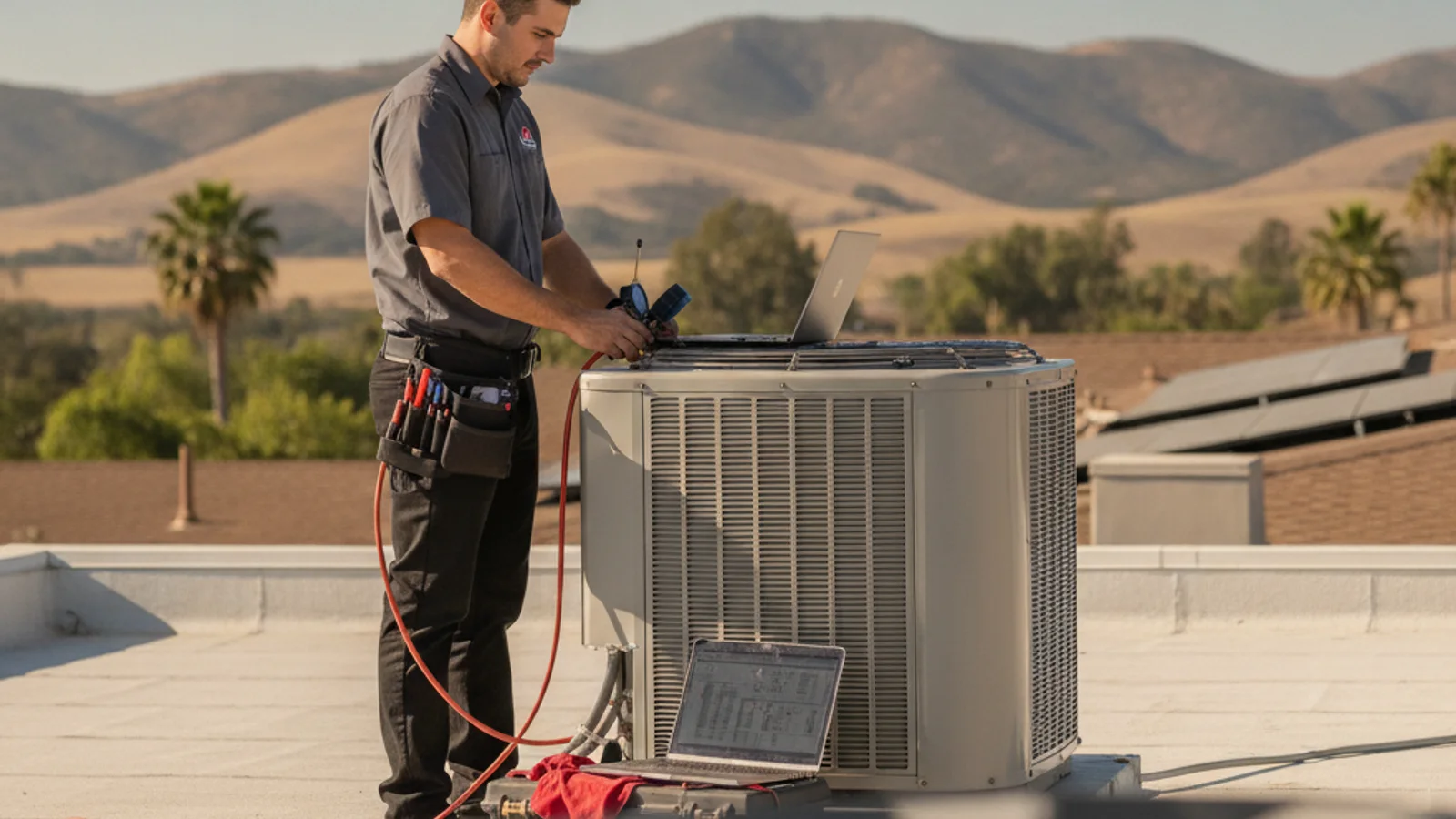
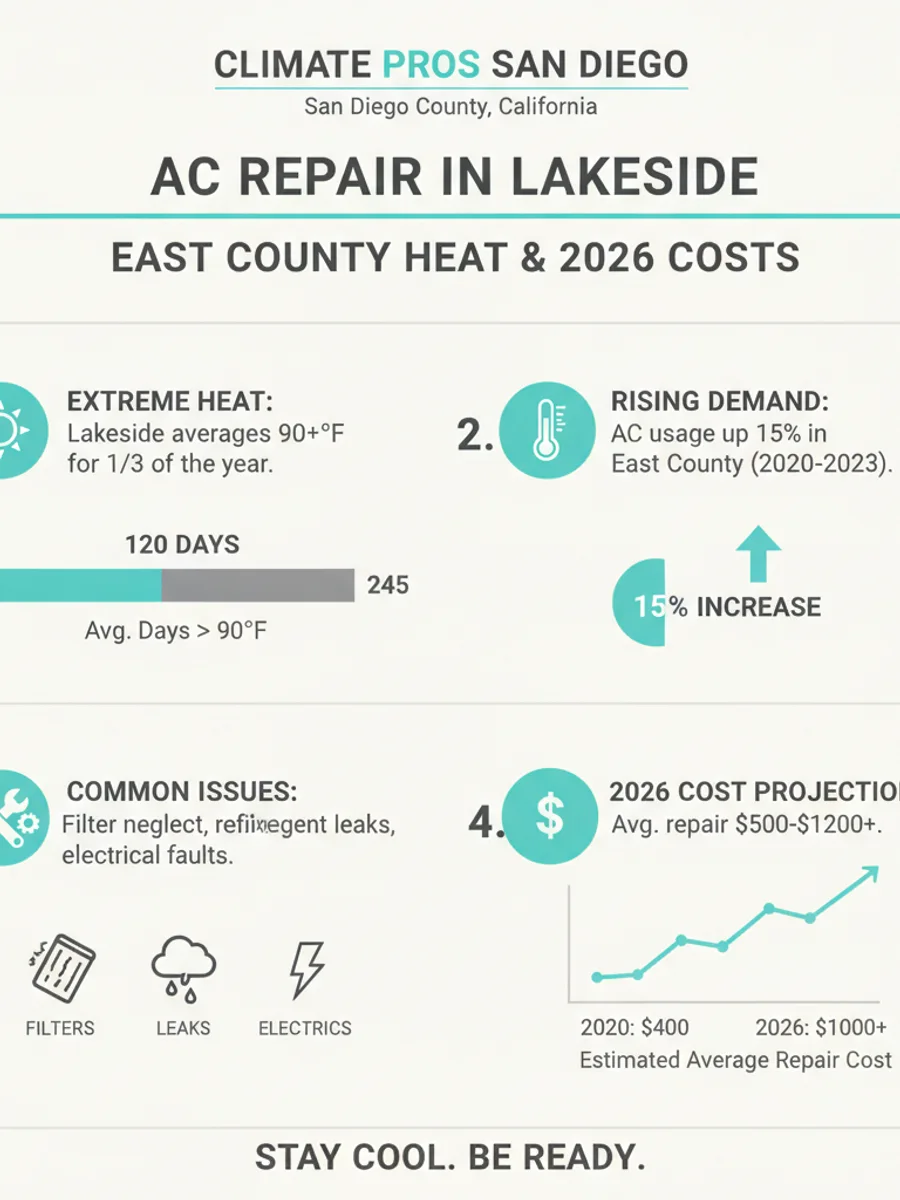
Lakeside sits well past the marine layer. Summer afternoons here routinely run 86 to 89 degrees from June through September, with heat waves running well above those normals. Coastal San Diego homes run in a narrow 68 to 80 degree outdoor range most of the year. A Lakeside home in July is asking the same equipment to run almost continuously for three to four months at design-limit load.
The consequence is accelerated wear. Capacitors fail under sustained heat stress. Refrigerant lines develop small leaks faster when temperatures cycle from morning cool to afternoon extreme. Condenser coils that are even partially dirty stop rejecting heat efficiently, which forces the compressor to work harder and run hotter.
Equipment sizing matters more. An undersized system doesn’t just cool slowly on hot days. It runs at 100 percent capacity for hours without cycling off, which means it never dehumidifies well and wears compressor components faster. Manual J load calculations on Lakeside homes routinely reveal that original equipment was oversized by 20 to 35 percent, which sounds like a good thing but isn’t. Oversized AC short-cycles, doesn’t manage humidity, and can also fail early.
What breaks most often in Lakeside AC systems
Capacitors. The most common failure in hot climates. Repeated exposure to peak-summer outdoor air degrades them faster than the manufacturer’s standard life expectancy. A failed capacitor means the system either won’t start, starts with a hard jolt, or runs sluggishly. Often completed the same visit.
Refrigerant leaks. Heat accelerates leaks through micro-fractures in line sets and coil connections. Low refrigerant makes the system blow warm, ice up on the indoor coil, or both. The repair involves finding the leak, not just adding refrigerant. R-410A is being phased out of new equipment. Older systems that rely on it become a replacement conversation as service gets harder.
Dirty condenser coils. Lakeside has more dust and particulate in the air than coastal neighborhoods. Annual coil cleaning is a legitimate maintenance item here, not a sales pitch.
Blower motor failures. The indoor air handler’s blower motor runs constantly during Lakeside summers. Signs include reduced airflow, squealing, or the system running with the fan not moving much air.
Compressor failures. Compressors fail from low refrigerant (liquid slugging), overheating from dirty coils, and age under high-load conditions. A failed compressor often means the repair cost exceeds the value of the system, especially on equipment over 12 to 15 years old. Compare the written quotes.
What belongs on a Lakeside repair quote
| Line to insist on | Why it matters |
|---|---|
| Diagnostic fee, in dollars | Confirm before the visit |
| Named part | Capacitor, leak search plus recharge, coil cleaning, blower, compressor |
| Access | Attic versus closet |
| Remaining life | Repair-versus-replace belongs in writing |
| Warranty | Part versus labor |
Climate Pros SD does not publish those dollar ranges.
AC installation and HVAC replacement: when repair stops making sense
The right answer for AC installation in Lakeside is increasingly a full heat pump system, not a straight AC replacement. Ask for both scopes in dollars. Equipment tier, ductwork, and whether you need a variable-speed inverter heat pump all change the bid.
The federal Section 25C tax credit expired for systems installed after December 31, 2025, so it no longer applies to a 2026 install. Confirm SDG&E rebates at quote time.
For the 1950s to 1970s homes along Maine Avenue and the Woodside Avenue corridor, full central forced-air replacement isn’t always practical. Homes with small attic clearance or no existing duct infrastructure often do well with a multi-zone mini-split system. HVAC installation in Lakeside via mini-splits avoids the ductwork problem entirely and gives room-level temperature control.
The equestrian properties in Eucalyptus Hills and Lakeside Country Estates run larger scope projects, often with multi-zone systems, ductwork renewal, and occasionally outbuilding HVAC for barn and tack room spaces. The long line-set runs that large rural lots require are standard work for matched companies on those properties.
Heat pump repair and heat pump conversion in Lakeside
Heat pump repair in Lakeside involves both the cooling and heating sides of the system. Common issues include reversing valve failures, refrigerant leaks, defrost cycle problems, and the same capacitor and blower failures that affect conventional AC.
Heat pump conversion is the more common project here. Lakeside’s combination of severe cooling load, aging housing stock, and the R-410A phase-out makes this the right time to think about conversion if your existing system is more than 12 years old. Variable-speed inverter heat pumps run more efficiently at part load. They also heat the home in winter without a gas furnace.
For properties on the eastern edge of Lakeside approaching Alpine and the El Capitan area, SDG&E PSPS events during fire season are a real operational concern. Battery backup paired with a variable-speed heat pump is increasingly standard on premium replacement projects in those areas. Matched companies coordinate electrical load planning with your solar and battery installer.
You can also look at our heat pump service page. For East County context, the AC repair in Santee post covers similar heat conditions.
Frequently asked questions about AC repair in Lakeside
How fast can you get to my Lakeside home when the AC goes out?
Response times vary with traffic on SR-67 or Woodside Avenue and how many calls are ahead of yours. We don’t quote a fixed window. Leave your details and we match you with a local pro. The pro sets the diagnostic fee and confirms it with you before the visit.
My Lakeside home is on equestrian property, can you handle barn and outbuilding HVAC?
Matched companies handle substantial equestrian-property HVAC across Lakeside, including main residence heat pump replacement, barn ventilation, tack room and feed storage climate control, and outbuilding HVAC for workshops, ADUs, and guest quarters.
When does it make sense to repair versus replace my Lakeside AC?
If the system is under ten years old and the repair is a small share of replacement cost on the quotes in your hand, repair usually makes sense. If the compressor has failed on a system over 12 years old, replacement is almost always the better financial decision. Equipment running R-410A that’s leaking repeatedly is another case where replacement math favors moving forward.
What does AC installation cost in Lakeside, CA?
Ask the matched installer. Climate Pros SD does not publish AC-only or heat-pump conversion bands. SDG&E rebates may reduce net project cost on qualifying installs. The federal 25C tax credit expired for systems installed after December 31, 2025.
Does Lakeside’s heat affect how often I should service my AC?
Yes. Annual maintenance matters more in Lakeside than in coastal zones because the system runs harder and longer every summer. Condenser coil cleaning, capacitor testing, refrigerant level verification, and blower motor inspection before the June heat arrives are legitimate items here. A system that runs far more hours a year in Lakeside accumulates wear faster than the same system on the coast.
When to call us
If your AC is struggling, blowing warm, not turning on, or you’re planning an HVAC installation in Lakeside, call Climate Pros SD. We serve Central Lakeside, Eucalyptus Hills, Lakeside Country Estates, the Lake Jennings area, Riverview, and the rural-edge properties near El Capitan Reservoir.
For AC repair in Lakeside or any HVAC service, reach us at (442) 777-6440.