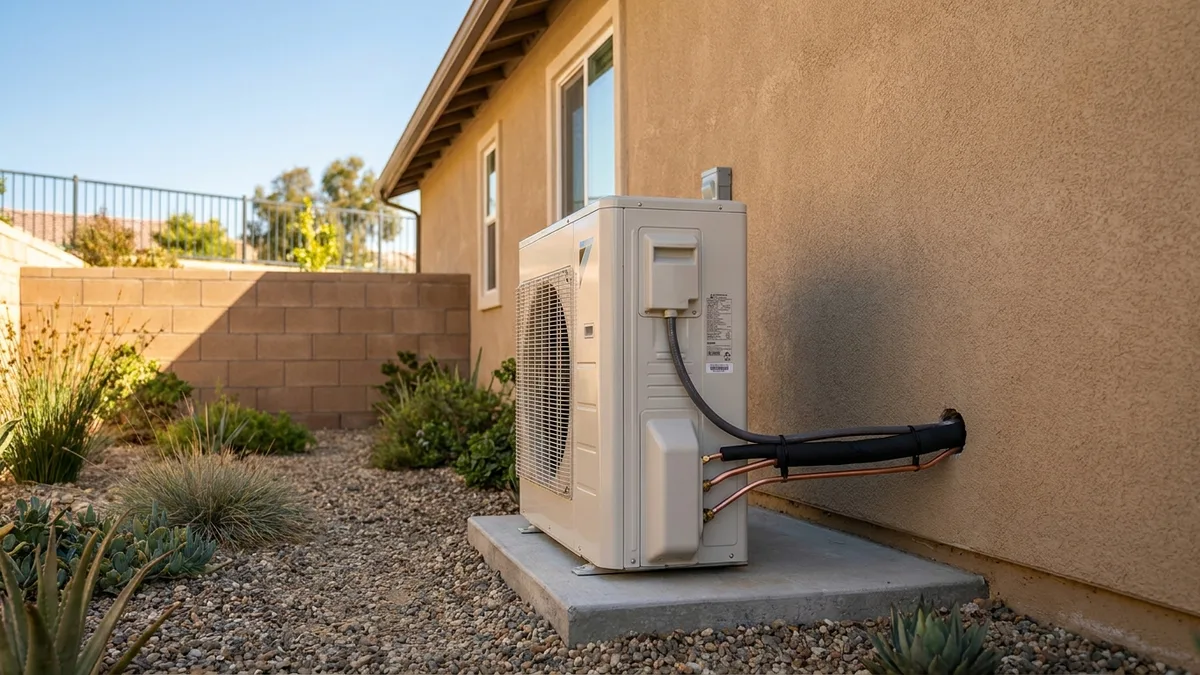
A split system air conditioner splits the job across two units: an outdoor condenser and an indoor air handler or coil, linked by refrigerant lines. It’s the setup behind most central AC in San Diego. The outdoor unit sits on a pad or side yard. The indoor coil usually sits on top of or next to the furnace, and ducts carry the cooled air through the house.
If you searched this term because you’re comparing quotes, or because someone used “split system,” “mini-split,” and “packaged unit” in the same conversation and you want the difference, this guide sorts all three out.
What is a split system air conditioner?
A split system air conditioner is any AC that’s divided between two physical units instead of packed into one box. The compressor and outdoor coil live outside in the condenser. The indoor coil lives inside, paired with a blower, usually built into or mounted next to your furnace or air handler. Refrigerant lines and a set of control wires connect the two.
This is the design almost every San Diego single-family home has. When an HVAC tech says “central air,” they usually mean a split system. The word “split” just describes the physical layout, not the brand or the technology.
Technically, a ductless mini-split is also a split system, since it has an outdoor unit and a separate indoor unit. But when homeowners search “split system air conditioner,” they almost always mean the standard ducted version with a furnace or air handler inside. This guide covers that version. If you’re actually trying to figure out whether a ductless setup fits your home, our how a mini-split works guide and our ductless mini split vs central AC comparison both go deeper on that path.
How does a split system work?
A split system works by moving heat, not by creating cold air out of nothing. Refrigerant absorbs heat from the air inside your house and carries it outside, where it’s released.
Here’s the cycle in order. The indoor coil sits in the path of your return air, and the blower pushes warm house air across it. The refrigerant inside that coil is cold, so it absorbs heat from the air and evaporates into a gas. The now-cooled air gets pushed back through the ducts into your rooms.
The gas refrigerant travels through a copper line to the outdoor unit. The compressor squeezes that gas, which raises its pressure and temperature. The hot, high-pressure gas moves through the outdoor coil, where a fan blows outside air across it. Heat transfers from the refrigerant to the outside air, and the refrigerant condenses back into a liquid.
The liquid refrigerant travels back inside through a second line, drops in pressure, and cools down again before it re-enters the indoor coil. The cycle repeats for as long as the system is calling for cooling.
Two lines carry the refrigerant between the units, one for cold gas heading in, one for hot gas heading out. That’s the “linked by refrigerant lines” part of the definition. Nothing about that cycle changes whether the system is a split system, a packaged unit, or a mini-split. What changes is where the parts are located.
Split system vs packaged unit vs mini-split
All three run the same refrigerant cycle. The difference is where the equipment sits and how it distributes air.
| Type | What it is | Where the equipment sits | Best-fit San Diego home | Rough installed cost |
|---|---|---|---|---|
| Split system (central) | Two units: outdoor condenser + indoor coil/air handler, connected by refrigerant lines and ducts | Condenser outside on a pad or side yard; coil indoors with the furnace, usually a garage or closet | Most single-family homes with existing ductwork | $5,500-$12,000 installed |
| Packaged unit | One cabinet holds the compressor, coil, and blower together | Outdoors, usually on the roof or a ground pad next to the house | Flat-roof homes, older builds without indoor closet space, small commercial buildings | $6,000-$13,000 installed |
| Ductless mini-split | Outdoor condenser + one or more small indoor heads, no ducts | Condenser outside; wall-mounted or ceiling heads indoors, one per zone | Homes with no ductwork, additions, ADUs, room-by-room cooling | $4,500-$22,000 installed depending on zone count |
These are estimates, and actual pricing depends on tonnage, ductwork condition, electrical work, and permit fees. For a full cost breakdown on the standard central setup, see our central AC installation cost guide. For the all-in-one option, see heater and air conditioner in one unit. For the no-ducts option, see ductless vs ducted HVAC.
Why split systems dominate San Diego homes
Most San Diego single-family homes were built with a gas furnace tucked into a garage, closet, or attic, and that furnace already had ductwork run for heating. Adding a split system AC to that setup means bolting an indoor coil on top of the existing furnace and running two refrigerant lines out to a condenser pad. It’s the path of least resistance, and it’s why split systems are the default quote you’ll get from most installers here.
Coastal air changes the math a little. Homes from La Jolla to Encinitas sit close enough to the ocean that salt air speeds up corrosion on the outdoor condenser’s coil and fins. A coastal condenser often needs replacing sooner than the same unit would inland, even with identical maintenance.
Inland valleys run the other direction. El Cajon, Santee, and Escondido see more days above 95 degrees, and the compressor works harder and longer to keep up. Inland split systems log more run hours per summer than coastal ones, which matters when you’re sizing the unit and thinking about maintenance intervals.
Flat-roof homes and small commercial buildings are the exception to the split-system default. Older builds without indoor space for an air handler, or commercial spaces where roof access is easier than running new ductwork, often go with a packaged unit instead. It’s one cabinet, one roof penetration, less indoor footprint.
Homes without any ductwork at all, think older Craftsman bungalows in North Park or additions that were never tied into the main system, tend to skip the split system entirely and go ductless. Adding ducts to a house that never had them can run $4,000-$7,000 before the AC itself, so a mini-split often pencils out cheaper.
If you’re trying to figure out which of these three fits your specific house, the what HVAC means guide is a good starting point for the bigger picture, and a straight AC installation quote will tell you fast whether your ductwork supports a split system or not.
Frequently asked questions
Is a mini split a split system?
Yes, technically. A mini-split has an outdoor condenser and a separate indoor unit, which is the definition of “split.” But in everyday use, “split system” means the standard ducted central AC, and “mini-split” refers specifically to the ductless, zone-by-zone version. If you don’t have ductwork, you’re probably shopping for a mini-split installation, not a central split system.
What’s the difference between a split system and central air?
Nothing, in most conversations. “Central air” and “split system” describe the same equipment: an outdoor condenser and an indoor coil connected by refrigerant lines and distributed through ducts. Some people use “central air” more loosely to include packaged rooftop units too, but a true split system always means two separate physical units.
How long does a split system air conditioner last?
Coastal San Diego homes typically get 12-15 years out of a split system before the outdoor unit needs replacing, mostly due to salt-air corrosion on the condenser. Inland homes usually see 15-20 years, since they’re spared the corrosion but run the compressor harder in summer heat. Regular filter changes and annual tune-ups push both ranges toward the higher end.
How much does a split system cost to install in San Diego?
Expect $5,500-$12,000 installed for a standard residential split system, depending on tonnage, SEER2 rating, and whether the existing ductwork needs repair or replacement. Larger homes, higher-efficiency units, and electrical panel upgrades push costs toward the top of that range. A same-day AC repair visit can also tell you whether your current system needs replacing at all before you commit to a new install.
Is a split system better than a packaged unit?
For most single-family homes with existing ductwork, yes, a split system is the more common and often more serviceable choice, since the indoor and outdoor components can be repaired or replaced independently. Packaged units make more sense for flat-roof homes or buildings where there’s no good indoor space for an air handler and roof access is easier than running new lines. Neither is universally “better,” it comes down to the building.
If you’re in Carlsbad and weighing a split system against other options for your home, our HVAC service in Carlsbad page covers what local installers typically recommend for that area’s housing stock.
Not sure which setup fits your house, or ready to get a quote on a split system replacement? Call the HVAC pros in the Climate Pros SD network at (442) 777-6440. They’ll walk your ductwork, your roofline, and your budget before recommending anything.