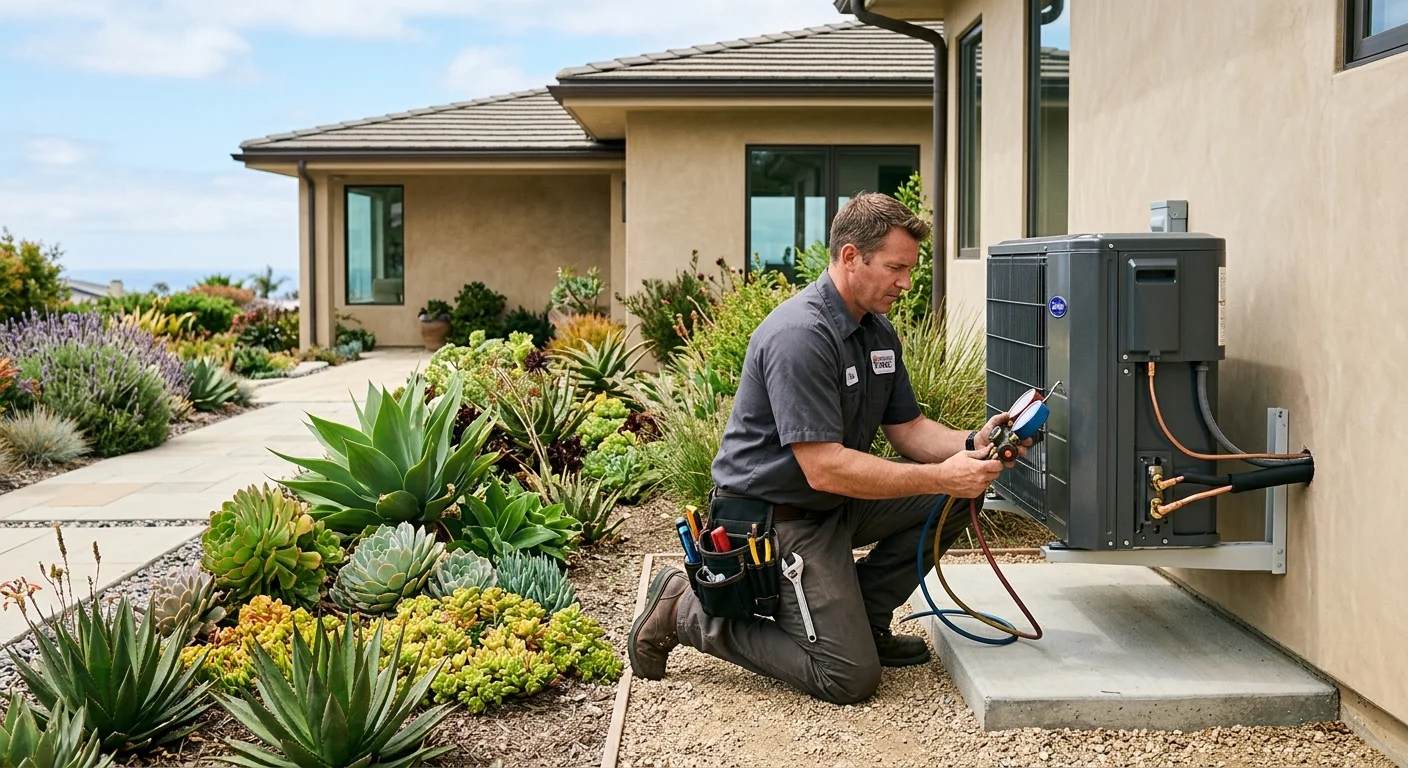
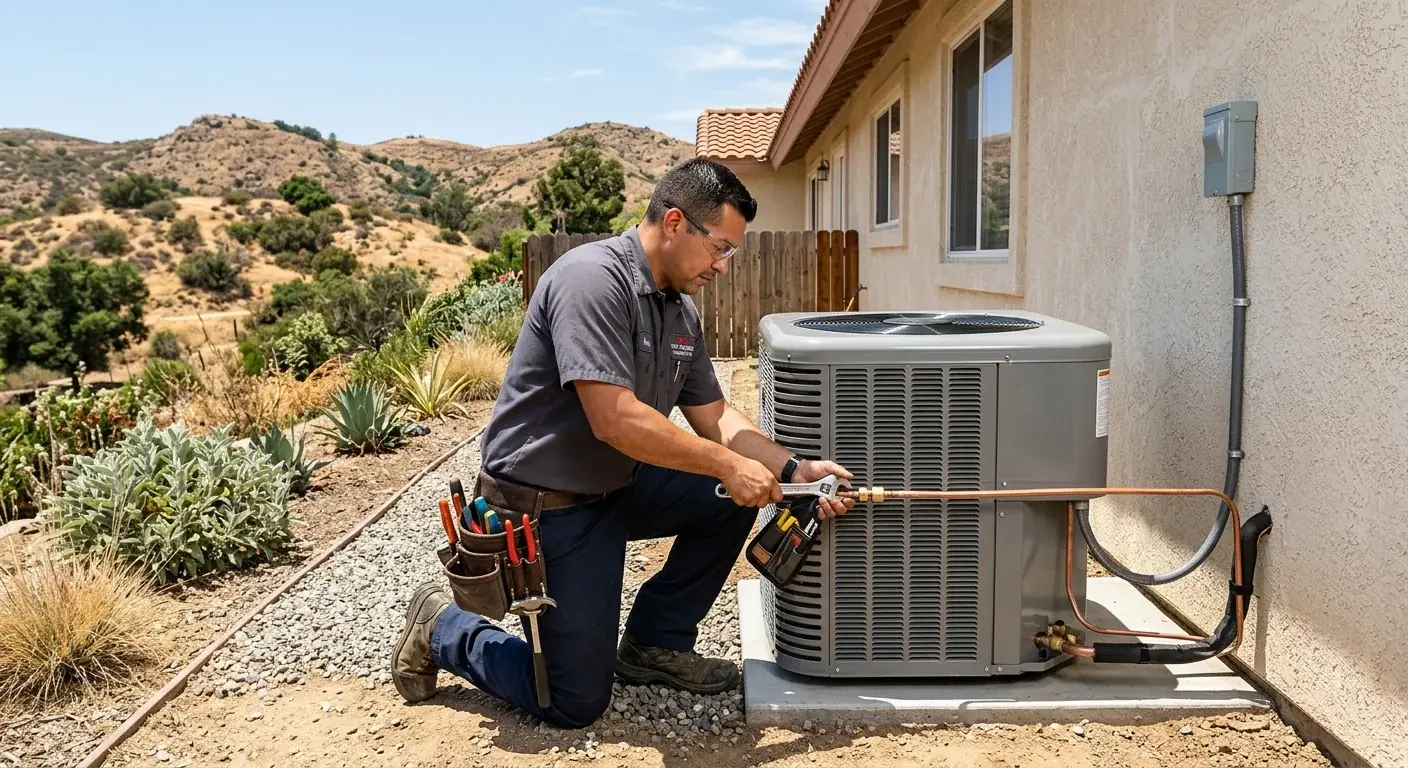
HVAC stands for heating, ventilation, and air conditioning. It’s the umbrella term for everything in your home that moves, heats, cools, or filters air. In San Diego that typically means a furnace, an air conditioner, and a duct system, or, increasingly in 2026, a single heat pump that handles both heating and cooling.
Here’s what each piece does and what San Diego homeowners actually need to understand.
The three letters
H. Heating. Whatever makes your house warm in winter. In San Diego that’s usually a gas furnace, sometimes electric resistance heat, increasingly a heat pump (which counts as both heating and cooling).
V. Ventilation. The movement of air. Includes the blower that pushes air through your ducts, the ductwork itself, return grilles, supply registers, and the exchange of indoor and outdoor air. Most San Diego homes have minimal mechanical ventilation (no whole-house energy recovery ventilators), relying on natural infiltration through doors and windows.
AC. Air Conditioning. The system that cools your house in summer. Either a central AC system or a heat pump running in cooling mode, plus the ductwork and blower from the V part to distribute the cool air.
In practice, when someone says “HVAC system,” they almost always mean the combination of these three things working together: the equipment that heats, the equipment that cools, and the ductwork that distributes air through your house.
What a typical San Diego HVAC system looks like
Most San Diego homes built after 1980 have:
- Outdoor condenser unit. The big metal box on the side of the house. Either an AC condenser (cooling only) or a heat pump (heating + cooling).
- Indoor air handler or furnace. Usually in the garage, attic, or a closet. Contains the blower fan and either the cooling coil (for AC) or the heat exchanger and burners (for gas furnace), often both stacked together.
- Refrigerant line set. Two insulated copper pipes connecting outdoor and indoor units. Carries refrigerant back and forth.
- Ductwork. Sheet metal or flexible duct that carries conditioned air from the air handler to each room.
- Supply registers. The vents in your floors, walls, or ceilings where conditioned air enters rooms.
- Return grilles. The larger vents (usually in hallways or central locations) where the system pulls air back to recondition.
- Thermostat. The control on the wall that tells the system when to run and at what temperature.
Older San Diego homes (pre-1970) often have a wall furnace or floor furnace instead of central forced air, and many of them never had central AC installed. Adding it usually means installing a ductless mini-split or doing a major retrofit to add central air with ductwork.
The main HVAC system types
1. Central AC + gas furnace. Most common in San Diego homes built 1980-2015. Two separate pieces of equipment that share the ductwork. AC for summer, furnace for winter.
2. Heat pump (single system). A single piece of equipment that does both heating and cooling. Becoming the new default for replacement installs in San Diego due to SDG&E rebates and federal tax credits. We covered the basics in our what is a heat pump guide.
3. Ductless mini-split. Outdoor unit + one or more indoor wall-mounted heads. No ductwork. Common in older homes that never had central air, and in additions or ADUs. Most modern mini-splits are heat pumps and handle both heating and cooling.
4. Dual-fuel. Heat pump for cooling and most heating, paired with a gas furnace for backup heat. Useful when you have a working gas furnace and want the heat pump’s efficiency without abandoning the furnace.
5. Wall or floor furnace (older homes only). Heating-only system common in pre-1960 San Diego homes. No ductwork; the furnace heats the air directly in one room and relies on air movement to warm the rest of the house. Inefficient by modern standards but cheap to maintain.
What HVAC actually costs in San Diego
| Equipment | Typical 2026 cost installed |
|---|---|
| Central AC system (3-ton, mid-tier) | $5,500-$9,500 |
| Gas furnace (80,000 BTU) | $3,500-$6,000 |
| Combined AC + furnace install | $8,500-$14,000 |
| Heat pump system (single, ducted) | $9,000-$16,000 before rebates |
| Single-zone ductless mini-split | $4,500-$7,000 |
| Multi-zone ductless mini-split | $8,000-$22,000 (by zone count) |
| New thermostat install | $150-$450 |
| Ductwork (whole house, retrofit) | $5,000-$12,000 |
| Annual maintenance | $179-$349 per system |
If you’re replacing equipment, get itemized quotes that show parts, labor, permit, electrical, refrigerant lines, removal, and rebate filing separately. Lump-sum quotes hide markups.
What HVAC homeowners commonly get wrong
Three patterns:
1. Buying the same size as what’s there. Most San Diego HVAC systems were sized by builders using rough rules of thumb. Many homes are running oversized systems that short-cycle, don’t dehumidify, and wear out 5-7 years early. A Manual J load calculation often shows you need a smaller system than the one you have. See our AC sizing guide.
2. Skipping annual maintenance. A real $200/year tune-up catches the $400 capacitor before it strands you in July, the $1,500 refrigerant leak before it kills the compressor, and the dust load that’s cutting your efficiency 20%. Skipping maintenance is the most expensive way to save $200.
3. Treating HVAC contractors as commodities. A bad install of a great system performs worse than a great install of a basic system. Spend more time picking the contractor than picking the brand. We covered this in our how to choose an HVAC contractor in San Diego guide.
San Diego-specific HVAC notes
Three things particular to our climate:
1. Most homes don’t really need huge heating systems. San Diego rarely gets below 38F outside the mountains. Heating loads are small compared to most of the country. This is why heat pumps make so much sense here, even modest heat pumps easily handle our winter loads.
2. Cooling loads vary dramatically by zone. Coastal homes use AC 15-30 days a year. Inland homes use it 100-130 days. East County more. The right system for each is different. We broke this down by neighborhood in our do you need AC in San Diego guide.
3. Salt-air corrosion is real for coastal homes. Anything within 5 miles of the Pacific sees salt-air attack on outdoor coils. System lifespan drops 3-5 years. Coastal-rated equipment or protective coatings are worth the small extra cost.
FAQs
What does HVAC stand for?
Heating, Ventilation, and Air Conditioning. The umbrella term for the systems that heat, cool, ventilate, and filter your home’s air.
What is included in HVAC?
The heating equipment (furnace or heat pump), cooling equipment (AC or heat pump), ductwork, blower, thermostat, supply registers, return grilles, and refrigerant line set. Some HVAC systems also include whole-house ventilation equipment like HRVs or ERVs, though these are uncommon in San Diego residential.
What is the difference between HVAC and AC?
HVAC includes heating, ventilation, and air conditioning. AC is just the air conditioning part. AC is one component of an HVAC system. People often use “HVAC” to mean the whole system and “AC” to mean specifically the cooling equipment.
What HVAC system is best for San Diego?
For most homes in 2026: a heat pump. Single system handles both heating and cooling, qualifies for SDG&E and federal rebates, and operates in its efficient range year-round in San Diego’s mild climate. For homes with a working gas furnace under 5 years old, a heat pump for cooling paired with the existing furnace (dual-fuel) is often the right call.
How much does HVAC cost in San Diego?
$5,500-$9,500 for a standard central AC install. $8,500-$14,000 for combined AC + furnace. $9,000-$16,000 for a heat pump before rebates ($4,000-$9,000 typical after). Single-zone ductless mini-split: $4,500-$7,000. Multi-zone ductless: $8,000-$22,000 depending on zones.
How often should HVAC be serviced?
Once a year for most San Diego homes. Twice a year for coastal homes (salt-air corrosion), heat pumps (year-round use), and inland homes with heavy summer use. See our how often should HVAC be serviced guide.
How long does an HVAC system last?
Coastal SD: 10-13 years due to salt-air corrosion. Inland SD: 14-18 years with maintenance. Gas furnaces: 15-25 years. Heat pumps: 12-18 years. See our how long does an AC unit last guide.
Do I need to replace my whole HVAC system or just part of it?
Depends on what failed and how old each piece is. Furnace and AC have different lifespans, so often one fails years before the other. If one is failing and the other has 5+ years of life left, replace only the failed component. If both are 12+ years old, combined replacement (usually as a heat pump) saves on labor and qualifies for full rebate stack.
When to call us
If you want to understand what HVAC system you actually have and what’s the right replacement when it dies, we’ll walk through it without trying to sell you anything you don’t need. Call (442) 777-6440 for a free assessment.