For the full San Diego HVAC picture (climate zones, costs, contractor vetting), see our complete guide to San Diego HVAC in 2026. This post is the dedicated Manual J sizing deep-dive.
TL;DR
- “1 ton per 500 square feet” is contractor shorthand, not real sizing
- Manual J is the only correct way to size AC, accounts for insulation, windows, climate zone, ductwork
- Oversized AC short-cycles, fails to dehumidify, and dies young
- Most San Diego homes need less AC than people think, coastal climate is mild
As a starting point, homes need roughly 20 to 25 BTU per square foot, about one ton of cooling per 600 to 800 sq ft. But San Diego’s mild coastal climate means most homes here get oversized by contractors, and a proper Manual J load calculation usually sizes a smaller unit than the rule of thumb suggests. A 2,000 sq ft coastal home often lands near 2.5 to 3 tons.
Quick AC sizing chart by square footage (San Diego)
Use this table to sanity-check a contractor’s quote before you read the Manual J details below. One ton equals 12,000 BTU.
| Home size | National rule (BTU) | Coastal SD (tons) | Inland SD (tons) |
|---|---|---|---|
| 600–1,000 sq ft | 18,000–24,000 | 1.5 | 2.0 |
| 1,000–1,500 sq ft | 24,000–30,000 | 1.5–2.0 | 2.5 |
| 1,500–2,000 sq ft | 30,000–36,000 | 2.0–2.5 | 3.0 |
| 2,000–2,500 sq ft | 36,000–42,000 | 2.5–3.0 | 3.5 |
| 2,500–3,000 sq ft | 42,000–48,000 | 3.0–3.5 | 4.0 |
| 3,000–3,500 sq ft | 48,000–60,000 | 3.5–4.0 | 4.0–5.0 |
Coastal means Zone 6 and 7 (La Jolla, Encinitas, Carlsbad, Mission Valley). Inland means Zone 10 (Escondido, El Cajon, Poway). Desert homes in Borrego Springs run higher than both. These are estimates, not quotes. The real number comes from the calculation below.
If three different HVAC contractors quote you three different system sizes for the same home, two of them are wrong. The right size isn’t a guess, it’s a calculation. Once you know the size, our central AC installation cost in San Diego breakdown shows what that tonnage runs.
The “ton per square foot” myth
The rule of thumb you’ll hear: “1 ton of AC per 500 square feet.” Or “600 sq ft per ton in mild climates.”
This is contractor shorthand that ignores:
- How well-insulated your home is
- Window quality, count, and orientation
- Ceiling height
- Number of people typically in the home
- Internal heat loads (cooking, electronics, lighting)
- Climate zone (San Diego has 4 distinct ones)
- Ductwork condition and routing
- Sun exposure
A 2,000 sq ft Carlsbad home with newer windows might need 2.5 tons. The exact same square footage in El Cajon with single-pane windows and an uninsulated attic might need 4 tons. Same square footage, very different answer.
What Manual J actually calculates
Manual J is the ACCA’s residential load calculation standard. Every legitimate HVAC contractor uses it (or should). It accounts for:
Building envelope. Wall R-value, ceiling R-value, window U-value and solar heat gain coefficient. Older San Diego homes often have R-11 walls and R-19 attics. Newer builds have R-13 walls and R-30+ attics. Big difference in load.
Solar gain. South-facing and west-facing windows add the most heat. East-facing add early-morning load. North-facing barely matter in San Diego. A house with picture windows on the west wall needs more cooling than the same house with windows facing other directions.
Infiltration. How much outside air leaks into the building. Older homes leak more. Newer homes are tighter (and need ventilation strategy as a result).
Internal loads. People, lights, appliances. A home office with multiple computers adds 500–1,000 BTU/hour just from electronics. A kitchen during cooking is a 5,000+ BTU load.
Climate zone. San Diego County has 4 climate zones per Title 24:
- Zone 6 (Coastal): La Jolla, Encinitas, Carlsbad, 5–10°F cooler than Zone 10
- Zone 7 (Coastal): Most of central San Diego, Mission Valley
- Zone 10 (Inland): Escondido, Poway, El Cajon, significantly hotter summers
- Zone 14 (Desert): Borrego Springs, Julian heights, extreme summer load
Why oversized AC is a real problem
Most San Diego homes have AC that’s 1/2 to 1 ton TOO BIG. Contractors oversize because:
- It’s safer for them (a too-small system gets complaints; oversized “works”)
- Square-footage rules round up
- They make more money on bigger equipment
What oversized AC does:
Short-cycling. The system reaches the temp setpoint in 8 minutes, shuts off, kicks back on 5 minutes later. Each cycle costs more energy than steady operation. Compressors die early from frequent starts.
No dehumidification. AC removes humidity by running long enough for water vapor to condense on the coil. Short cycles never reach this point. Result: the air is cool but clammy.
Hot/cold spots. A short cycle doesn’t move enough air through the ducts to evenly cool the home. Rooms far from the air handler stay warm.
Reduced equipment life. A right-sized system runs 10–15 years. An oversized system that short-cycles often dies in 8.
Typical San Diego sizing by zone
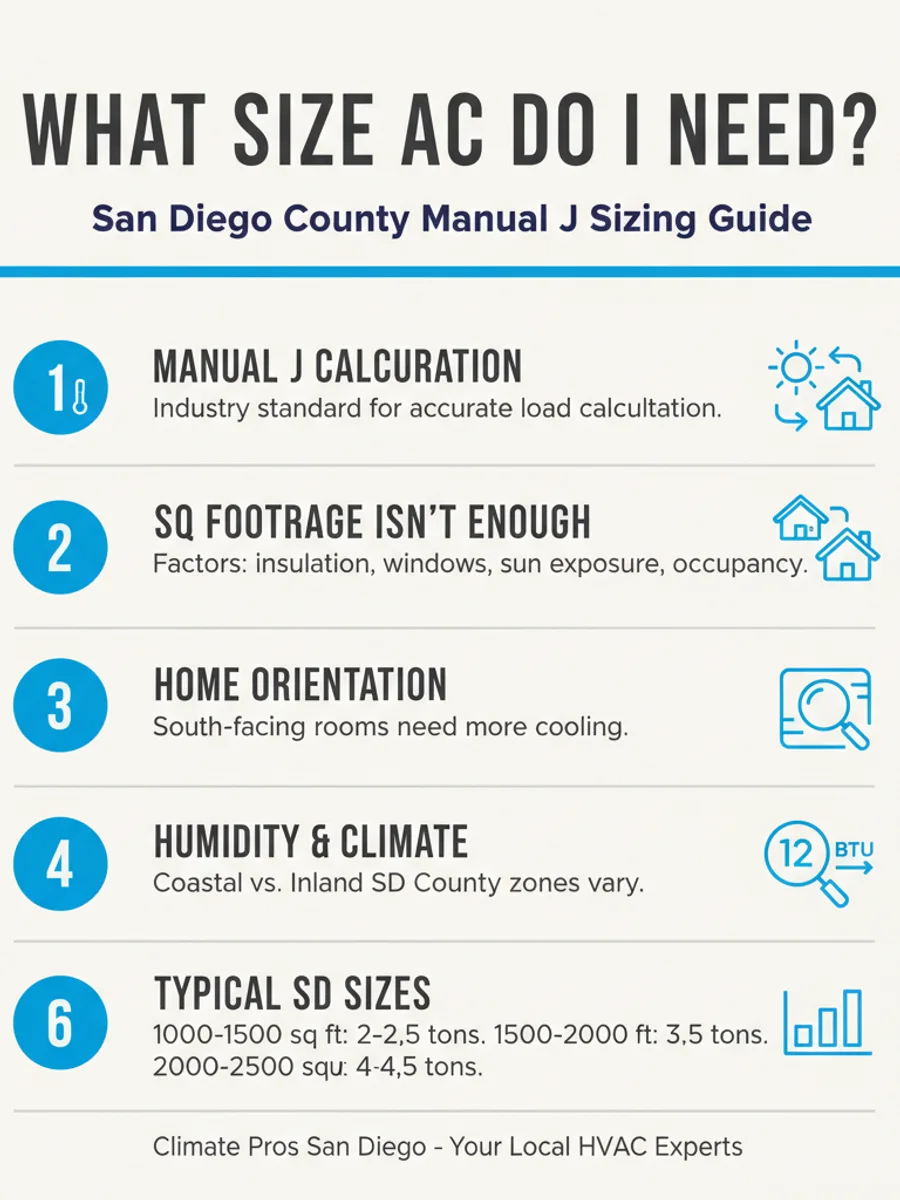
These are starting estimates. Real Manual J might come out 0.5 ton above or below depending on your home.
Zone 6 (Coastal, La Jolla, Encinitas, Carlsbad):
- 1,000 sq ft: 1.5 ton
- 1,500 sq ft: 2.0 ton
- 2,000 sq ft: 2.5 ton
- 2,500 sq ft: 3.0 ton
- 3,000 sq ft: 3.5 ton
Zone 10 (Inland, Escondido, El Cajon, Poway):
- 1,000 sq ft: 2.0 ton
- 1,500 sq ft: 2.5 ton
- 2,000 sq ft: 3.0 ton
- 2,500 sq ft: 3.5–4.0 ton
- 3,000 sq ft: 4.0–5.0 ton
Zone 14 (Desert, Borrego Springs):
- 1,000 sq ft: 2.5 ton
- 1,500 sq ft: 3.0 ton
- 2,000 sq ft: 3.5–4.0 ton
- 2,500 sq ft: 4.0–5.0 ton
If a contractor quotes you 5 tons for a 2,000 sq ft Carlsbad home, get a second opinion.
Two-stage and variable-speed AC
If your home has rooms that load very differently (sun-baked west side, shaded east side), or if you live in a coastal area where 70% of the year you don’t need full AC capacity, consider:
Two-stage AC. Runs at 65% capacity most of the time, ramps to 100% when needed. Better dehumidification, quieter, longer equipment life. Ask for the premium over single-stage in dollars. We break down the math in is two-stage AC worth it in San Diego.
Variable-speed AC. Modulates from 25% to 100% smoothly. Best comfort and efficiency. Ask for that premium over single-stage. Often qualifies for utility rebates.
Mini-split heat pumps. For zoned cooling without expanding ducts. Each room has its own air handler. Ask for per-zone installed price. Eliminates duct losses entirely.
Frequently asked questions
What size AC do I need for a 2,000 sq ft house in San Diego?
A 2,000 sq ft coastal home usually needs 2.5 to 3 tons. The same size inland in Escondido or El Cajon often needs 3 to 3.5 tons because summers run hotter. Window quality, insulation, and sun exposure shift the real number, so size from a Manual J calculation, not square footage alone.
How many tons of AC do I need per square foot?
The national rule is 1 ton per 500 sq ft. In San Diego’s mild coastal climate, 1 ton per 600 to 700 sq ft is closer to right. Inland and desert homes need more. A contractor who sizes by square footage alone is guessing.
How do you convert BTU to tons of AC?
One ton of cooling equals 12,000 BTU per hour. So a 36,000 BTU system is 3 tons, and a 24,000 BTU system is 2 tons. The fast estimate is square footage times 20 BTU, then divide by 12,000 to get tons.
Is it bad to oversize an AC unit?
Yes. Oversized AC short-cycles, fails to pull humidity out of the air, leaves hot and cold spots, and wears out years early. In San Diego most homes are oversized by half a ton to a full ton. Right-sizing saves money and lasts longer.
What is a Manual J calculation?
Manual J is the ACCA’s residential load calculation standard. It accounts for insulation, windows, ceiling height, air leakage, internal heat loads, and your Title 24 climate zone. It’s the only correct way to size an AC system. Ask any contractor for their Manual J before you sign.
Do coastal San Diego homes need less AC than inland homes?
Yes. Coastal zones run 5 to 10 degrees cooler than inland zones on summer afternoons. A Carlsbad home often needs half a ton less than the same house in El Cajon. That’s why one square-footage rule can’t cover the whole county.
Related services: AC repair and HVAC maintenance.
When to call us
Every quote includes a real Manual J calculation. No guesses, no rule-of-thumb sizing. You get a clear answer on what your home actually needs, what equipment delivers that, and what you’ll save on energy compared to your current system. If you’re weighing a new system, our AC installation service page covers what’s involved, and our complete guide to San Diego HVAC in 2026 walks through costs and contractor vetting.
A quick reader tip: before you sign with anyone, verify their license at the California CSLB site. A legitimate HVAC contractor carries an active C-20 license.
Call us at (442) 777-6440 and we’ll match you with a local pro for an HVAC quote in San Diego County, Manual J included.