If your air conditioning system is struggling in Imperial Beach, you’re not alone. Homes in the 91932 zip code face unique challenges, from the constant salt air to the quirks of older South Bay housing stock.
Climate Pros SD matches you with licensed HVAC companies. We do not publish a 91932 parts menu.
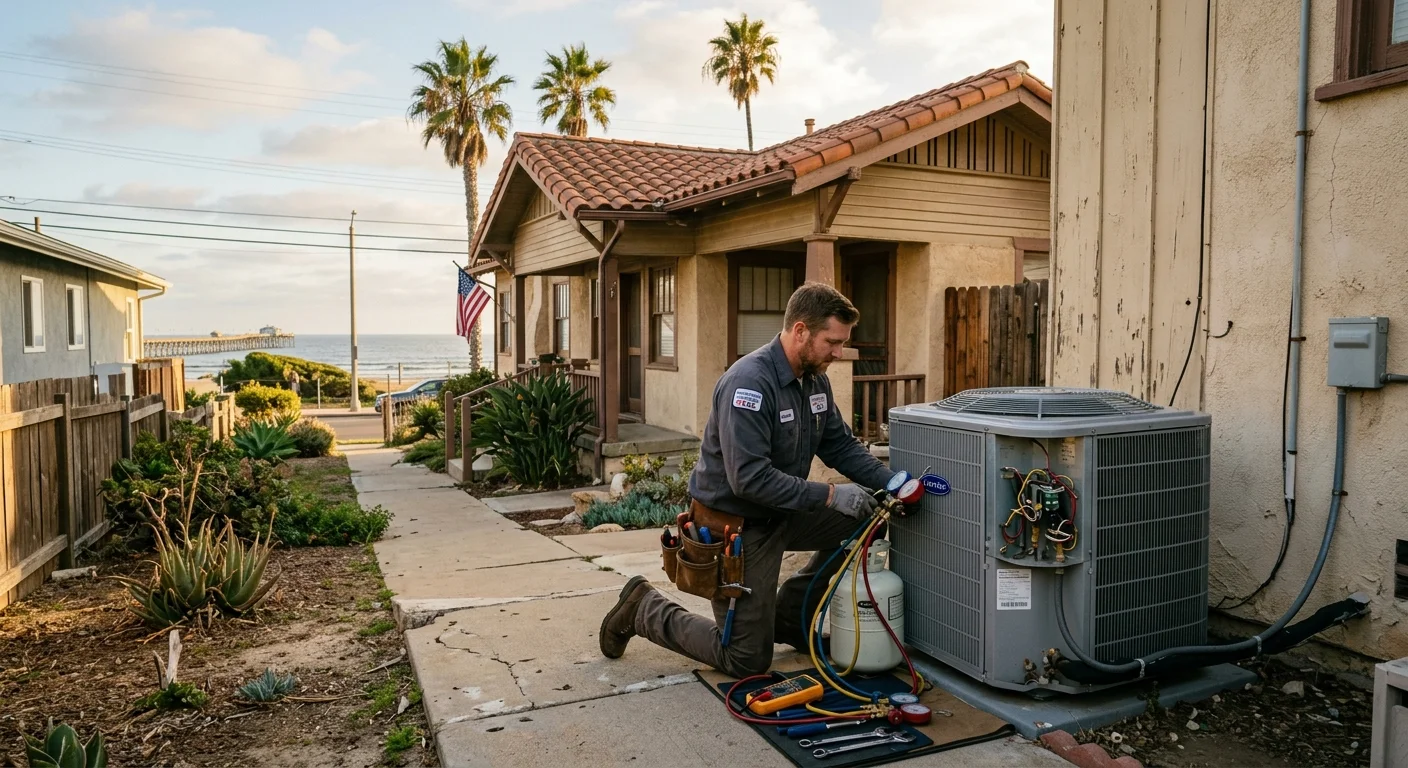
Why Imperial Beach AC systems face triple coastal exposure
Imperial Beach sits in a truly unique environmental position, exposing its HVAC systems to salt from three different directions. To the west, you have the mighty Pacific Ocean, constantly sending salty mist inland. Then, to the north, there’s the Tijuana River estuary, another source of saline air and moisture, especially for homes along the Palm Avenue corridor. And finally, the eastern border features San Diego Bay, contributing yet another layer of corrosive salt to the atmosphere. This triple coastal exposure is a significant factor in why AC systems here often wear out faster than those even a few miles inland.
This constant bombardment of salt and moisture accelerates corrosion on outdoor condenser units, evaporator coils, and critical electrical components. It’s not just the oceanfront homes on Seacoast Drive that feel the impact; properties in the Bayside neighborhood and throughout the entire city are affected. Over time, this salt residue builds up, causing metal parts to rust, coils to degrade, and electrical connections to become intermittent or fail entirely. This isn’t just about aesthetics; it directly impacts your system’s efficiency and lifespan, leading to more frequent breakdowns and a greater need for specialized AC repair. We often find systems that look much older than their actual age due to this relentless coastal assault.
Common failures we see in 91932
Given Imperial Beach’s unique environment, Climate Pros SD sees a distinct pattern of common AC failures in the 91932 area. The most prevalent issue we encounter is corrosion-related damage. Outdoor condenser coils, exposed directly to the salt-laden air, frequently show signs of rust and deterioration. This can lead to refrigerant leaks, causing your system to blow warm air or work much harder than it should. We also commonly find corroded electrical connections and wiring within the outdoor unit, leading to intermittent power, shorts, or complete system shutdowns.
Beyond the salt, the general age of many AC systems in Imperial Beach contributes to other common problems. Many homes still rely on units that are 10-15 years old or more, reaching the end of their operational life. This means components like capacitors, contactors, and fan motors are more prone to failure. Worn-out fan motors can lead to poor airflow, while failing capacitors often cause units to hum but not start. Refrigerant leaks, whether from coil corrosion or aging lines, are also a frequent call. If your AC is running but not cooling, or if you hear unusual noises, it’s often a sign of these common failures. We’re skilled at diagnosing these issues quickly and performing effective AC repair to restore your comfort. Many of these issues are similar to what we observe in other coastal parts of the South Bay, such as in our detailed look at AC repair in Chula Vista.
Older South Bay housing stock and undersized returns
A significant portion of Imperial Beach’s housing stock dates back to the 1950s, 60s, and 70s. While charming, these older homes often come with HVAC systems that weren’t designed for today’s cooling demands or modern efficiency standards. A pervasive issue we see in these South Bay properties is undersized return air ducts. In many older homes, the ductwork was simply not built to handle the volume of air required by contemporary AC units. This means your system struggles to pull enough warm air from your home to properly condition it, creating an imbalance.
Undersized returns force the AC system to work harder, increasing energy consumption and putting undue strain on the compressor and fan motor. This constant overexertion can lead to premature component failure and higher utility bills. Additionally, older homes often have less insulation than newer constructions, allowing more heat to penetrate and further exacerbating the cooling challenge. We frequently find original, leaky ductwork in attics and crawl spaces, which wastes cooled air before it even reaches your living areas. Addressing these issues, whether through duct sealing, modifications, or ensuring proper sizing during an AC installation, is crucial for efficient and long-lasting comfort in Imperial Beach.
What belongs on an Imperial Beach repair quote
Exact pricing always depends on a diagnostic. Climate Pros SD does not publish capacitor, contactor, leak, motor, or coil bands. Coastal rusted fasteners and seized components add labor.
| Line to insist on | Why it matters |
|---|---|
| Diagnostic fee, in dollars | Confirm credit toward repair |
| Named electrical part | Capacitor and contactor fail from salt and age |
| Leak search vs coil | Corroded coils are a different ticket than a fitting |
| Motor or evaporator coil | Access and corrosion change hours |
| Warranty | Part versus labor |
Matched companies provide a transparent estimate after diagnosis.
When coastal-grade replacement beats another repair
Deciding between another AC repair and a full system replacement is a common dilemma for Imperial Beach homeowners. While we always aim to repair your system when it’s cost-effective, there comes a point where investing in repeated repairs simply doesn’t make sense, especially with the unique challenges of the 91932 zip code. If your AC unit is over 10-12 years old, requires frequent repairs (multiple times a year), or if a single repair approaches half the cost of a new system on the quotes in your hand, replacement is often the smarter long-term investment.
Older systems, particularly those not designed for coastal environments, are inherently less efficient. A new, ENERGY STAR® rated, coastal-grade AC system can offer significantly better performance, lower utility bills, and enhanced durability against the triple salt exposure. These newer units often feature corrosion-resistant coils and components specifically built to withstand harsh coastal conditions, extending their lifespan and reducing future repair needs. Replacing an old, struggling unit also eliminates the worry of unexpected breakdowns during the hottest months. Climate Pros SD can help you weigh the costs and benefits, providing clear information on whether another AC repair is truly worthwhile or if it’s time to consider a modern, efficient, and resilient new system for your Imperial Beach home.
When to call us
If your AC system in Imperial Beach is making strange noises, blowing warm air, or failing to cool your home efficiently, it’s time to call a licensed HVAC professional. Ignoring these signs can lead to more extensive and costly repairs down the line.
For Imperial Beach-specific pricing, triple-exposure coastal equipment specs, and repair vs. replacement guidance for older South Bay housing, see our full AC repair in Imperial Beach service page. Call us at (442) 777-6440.