For the full San Diego HVAC picture (climate zones, costs, rebates, maintenance), see our complete guide to San Diego HVAC in 2026. This post is the dedicated contractor-vetting deep-dive.
Choosing an HVAC contractor in San Diego is the kind of decision homeowners make under pressure. The AC is out. It’s July. Someone has to fix it. Most homeowners pick whoever answers first. If you’re not sure who to call first, who to call for AC repair in San Diego routes you by situation.
That’s how people end up with a replacement they didn’t need, or a repair that should have been a second opinion. Here are twelve checks that separate careful contractors from careless ones. Climate Pros SD is a referral service. We match you with licensed, independent HVAC professionals. We do not do the work.
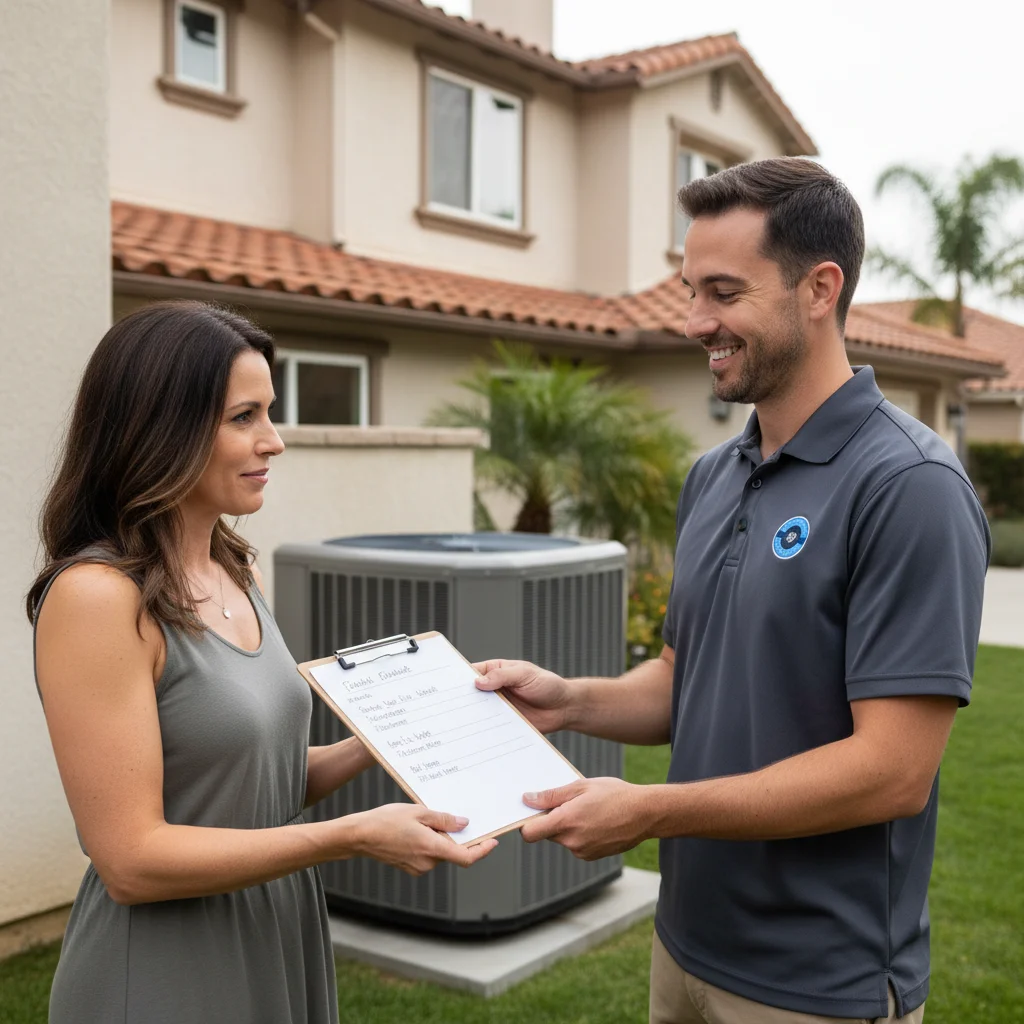
The fast version
- C-20 license, verified at the California CSLB website
- Licensed and insured (general liability and workers’ compensation). Ask for current certificates. Do not accept a made-up liability dollar figure from a website.
- Written estimate before any work starts
- Diagnostic fee disclosed upfront
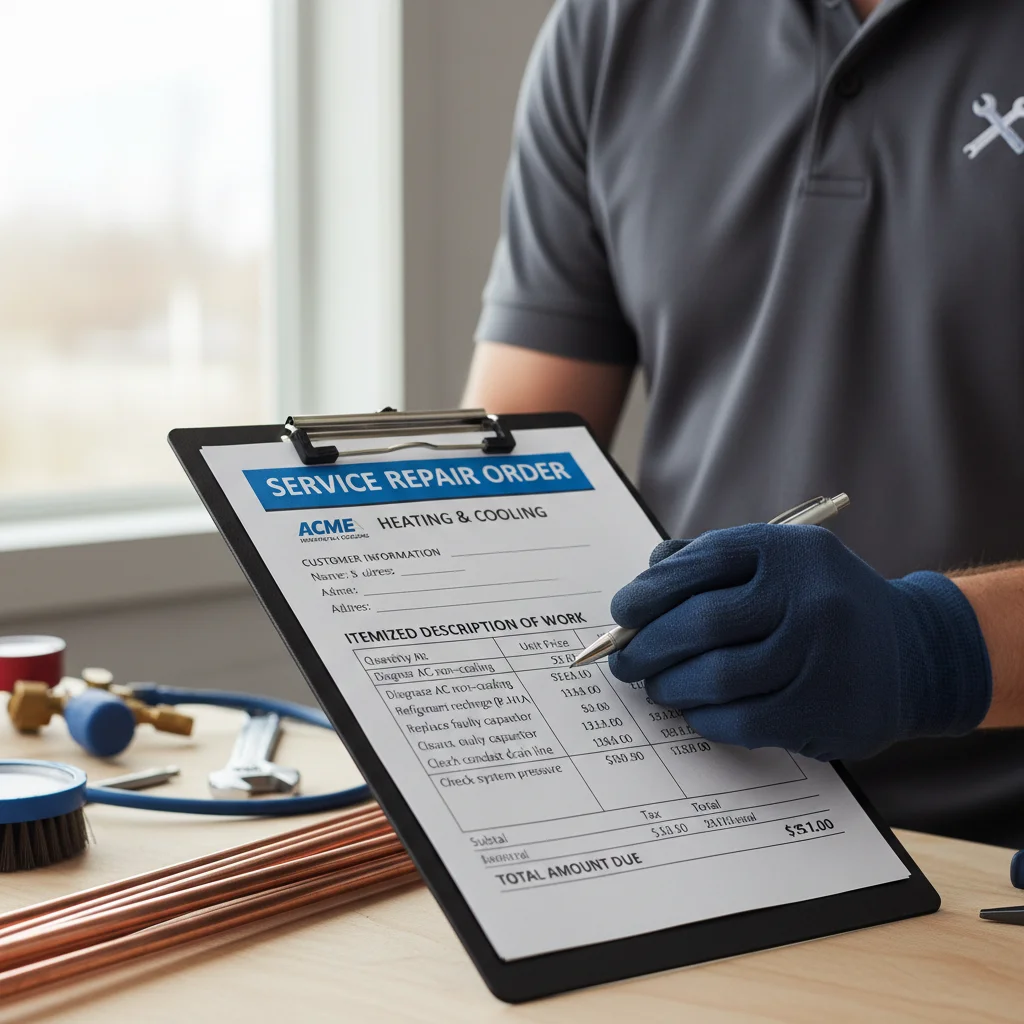
- Itemized pricing, parts and labor listed separately
- EPA Section 608 certification for refrigerant work
- Permits pulled by the contractor for installs and replacements
- Manual J load calculation on any system replacement
- Real warranty terms in writing
- Direct phone number, not just a national dispatch
- Reviews from multiple independent sources
- They’re willing to be a second opinion
If a contractor checks all twelve, you’re probably safe. If they check fewer than nine, walk.
The full version
1. C-20 license (non-negotiable)
A C-20 (Warm-Air Heating, Ventilating and Air-Conditioning) contractor fabricates, installs, maintains, services, and repairs warm-air heating, ventilating, and air-conditioning systems, including related ducts, registers, flues, controls, and filters. California requires this license for HVAC work above the B&P section 7048 threshold (aggregate contract under $1,000, with conditions that typically exclude HVAC installs). An unlicensed person advertising as a contractor is a separate problem.
How to verify. Go to cslb.ca.gov and look up the license number. The contractor should be happy to give it to you. Verify the license is C-20, currently active, with no recent disciplinary actions.
Red flag. “We’re qualified” without a number to look up.
2. Insurance, both kinds
A real HVAC contractor carries general liability insurance and workers’ compensation. California contractor licenses legally require insurance. The liability covers damage to your property. Workers’ comp covers their crew if someone gets hurt on your property.
How to verify. Ask for current certificates of insurance. Reputable contractors send these by email quickly. Check expiration dates.
Red flag. “We’re a small operation, we don’t carry workers’ comp.” Your homeowner’s policy is not their workers’ comp.
3. Written estimate before work starts
A licensed contractor will hand you a written estimate, itemized by labor and parts, and wait for your signature before touching anything.
How to verify. Ask. If the answer is anything other than yes, that’s the answer.
Red flag. “We’ll figure it out as we go.” Or “we don’t do estimates, we just bill what it takes.”
4. Diagnostic fee disclosed upfront
Ask what the diagnostic fee is, whether it is flat, and whether it applies toward the repair if you approve the work. Each company sets its own policy. Climate Pros SD sets none.
How to verify. Ask when you book. If the answer changes between booking and the invoice, that’s a problem.
Red flag. A cheap “service call” on the truck, then extra inspection fees on the bill. Or a no-charge diagnostic that vanishes when the repair is quoted. “Free estimate” language that turns into a scare-replace pitch is a pattern to walk away from. This brand does not advertise free estimates.
5. Itemized pricing
You’re entitled to know what the part costs separately from labor. That lets you compare quotes.
How to verify. Ask for itemized pricing in writing. Reputable contractors itemize without being asked.
Red flag. “It’s all included in the flat-rate book price” as the only number on the invoice.
6. EPA Section 608 certification
Anyone handling refrigerant in the US must hold EPA Section 608 certification. This is separate from the C-20 license.
How to verify. Ask if the technician on your job holds Section 608 certification.
Red flag. Discomfort with the question.
7. Permits pulled by the contractor
For City of San Diego, no part of heating, ventilating, air conditioning, or refrigeration systems shall be installed, altered, replaced, or repaired unless a mechanical permit has been obtained. Simple no-plan permits exist for some minor work on non-historic properties, including AC unit installations and furnace replacements. Plan-required permits apply to complex work or historically designated properties.
Other cities and unincorporated areas have their own rules. This site has not verified County of San Diego permit text as a countywide claim. The matched licensed contractor pulls the permit for the jurisdiction that applies. Climate Pros SD does not pull permits.
How to verify. Ask “are you pulling the permit?” Confirm in writing. After the work is done, ask for the permit closure document.
Red flag. “We don’t usually pull permits for this size of job.”
8. Manual J load calculation on system replacements
For any AC or heat pump replacement, the contractor should run a Manual J load calculation to size the system correctly. Many San Diego homes do not need the same size they came with.
How to verify. Ask “what size system did you calculate, and how?” The right answer references window orientation, insulation, infiltration, and climate. The wrong answer is “we matched what you had.”
Red flag. “We don’t do load calcs, we go by square footage.”
9. Real warranty terms
Included product warranties and separately purchased service contracts are different. Compare overlapping coverage, total price, deductibles, exclusions, and who actually repairs. Read the written warranty. Get oral promises in writing.
How to verify. Get warranty terms in writing. The most common warranty-voider is skipped maintenance. If you skip a year, parts coverage on the compressor can disappear. That is certificate-specific.
Red flag. “We back our work” with no term, no exclusions, no paper.
10. Direct phone number
You want to be able to call the contractor directly when something goes wrong. National dispatch services route through call centers that have no relationship with the local technician.
How to verify. When you call, are you talking to someone who can name the local company?
Red flag. Multiple companies sharing the same phone number with murky billing.
11. Reviews from multiple sources
Single-source review profiles can be gamed. Cross-reference Google, Yelp, BBB, Nextdoor, and Reddit’s r/sandiego threads. Look for substance about the work, not identical five-star blurbs.
Red flag. Hundreds of identical-sounding reviews posted in a tight window.
This site does not publish testimonials.
12. Willing to be a second opinion
A confident contractor is happy to look at another company’s quote. If a contractor pushes you to decide immediately without comparing, walk.
How to verify. Ask. “I’m getting a second opinion. Do you do those?” The right answer is yes, with their normal diagnostic fee.
Red flag. “This offer expires if you don’t sign now.” That is sales-floor pressure. It is also not the same as asking whether a tech is available today. Availability is their calendar. Fake urgency on the quote is a tell.
Red flags that should kill a quote immediately
- Pressure to sign today. Real HVAC work doesn’t have exploding quote timers.
- A “your whole system must be replaced” diagnosis on the first visit with no measurements. Common scare pattern.
- Refusal to itemize parts vs labor.
- A quote dramatically below two others on the same scope. Ask what was excluded: permits, line set, electrical, or used parts.
- “Your warranty requires you to use us.” Manufacturer warranties do not generally require a specific local company. Read the certificate.
What good contractors do that bad ones don’t
- They measure things. Static pressure, temperature split, refrigerant subcooling.
- They show you the problem. Capacitor reading versus rated microfarads, for example.
- They give you both numbers: this repair, and replacement, with age as context. The 5,000 rule is a heuristic they may mention. It is not a guarantee.
- They write findings down before you commit.
- They explain trade-offs: single-stage vs two-stage, SEER2 tiers, what each means for your house. See SEER2.
- They follow up after a major install.
How to compare quotes apples-to-apples
When you get two or three quotes, line them up against:
- System size and brand. Same tonnage and equipment tier?
- Efficiency rating (SEER2). Confirm AHRI, not a verbal badge.
- What’s included. Line set, electrical, permits, thermostat, removal, rebate paperwork if a live program exists.
- Warranty terms. Parts and labor, what voids them.
- Payment terms. Deposit, progress, completion.
A wide spread usually means the quotes aren’t the same scope. Figure out why before signing.
California Title 24 requires field verification testing when HVAC systems are altered or replaced. Testing must be performed by a CEC-certified rater. Specific leakage percentages are not published here.
Section 25C does not apply to property placed in service after December 31, 2025. Don’t let a 2026 quote subtract a federal credit.
FAQs
How do I know if an HVAC contractor is licensed in California?
Look up the license at cslb.ca.gov. You need the license number. It should be C-20, currently active, with no recent disciplinary actions.
Should I get multiple HVAC quotes?
Yes for anything beyond a simple diagnostic-plus-small-part conversation. Two quotes is the minimum. Three is better for replacements.
What questions should I ask an HVAC contractor before hiring?
What’s your C-20 license number? Are you EPA Section 608 certified? Do you pull the permit? Is the estimate written and itemized? What’s your diagnostic fee, and does it apply toward the repair? What’s your warranty on parts and labor? Will you run a Manual J calculation?
How much should an HVAC service call cost in San Diego?
Ask. It should be disclosed before they show up. Most reputable contractors will tell you whether the fee applies toward repair. Climate Pros SD does not publish a diagnostic price.
What’s the difference between a C-20 license and other licenses?
C-20 is California’s HVAC contractor license. C-36 is plumbing, C-10 is electrical, C-46 is solar. An HVAC company might hold multiple licenses. The C-20 is the one that covers HVAC.
Should I worry about a contractor that’s much cheaper than competitors?
Yes. Ask specifically what’s included: permits, refrigerant line set, electrical, warranty.
Is it safe to hire an HVAC contractor I find on Yelp or Google?
Yes, with CSLB and insurance verification. Read the negative reviews. Five-star counts are not a testimonial on this site.
What does a good HVAC contract look like?
Itemized scope, total price with parts and labor separated, warranty terms in writing, payment schedule, permit responsibility named, expected work duration for the job itself (not an arrival promise), signed by both parties.
Related services: AC repair and AC installation. Local coverage: all 67 cities we cover in San Diego County.
When to call us
If you have a quote from another contractor and want a second opinion, that’s a normal diagnostic visit with the matched company. Call (442) 777-6440. Ask whether they can review the quote. They confirm their own timing.