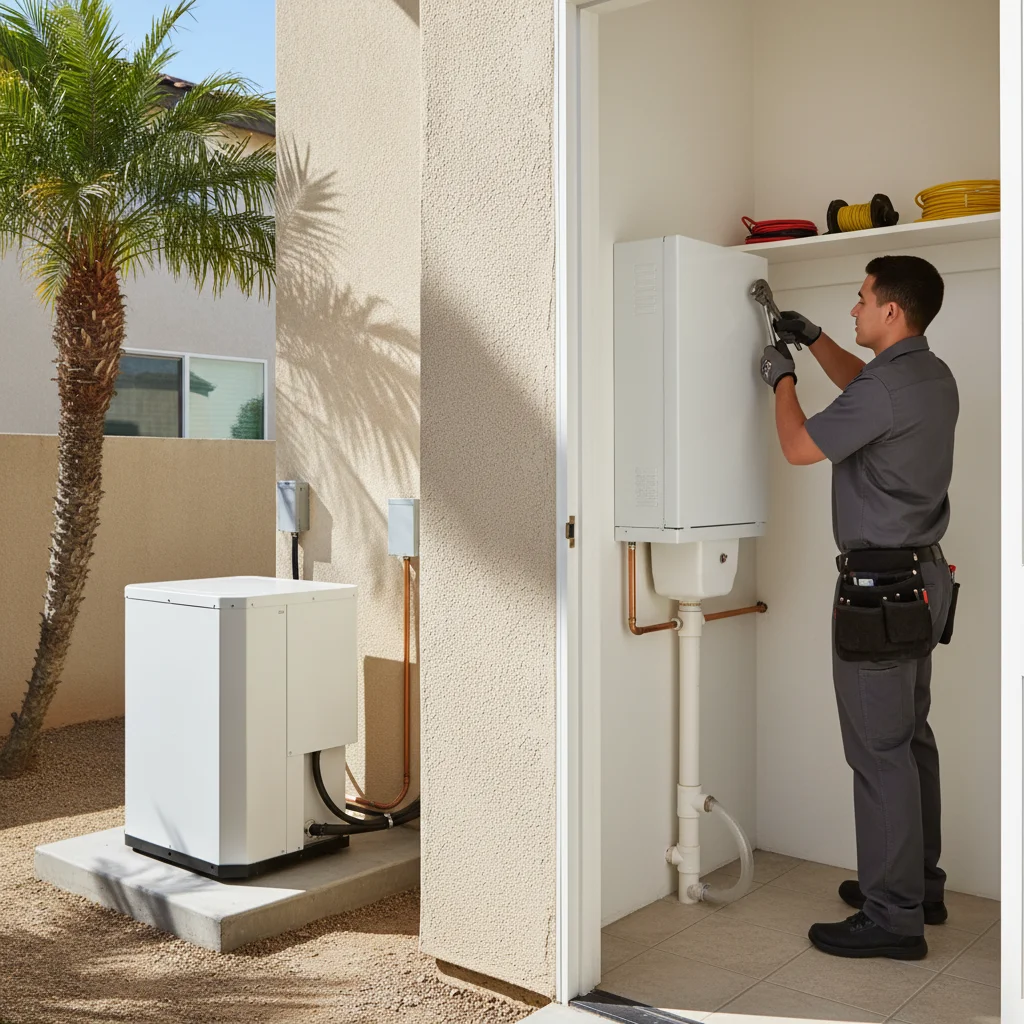
This is the complete 2026 guide to home HVAC in San Diego County. It covers the five microclimates that decide which system you actually need, real 2026 install and repair costs, the current SDG&E and federal rebate stack, how to vet contractors without getting burned, maintenance schedules by zone, indoor air quality and wildfire smoke prep, and Title 24 rules for new construction and replacements. Every section links out to a deeper post, so you can stay here for the overview or jump in anywhere.
San Diego’s five climate zones decide everything about your HVAC
San Diego County is not one climate. It’s five, and the system that’s right for a coastal home in Encinitas is the wrong system for a valley home in El Cajon. Build your decisions around the zone you live in, not the average for “San Diego.”
Coastal (Encinitas, Carlsbad, Oceanside, Del Mar, Coronado, Imperial Beach). Mild year-round. Summer highs usually 72-78°F, winter lows in the upper 40s. Salt air corrodes outdoor coils faster, so equipment lifespan is shorter (12-15 years instead of 15-20) and maintenance frequency is higher. Many coastal homes do fine with a heat pump or mini-split and don’t need a traditional furnace at all. See AC installation in Encinitas and coastal humidity and dehumidifiers for the specifics.
Central / Mesa (San Diego city, La Mesa, Mission Valley, Clairemont, Kearny Mesa). The transition belt. Summer highs in the low 80s, occasional Santa Ana spikes into the 90s. Most homes have central AC and a gas furnace. This is the zone where a heat pump conversion makes the most financial sense in 2026. See AC repair across San Diego neighborhoods.
Inland (Escondido, San Marcos, Vista, Poway, Rancho Bernardo, Scripps Ranch, 4S Ranch). Summer highs regularly 90-100°F. AC is not optional here. Heat-pump-only systems can struggle in heat waves above 105°F and may need a backup heat strip or a dual-fuel setup. See HVAC repair in Escondido valley heat and AC installation in Escondido.
East County / Valley (El Cajon, Santee, Lakeside, Lemon Grove, Spring Valley). Hotter and drier than inland. Highs of 100-105°F in July and August are normal, with overnight lows that don’t drop below 75°F during heat waves. Two-stage and variable-speed equipment earn their premium here. See AC repair in El Cajon.
Mountain / Desert fringe (Julian, Alpine, Ramona, Pine Valley). Real four-season climate. Winter lows in the 20s, occasional snow, summer highs 85-95°F. These homes need real heating, not just an AC with electric strips. A gas furnace or a cold-climate heat pump rated to 5°F is the right call. See HVAC for Julian and the mountains.
For a full zone-by-zone repair playbook, read HVAC repair by San Diego climate zone.
Two practical implications of these microclimates that get missed in national HVAC content. First, the same brand and model will perform differently across these zones. A condenser that’s “high efficiency” in Phoenix may not maintain its SEER2 rating in Carlsbad because coastal corrosion degrades the coil within five years. Brands that don’t sell a marine-grade condenser variant (sometimes called a “seacoast” model with epoxy-coated fins and stainless hardware) are the wrong call within two miles of the ocean. Second, ductwork sizing assumptions baked into national rules of thumb often miss San Diego’s mild design days. Most homes in the Central and Coastal zones never see a 100°F design day, so contractors who size ducts for “Southern California averages” often oversize trunks and undersize returns. Ask the contractor what design temperature they’re sizing for. The right answer in Coastal is 82-85°F, Central 88-92°F, Inland 95-100°F, East County 100-105°F, Mountain 90-95°F summer and 25-30°F winter.
City and neighborhood deep-dives: AC repair in Carlsbad, Chula Vista, Coronado, Escondido, Hidden Meadows, Imperial Beach, La Mesa, Lemon Grove, Oceanside, Poway, Rancho Bernardo, San Marcos, Santee, Scripps Ranch, Vista, 4S Ranch and Del Sur.
Do you actually need AC in San Diego
If you live within three miles of the coast, you can usually skip central AC and still be comfortable. If you live anywhere else, you’ll want it. The honest answer depends on how many hot nights you’re willing to lose sleep over, whether the house has insulation, and how your floor plan moves air. We wrote a full breakdown at Do you need AC in San Diego? and a related piece on whole house fan vs AC for coastal homes that want a middle path.
Short version: 60% of San Diego County homes have AC. The other 40% manage with fans, evening cross-breezes, and good window placement. If you’re inland or east county, you’re in the 60%. If you’re coastal, you have a real choice.
AC types explained: which one wins in San Diego
There are four mainstream options. Each one wins in specific situations.
Central air conditioning. A condenser outside, an air handler or furnace inside, ducts to every room. The default in homes built after 1980. Best when you already have ducts in good condition. Install cost runs $7,000-$15,000 in San Diego in 2026. Deep dive: central AC installation cost in San Diego.
Ductless mini-split. Wall-mounted indoor head, small refrigerant lines through the wall to an outdoor unit. No ducts needed. The right call for older homes without ductwork, ADUs, granny flats, and additions. Install runs $4,500-$8,000 per zone in 2026. See mini-split cost in San Diego, mini-split vs central AC, and mini-split for ADU and granny flat.
Heat pump (central or ductless). Heats and cools with one unit. The fastest-growing category in San Diego because the climate is nearly perfect for them and the SDG&E rebate stack is generous. Install cost is similar to central AC plus furnace combined, but you only buy one machine. See heat pump install cost 2026 and heat pump vs AC.
Window unit / portable. Cheap, loud, inefficient. Fine as a stopgap or for a single bedroom in a coastal apartment. Not a real solution for an inland home.
The honest comparison for a typical San Diego homeowner. If you have ducts and they’re in decent shape (less than 15% leakage by HERS test), central AC or a central heat pump is the lowest-friction upgrade. If you don’t have ducts, or your ducts are in the attic and leaking 30% of the conditioned air into the rafters, a ductless system delivers more comfort per dollar than a duct retrofit plus central AC. The break-even point is usually a duct repair quote over $4,000; above that, ductless wins.
Two-stage vs variable-speed equipment. Single-stage is on or off. Two-stage runs at about 65% load most of the time and 100% on the hottest days. Variable-speed modulates between 25% and 100% continuously. In San Diego, two-stage is almost always worth the upgrade over single-stage because most operating hours are at part-load. Variable-speed adds another $1,500-$3,000 over two-stage and pays back in 8-12 years through quieter operation, better dehumidification, and lower wear. See two-stage AC worth it and variable-speed vs single-stage AC.
SEER2 ratings. The new SEER2 standard replaced SEER in 2023. Don’t compare a 2023+ SEER2 rating directly against an older SEER number. The federal minimum in California is SEER2 14.3 for new installs in 2026. The sweet spot for cost-per-comfort in San Diego is SEER2 16-18. Above SEER2 18, you’re paying for incremental efficiency that takes 15+ years to pay back, longer than most coastal systems even last. Full breakdown: what is SEER2.
Brand selection. The honest take: installation quality matters 3x more than brand. A mid-tier brand installed correctly outperforms a premium brand installed sloppily. That said, the most-installed brands in San Diego are Carrier, Trane, Lennox, Bryant, Goodman, and Daikin. See best AC brands in San Diego for the brand-by-brand decision framework.
For a head-to-head on the whole-home options, read ductless vs ducted HVAC and variable-speed vs single-stage AC.
HVAC system sizing: why bigger isn’t better
The biggest mistake in San Diego HVAC isn’t picking the wrong brand. It’s installing a system that’s too big. An oversized AC short-cycles, dehumidifies poorly, wears out parts faster, and costs more upfront. An undersized one runs nonstop and never catches up.
The fix is a Manual J load calculation. Manual J is an industry-standard formula that accounts for square footage, insulation, window orientation, ceiling height, climate zone, and air leakage. It’s not optional. Any contractor who doesn’t perform one and just sizes off square footage is guessing.
A rule of thumb that almost always overshoots: 1 ton per 600 square feet in San Diego. The real number, after a Manual J, is usually closer to 1 ton per 800-1,000 sq ft on a well-insulated newer home. That difference matters: a 4-ton install when you needed 3 tons costs about $1,500 more upfront and runs less efficiently for the next 15 years.
Full breakdown: AC sizing and Manual J for San Diego homes and HVAC zoning systems for multi-story or large homes.
Real 2026 costs in San Diego
Numbers vary by zone, equipment tier, and how complicated the install is. These are the honest 2026 ranges from quotes we see across the county.
New AC installation (replacement of existing system). $7,000-$15,000 for a complete central AC system, 14-18 SEER2, including refrigerant lines, basic ductwork tie-in, and permit. Premium variable-speed or two-stage equipment runs $12,000-$18,000. See new AC cost 2026 and HVAC installation cost 2026.
Full HVAC system replacement (AC + furnace). $12,000-$22,000 for a matched set, including removal of the old equipment. See HVAC replacement cost 2026 and furnace replacement cost 2026.
Heat pump install (replacing AC + furnace with a single heat pump). $14,000-$24,000 before rebates. After SDG&E + federal stack you’re often down to $9,000-$17,000. See heat pump install cost 2026 and heat pump vs gas furnace cost.
AC repair. Service call $89-$149. Capacitor replacement $250-$450. Refrigerant leak repair $400-$1,500 depending on access. Compressor replacement $1,800-$3,500. See AC repair cost 2026 and AC compressor replacement cost.
Maintenance. $89-$179 per visit for a tune-up. Annual maintenance plans run $179-$349 per year for two visits. See HVAC maintenance cost, AC tune-up cost, and is HVAC maintenance worth it.
Financing. Most installs over $8,000 are financed. We cover terms and traps in HVAC financing options and the deeper HVAC financing in San Diego.
Extended warranties. Manufacturer parts warranties typically run 10 years on registered equipment. Extended labor warranties from the installer are an upsell. The math gets complicated by who has to honor them in year 7 when contractors come and go. Read HVAC extended warranty worth it before signing.
Best time of year to buy. Quote prices are softest in March-April and October-November when contractors are between peak seasons. Quote prices peak in July-August when emergencies are running 100% utilization. Plan a non-emergency install in spring or fall and you’ll save 10-15% on the same install. See best time to buy AC.
Hidden cost lines that show up on quotes. Refrigerant line set replacement ($600-$1,400). Electrical disconnect upgrade ($200-$500). Pad or stand replacement ($150-$400). Surge protector ($200-$350). Hard start kit on older units ($150-$300, often worth it; see hard start kit). Code-required condensate float switch ($75-$150). Permit and HERS testing ($300-$600 combined). Any quote missing these isn’t apples-to-apples with one that includes them.
SDG&E rebates and the federal 25C tax credit (the 2026 stack math)
In 2026, a heat pump install in San Diego can stack three or four different incentive programs. The math is real money: $3,000-$8,000 off a $20,000 install is normal.
SDG&E heat pump rebate. $1,000-$3,000 depending on system type and home size. Full details at SDG&E heat pump rebate eligibility and SDG&E heat pump rebate program. For the live performance data on this rebate program in 2026, read SDG&E heat pump rebate data 2026.
Federal 25C tax credit. 30% of the install cost, up to $2,000 for a qualifying heat pump. This is a tax credit, not a deduction, so it reduces your tax bill dollar-for-dollar. Full breakdown: federal 25C tax credit for HVAC.
TECH Clean California. Income-qualified rebate that stacks on top of SDG&E. For households under 80% of area median income, this can cover most of the install. See the heat pump rebate stack for the full layered math.
Statewide HVAC rebates. Other California programs sometimes apply, especially for low-GWP refrigerant equipment. See HVAC rebates California 2026.
Stack rule: rebates pay out after install, the federal credit lands on your next tax return. So your out-of-pocket on day one is still the full sticker price minus the upfront SDG&E rebate, then you recover the rest at tax time. Plan the cash flow accordingly.
Choosing a contractor without getting burned
This is the section that saves you the most money. Most overpriced installs and most bad outcomes trace back to skipping these checks.
Verify the license at CSLB. California requires a C-20 license for HVAC. Look it up at the California Contractors State License Board search tool. The license number should be on the contractor’s website, truck, and quote. Verify it’s active, in the contractor’s actual business name, and has no recent disciplinary action. Educational, free, takes 90 seconds.
Get three quotes. Not two. Three. The middle quote is usually closest to fair market. The lowest is often missing scope (skipping the permit, undersizing equipment, leaving out the refrigerant line set). The highest is often a high-pressure sales operation.
Demand a written Manual J. If the quote sizes the system by square footage and doesn’t include a Manual J load calculation, walk away. Full reasoning in how to choose an HVAC contractor and the best HVAC company guide.
Watch for the deposit trap. California law caps the deposit on a home improvement contract at the lesser of 10% of the total or $1,000. A contractor asking for 30-50% upfront is operating outside the law. See AC repair scams to avoid.
Ask about warranty. A one-year labor warranty is the floor. Premium installers offer 5-10 years. The manufacturer’s parts warranty is separate and usually 10 years on registered equipment.
Avoid the “sign today” pressure. Any quote should be valid for 15-30 days. Pressure to sign on the first visit is a tell.
For a regional shortlist of where to start your search, see top-rated HVAC contractor in North County and the best HVAC companies guide. For an emergency, emergency AC repair same-day in San Diego and HVAC repair near me cover the after-hours rules.
Insurance and bonding. A licensed C-20 contractor in California is required to carry workers’ comp insurance and a contractor’s bond (the bond is $25,000 minimum as of 2026). Ask for current certificates. Verify the workers’ comp policy is active by name; bonds are listed on the CSLB record. If a sub-contractor or “1099 installer” shows up without a W-2 employee credential and gets hurt on your property, you can be liable. This sounds paranoid until it happens.
The “free estimate” expectation. A quote for new equipment should be free in San Diego. A diagnostic service call for a repair has a fee ($89-$149 typically) that’s often credited toward the repair if you go ahead. Anyone charging an “estimate fee” on a clean install bid is using a scarcity tactic.
References specific to your zone. A contractor with a portfolio of 200 installs in Mission Valley may have done five in Escondido. Ask for two recent references in your zip code or neighboring zone. Drive by the homes. Look at the condenser placement, the line set, the disconnect box. Sloppy exterior work is a fingerprint of sloppy interior work.
Insist on a load calculation in writing. Manual J output is a multi-page document. If the contractor refuses to share it or claims it’s proprietary, they didn’t run one. A real Manual J takes 30-60 minutes per home and contractors who skip it are sizing by guesswork.
Don’t pay the final balance until inspection passes. Pull permit, schedule HERS test, schedule city or county inspection, then write the final check. Reputable contractors expect this. Anyone who pushes for full payment before inspection is the wrong contractor.
Maintenance schedule by climate zone
The “service your HVAC once a year” rule is a national average. San Diego is not the national average. Frequency depends on your zone.
Coastal homes: twice a year. Salt air corrodes outdoor coils, copper line sets, and electrical contacts. A coil cleaning and electrical check every spring and fall is the difference between an 18-year system and a 12-year system. See AC maintenance in Escondido for the 21-point checklist, how often HVAC should be serviced, and the HVAC maintenance schedule.
Inland and valley homes: once a year, plus a pre-summer check. Spring tune-up before the first heat wave. A mid-summer DIY filter check.
Mountain homes: twice a year. Once for cooling, once for heating. The wide temperature swing stresses both modes.
Seasonal checklists: spring AC tune-up checklist, fall HVAC checklist, winter HVAC checklist, and heat wave prep.
DIY items worth doing monthly: replace or wash the filter (see HVAC filter MERV ratings), clear leaves and debris from the outdoor unit, and hose down the condenser coil from the outside. For the inside coil, leave it to a tech. See how to clean AC coils.
Maintenance contracts: usually worth it for inland and east county homes, often worth it on the coast, rarely worth it for newer systems still under warranty. Read HVAC maintenance contract for the decision math.
Common failures and what they cost
This is the shortlist of what actually breaks in San Diego HVAC systems and what each one costs in 2026.
Capacitor failure. $250-$450. The most common AC repair. Symptoms: humming, won’t start, blower runs but compressor doesn’t. See AC capacitor replacement.
Refrigerant leak. $400-$1,500 to find and repair, plus refrigerant. Symptoms: warm air, ice on the line set, system runs constantly. See AC refrigerant leak signs and cost and R-22 vs R-410A vs R-454B for the refrigerant transition that’s reshaping repair pricing in 2026.
Clogged drain line. $150-$300. Symptoms: water around the indoor unit, AC shuts off. See AC drain line clogged.
Bad fan motor. $400-$800. Symptoms: humming outdoor unit, no air movement. See AC fan motor not spinning.
Compressor failure. $1,800-$3,500 or full replacement. The death sentence for old systems. See AC compressor replacement cost and the AC replacement vs repair decision.
Tripping breaker. $200-$800 depending on cause. See AC tripping breaker.
Short cycling. Often a $250 capacitor or a $400 thermostat; sometimes an oversized system that can’t be fixed. See AC short cycling causes and fix.
Furnace won’t ignite. $200-$600 for igniter or flame sensor. See why won’t my furnace ignite and furnace not igniting troubleshooting.
For the full noise-by-noise diagnostic shortcut: AC banging noise, AC hissing noise, AC squealing noise, AC making loud noise.
For a data view of which systems fail most in San Diego, read San Diego AC failure data 2026.
Why San Diego is the best heat pump market in the United States
If you’re replacing a furnace and AC in San Diego in 2026, the default answer is a heat pump, not a new furnace plus new AC. Three reasons:
The climate. Heat pumps lose efficiency below about 30°F. The average San Diego winter low is 45-55°F depending on zone. Even Julian rarely sees more than a handful of nights below 30°F a year. The climate is nearly tailor-made for heat pump operation.
The rebate stack. SDG&E + federal 25C + sometimes TECH Clean California = $4,000-$8,000 off a typical install. No other major US market has this stack live in 2026.
The grid economics. SDG&E electricity is expensive, but natural gas in California is also expensive and getting more so. A modern variable-speed heat pump at SEER2 17+ beats a 95% AFUE gas furnace on operating cost in most San Diego homes, especially with solar.
The exceptions: mountain homes that see real cold, homes with cheap legacy gas service and a furnace still under warranty, and homes where the existing electrical panel can’t support a heat pump without an expensive upgrade.
Deep dives: heat pump vs furnace, replacing AC with heat pump, how a heat pump works, what is a heat pump, and high-efficiency furnace, is it worth it if you’re staying on gas.
For the solar interaction: AC + solar under NEM 3.0.
Indoor air quality, filtration, and wildfire smoke
San Diego has three air quality realities: marine layer humidity on the coast, year-round pollen, and wildfire smoke events that can run for weeks. A good HVAC system addresses all three.
Filtration. MERV 11-13 filters catch most particulate matter including PM2.5 from wildfire smoke. Higher MERV is better, but past 13 you start restricting airflow on residential systems unless the ductwork is sized for it. Full breakdown: HVAC filter and MERV ratings.
Ventilation. California’s Title 24 requires mechanical ventilation in new and significantly remodeled homes. The standard answer is an ERV (energy recovery ventilator) or HRV. See ERV / HRV fresh air ventilation under Title 24.
Wildfire smoke prep. Run the HVAC fan continuously on smoke days with a MERV 13 filter. Consider a portable HEPA in the bedroom. Keep windows closed and the fresh-air damper sealed if you have one. See indoor air quality during wildfire season and what is indoor air quality.
For asthma and allergies. HEPA-grade filtration and humidity control matter most. See HVAC for asthma and allergies.
For pet owners. Higher filter changes and coil cleaning frequency. See HVAC for pet owners.
Duct cleaning. Worth it if there’s visible debris, after construction, or after a rodent incident. Not a routine maintenance item. See duct cleaning worth it, duct cleaning cost, and duct leak repair.
Smart thermostats and demand response
A smart thermostat is the cheapest HVAC upgrade with the highest comfort return in San Diego. The honest savings number is 8-15% on cooling bills, not the 25% the marketing claims. But the comfort benefits (geofencing, scheduling, remote control) are real.
Nest vs Ecobee. Both work well. Ecobee has the edge for multi-zone homes and humidity readings; Nest has the edge for ease of setup and the learning algorithm. See Nest vs Ecobee installer, smart thermostat installation guide, and thermostat installation cost.
SDG&E demand response. SDG&E pays you for letting them briefly cycle your AC during grid emergency events (usually 4-7 PM on extreme heat days). Most smart thermostats support enrollment. The payout is small but real, and the comfort impact is minimal.
Setpoint strategy. In San Diego, 76-78°F daytime in summer and 68-70°F in winter is the sweet spot for cost vs comfort. See what temperature to set AC and lower your AC bill in summer.
Troubleshooting. Smart thermostat not cooling, thermostat not working.
For full smart home integration: smart home HVAC integration.
When to repair vs replace: the $5,000 rule for San Diego
National guides use the “$5,000 rule”: multiply the repair cost by the age of the unit; if the result is over $5,000, replace. That math is roughly right for San Diego, with two zone-specific adjustments.
Coastal homes: lower the threshold to $4,000. Salt corrosion compounds. A 12-year-old coastal AC that needs a $400 repair is past the point where repair pays back. See the $5,000 rule for San Diego and how long does an AC unit last.
Inland homes with R-22 refrigerant: replace. R-22 is no longer manufactured. Any meaningful refrigerant repair on an R-22 system costs $1,200+ in 2026 and that money is better spent on a new R-454B-ready system. See R-22 vs R-410A vs R-454B and the AC replacement vs repair decision.
The compressor question. A failed compressor on a system over 10 years old is almost always a replace, not a repair. The labor to replace a compressor is most of the cost of a new outdoor unit. See AC compressor replacement cost.
The “I might sell” angle. If you’re selling in the next 2-3 years, repair and disclose. If you’re staying 5+ years, replace. The buyer’s inspector will flag an old system either way.
For a pre-sale inspection guide: pre-purchase AC inspection.
Permit requirements (and why they matter)
Any HVAC equipment change-out requires a permit in San Diego County. This is not optional and it is not a contractor formality. Skipping the permit creates four real problems:
- The work is uninspected, which means installation defects don’t get caught.
- If you sell, the unpermitted work has to be disclosed or retroactively permitted (often at full price plus penalties).
- Your homeowner’s insurance may deny a claim if a fire or water loss traces back to unpermitted work.
- SDG&E rebates and federal tax credits often require a permit on file.
A good contractor pulls the permit themselves and includes it in the quote. The permit fee is usually $150-$400 depending on the jurisdiction (city of San Diego, county unincorporated, Carlsbad, Encinitas, etc.). Full guide: do I need a permit for HVAC in San Diego.
Title 24 and what new buyers need to know
California Title 24 is the building energy code. It changes every three years and the 2025 cycle is in effect through 2027. Three things it does that matter for HVAC:
Mandates duct testing. Any new system or replaced system must have its ducts pressure-tested by a HERS rater. The tested leakage has to be under 5%. Older homes often leak 20-30% before sealing.
Mandates ventilation. Any major remodel or new build needs an ERV or HRV providing balanced fresh air. Bath fan exhaust doesn’t satisfy this anymore.
Strongly favors heat pumps. The code’s energy budget is much easier to meet with a heat pump than with a gas furnace, especially in new construction. Some Bay Area cities have banned new gas hookups. San Diego hasn’t, but the direction is one way.
Full guides: HVAC for new construction under Title 24 and ERV / HRV ventilation under Title 24.
What new construction and major remodels need to know
If you’re building new or doing a major remodel in San Diego County in 2026, the HVAC scope is bigger than people expect.
Title 24 HERS testing is mandatory. Duct leakage testing, refrigerant charge verification, and airflow verification all have to be performed by a third-party HERS rater. Budget $400-$800 for the testing.
Mechanical ventilation is required. Continuous fresh-air supply is part of the energy code now. The cheapest path is a 50-100 CFM continuous bath fan; the better path is an ERV that recovers heat and moisture from the exhaust. See ERV / HRV ventilation under Title 24.
Electric-only future-proofing. Even if you’re installing gas appliances now, run a 240V circuit and conduit to a future heat pump location, and oversize the electrical service to at least 200 amps. Retrofitting electric service later costs $3,000-$8,000.
Solar plus heat pump as a package. Title 24 already requires solar on new homes. Sizing the solar array to cover heat pump operation costs incrementally less than adding solar capacity later. The math is in HVAC for new construction under Title 24.
Refrigerant lines and condensate routing. Plan these in framing. Refrigerant line sets longer than 50 feet need oversizing and capacity correction. Condensate routing to an approved drain (not just to a wall) is required by code in most jurisdictions.
Energy bills and runtime: what’s normal in San Diego
The honest baseline for typical 2,000 sq ft homes on SDG&E in 2026, mid-tier insulation, modern equipment:
Coastal: $80-$140/month average across the year. Cooling load is small; heating is occasional. Central: $130-$220/month average. Both cooling and heating matter. Inland: $180-$320/month average. Summer cooling is the dominant load. East County: $200-$360/month average. Long cooling season plus winter heating. Mountain: $200-$400/month average. Real heating load drives the bill.
Smart thermostat with reasonable setpoints (76-78°F summer, 68-70°F winter) trims 10-15%. Solar with net metering under NEM 3.0 changes the math entirely; you’re effectively self-supplying daytime cooling. See lower your AC bill in summer and can I run AC 24/7 in San Diego.
Closing vents in unused rooms. Tempting but usually a bad idea on central systems. The blower is sized for the full duct layout; closing vents raises static pressure and stresses the motor without saving real money. Better answer: a zoning system or per-room mini-splits. See should I close vents in unused rooms.
Special-case homes
Not every San Diego home is a single-family detached on a quarter-acre lot. The recommendations shift for:
- Condos: condo HVAC
- Townhouses: townhouse HVAC
- ADUs and granny flats: mini-split for ADU
- Mobile and manufactured homes: mobile home HVAC
- Short-term rentals: HVAC for short-term rentals
- Small commercial: commercial HVAC for small business
FAQs
How much does HVAC cost in San Diego in 2026?
A new central AC install runs $7,000-$15,000. A full HVAC replacement (AC and furnace) runs $12,000-$22,000. A heat pump install runs $14,000-$24,000 before rebates, or $9,000-$17,000 after the SDG&E and federal stack. Repairs range from $250 for a capacitor to $3,500 for a compressor. Routine maintenance is $89-$179 per visit.
Do I really need air conditioning if I live near the coast in San Diego?
Probably not for daily comfort, but you might want it for the 5-15 hot days a year when an offshore Santa Ana event pushes coastal temperatures into the 90s. A ductless mini-split or a heat pump that handles both cooling and the rare cold snap is the right answer for most coastal homes. Full central AC is usually overkill within three miles of the ocean.
What is the best HVAC system for San Diego?
For most homes built after 1980 with existing ducts, a variable-speed heat pump rated SEER2 17+ is the best 2026 answer. For older homes without ducts, ductless mini-splits per zone are better. For mountain homes that see real winter, a gas furnace plus AC or a cold-climate heat pump rated to 5°F is the right call.
How long does an HVAC system last in San Diego?
Inland homes get 15-20 years on a well-maintained system. Coastal homes get 12-15 years because salt air corrodes coils and electrical contacts faster. Mountain homes get 15-20 years on the furnace and 12-15 on the AC. Maintenance frequency makes a real difference: a coastal home serviced twice a year often outlasts an inland home serviced never.
How do I check if my HVAC contractor is licensed?
Search the California Contractors State License Board (CSLB) website for the contractor’s license number, which should appear on their website, truck, and quote. HVAC work in California requires a C-20 license. Verify the license is active, in the contractor’s actual business name, and has no recent disciplinary actions. The lookup is free and takes about 90 seconds.
What rebates are available for a heat pump in San Diego in 2026?
The current stack: SDG&E heat pump rebate ($1,000-$3,000), federal 25C tax credit (30% of install up to $2,000), and TECH Clean California for income-qualified households (can cover most of the install). Typical combined savings on a $20,000 install are $3,000-$8,000. SDG&E rebates pay out after install; the federal credit comes back at tax time.
How often should HVAC be serviced in San Diego?
Coastal homes: twice a year (salt air accelerates wear). Inland and valley homes: once a year minimum, plus a pre-summer filter check. Mountain homes: twice a year (once for heating, once for cooling). Monthly DIY: replace or wash the filter, clear debris from the outdoor unit. A professional tune-up runs $89-$179 and pays for itself by catching small issues before they become big repairs.
Should I repair or replace my HVAC system?
Apply the $5,000 rule: multiply the repair cost by the unit’s age in years. If the result is over $5,000, replace. For coastal homes, lower the threshold to $4,000 because corrosion shortens system life. For any R-22 system, replace; refrigerant repairs on R-22 systems run $1,200+ in 2026 and the money is better spent on a new R-454B-ready system.
Do I need a permit to replace my HVAC in San Diego?
Yes. Any HVAC change-out requires a permit in San Diego County and the cities within it. Permits run $150-$400 depending on jurisdiction. Skipping the permit voids many SDG&E rebates, can complicate a future home sale, and may give your homeowner’s insurance grounds to deny a related claim. A reputable contractor pulls the permit themselves and includes it in the quote.
What’s the difference between a heat pump and an AC?
A heat pump is an AC that can run in reverse to provide heat. Mechanically, almost identical hardware. The difference is the reversing valve that lets the refrigerant flow either direction. In San Diego’s climate, a single heat pump replaces both an AC and a furnace, which is why it’s the fastest-growing category in the county.
Is a mini-split better than central AC?
Mini-splits are better when there are no existing ducts (or the ducts are leaky and old), when you want per-room temperature control, when you’re cooling just one zone (an ADU, a master bedroom, an addition), or when you live within three miles of the coast and only need cooling for a handful of hot days a year. Central AC is better when you already have good ducts and want whole-home conditioning from one system.
What size HVAC do I need for my San Diego home?
The right answer comes from a Manual J load calculation, which factors in square footage, insulation, window orientation, ceiling height, climate zone, and air leakage. A rough San Diego rule of thumb is 1 ton per 800-1,000 square feet on a newer, well-insulated home. Any contractor sizing your system by square footage alone is guessing. An oversized system short-cycles, dehumidifies poorly, and costs more upfront.
What MERV filter should I use in San Diego?
MERV 11-13 catches most particulate matter including pollen and PM2.5 from wildfire smoke. Higher MERV ratings filter more but restrict airflow more, which can stress residential systems not designed for them. For homes with allergies or wildfire smoke concerns, MERV 13 is the sweet spot. Change or wash the filter monthly, especially during smoke events.
Can I install a heat pump if I have solar?
Yes, and it’s often a great match. Under SDG&E’s NEM 3.0 export rates, the math favors using your solar to run a heat pump rather than exporting at low compensation. The sizing and load calculations are slightly different when you have solar plus battery storage. See AC + solar under NEM 3.0 for the full breakdown.
What’s the difference between R-22, R-410A, and R-454B refrigerants?
R-22 is phased out and no longer manufactured; any system still using it should be replaced. R-410A is the current standard but is being phased out under the 2025 EPA rules. R-454B is the new standard for 2025+ installs. If you’re buying a system in 2026, get R-454B; it’s lower-GWP and future-proof.
When to call us
When you’re ready for an estimate from a vetted local team that runs a Manual J, pulls the permit, walks you through the rebate stack, and answers your questions before quoting, we’re here. Whether you want a repair, a maintenance plan, or a full heat pump install, the first conversation costs nothing.
Call us at (442) 777-6440 for a same-day estimate.