If you are buying a new construction home in San Diego County in 2026, the HVAC question is not the 2022 code question. The 2025 Building Energy Efficiency Standards (Title 24, Part 6) apply to permit applications filed on or after January 1, 2026. Heat pump space heating is the prescriptive baseline. That changes spec sheets in San Marcos, Otay Mesa, Vista, and Carlsbad, and it changes which rebates you can even ask about.
Climate Pros SD matches buyers with licensed local HVAC pros for a second look at a builder spec. We are not the builder’s sub. We do not close your escrow. Verify any contractor at cslb.ca.gov.
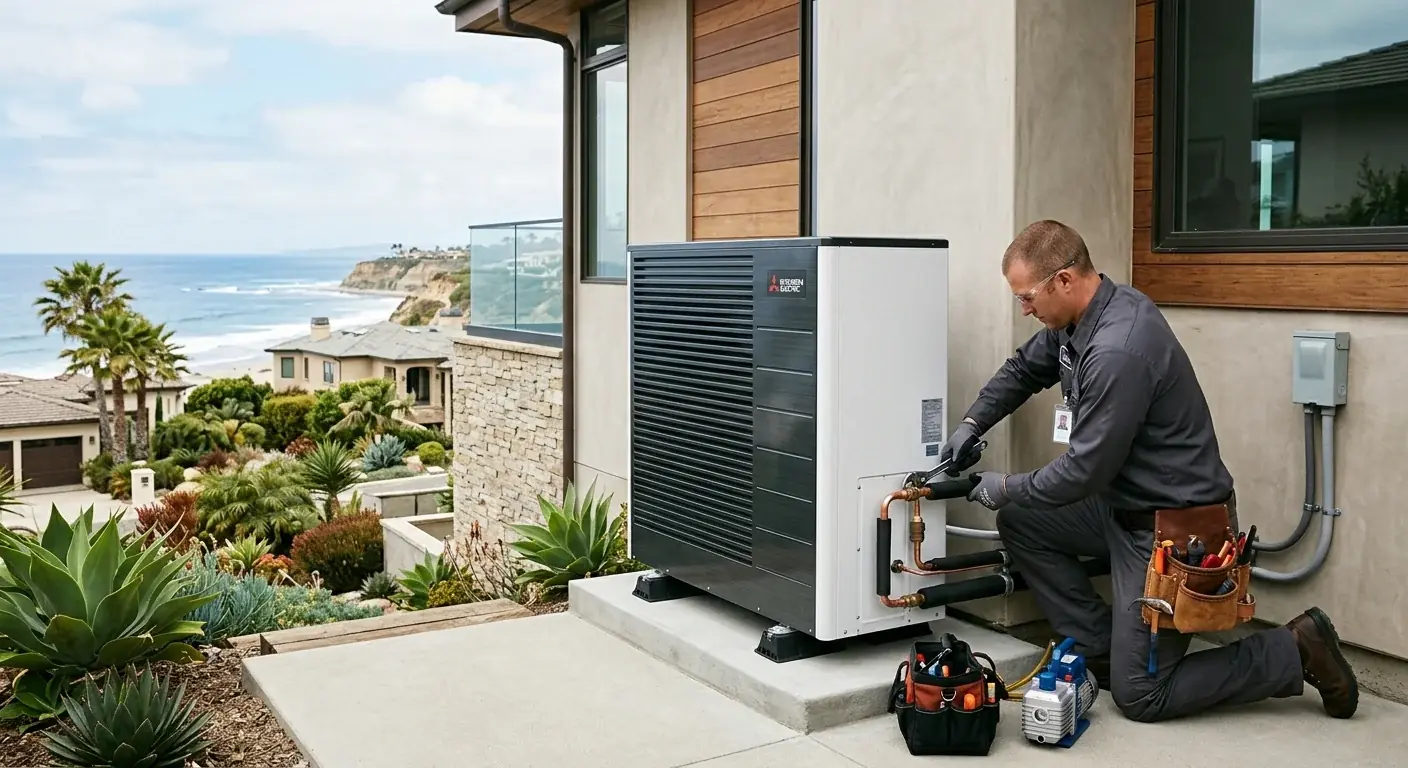
What does the 2025 Title 24 update actually require?
Homes still selling in Otay Mesa, San Marcos, Vista, and Carlsbad may sit on either the 2022 or 2025 cycle depending on when the permit application was filed. Two model homes on the same street can have different systems for that reason. Ask which cycle your lot is on.
Headline HVAC pieces:
Heat pump space heating is the prescriptive baseline. The energy budget is calculated as if the house has a heat pump. A builder can still install a gas furnace if they make up the energy elsewhere (windows, insulation, tighter ducts, higher-SEER2 cooling). Many production builders are defaulting to heat pumps because it is the cheaper compliance path.
Electric-ready. Even with a gas range or gas water heater, the house must be wired for future electric swap: 240V and panel capacity reserved for a heat pump water heater and induction. Read the panel schedule.
HERS. Field verification is required on more systems. The sticker on the air handler is how you know someone independent tested it.
SEER2. Federal minimums are the floor. Title 24 compliance often pushes installed efficiency above that floor. Put the actual SEER2 and HSPF2 on the options addendum.
For climate context, see how a heat pump works in San Diego.
What do builders include, and what is an option?
Base HVAC on a spec sheet is code compliance, not a premium system. North County master plans (San Elijo Hills phases, Shadowridge, Robertson Ranch, Otay Mesa Ranch) tend to break out like this:
| Tier | What you are usually looking at |
|---|---|
| Builder base | Single-stage heat pump, minimum-legal efficiency, bulk-buy brand, standard ducts, basic thermostat |
| Mid option | Two-stage equipment, better sealing, a smart thermostat |
| Premium | Variable-speed inverter, zoning, HRV/ERV, higher filtration |
Details buyers miss:
Production builders use whichever brand won the sub’s bulk contract. Model and serial show up at close-out. Ask before you sign.
Two-zone ductwork is cheap at framing and expensive as a retrofit. Multi-story plans in Otay Mesa Ranch and newer San Elijo phases are where that option pays.
Salt-air coil protection is not standard west of I-5 (Bressi Ranch, La Costa, coastal Encinitas). See heat pump installation in Carlsbad.
Heat pump water heaters are often optional even when the house is electric-ready. Installing at construction is usually simpler than a closet retrofit later. Confirm SDG&E incentives at option time. The federal 25C credit expired for equipment placed in service after December 31, 2025, so a 2026 close does not get that credit.
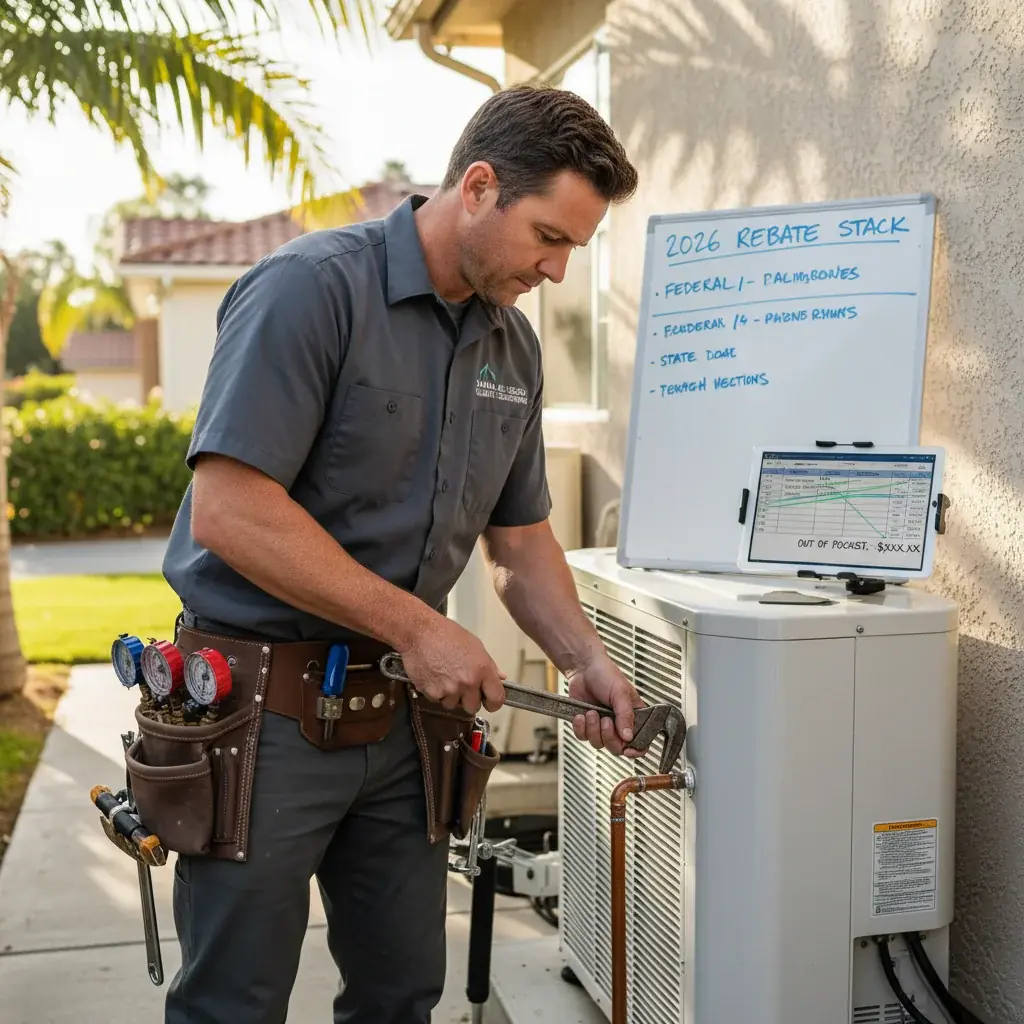
How do rebates work on new construction versus a retrofit?
Federal 25C. Expired for equipment placed in service after December 31, 2025. A 2026 occupancy date does not revive it. If equipment was placed in service in 2025, that is a 2025 tax-year question for your CPA.
SDG&E TECH and equity programs. Written mainly for retrofits. New-construction eligibility is limited in most program years. A minimum code heat pump often does not qualify. A high-efficiency upgrade at options sometimes does if the installer enrolls it. Confirm before you sign the option, not after.
Panel upgrades. Some lower floorplans still ship under 200A. Adding capacity at framing is the cheap moment if you want EV charging, induction, and a heat pump water heater later.
See HVAC rebates California 2026 and SDG&E heat pump rebate eligibility.
Should you upgrade at close or wait?
If you close in the next 90 days, anything that has to live in the walls (zones, ducts, ERV) is cheaper now. Bolt-on thermostats and filter cabinets can wait.
Single-story houses get most of their benefit from a decent two-stage system. Multi-story houses benefit from zoning designed in.
Inland San Marcos and Otay Mesa run more cooling hours than immediate-coast Carlsbad. Higher SEER2 matters more there. Do not use a fake annual bill gap from a blog. Ask SDG&E rate and a load calc.
Upgrade at close when you have zoning potential, you are in a corrosion zone, a rebate actually applies to the upgrade, or the plan is multi-story.
Wait when the option is only a name-brand swap on equal equipment, the builder markup is obviously above retail, or you would rather pick your own contractor after the builder warranty.
Already closed? Replacing AC with a heat pump covers retrofit logic.
What should you ask the builder’s HVAC sub?
- Brand and model, in writing on the addendum
- SEER2, HSPF2, tonnage, and the Manual J
- Coastal coatings for this lot, yes or no
- AHRI certificate and HERS report in the closing packet
- Labor warranty length, separate from parts
- Who designs zoning and Manual D if you add it
- Heat pump water heater: kWh draw and closet ventilation
- Panel: 200A ready for EV and induction, or code minimum only
If the answers are “we will figure it out later,” that is a signal.
FAQ
Are heat pumps required in California new construction?
Not as a ban on gas. As of January 1, 2026, heat pump space heating is the prescriptive baseline. Gas is still possible if the rest of the house makes up the energy. Most production builders in this county are defaulting to heat pumps.
Can I claim the federal heat pump credit on a 2026 new home?
Not if the equipment is placed in service in 2026. 25C expired after December 31, 2025.
What SEER2 should I want?
Coastal mild climate: the code-legal mid teens are often enough. Inland San Marcos, Vista, Escondido, Otay Mesa, El Cajon: higher SEER2 works more hours. Above the high teens usually wants zoning and a tight envelope to make sense.
Does builder HVAC qualify for SDG&E rebates?
Often no on the base unit. Ask the installer to enroll a qualifying upgrade before you buy the option.
How much do HVAC options cost?
Builders set option prices. Some mark them up hard versus a post-close contractor. Compare scope, not a blog table.
Should I upgrade to 200A at framing?
If you want an EV charger, induction, HPWH, or a spa within a few years, yes. After move-in it is a bigger permit job.
What warranties exist?
Manufacturer parts (register them) and builder labor, often 1 to 2 years. After that, labor on a parts swap is on you unless someone sold extended labor.
Can I pick my own HVAC contractor for the original install?
Almost never on a production builder. You pick your own people after close for extra work.
When to call
If you are under contract in San Marcos, Vista, Carlsbad, Otay Mesa, or elsewhere in the county and want a second set of eyes on the HVAC options, call (442) 777-6440. See heat pump service and AC installation.