When you think about heating and cooling your San Diego home, you probably imagine two separate systems: a furnace for warmth and an air conditioner for cool air. But what if one system could do both, and do it more efficiently than ever before? That’s exactly how a heat pump works, and it’s an increasingly popular choice for our mild Southern California climate. Understanding the simple science behind these innovative systems can help you see why they’re such a smart investment for year-round comfort.
The simple job of moving heat, not making it
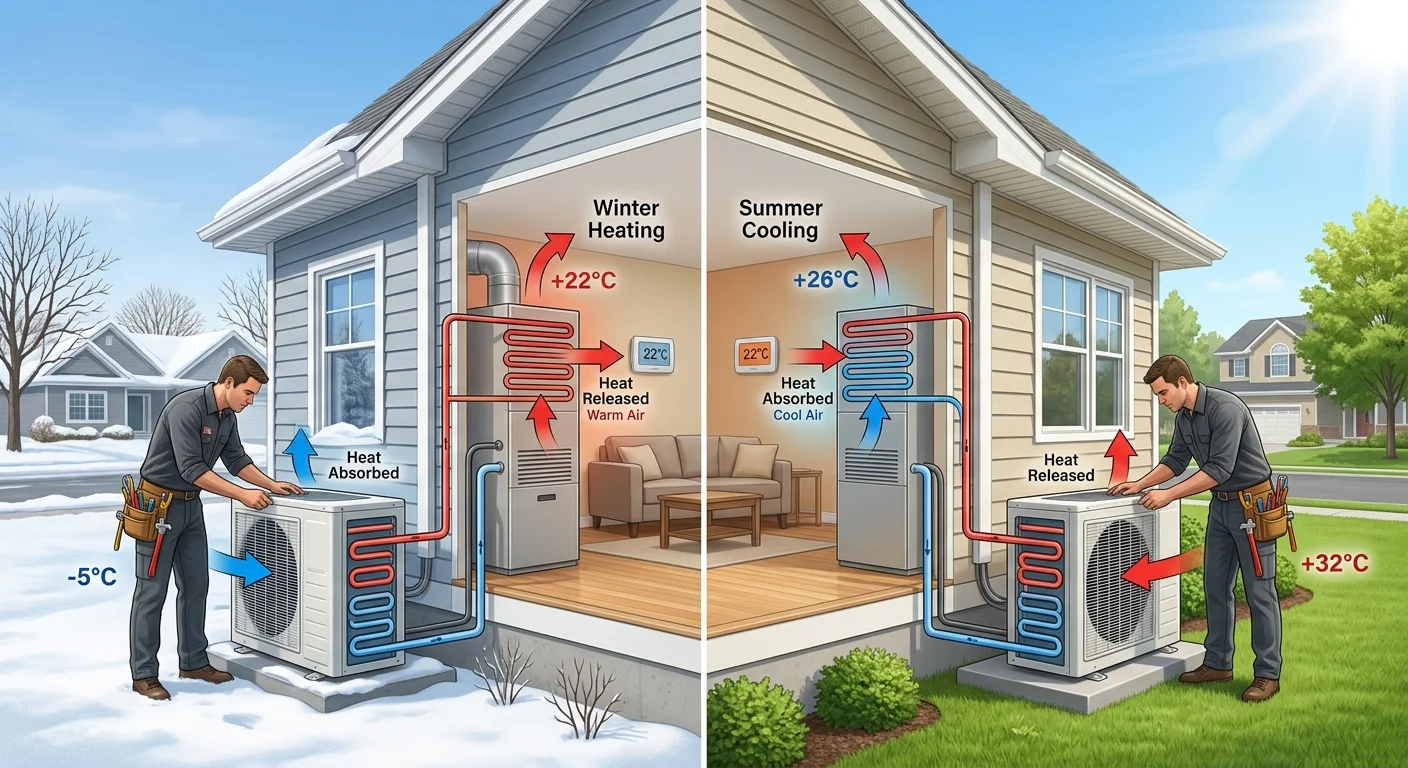
At its core, a heat pump doesn’t generate heat in the way a furnace does by burning fuel. Instead, it simply moves existing heat from one place to another. Think of it like a smart thermal conveyor belt. In the summer, it moves heat from inside your home to the outside. In the winter, it reverses direction, pulling heat from the outdoor air and bringing it indoors. This fundamental difference in operation is what makes a heat pump so incredibly energy-efficient, especially in places like San Diego where extreme temperatures are rare.
This process relies on a closed loop of refrigerant circulating through coils, much like the coolant in your refrigerator. Refrigerant has a unique ability to absorb and release heat as it changes between liquid and gaseous states. By manipulating the pressure and state of this refrigerant, the heat pump can absorb heat from one area and then release it in another. This “heat transfer” method requires significantly less energy than burning fossil fuels or using electric resistance coils to create heat from scratch. It’s an intelligent use of thermodynamics, offering a dual-purpose system for heating and cooling that saves energy and money for homeowners across San Diego County.
Heating mode: how it pulls warmth from cool winter air
The idea of pulling warmth from cool air might sound counter-intuitive, but it’s a critical concept for understanding how a heat pump works in heating mode. Even on a chilly San Diego winter day, the air outside still contains thermal energy. A heat pump’s outdoor unit is designed to capture this latent heat. Here’s how the process unfolds:
First, the outdoor coil, filled with cold, low-pressure liquid refrigerant, absorbs heat from the surrounding outdoor air. As the refrigerant absorbs this energy, it warms up and changes into a low-pressure gas. Next, this warm, gaseous refrigerant travels to the compressor, located in the outdoor unit. The compressor increases the pressure and temperature of the refrigerant significantly, turning it into a hot, high-pressure gas. This superheated gas then moves to the indoor coil. Here, a fan blows cooler indoor air across the hot coil. The heat from the refrigerant transfers to the indoor air, which is then circulated throughout your home, making it warm and comfortable. As the refrigerant releases its heat, it cools down and condenses back into a high-pressure liquid. Finally, it passes through an expansion valve, which drops its pressure and temperature, returning it to a cold, low-pressure liquid state, ready to absorb more heat from outside and restart the cycle. This continuous loop efficiently extracts and delivers warmth, even when outdoor temperatures dip into the 40s or 50s, common for our San Diego winters.
Cooling mode: how it works just like a regular AC
When summer arrives in San Diego and you need to cool your home, a heat pump essentially reverses its operation and functions almost identically to a traditional central air conditioner. In cooling mode, the system’s objective is to remove heat from inside your house and expel it outdoors, leaving your indoor spaces feeling cool and comfortable.
The process begins inside your home. Warm, humid indoor air is drawn across the indoor coil, which now contains cool, low-pressure liquid refrigerant. The refrigerant absorbs the heat and humidity from your indoor air, causing it to warm up and change into a low-pressure gas. This warm, gaseous refrigerant then travels to the outdoor unit. The compressor, as before, increases the refrigerant’s pressure and temperature, turning it into a hot, high-pressure gas. Next, this hot gas moves through the outdoor coil. A fan blows ambient outdoor air across the coil, helping to dissipate the heat from the refrigerant into the atmosphere. As the refrigerant releases its heat, it cools down and condenses back into a high-pressure liquid. Finally, it passes through an expansion valve, reducing its pressure and temperature, returning it to a cold, low-pressure liquid state. This chilled refrigerant then cycles back to the indoor coil, ready to absorb more heat from your home. The cycle repeats, continuously extracting heat and humidity from your living spaces, delivering a refreshing breeze, much like a conventional air conditioning system.
Why San Diego’s mild winters are the perfect match for heat pumps
San Diego County is known for its incredible weather, with mild winters and warm, sunny summers. This climate is, quite simply, ideal for heat pump technology. Unlike regions with harsh, freezing winters, San Diego rarely experiences temperatures that drop below what a standard heat pump can efficiently handle.
Heat pumps perform at their peak efficiency when the temperature difference between inside and outside isn’t too extreme. In San Diego, winter daytime temperatures typically hover in the 60s, and even nights usually stay above freezing in most areas. This means a heat pump can easily extract enough warmth from the outdoor air without relying heavily on supplemental heat sources, known as “auxiliary heat” or “backup heat.” This reliance on auxiliary heat, often an electric resistance coil, is what can drive up operating costs for heat pumps in colder climates. Since San Diego rarely needs it, homeowners here get to enjoy the full energy-saving benefits.
Choosing a heat pump means you get efficient heating and cooling from a single system. If you’re weighing options, start with heat pump vs AC in San Diego. Do not treat a rebate stack as part of the sticker. Section 25C does not cover property placed in service after December 31, 2025. The IRS $2,000 figure is the 2025 qualified heat-pump cap. TECH single-family HVAC reservations stopped November 14, 2025. HEEHRA single-family design caps of $8,000 / $4,000 are not live money for a new application (reserved February 24, 2026). Confirm SDG&E on the live page. Current status: California HVAC rebates 2026. The US Department of Energy still treats heat pumps as an efficient heating and cooling option in a mild climate.
What is a reversing valve and why does it matter?
The true genius behind a heat pump’s dual heating and cooling capabilities lies in a seemingly small but incredibly important component: the reversing valve. Often called the “four-way valve,” this part is the brain of the heat pump, allowing it to switch between heating and cooling modes. Without it, a heat pump would simply be an air conditioner.
Here’s how it works: the reversing valve is a mechanism that changes the direction of refrigerant flow within the heat pump system. In cooling mode, it directs the hot, high-pressure refrigerant from the compressor to the outdoor coil, where heat is released. When you switch to heating mode, the reversing valve literally reverses this flow. It redirects the hot, high-pressure refrigerant to the indoor coil instead. This makes the indoor coil act as the condenser, releasing heat into your home, while the outdoor coil then acts as the evaporator, absorbing heat from the outside air.
This ability to reverse the refrigerant flow is why a single heat pump unit can effectively warm your home in the winter and cool it in the summer. It eliminates the need for two separate, bulky, and often less efficient systems. The reversing valve ensures that your home stays comfortable year-round, simply by changing the thermal direction. Understanding its function underscores the clever engineering that makes heat pump service such a versatile and efficient choice for climate control in San Diego. It’s a critical piece of technology that gives heat pumps their distinct advantage in temperate climates, offering unparalleled flexibility and energy savings.
Related services: AC repair and AC installation. Local coverage: all 67 cities we cover in San Diego County.
When to call us
Understanding how a heat pump works is a first step. Installing, maintaining, or repairing one is licensed work. Call us at (442) 777-6440 and we will match you with a licensed local pro. Climate Pros SD does not quote an installed price.