If your AC is dying and you’re trying to decide between replacing it with another AC or converting to a heat pump, the 2026 answer is a quote comparison, not a stacked-rebate slogan. Qualifying 2025 installations may still fall within the federal Section 25C credit period. Property placed in service after December 31, 2025 does not. SDG&E programs and remaining state funds have to be confirmed, not assumed.
Climate Pros SD is a referral service. We match San Diego County homeowners with licensed, independent HVAC professionals. Those companies quote, permit, and install. You contract with them directly.
The fast answer
| Your situation | What to compare | Why |
|---|---|---|
| Gas furnace under 5 years old, AC dying | AC-only replacement, or dual-fuel heat pump | Don’t abandon a young furnace without a reason |
| Gas furnace mid-life, AC dying | Heat pump that replaces both functions | One project, one permit path, one set of indoor/outdoor matches |
| Gas furnace 12+ years old, AC dying | Heat pump as the default conversation | Both boxes are near end of life |
| All-electric home (no gas furnace) | Heat pump | Resistance heat is the expensive way to do the same job |
| Solar already installed | Heat pump | Using on-site electricity for heating and cooling is the point of NEM 3.0 for many households |
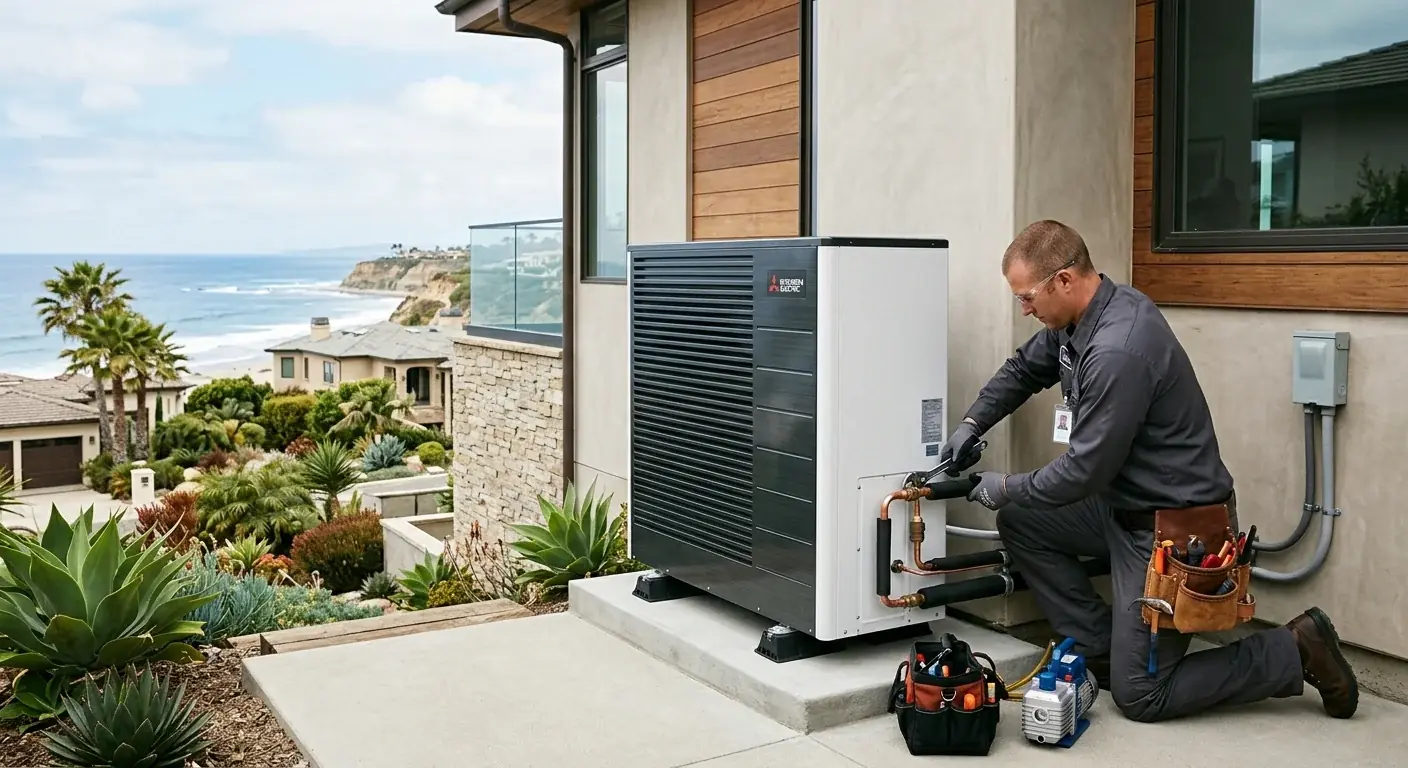
| Coastal home | Heat pump or AC with a coastal-rated coil | Coatings are a quote line, not a published add-on |
| Limited electrical panel | AC-only until an electrician prices a service upgrade | Heat pump load is an electrical question |
| Inland heavy-use home | Heat pump if the quote and runtime support it | Runtime is why efficiency matters |
Why this question changed in 2024-2026
Five years ago, many San Diego homes kept the gas furnace and swapped the AC. Heat pumps were a harder sell.
Three things changed, and one of them reversed:
- Utility and state heat-pump programs existed and then tightened. Confirm current SDG&E offerings. Golden State Rebates Program retail rebate offerings have ended. That name is specific. It is not every SDG&E program.
- Federal Section 25C. Qualifying 2025 installations may fall within the credit period. Property placed in service after December 31, 2025 does not. For qualifying 2025 property, the taxpayer must report its QMID. The IRS says the annual limit for qualified heat pumps and heat pump water heaters was $2,000. The credit is nonrefundable. Direct tax questions to a tax professional. Do not promise a current federal credit for a 2026 installation.
- TECH and HEEHRA are not a 2026 stack. TECH Clean California single-family heat pump HVAC and heat pump water heater incentives were fully reserved and stopped accepting new reservations on November 14, 2025. HEEHRA single-family rebates were fully reserved statewide as of February 24, 2026. No new single-family income-verification applications were being accepted. Existing approved reservations may continue. As of July 15, 2025, a project cannot receive both a TECH incentive and a HEEHRA rebate.
A 2026 heat pump conversion usually costs more upfront than AC-only replacement. Whether it is still the better 15-year machine is a usage and comfort question.
The real cost comparison
Ask the same licensed contractor for two itemized quotes on your house:
- Replace the AC only, keep the furnace
- Replace both functions with a heat pump (and dual-fuel if the furnace still has life)
Include equipment, labor, removal, electrical, and permit. Then subtract only programs that are actually approved for that project. Do not subtract a 25C line on a 2026 placed-in-service date. Do not subtract TECH or HEEHRA unless you already hold an approved reservation.
This site will not publish a $14,000 versus $7,400 table.
Operating cost: heat pump vs AC + gas furnace
In San Diego, a heat pump does both jobs. A higher-SEER2 heat pump can use less electricity for cooling than an older AC. Winter heating moves from gas to electricity. Whether that is cheaper depends on your rate plan, how you heat, and whether you have solar.
Current listed SDG&E residential time-of-use plans have a 4 p.m. to 9 p.m. on-peak period. Confirm rates. This page will not invent seasonal dollar totals.
DOE states actual savings from higher efficiency vary with usage.
When to keep the gas furnace and just replace the AC
Three legitimate scenarios:
1. Gas furnace is still young. Full conversion means abandoning equipment with years of life left. Dual-fuel keeps the furnace as backup while the heat pump handles cooling and most heating.
2. Electrical panel is at capacity. If the panel will not support heat-pump loads, price the service upgrade with a licensed electrician before you pick equipment. That can flip the comparison.
3. You’re moving soon. Operating-cost savings accrue over years. If you will not be there, AC-only keeps the project smaller.
When the heat pump conversion is the clear conversation
Aging furnace + aging AC. You are replacing both anyway. Combined replacement avoids two mobilizations.
All-electric home. A heat pump is far more efficient than electric resistance for the same heat.
Existing solar. Using production on site for heating and cooling is the usual NEM 3.0 logic.
You already hold an approved HEEHRA or TECH reservation. Existing approved reservations may continue. A waitlist or a submitted request is not approved funding. Recheck status before purchase. HEEHRA program design permits up to $8,000 below 80 percent AMI and up to $4,000 from 80 to 150 percent AMI for qualifying replacement of an existing primary heating source with a heat pump. Those are program caps, not currently available money. Reservations must be approved before installation. HEEHRA is not retroactive.
The most common mistakes
1. Buying the wrong size. Oversized heat pumps short-cycle and dehumidify poorly. Get a Manual J load calculation. Don’t accept a size larger than the calc says.
2. Skipping the dual-fuel option when the furnace still has life.
3. Picking the wrong thermostat. Heat pumps need thermostats configured for heat-pump operation. Wrong setup can run backup heat when it shouldn’t. See Nest vs Ecobee.
How to get an honest quote
- Both numbers from the same contractor, itemized.
- Manual J in writing. Not “we matched what you had.”
- Permit and rebate filing named. For City of San Diego, a mechanical permit is required to install, alter, replace, or repair HVAC. The matched contractor pulls it. Rebate paperwork is their process if they enroll in a live program.
See how to choose an HVAC contractor.
FAQs
Should I replace my AC with a heat pump in San Diego?
For many homes, yes as a long-term machine, especially if the furnace is also old or you have solar. Keep the gas furnace and replace AC only if the furnace is young, the panel is maxed, or you’re moving soon. Do not decide based on a 2026 federal credit. There isn’t one.
Is a heat pump cheaper than central AC in San Diego?
Usually not before incentives. Ask for both quotes. TECH single-family funds are not taking new reservations after November 14, 2025. HEEHRA single-family is fully reserved as of February 24, 2026.
Will a heat pump work in San Diego summers?
Yes. Heat pumps cool like an air conditioner. Modern inverter units modulate instead of only running flat out. NWS notes warmer inland summer days. Size for your house, not a slogan.
What about San Diego winters?
Heat pumps are built for climates much colder than typical San Diego winters. Dual-fuel is still reasonable if you already have a working furnace. Use NOAA normals for your city, not invented overnight lows.
How long does a heat pump last in San Diego?
Coastal salt air shortens outdoor-coil life versus inland. Maintenance and coatings matter. Ask the matched company for a site-specific estimate. No years table here.
Does a heat pump need a special thermostat?
Yes. It needs a thermostat configured for heat-pump operation, including auxiliary heat. Don’t leave with a misconfigured control.
Are there income-based rebates for heat pumps in San Diego?
HEEHRA single-family design used AMI tiers and dollar caps (up to $8,000 below 80% AMI, up to $4,000 from 80 to 150% AMI). Those funds were fully reserved statewide as of February 24, 2026. Do not treat a submitted request as money. See SDG&E heat pump rebate eligibility.
Can I replace just the outdoor unit with a heat pump?
Usually no. The outdoor heat pump needs a compatible indoor air handler. Most AC-only indoor coils are not the right match, and line-set sizing can differ.
Related service: AC repair.
When to call us
If you haven’t decided whether you actually need AC, start with Do You Need AC in San Diego?. If you need cooling and you’re choosing between AC replacement and heat pump conversion, we’ll match you with a licensed pro who can quote both. Call (442) 777-6440.