We install Nest and Ecobee thermostats every week in San Diego homes. Most of the tech-reviewer comparisons miss what actually matters for HVAC compatibility, and they almost never address the question that drives most installation calls: which one works better with your specific system?

Here’s the honest installer’s answer.

Side-by-side comparison of a Nest Learning Thermostat and an Ecobee Premium smart thermostat installed on a residential wall

The fast answer

Your systemBetter pickWhy
Heat pump (single or dual-fuel)Ecobee Premium or EnhancedNative heat pump support, two-stage compressor control, accessory relay for backup heat
Standard AC + furnace, no C-wireEcobee Enhanced (PEK kit included)Power Extender Kit solves the no-C-wire problem cleanly
Standard AC + furnace, has C-wireEither, slight edge to Nest 4th GenBoth work fine; Nest’s learning algorithm is genuinely better
Multi-zone home with 2+ zonesEcobeeMultiple sensors per zone, better zone-by-zone scheduling
Want native Apple HomeKit / MatterEcobeeNest dropped HomeKit support; Ecobee is Matter-native
Want best learning automationNest Learning 4th GenThe learning algorithm is the best in the category
Lowest budgetEcobee Enhanced ($189)Nest Learning runs $279+; Ecobee Enhanced has 90% of the features

What tech reviewers usually get wrong

Most Nest vs Ecobee comparisons focus on screen quality, app design, and learning features. Those matter, but they’re the secondary criteria. The primary criteria for an HVAC contractor are:

  1. Compatibility with your HVAC system. A thermostat that “almost works” with your heat pump will burn out the compressor over time.
  2. Wiring. Whether your house has a C-wire decides which models install cleanly versus which need workarounds.
  3. Multi-stage and multi-equipment support. Two-stage compressors, variable-speed blowers, dual-fuel systems all need thermostats that can actually control them properly.
  4. Sensor strategy. Where the thermostat measures temperature determines whether the whole house feels comfortable or just the hallway.

We rarely care about learning algorithms in San Diego where the cooling season is short and routines are simple. We care a lot about whether the thermostat will safely control your $8,000 HVAC investment for the next 8-10 years.

Heat pump systems. Ecobee wins, cleanly

If you have a heat pump, get an Ecobee. This isn’t close.

Nest supports heat pumps, but the implementation is awkward. Heat pump systems need specific control over auxiliary heat (the backup electric strips or gas furnace that engages when the heat pump can’t keep up), and Nest’s logic for switching to aux heat is conservative, it fires aux heat sooner than necessary, which costs you money. Ecobee gives you direct control over the temperature threshold and time delay before aux heat engages.

Heat pumps also benefit from staged operation. A two-stage compressor (low and high speed) modulates output based on demand. Ecobee handles this natively in the Enhanced and Premium models. Nest can do it but the configuration is buried and the staging logic isn’t as refined.

Finally, dual-fuel systems (heat pump + gas furnace) need balanced control between the two heat sources. Ecobee has direct settings for outdoor temperature thresholds, switching points, and staging delays. Nest tries to learn these and often gets them wrong for the first heating season.

In San Diego where heat pump adoption is growing fast due to SDG&E rebates, this is the single most important factor. See our heat pump rebate guide for context on why heat pumps make sense here.

The C-wire question (biggest install gotcha)

Smart thermostats need constant low-voltage power. They get it from a wire called the C-wire (common wire) running from the HVAC system to the thermostat location. About 60% of San Diego homes have a C-wire. The other 40%, usually homes built before 1990, don’t.

No C-wire? Ecobee wins. Ecobee Enhanced and Premium include a Power Extender Kit (PEK) that adds a C-wire signal at the HVAC equipment, no new wiring needed at the thermostat. Install is clean and reliable.

Nest’s no-C-wire approach is to “power steal”, trickle-charge off the heating/cooling wires during off cycles. This works most of the time but causes intermittent issues on certain systems: phantom heat calls, thermostat reboots, communication errors. We’ve replaced a non-trivial number of Nest installations in older homes because of power-stealing problems.

If your home doesn’t have a C-wire and you’re set on a Nest, plan to run a new C-wire (15-20 minutes if attic access is easy, 2-3 hours if not) or install a Nest Power Connector kit. Either adds cost and labor.

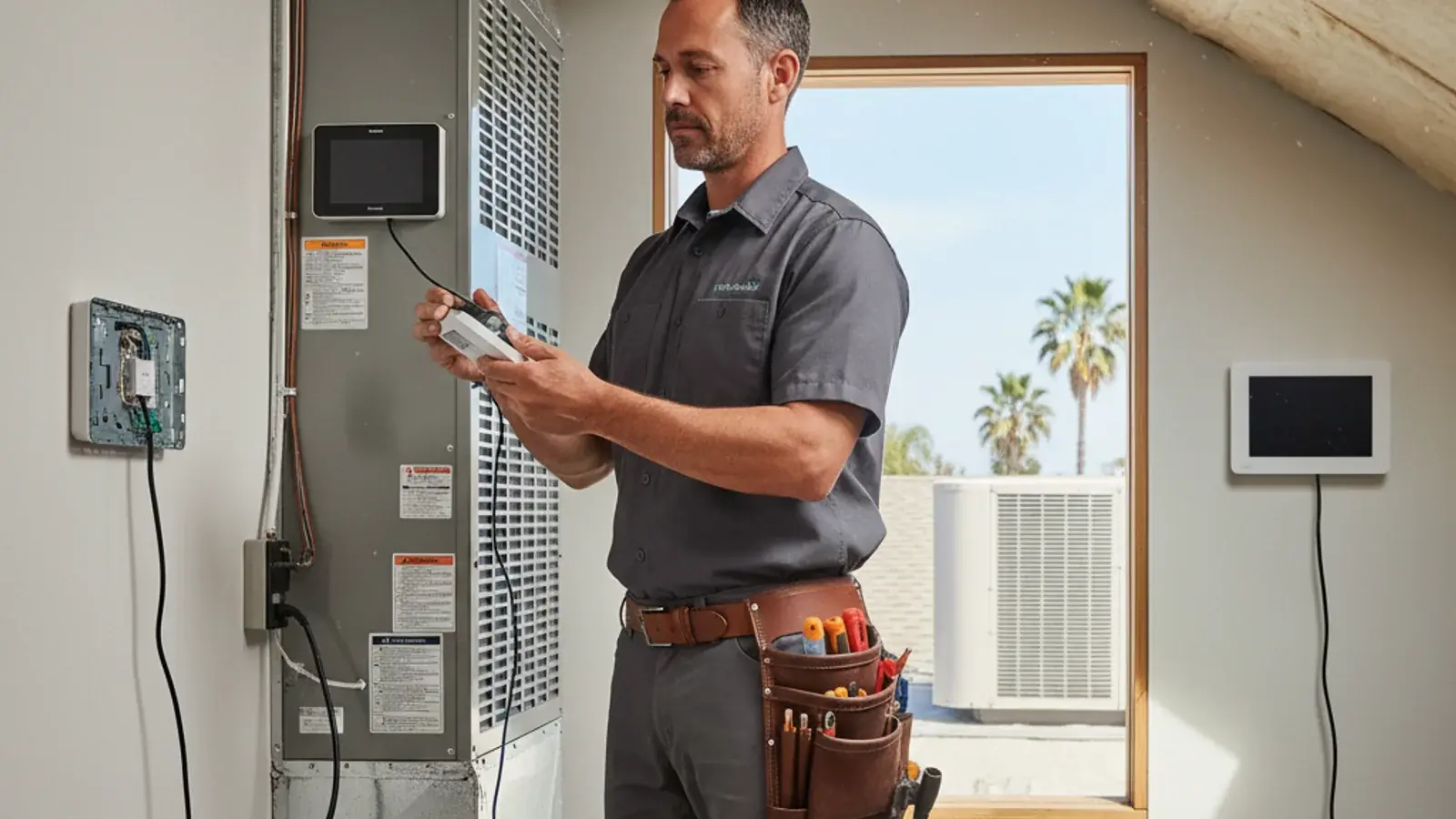
HVAC technician installing a smart thermostat with C-wire connection on a residential wall

Multi-zone and multi-sensor. Ecobee’s strength

Most San Diego homes are single-zone. But if you have a multi-zone system (separate thermostats for upstairs/downstairs, or for different wings), Ecobee handles it noticeably better.

The Ecobee SmartSensor lineup is the real differentiator. You can place sensors in any room and have the thermostat average temperatures across active rooms, prioritize specific rooms during sleep hours, or detect occupancy room-by-room. Nest’s remote sensors are clunkier and don’t integrate as smoothly.

For homes with hot bedrooms (common in two-story SD homes with the main thermostat downstairs), Ecobee sensors solve the comfort problem without rewiring the HVAC system. A $40 sensor in the master bedroom plus a “follow this room at night” schedule beats $6,000 of duct redesign.

Where Nest wins

Three places Nest is genuinely better:

Learning algorithm. Nest’s auto-schedule actually works. After 2-3 weeks of manual adjustments, the system builds an effective schedule you can leave alone. Ecobee has a similar feature but it’s less polished. If you want set-and-forget, Nest delivers it more reliably.

Design and screen. Nest’s circular dial and high-resolution display are nicer to use day-to-day. Ecobee’s interface is functional but less elegant. For a thermostat that lives in your hallway for 8-10 years, this matters.

Google Home integration. If your smart home is built around Google Home (Nest cameras, Nest doorbell, Google speakers), Nest integrates seamlessly. Ecobee works with Google but isn’t as tight.

Solar + time-of-use rate optimization. Nest has a “Savings Finder” feature that can detect San Diego’s SDG&E time-of-use rate structure and shift cooling to off-peak hours automatically. Ecobee can do this too but requires more setup.

Pricing in San Diego 2026

ModelList priceTypical installed cost in SD
Nest Learning Thermostat (4th gen)$279$379-$479
Nest Thermostat (basic)$129$229-$299
Ecobee Premium$249$349-$449
Ecobee Enhanced (with PEK)$189$289-$389

Installation cost includes labor (45-90 minutes), C-wire installation if needed, system configuration, and app setup. Most San Diego HVAC contractors charge $100-$150 for installation alone if you provide the thermostat.

The recommendation, by situation

If you have a heat pump or dual-fuel system: Ecobee Premium. Not optional. The heat pump controls actually matter.

If you have standard AC + furnace, no C-wire: Ecobee Enhanced. The included PEK saves a service call.

If you have standard AC + furnace, has C-wire, want best learning: Nest Learning 4th Gen.

If you have multi-zone or want room-by-room sensors: Ecobee, every time.

If you’re deep in the Google smart home ecosystem: Nest.

If you’re deep in the Apple HomeKit ecosystem: Ecobee (Nest dropped HomeKit support years ago).

What gets installed wrong most often

We see three install mistakes constantly when we replace homeowner-installed smart thermostats:

  1. Wrong heat pump configuration. Owner sets up as conventional AC + furnace because they don’t know the system is a heat pump. Result: backup heat runs constantly, heat pump efficiency disappears.
  2. Missing or weak C-wire on Nest. Power-stealing works for 6 months then starts causing problems. Phantom calls, system shutting off mid-cycle.
  3. No sensor strategy. Single thermostat in the hallway averages a comfortable space while bedrooms swing 5-10 degrees off setpoint. Adding sensors fixes it.

Most of these are 30-minute fixes during a regular tune-up if you catch them.

FAQs

Which is better, Nest or Ecobee?

For heat pumps, Ecobee. For multi-zone homes, Ecobee. For homes without a C-wire, Ecobee. For standard single-zone AC + furnace with a C-wire and you want best learning, Nest. They’re both good thermostats; they win at different things.

Does Ecobee work with HomeKit?

Yes, natively, and Ecobee is Matter-native too. Nest dropped HomeKit support several years ago.

Do I need a C-wire for a Nest thermostat?

Nest will work without one through power-stealing, but reliability is mixed and we see intermittent issues on older systems. Ecobee Enhanced and Premium include a Power Extender Kit that solves the no-C-wire problem cleanly.

Which is better for a heat pump, Nest or Ecobee?

Ecobee. The heat pump control logic, dual-fuel handling, and auxiliary heat thresholds are all configurable and better-tuned. Nest works with heat pumps but the auxiliary heat behavior runs your backup strips more than necessary, which costs money.

Can I install a smart thermostat myself?

For a simple single-stage AC + furnace with a C-wire, yes, both Nest and Ecobee have decent install guides. For heat pumps, dual-fuel, multi-stage compressors, or no C-wire, get a pro. Wiring a thermostat wrong can damage the HVAC system, and HVAC repair is expensive.

How long does a smart thermostat last?

Both Nest and Ecobee average 8-12 years before the screen, battery, or wireless radio fails. Older units start losing app connectivity as the underlying tech stack moves forward. Plan to replace every 8-10 years.

Are smart thermostats worth it in San Diego?

Yes, but the savings come from scheduling rather than learning. A simple schedule that sets back the temperature during work hours and overnight saves 10-15% on SDG&E. Smart features add another 3-7%. For a $300 installed cost, payback runs 2-4 years depending on usage.

When to call us

If you’re not sure whether you have a heat pump, whether you have a C-wire, or which model fits your system, the diagnosis is a 5-minute call. Call (442) 777-6440 or check our smart thermostat installation guide for our standard install process.