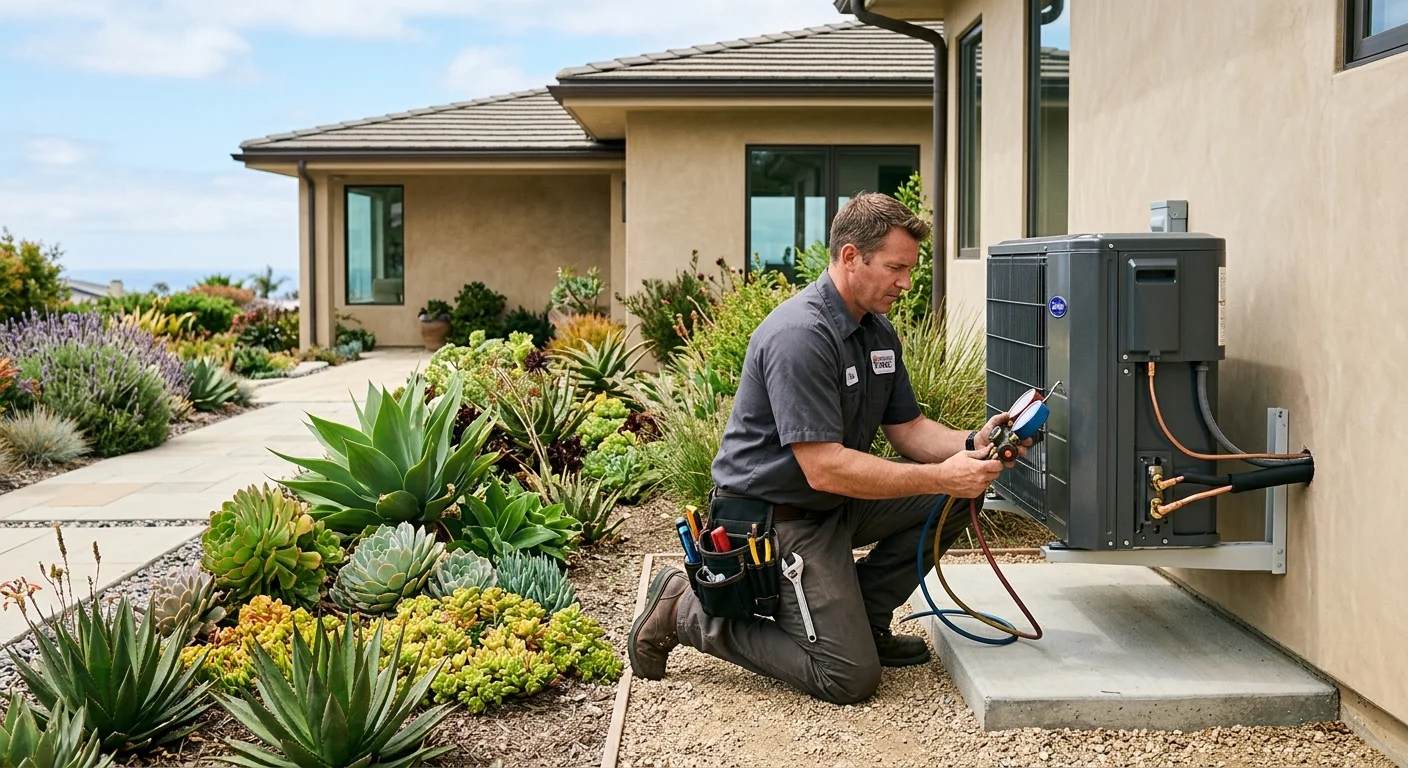
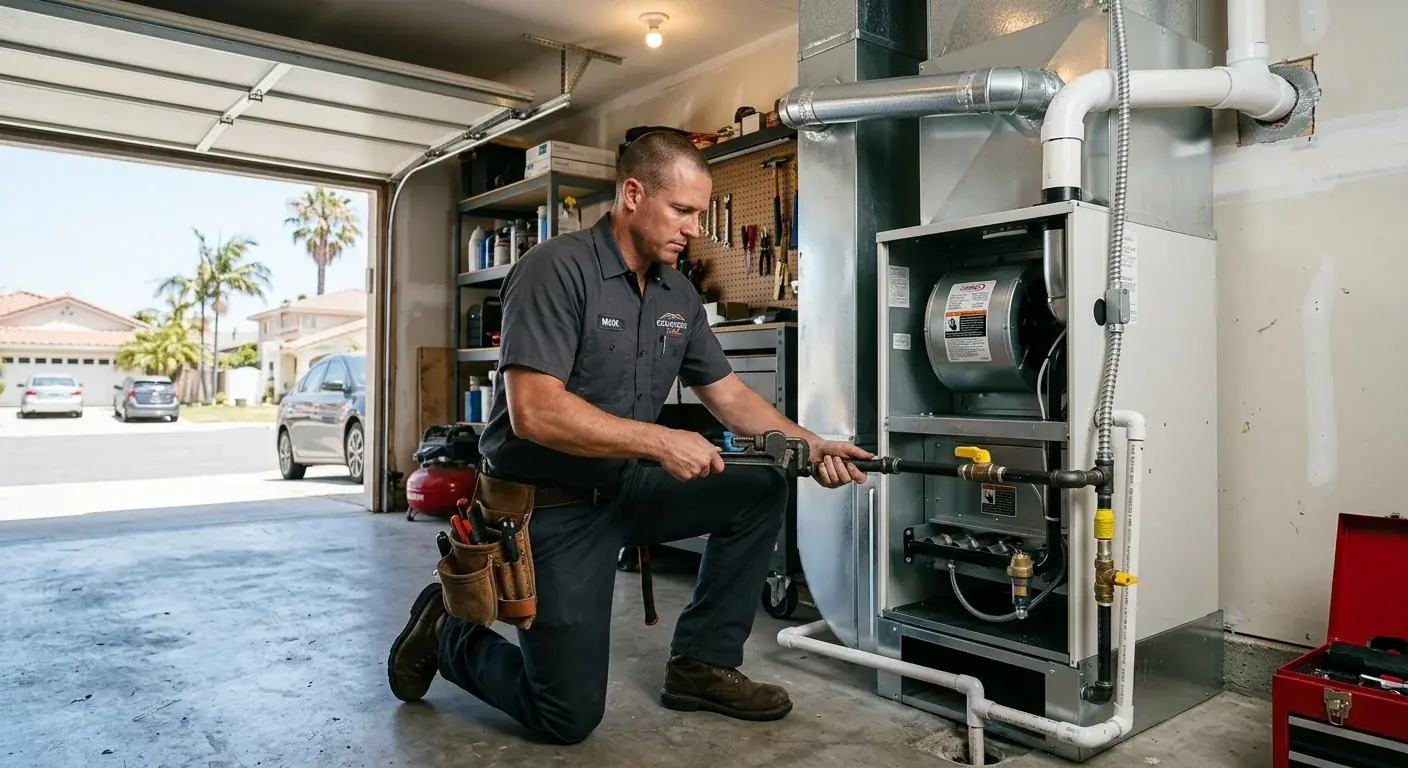
Yes. For almost every San Diego home, HVAC maintenance is worth the cost. The math is one-sided: $200 a year prevents $400-$3,000 in repairs on average, cuts your cooling bill 5-15%, adds 3-5 years of useful system life, and protects the manufacturer warranty coverage on your most expensive components. The only way it doesn’t pay back is if the “maintenance” you’re buying is fake.
Here’s the actual cost-benefit data, plus how to tell the difference between real maintenance and a sales-call dressed as one.
The fast answer
| Scenario | Annual maintenance | No maintenance | Net effect |
|---|---|---|---|
| Cost per year | $179-$249 | $0 | Maintenance: -$200 |
| Avoided emergency repair (capacitor caught early) | $0 | $400-$600 every 2-3 years | Avg savings: $200/year |
| Avoided refrigerant leak damage | $0 | $1,500-$3,000 if missed | Avg savings: $150/year |
| Avoided compressor replacement (from running on weak parts) | $0 | $3,500-$6,000 risk | Avg savings: $400/year |
| System lifespan | 14-18 years | 10-13 years | 3-5 extra years of $7,000+ value |
| Manufacturer warranty | Honored | Often voided | Coverage on $2,000-$5,000 in parts |
| Net ROI | $200 invested | $750-$1,500/year cost | 3-7x return on maintenance |
These are average outcomes. Some homes never need any of those repairs. Others need all of them. Maintenance shifts the odds heavily toward the “never needs them” outcome.
The math, in detail
Let’s price out the alternatives over a 15-year system life:
With annual maintenance:
- 15 maintenance visits × $200 = $3,000
- 2-3 minor repairs caught at maintenance = $600-$900
- System lasts the full 15 years, sometimes longer
- Total cost of ownership: $3,600-$3,900 over 15 years
Without maintenance:
- $0 in maintenance
- 4-6 emergency repair calls × $400-$800 = $1,600-$4,800
- 1-2 major repairs (refrigerant leak, motor) × $1,200-$2,500 = $1,200-$5,000
- System dies at 10-12 years instead of 15-18 = early replacement cost premium
- Increased operating cost from running degraded equipment = $50-$150/year × 8-10 years = $400-$1,500
- Total cost of ownership: $3,200-$11,300 over 12 years (plus early replacement)
The downside scenarios on the no-maintenance path get much worse, and the loss includes the value of the equipment dying years earlier than necessary.
Lifespan by equipment type
The lifespan gain isn’t the same for every system. Here’s the maintained-versus-neglected spread by component, with the San Diego coastal note that national guides leave out.
| Equipment | With maintenance | Neglected | SD coastal adjustment |
|---|---|---|---|
| Central AC condenser | 15-20 years | 10-14 years | Subtract 2-4 years within 1 mile of the coast |
| Gas furnace | 18-25 years | 12-18 years | Less affected by salt air |
| Heat pump | 12-17 years | 8-12 years | Runs year-round, so wear is higher |
| Air handler / blower | 15-20 years | 10-14 years | Coastal humidity speeds bearing wear |
A neglected system loses roughly 5% efficiency per year, so it’s burning more SDG&E power every season while it heads toward an early death. The lifespan column is where most of the dollar value sits: a system that dies at year 11 instead of year 17 forces a $7,000-$12,000 replacement six years sooner than it had to happen.
What real maintenance covers
A real annual visit measures, doesn’t just clean. Here’s what should happen:
Refrigerant charge measured by superheat and subcooling (not just pressure). A 5% undercharge cuts efficiency 10-15%. Catching it early avoids both energy waste and compressor damage.
Capacitor microfarads measured. Capacitors weaken over years before they fail completely. Replacing one at 85% of rated value during maintenance is $200; replacing one after it kills the compressor is $3,500.
Static pressure across the air handler. Diagnoses ductwork restrictions, filter sizing problems, blower issues. Most homes are running outside the design spec; nobody ever measures.
Temperature split across the coil. Tells you the system is moving heat correctly. Drift indicates refrigerant, airflow, or coil problems.
Amp draw on compressor and fans. Rising amps predict motor failure 6-18 months out.
Electrical connection inspection. Loose lugs and burned terminals are common in older systems and easy to fix during maintenance.
Drain line and condensate pan check. Cleared, treated, float switch tested. A clogged drain on a hot summer day floods your air handler.
Combustion analysis (gas furnace). CO levels, flame quality, gas pressure. Catches a cracking heat exchanger before it dumps CO into your living space.
Heat exchanger visual inspection. Cracks kill people. A trained tech with a borescope catches them early.
A visit that doesn’t include most of this is a sales call, not maintenance. We cover the full 21-point spec on our HVAC maintenance service page.
The warranty argument
Most manufacturers. Carrier, Trane, Lennox, American Standard, Goodman, Rheem, require documented annual maintenance to honor the parts warranty on major components. Skip a year and the 10-year compressor warranty becomes worthless.
When a compressor fails out of warranty at year 8 because you skipped maintenance, that’s a $3,500-$6,000 hit. The “I saved $200 on maintenance” argument disappears immediately.
Manufacturers police this seriously. If you file a warranty claim, the first thing they ask for is maintenance records. No records, no coverage.
The energy-bill math at SDG&E rates
San Diego has some of the highest electricity rates in the country, so the efficiency argument carries more weight here than almost anywhere else. SDG&E residential rates run roughly $0.40 to $0.50 per kilowatt-hour on the higher tiers, two to three times the national average. Every percent of lost AC efficiency costs you real money on this grid.
A neglected system loses 5-15% efficiency. Dirty coils, a slightly low refrigerant charge, and a clogged filter each shave a few points, and they stack. On a coastal home running light AC, that might be $80 a year. On an inland home in Escondido, El Cajon, or Santee that runs the AC hard from June through September, the same efficiency loss can cost $200-$350 a year in extra SDG&E charges alone.
Run the numbers and a single maintenance visit often pays for itself on the power bill before you count a single avoided repair. That’s the part the national pricing guides miss: at California rates, the energy savings alone can cover the cost of the visit. We go deeper on this in our guide to lowering your AC bill in San Diego summer.
One more local wrinkle: Title 24, California’s energy code, requires a refrigerant charge and airflow verification when you install or alter a system. A maintenance visit that actually measures superheat and subcooling keeps you in line with what the code already expects, instead of running an out-of-spec system for years.
The coastal-air problem nobody prices in
Most maintenance articles treat the country as one climate. San Diego isn’t. The marine layer that keeps the coast comfortable is also salt-laden, and salt eats outdoor condensers. Homes in Encinitas, Carlsbad, Del Mar, and along the Oceanside coast see fin corrosion, contactor pitting, and cabinet rust years before inland systems do.
That changes the maintenance math two ways. Coastal condenser coils need rinsing and corrosion checks more often, which is why we push coastal homes toward a twice-yearly cadence. And a corroded contactor or pitted electrical connection caught at a tune-up is a $150 fix; missed, it’s a failed start on the first hot day and an emergency call.
There’s an air-quality side too. The same coastal humidity that corrodes metal also feeds mold on a dirty evaporator coil and in a clogged condensate pan. A maintenance visit that clears and treats the drain line and checks the coil keeps that moisture from turning into the musty smell and allergens you breathe all summer. If indoor air quality is the bigger concern for your household, our San Diego indoor air quality guide covers the filter and ventilation side, and the HVAC filter and MERV rating guide explains which filter actually fits your system.
Inland homes have the opposite problem. Santa Ana heat events push systems to their limit, so a weak capacitor or low charge that a coastal home tolerates will fail an inland system on the hottest afternoon of the year. Maintenance timing matters more inland, which is why spring is non-negotiable east of the 5.
When maintenance doesn’t pay back
Three situations where the cost-benefit math gets murky:
1. System is in its last 1-3 years anyway. A 16-year-old system that’s clearly headed for replacement next year doesn’t need a comprehensive tune-up. A basic filter change and visual check is enough. Save the $200.
2. You can do the basics yourself reliably. Some homeowners are mechanically capable enough to do filter changes, coil rinses, drain line clearance, and visual inspections themselves. That doesn’t replace professional measurement of refrigerant charge and electrical components, but it covers some of the value. Real cost savings: $50-$100/year, not the full $200.
3. You’re getting fake maintenance. A “tune-up” that’s 20 minutes of vacuuming the outdoor unit and changing the filter is not maintenance. You’re paying $200 for a sales pitch. In that case, the real call is to find a different contractor, not to skip maintenance entirely.
How to tell real maintenance from fake
Three checks:
1. Ask for written measurements. Real maintenance produces a written report with specific values: refrigerant charge, capacitor microfarads, static pressure, temperature split, amp draw. Vague “we cleaned and inspected” notes are a sales call.
2. Time on site. A real 21-point maintenance visit takes 75-120 minutes. A 20-minute visit is fake. Watch the truck.
3. Recommended repairs that match measurements. A tech who recommends a $400 capacitor replacement should be able to show you the reading: “Your capacitor is reading 24 microfarads on a 35-microfarad rated part. That’s 31% under spec.” Recommendations without measurements are sales scripts.
What it costs in San Diego (real 2026 prices)
| Service | Typical 2026 cost |
|---|---|
| Single annual maintenance visit | $149-$249 |
| Annual maintenance plan (1 visit/year) | $179-$249/year |
| Bi-annual plan (2 visits/year, spring + fall) | $249-$349/year |
| Multi-system plan (AC + furnace separate) | Add ~$80/year per extra system |
| Heat pump plan (always twice yearly) | $269-$369/year |
Most maintenance plans include 10-15% discount on repairs, priority scheduling during heat events, and waived diagnostic fees on the system covered. For typical SD homes, the plan pays for itself the first time you avoid an emergency call.
If you’d rather pay for individual tasks instead of a bundled visit, here’s what each piece runs in San Diego in 2026. A real annual visit covers most of these for less than buying them one at a time.
| Individual task | Typical 2026 SD cost |
|---|---|
| Refrigerant charge check and top-off | $150-$450 |
| Coil cleaning (evaporator or condenser) | $150-$300 |
| Condensate drain line clearing | $75-$200 |
| Capacitor replacement | $150-$400 |
| Blower motor cleaning and amp test | $80-$150 |
| Combustion analysis (gas furnace) | $90-$200 |
| Filter replacement (per filter) | $5-$40 |
Buying these separately after something fails costs more than catching them at one $200 visit. That’s the whole argument: maintenance is cheap because it’s scheduled, and repairs are expensive because they’re not.
San Diego-specific timing and patterns
Spring maintenance (March-May) is the priority for AC-only homes. Catches the issues that surface in summer heat.
Fall maintenance (October-November) is essential for furnaces, especially for combustion analysis. CO risks are season-specific.
Bi-annual is the right cadence for coastal homes (salt-air corrosion), heat pumps (year-round use), and inland homes with heavy summer use (Escondido, El Cajon, Santee).
Single annual visit is enough for mid-county homes with light AC use, gas furnace only homes that rarely run, and any system under 5 years old in a low-corrosion area.
For more on cadence and what’s covered, see our how often should HVAC be serviced guide.
FAQs
Is HVAC maintenance worth the money?
For almost every San Diego home, yes. $200/year of real maintenance prevents $400-$3,000 in average annual repair risk, adds 3-5 years of system life, and preserves warranty coverage on $2,000-$5,000 in major components. The ROI runs 3-7x for typical scenarios.
What is included in HVAC maintenance?
A real 21-point visit measures refrigerant charge, capacitor microfarads, static pressure, temperature split, and amp draw, plus inspects electrical connections, drain line, blower motor, coils, combustion (for gas furnaces), and heat exchanger. Takes 75-120 minutes.
How much does HVAC maintenance cost in San Diego?
$149-$249 per single visit. $179-$249/year for an annual plan. $249-$349/year for bi-annual. Heat pump plans (always twice yearly): $269-$369/year. Most plans include repair discounts and priority scheduling.
Do I really need an annual tune-up?
For most San Diego homes, yes. Some homes can stretch to every 18 months if the system is new and use is light. But skipping years routinely usually shortens system life and voids warranty coverage on major components.
What happens if I never get my HVAC serviced?
The system runs but loses efficiency gradually (5-10% per year), develops issues that go undiagnosed until they cause breakdowns, and almost always fails 3-5 years earlier than properly maintained equipment. You also lose warranty coverage on major component failures.
Can I do HVAC maintenance myself?
You can do filter changes, outdoor coil rinses, condensate drain checks, and visual inspections, about 20-30% of what professional maintenance covers. The part you can’t easily DIY (refrigerant measurement, electrical testing, combustion analysis) is the part that catches the expensive failures.
Are HVAC maintenance plans worth it?
For homes with one system: marginally. The plan saves $20-$40 vs paying per visit, plus priority scheduling. For homes with multiple systems or heat pumps requiring twice-yearly service: clearly yes. The plan economics get better the more equipment you cover.
How long does an HVAC system last with regular maintenance?
14-18 years in San Diego with consistent maintenance, vs 10-13 years without. Coastal homes see shorter lifespans due to salt-air corrosion regardless of maintenance, but maintenance still adds 2-4 years to the coastal-home baseline.
Does HVAC maintenance actually lower my energy bill?
Yes, and it matters more in San Diego because SDG&E rates are among the highest in the country. A maintained system runs 5-15% more efficiently. On an inland home running heavy summer AC, that’s $200-$350 a year in avoided charges, often enough to cover the maintenance visit on the power bill alone.
Do coastal San Diego homes need more maintenance?
Yes. Salt air corrodes condenser coils, contactors, and electrical connections faster on the coast. Homes in Encinitas, Carlsbad, Del Mar, and Oceanside benefit from twice-yearly visits to catch corrosion early and keep the system from failing on the first hot day.
When to call us
If you haven’t had a real maintenance visit in over a year, schedule one before summer hits. Call (442) 777-6440 or read more about our 21-point process on the HVAC maintenance service page.