A San Diego summer bill often rises when cooling hours rise. The National Weather Service describes milder ocean-side weather and warmer inland valley days. That helps explain different runtime, not a typical household total.
Use the formula in cost to run AC per month. This page ranks actions by how directly they change load or when you buy electricity. It does not publish dollar or percent savings.
What should you try first at no extra equipment cost?
1. Test a slightly warmer occupied setpoint
Comfort comes first. SDG&E suggests precooling earlier, then 78°F or higher from 4 to 9 p.m., health permitting. That is conservation guidance, not a medical rule. The CDC tells older adults to use air-conditioned space in hot weather and not to treat a fan as the main cooling source when it is very hot.
Compare similar-weather days on your bill after a small change. A one-degree change is not a fixed percent of the whole bill.
2. Close blinds on sun-facing glass in the afternoon
West glass is a common afternoon load. Closing blinds costs nothing. It does not replace a system that cannot keep up.
3. Use ceiling fans only in occupied rooms
Fans move air across people. Turn them off in empty rooms. They are not a substitute for AC when heat risk is high.
4. Confirm whether you are on a time-of-use plan
Listed SDG&E residential time-of-use plans use a 4 p.m. to 9 p.m. on-peak period. Check current plans. CCA customers pay delivery plus CCA generation. Displayed energy prices exclude the Base Services Charge. Run SDG&E’s own tools before you switch plans. This page does not invent a monthly TOU savings figure.
What low-cost habits help the equipment?
5. Put occupancy into the thermostat schedule
Let empty hours run warmer if pets, plants, and people can tolerate it. Precool before 4 p.m. only if the house actually holds that cool-through. A house that reheats fast may still need cooling during peak. See Nest vs Ecobee for model questions, not payback claims.
6. Add shade where west sun hits glass
Interior blinds, film, or exterior shade are contractor or DIY choices. Ask for those prices in dollars. Inland homes in places such as Escondido often see more cooling hours. That is not a 2-year payback promise.
7. Change filters on the interval the equipment specifies
A dirty filter can raise fan work and cut airflow. Follow the printed interval, especially in heavy cooling months. This site does not publish a 5 to 15 percent energy penalty.
What should a licensed visit cover?
8. Ask for a cooling-season inspection
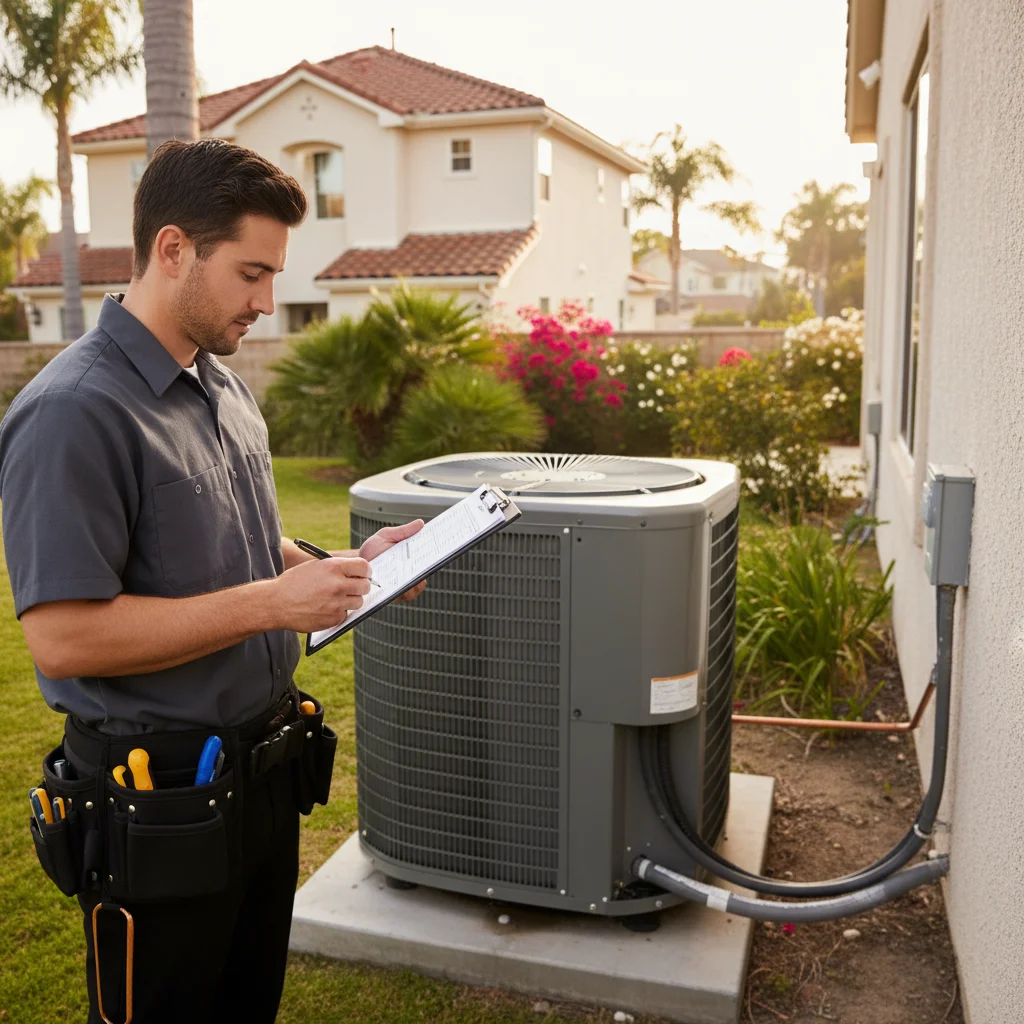
Ask the matched company to measure, not just glance: coil condition, electrical parts, refrigerant indications if they are licensed for that work, and airflow. Ask for the visit fee in dollars. See whether maintenance is worth it for the decision questions, not a guaranteed ROI.
9. Ask whether ducts leak
ENERGY STAR says a typical forced-air house can lose about 20 to 30 percent of the air moving through ducts to leaks. That is a national typical-house statement. ENERGY STAR. EPA does not recommend routine duct cleaning on a calendar; cleaning is as needed. EPA. Sealing and cleaning are different jobs. Neither guarantees a bill result.
When does larger work enter the conversation?
10. Replacement equipment
SEER2 compares rated seasonal efficiency. DOE says actual savings vary with use. DOE. Ask for a model of the proposed system against your measured baseline. Climate Pros SD does not publish installed price bands. Incentive status is separate: see California HVAC rebates in 2026.
11. Attic insulation or roof-side heat control
A hot roof over bedrooms raises the cooling load. A licensed insulator or roofer speaks to that scope. HVAC work does not automatically include it.
12. Night ventilation equipment
A whole-house fan only helps when outdoor air is cooler than indoor air and outdoor air quality is acceptable. That pattern is more common inland on some evenings. It is not a published 10 to 20 degree drop for every house.
What is not a proven bill tactic on this page?
Do not count on winter AC covers, add-on ionizer gadgets, or a percent-per-degree rule copied from an old article. Compare your own kWh instead.
AC is often the swing in a summer bill. It is not the whole bill. Check plan, CCA status, and other loads too.
FAQs
What temperature should I set my AC in San Diego summer?
Use a setting people can live with. SDG&E’s 78°F-or-higher 4 to 9 p.m. note is health-permitting conservation guidance. See what temperature to set.
Does cycling the AC cost more than leaving it at one setpoint?
Compare runtime and kWh on similar days. This page does not publish a 10 to 15 percent programmable-thermostat saving.
When is the cheaper window to use AC under SDG&E TOU?
Outside your plan’s on-peak period, which is 4 to 9 p.m. on listed residential TOU plans. Confirm on your bill.
How can I stay cooler without extra compressor hours?
Shade, fans in occupied rooms when heat is not extreme, and evening air only when outdoor conditions are actually cooler and safe.
Does closing vents in unused rooms save money?
Usually it is a poor airflow idea. See closing vents.
Why is my SDG&E bill so high in summer?
Cooling hours, on-peak timing, and the rest of the household load. Walk through why the bill looks high.
Related services: HVAC maintenance and AC repair.
Climate Pros SD is a referral service. Call (442) 777-6440 to be matched with a licensed independent HVAC professional. Ask for fees in dollars.