No. Closing vents in unused rooms does not save energy in a typical forced-air system. It raises static pressure inside the ductwork, makes the blower work harder, stresses the compressor, and pushes conditioned air out through duct leaks instead of into the rooms you actually use. The right answer is usually duct zoning or a separate mini-split, not a closed register.
Climate Pros SD matches you with licensed HVAC companies. We do not set prices or promise bill savings. Ask for the diagnostic or static-pressure fee in dollars.
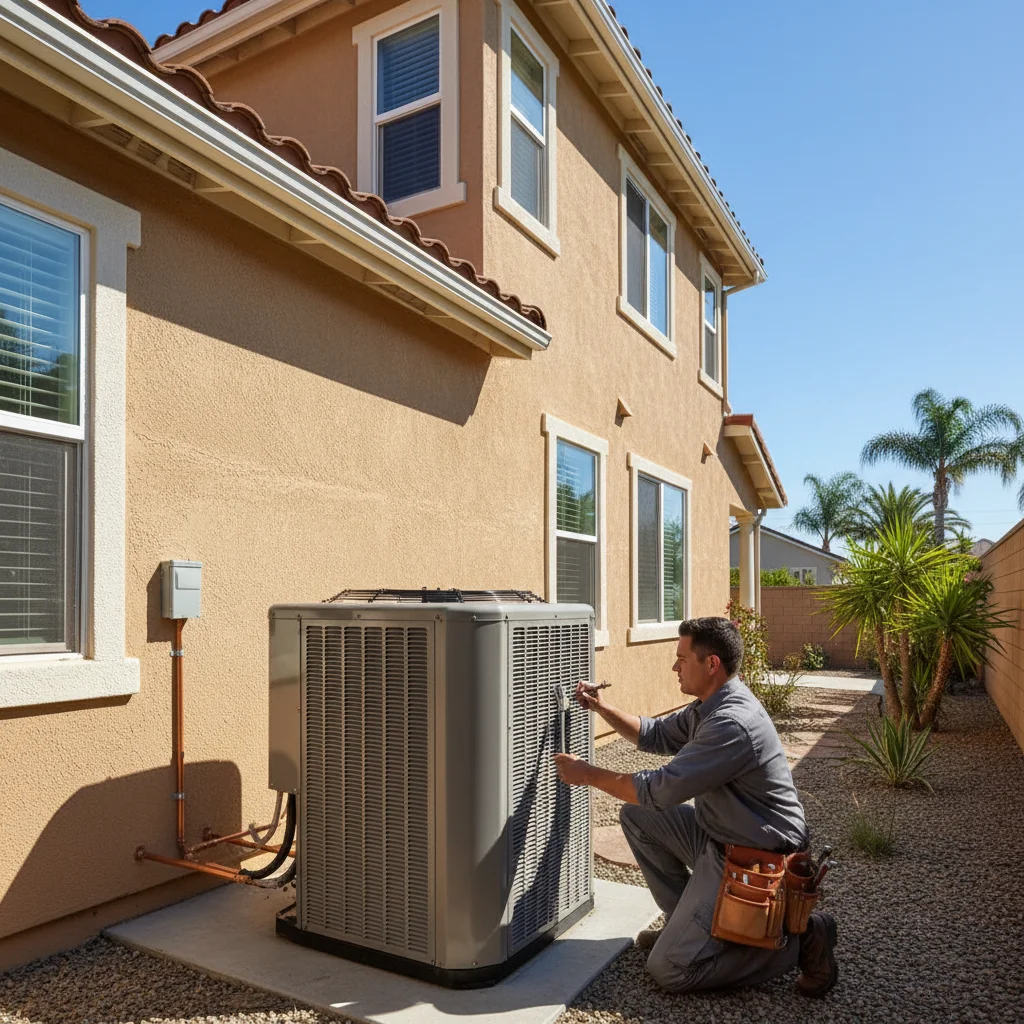
Why closing vents backfires (the static pressure problem)
A central AC or heat pump is a sealed loop. The blower is sized to move a specific volume of air across the indoor coil. When you close a large share of the supply registers, the air has fewer exit paths but the blower still tries to push the same volume. Static pressure inside the supply trunk rises, and three things start happening at once.
First, the indoor evaporator coil can get too cold. Less airflow across the coil means less heat absorbed from the room air, so coil temperature can drop below freezing. Refrigerant can come back to the compressor as a liquid instead of a gas. Liquid refrigerant does not compress. That slugging is a fast way to damage a compressor.
Second, the blower motor draws more amps to push against the higher resistance. ECM blowers may speed up, which uses more electricity. PSC blowers (still common in San Diego homes built before 2010) can overheat and shorten bearings. Either way the energy math goes the wrong direction.
Third, every duct seam, joint, and boot that was not sealed perfectly starts leaking harder. ENERGY STAR says a typical forced-air house can lose about 20% to 30% of the air moving through ducts because of leaks, holes, and poorly connected ducts. That is a national typical-house statement, not a measured leakage rate for your attic. Raise the pressure and leakage gets worse. The cool air you thought you were saving vents into a hot attic.
This page does not publish a 2026 repair-cost table for frozen coils, blower motors, compressors, or early replacement. Ask the matched company to name the failure and quote it.
Why this is worse in San Diego than in many other markets
San Diego AC systems are often sized tightly because designers assumed marine-layer afternoons. Inland homes can still run hard. NWS describes ocean moderation near San Diego and warmer summer days in nearby valleys. A system already near capacity on a hot inland afternoon cannot absorb the static-pressure penalty of closed vents.
Ducts in San Diego attics also sit in very hot air in summer. Any leak driven by elevated static pressure dumps conditioned air into that space, which is expensive air to make. SDG&E residential plans can price electricity by time of use, with a 4 p.m. to 9 p.m. on-peak period on current listed plans. Confirm your plan on sdge.com. Do not treat a closed vent as a bill-cut strategy.
Coastal systems in Encinitas, Carlsbad, Coronado, La Jolla, and Imperial Beach already deal with salt-air corrosion. Adding compressor stress on top of that is a reason to stop closing vents, not a published years-of-life penalty.

How much can you safely close?
If you only ease one register in a multi-register system and you do not fully shut it, the pressure spike stays smaller. Beyond that, you are gambling on the weakest joint in the ducts.
A practical limit: do not close most of the supply registers in a single-zone home, and do not fully seal any of them. If you need more control than that, the answer is zoning.
Zoning is the real solution
Duct zoning splits the house into independently controlled areas with motorized dampers in the supply trunks and a separate thermostat for each zone. When a zone calls for cooling, only that zone’s dampers open. The system also needs a bypass damper or a variable-speed blower so airflow does not dead-end into closed dampers.
Ask for a 2-zone or 3-zone retrofit quote in dollars. Climate Pros SD does not publish those bands. The full comfort discussion is in HVAC zoning systems for San Diego homes.
Zoning pays back through real reductions in runtime in the unused part of the house, not by tricking the blower. Common San Diego cases:
- A two-story home where the upstairs runs much hotter than downstairs in summer
- A single-story home with an unused guest suite or office wing
- A house with a west-facing room that bakes in the afternoon
- An ADU or converted garage with different occupancy
A ductless mini-split is the other clean answer for a single unused room. Adding a head to a sunroom, garage conversion, or studio decouples that room from the main system. See mini-split vs central AC.
Decision framework
- One room, occasionally unused. Close the damper partway. Do not seal it. Open it before a heat wave.
- One room, permanently unused. Close partway, then plan zoning or a mini-split. Do not seal completely.
- Multiple rooms, different schedules. Get a zoning quote. Closing vents will stress the equipment.
- A whole separate area (ADU, garage conversion, office wing). Get a mini-split quote.
- You are trying to lower a high SDG&E bill. Do not close vents. See lowering your SDG&E AC bill in San Diego summer. SDG&E suggests precooling earlier in the day, then setting the thermostat to 78F or higher from 4-9 p.m., health permitting. That is utility guidance, not a guaranteed savings figure.
Frequently asked questions
Is it ever okay to close a vent fully?
In a small forced-air system, no. If you need a room sealed off, install a motorized damper on a zone controller, or add a mini-split and keep the central system out of that room.
What about closing the floor register in a basement or crawlspace?
San Diego homes mostly do not have basements. For the rare ones (parts of Mission Hills, Hillcrest, North Park, La Jolla), keep some basement vents open. Closing all of them changes return-air balance and can starve upstairs supply.
Does this apply to mini-split systems?
No. Ductless mini-splits do not have shared ductwork or a central blower fighting closed registers. You can turn off the head in an unused room without a static-pressure penalty.
My HVAC installer told me to close vents in unused rooms. Why?
Two possibilities. They are working from old single-speed habits. Or the system is oversized and they are using vent closures to mask short-cycling. If it is the second one, the right fix is proper sizing, not duct restriction. See how to choose an HVAC contractor in San Diego.
Will closing vents in winter for heating hurt the same way?
Yes, with the same mechanism. Gas furnaces care about static pressure too. High-efficiency furnaces have tighter airflow tolerances. Closing vents can trip limit switches and show up as short-cycling. See why won’t my furnace ignite.
How do I tell if vent-closing has already hurt my system?
Listen for the blower struggling, check for ice on the refrigerant line at the outdoor unit on a hot afternoon, and look for unexplained SDG&E bill jumps in the cooling season. A static-pressure measurement at the supply trunk by a tech with a manometer is the definitive check. Ask for that fee in dollars. This page does not publish a “too high” dollar cost or a universal inches-of-water cutoff as a brand spec.
Want a static-pressure check before the next heat wave?
If you have been closing vents and the system is not new, ask a licensed pro to measure static pressure and say whether zoning or a duct repair is the next move. Climate Pros SD matches you with licensed independent HVAC professionals. Call (442) 777-6440.
Related services: AC repair, AC installation and HVAC maintenance.