TL;DR

  • AC systems in Escondido run 30-50% more hours per summer than coastal North County units. Spring tune-up isn’t optional here, it’s the difference between a $99 maintenance visit and a $1,500 August repair.
  • A real 21-point tune-up takes 75-90 minutes with written measurements. Expect to pay $99-$249. The $39-$79 “specials” are upsell vehicles, not maintenance.
  • The two items that matter most in Escondido specifically: condenser coil flush (ag dust loads up coils faster here) and capacitor microfarad readings (heat degrades capacitors faster).
  • Book by mid-April. Once the first 95°F day hits Escondido, repair calls take priority and tune-up slots disappear.

AC maintenance in Escondido, CA means a real 21-point spring tune-up: 75-90 minutes of written measurements and cleaning, priced $99-$249 for a single system. Book it by mid-April, before the first 95°F valley day. Escondido units run nearly double the hours of coastal Carlsbad, so a thorough tune-up here is the difference between a $99 visit and a $1,500 August repair.

Why does Escondido work an AC so hard? Coastal Carlsbad sits in marine layer most of the summer. Escondido sits in a valley that traps heat, blocks ocean breeze, and bakes condenser units in 100°F afternoons for three to four months a year. That extra workload turns small problems into expensive ones fast. A spring tune-up catches the small problems while they’re still small.

Here’s what a real AC maintenance visit looks like in 92025, 92026, 92027, and 92029, what it should cost, and the Escondido-specific items most generic checklists miss.

Why Escondido needs a more thorough tune-up than the coast

The standard manufacturer maintenance interval assumes a unit running maybe 800-1,200 cooling hours per season. That’s a reasonable estimate for Encinitas or Del Mar. In Old Escondido, Hidden Meadows, or Felicita, central AC commonly logs 1,800-2,400 cooling hours per season. That’s nearly double the wear on every moving part, every electrical contact, and every refrigerant cycle.

Three Escondido conditions push systems harder than coastal units:

  1. Longer compressor runtime. When it’s 102°F outside and you want 74°F inside, your compressor stays on. Sustained runtime accelerates capacitor degradation, contactor pitting, and refrigerant pressure swings.
  2. Dust load from inland and ag operations. West Escondido and the valleys around Hidden Meadows carry steady fine particulate, especially September through November during Santa Ana wind events. Condenser coils fur up faster, sometimes losing 15-20% of heat-rejection capacity in a single season.
  3. Wall-heat soak on west-facing exteriors. Single-story stucco homes in Old Escondido absorb afternoon sun and radiate it back into the home well into the evening. AC keeps running long after sundown to catch up.

A coastal system that gets a “looked at it” tune-up usually survives. An Escondido system that gets the same treatment is the one calling for emergency service in the second week of August. For a fuller picture of how inland conditions affect repair frequency, our AC repair in Escondido guide covers the failure patterns we see by zip code.

The 21-point spring tune-up: what every item actually means

A legitimate tune-up is a sequence of measurements, cleanings, and safety checks. Every item below is a number written on a report or a physical task completed, not a visual nod. Insist on the written report.

Close-up of a multimeter reading the microfarad value of an AC run capacitor inside an opened condenser service panel
Capacitor microfarad readings catch the #1 cause of August breakdowns in inland North County.

Electrical diagnostics (catches the majority of summer breakdowns)

  1. Run capacitor microfarad reading. Healthy capacitors measure within 6% of nameplate. A capacitor at 10-20% below nameplate is failing and will likely die on the next 100°F day. Replacement at maintenance: $40-$120. Replacement on an emergency call: $250-$400.
  2. Start capacitor check if equipped.
  3. Contactor inspection. Pitting, burning, or welding on contacts. Heavy cycling in Escondido eats contactors faster than coastal units. A $25 part replaced now beats a $300 emergency call.
  4. Relay function test.
  5. Wire and terminal tightening at the disconnect, contactor, and capacitor. Heat cycling loosens connections every season.
  6. Outdoor disconnect inspection. Corrosion, moisture, and rodent damage.
  7. Amperage draw on compressor and condenser fan motor. Compares to nameplate. High draw means the motor is laboring, often from a dirty coil or weak capacitor.

Refrigerant-side diagnostics

  1. Refrigerant pressure measurement with calibrated gauges, both high and low side.
  2. Superheat measurement. Tells you if charge is correct under current operating conditions. Critical in Escondido because outdoor ambient changes superheat targets.
  3. Subcooling measurement. Confirms refrigerant charge from the high side.
  4. Temperature split across the indoor coil. Healthy split is 16-22°F between return and supply. Less than 14°F or more than 24°F means a problem worth diagnosing.

Airflow and indoor unit

  1. Static pressure across the indoor coil and filter. High static pressure cooks blower motors and freezes coils. Common in Escondido homes with original 1990s ductwork that’s now undersized for modern higher-CFM equipment.
  2. Blower motor amp draw.
  3. Evaporator coil visual inspection. Pulled if accessible. Dust and biological growth restrict airflow and harbor smell.
  4. Condensate drain line flush. Algae and mineral scale clog drains. An overflowing pan damages drywall, attic insulation, and electrical components.
  5. Drain pan inspection for cracks, rust, and standing water.
  6. Filter check and recommendation. A filter restricting airflow is the cheapest way to kill a compressor.

Outdoor unit and the Escondido extras

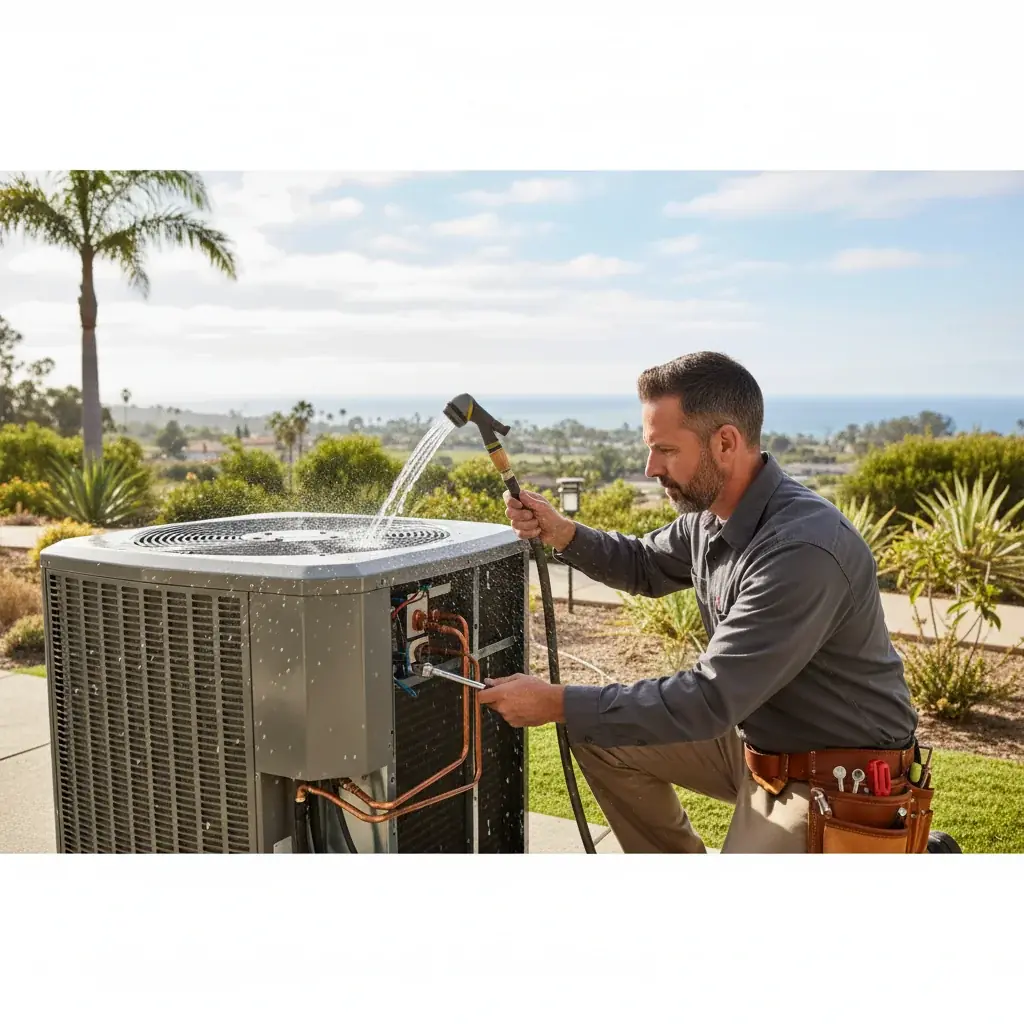
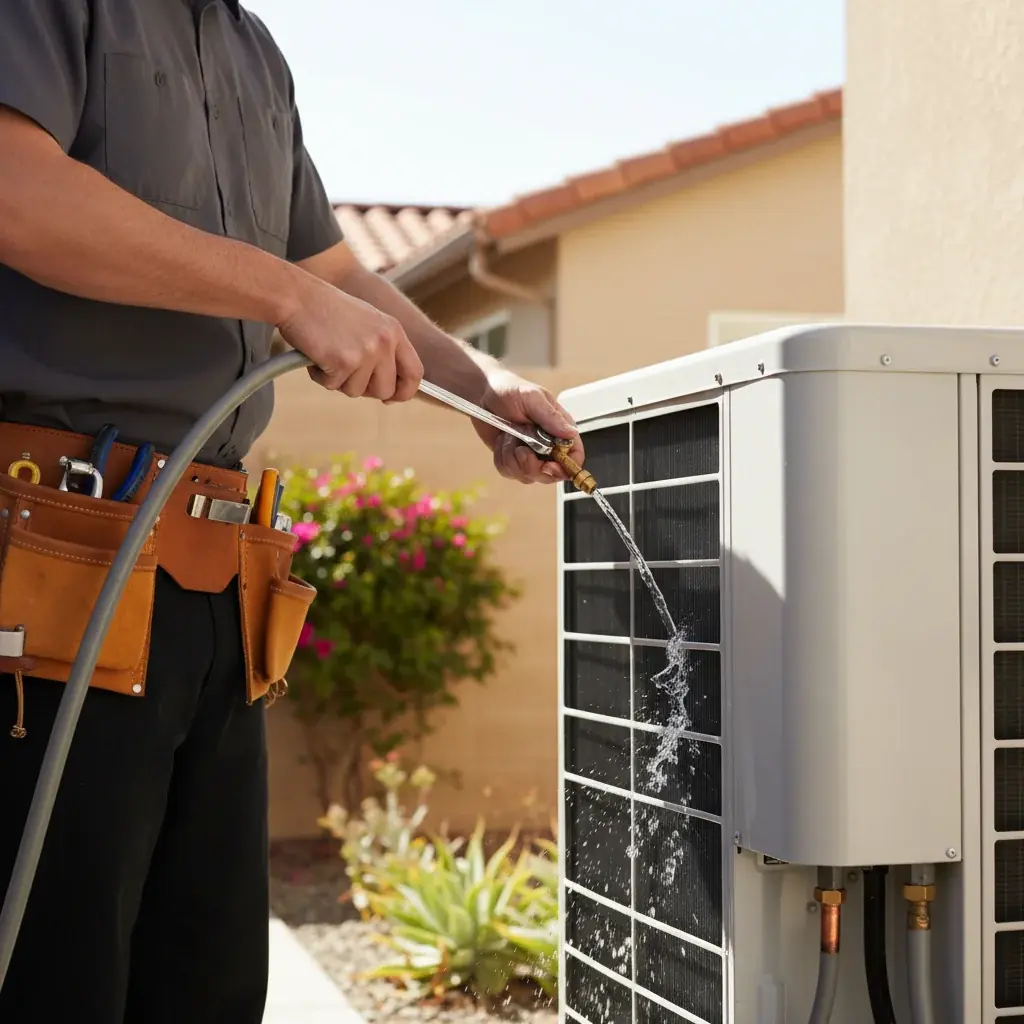
  1. Condenser coil flush. This one matters more in Escondido than anywhere on the coast. We back-flush from the inside out with a non-acid coil cleaner to clear ag dust, pollen, and Santa Ana grit. Skipping this loses 15-20% of cooling capacity and ages the compressor 2-3 years per skipped season.
  2. Condenser fin inspection. Bent fins reduce surface area. Combed straight where needed.
  3. Fan blade balance and motor bearing check.
  4. Thermostat calibration. A thermostat reading 2°F high means the system never reaches setpoint and runs constantly. Common in homes near west-facing windows.

A real Escondido tune-up will spend extra time on items 18-21 because that’s where the inland-specific wear lives.

What a fair price looks like, and where the traps are

San Diego County tune-up pricing for a single-system home in 2026:

  • $39-$79 specials: not a tune-up. These are sales calls. The tech is paid to find something to sell you, and they will.
  • $99-$149 single-system tune-up: realistic floor for a thorough single-system visit when the company isn’t trying to upsell. Expect 60-75 minutes on site.
  • $149-$249 single-system tune-up with written multi-point report: what a legitimate 21-point service costs. 75-90 minutes on site. This is what you want in Escondido.
  • $249-$349 dual-system tune-up: two AC systems in the same home, full report each.
  • Annual maintenance plan: $179-$299/year typically covers spring AC tune-up plus fall furnace tune-up, priority scheduling, and discounted repairs. Our HVAC maintenance plan guide breaks down what’s actually included.

For a deeper price breakdown across all SD County, our HVAC maintenance cost guide covers what’s reasonable and what’s a red flag.

When tune-ups pay for themselves: real Escondido examples

A tune-up isn’t insurance. It’s preventive math. Here are the most common saves we see in inland North County:

  • Weak capacitor caught at tune-up: $80 swap during maintenance vs. $350 emergency call when it fails on a 102°F Saturday. Multiply by the odds of failure on a system over 5 years old and the math becomes obvious.
  • Dirty condenser coil cleaned: restores 15-20% of cooling capacity, drops energy bills 8-15% the rest of the season, extends compressor life. A coil left dirty for three Escondido seasons can shorten compressor life by 4-6 years. Compressor replacement runs $1,500-$2,200.
  • Clogged drain line flushed: prevents pan overflow, which prevents $500-$2,000 in drywall and ceiling damage.
  • Static pressure measured, restricted filter or duct caught: prevents coil freeze-ups, blower motor burnout ($400-$700), and the related comfort complaints.

Across an average Escondido service life of 12-15 years, homeowners who tune up annually spend $1,200-$3,000 on maintenance and avoid $4,000-$8,000 in premature replacement and emergency repairs. Homeowners who skip maintenance routinely replace at 9-11 years instead of 14-16. The math runs strongly toward the tune-up.

What a tune-up saves on your SDG&E bill

This is the part most maintenance articles skip, and it matters more in Escondido than almost anywhere. SDG&E has some of the highest residential electricity rates in the country. Summer tiered and time-of-use rates push well past $0.40 per kilowatt-hour during the 4 p.m. to 9 p.m. peak window, which is exactly when an inland AC is grinding hardest to fight afternoon heat soak.

Run the math on a dirty condenser coil. A central AC in an Old Escondido home commonly draws 3 to 4 kilowatts while running. Lose 15-20% of heat-rejection capacity to ag dust and Santa Ana grit, and the compressor runs longer and pulls more amps to hit the same setpoint. Over a 1,800 to 2,400 hour Escondido cooling season, that inefficiency adds up fast.

Here’s a realistic range for a single-system inland home:

Tune-up itemEfficiency loss if skippedRough summer cost on SDG&E
Dirty condenser coil8-15% more runtime$90-$220 over the season
Low or off-spec refrigerant charge5-20% efficiency drop$60-$280 over the season
Restricted airflow (filter/duct)5-10% more runtime$55-$150 over the season
Thermostat reading 2°F highconstant overrun$40-$120 over the season

A $149 tune-up that restores correct charge and a clean coil often pays for itself in one Escondido summer of avoided SDG&E charges, before you count a single avoided repair. For the full list of ways to cut cooling costs here, see our guide to lowering your AC bill in San Diego summer. None of the discount “specials” measure the numbers that drive these savings, which is the whole point of paying for a real tune-up.

When a tune-up tells you it’s time to replace, not repair

A written tune-up report is also a replacement-decision tool, and the 2026 rules make that decision more consequential than it used to be. Three Escondido-specific factors your tech should flag:

Efficiency vs. a modern unit. Older systems in the 8-10 SEER range waste a lot of the energy you’re paying SDG&E peak rates for. Today’s minimum is SEER2, the revised federal efficiency standard that took effect in 2023 and measures performance under real-world static pressure. If your unit is 13+ years old and the coil-clean barely moves the temperature split, the report is telling you the next failure is the one to replace on. Our plain-English SEER2 guide for San Diego buyers breaks down what the numbers mean.

The R-454B refrigerant shift. As of 2025, new equipment uses R-454B, and R-410A is being phased down. For an older R-410A or, worse, an R-22 system, that means refrigerant repairs get pricier as supply tightens. A tune-up that finds a slow leak in a 12-year-old R-410A unit is a different conversation than the same leak in a 3-year-old one. We cover the cost reality in our R-22 vs R-410A vs R-454B refrigerant guide.

Title 24 and the permit reality. A tune-up is not a replacement, so it needs no permit. But when the report points toward replacement, know that a like-for-like AC changeout in San Diego County requires a permit and a Title 24 compliance check, California’s energy code for the duct sealing and equipment efficiency the new system has to meet. Honest shops fold the permit into the quote. A tune-up gives you the condition report to plan that replacement on your schedule instead of during an August outage.

A good tech won’t push you toward replacement at a tune-up. The report just gives you the numbers to decide before the system decides for you.

Decision framework: do you need a tune-up this spring?

Use this quick check.

SituationRecommendation
AC is under 3 years old, in warranty, no symptomsSkip this year. Most manufacturer warranties don’t require annual professional service. Change the filter, hose the condenser.
AC is 3-7 years old, no symptomsYes. Annual tune-up. This is the catch window for capacitor and contactor wear.
AC is 8-12 years oldYes, every spring without exception. This is when small failures compound.
AC is 13+ years old, considering replacement soonTune-up still pays. It buys reliability for one more season and gives you a written condition report to inform the replace decision.
AC is making noise, short cycling, or not cooling wellSkip the tune-up, call for a diagnostic. A tune-up isn’t a repair visit. Our AC repair page covers what a diagnostic includes.
You bought the home in the last year and don’t know the maintenance historyGet a tune-up. It functions as a baseline condition report.

When to book

Book between mid-March and mid-April for the best availability. The first 90°F day in Escondido is typically late April or early May. Once that hits, repair calls take priority and tune-up slots get pushed two to three weeks out. By late May, most reputable companies stop scheduling new tune-ups until fall because crews are committed to emergency repair backlog.

If you’re reading this in late May or June and haven’t booked, do it now anyway. A late tune-up is better than no tune-up, and August in Escondido is exactly the wrong time to discover a weak capacitor.

What you can do before the tech arrives

Spend 20 minutes the weekend before. It makes the visit faster and cheaper:

  • Replace the filter. A clean filter at the start of the visit means accurate static pressure readings.
  • Clear two to three feet around the outdoor condenser. Trim back any shrubs, move trash bins, sweep leaves out of the fins.
  • Gently hose the condenser exterior fins from the outside. Don’t use a pressure washer.
  • Make sure the indoor air handler is accessible. Move boxes, clear the attic ladder if it’s an attic unit.
  • Find your service records if you have them. The tech can spot patterns faster with history.

Frequently asked questions

How long should an AC tune-up take in Escondido?

A real 21-point tune-up on a single-system home takes 75-90 minutes. Anything under an hour is a visual inspection, not a tune-up. Anything over two hours either includes substantial cleaning work the system needed, or the tech is running into problems worth a separate conversation.

Is the $39 tune-up special worth it?

No. Companies selling $39-$79 tune-ups make their margin on what they sell after the technician is at your house. Industry-wide, the rate at which $39 tune-up visits result in a recommended repair or replacement runs above 70%, and most of those recommendations are optional or padded. Pay $129-$199 for a real tune-up from a company that doesn’t need to find work to be profitable.

How often should I get AC maintenance in Escondido specifically?

Once a year, every spring, for any system over three years old. Coastal homes can sometimes stretch to every 18 months. Escondido homes should not. The combination of run hours, dust load, and heat exposure makes annual maintenance the breakeven point.

What’s the difference between a tune-up and a service call?

A tune-up is preventive: scheduled in advance, no failure has occurred, the tech performs a checklist of measurements and cleanings. A service call is reactive: something has failed or is failing, the tech diagnoses and proposes a repair. Different visit, different pricing, different goal. If your AC isn’t cooling right now, you need a diagnostic, not a tune-up.

Will a tune-up include refrigerant if my system is low?

No. A tune-up includes refrigerant measurement. If the system is low, that’s a separate diagnostic and repair (refrigerant doesn’t get consumed, so low refrigerant means a leak). Most reputable companies will quote the additional work before adding anything. If the tech tries to bundle refrigerant top-off into the tune-up without finding the leak, that’s a red flag.

Should I sign up for an annual maintenance plan?

If you’ll actually use it. Plans run $179-$299/year and typically include spring AC tune-up, fall furnace tune-up, priority scheduling during heat waves, and 10-15% off any repairs. For an Escondido home with a system over 5 years old that needs both spring and fall service anyway, the plan usually pays for itself. For a new system under warranty, a single tune-up a year is fine.

Does a tune-up affect my warranty?

It can preserve it. Most manufacturer warranties require “documented annual professional maintenance” to honor major-component claims. Without records, the manufacturer can reject a compressor warranty claim. Save the written tune-up reports.

Ready to book

The technician we dispatch to Escondido is a vetted local HVAC pro who knows the failure patterns of inland systems, brings calibrated gauges, and leaves you with a written report. We service 92025, 92026, 92027, 92029, plus Hidden Meadows, Felicita, and the surrounding North County inland communities.

Call (442) 777-6440 for a spring tune-up estimate, or visit our AC tune-up service page for details on what’s included. If your system is already showing symptoms, start with our AC repair service instead.