It’s a hot San Diego afternoon, but your AC is blowing lukewarm air. A technician comes out, glances at the unit, and says, “You’re just low on Freon. We can top it off for a few hundred bucks.” This is the single most common AC repair scam in Southern California, and it’s crucial to understand what’s really happening.

An air conditioner is a sealed system. If it’s low on refrigerant, it means there is an ac refrigerant leak somewhere. Simply adding more without fixing the source is like putting air in a tire with a nail in it, it’s a temporary fix that guarantees you’ll be calling for service again soon.
How to tell if your AC has a refrigerant leak
A refrigerant leak isn’t always obvious, but your air conditioner will give you clear signs that something is wrong. Because the system relies on a precise amount of refrigerant to transfer heat out of your home, even a small leak can have a big impact on performance and efficiency.
Here are the most common symptoms we see in San Diego homes:
- Warm air from vents: This is the number one sign. If the AC is running but the air isn’t cold, it’s often due to low refrigerant. You can learn more about the various causes when your AC is not blowing cold air in San Diego.
- Ice on the refrigerant lines: Check the larger copper pipe leading into your outdoor condenser unit. If it’s covered in frost or ice, it’s a classic sign of a low refrigerant charge. This happens because the pressure drop in the system causes the evaporator coil to get too cold, freezing the condensation on it.
- Hissing or bubbling noises: A large leak can sometimes be audible. You might hear a hissing sound from the indoor or outdoor unit. Bubbling could indicate a leak in the lines where refrigerant is escaping.
- Longer cooling cycles: Does your AC seem to run constantly without ever reaching the temperature on the thermostat? A low charge forces the system to work much harder and longer to cool your home, which leads to the next point.
- Higher energy bills: An inefficient system uses more electricity. If your SDGE bill suddenly spikes during the summer with no change in your usage habits, an undiagnosed refrigerant leak could be the culprit.
Recognizing these signs early can help you avoid more expensive damage to your compressor, which can overheat when running with a low refrigerant charge.
Why refrigerant doesn’t get ‘used up’, it leaks
Let’s clear up a major misconception. Air conditioner refrigerant is not a fuel like gasoline. It doesn’t get consumed or “used up” over time. It circulates in a closed loop, changing from a liquid to a gas and back again to absorb heat from inside your home and release it outside.
The system is designed to hold that same charge of refrigerant for its entire lifespan.
So, if a technician tells you your system is “low on Freon” and needs a “top-off” or “recharge,” the only possible reason is that there’s a leak. Adding more refrigerant without finding and fixing the leak is malpractice. It’s a temporary fix that costs you money in several ways:
- You pay for wasted refrigerant: The new refrigerant will just leak out again, whether it takes a week or a few months.
- You pay for repeat service calls: The problem will return, and you’ll have to call another technician.
- You risk major component failure: Running the system with an improper charge puts immense strain on the compressor, the most expensive part of your AC.
- It’s bad for the environment: Refrigerants are potent greenhouse gases, and knowingly releasing them into the atmosphere is illegal under EPA regulations.
An honest, licensed HVAC professional will never recommend a simple top-off. They will always recommend a leak search to find the source of the problem first.
What a real leak search and repair should include
When you call a reputable company for a potential leak, the process should be diagnostic, not just a quick fix. The goal is to pinpoint the exact location and severity of the leak to determine the best course of action. This involves a dedicated leak search.
The leak search
The first step is the search itself. This is a separate diagnostic fee because it can be time-consuming and requires specialized equipment. Ask for that fee in dollars before they start. Common methods include:
- Electronic Leak Detector: This is a handheld “sniffer” that alarms when it detects refrigerant gas. It’s great for quickly finding leaks in accessible areas.
- UV Dye Test: A fluorescent dye is added to the refrigerant. After running the system for a few days, a technician uses a UV light to find the glowing dye at the leak’s location.
- Nitrogen Pressure Test: For very small or hard-to-find leaks, a technician will recover the existing refrigerant, fill the system with pressurized nitrogen, and listen for the escaping gas or use a soap bubble solution to find the leak.
The repair
Once the leak is found, the refrigerant leak repair quote varies with location and complexity.
- Simple braze: A small leak on an exposed copper line is the easiest fix. It involves brazing the joint or pipe closed.
- Coil repair or replacement: If the leak is in the indoor evaporator coil or the outdoor condenser coil, the repair is much more involved. These coils are a dense network of thin tubes, and sometimes replacement is the only viable option. Ask for coil vs system as separate bids.
The total ac freon leak cost will be the sum of the leak search, the repair itself, and the cost to recharge the system with the correct amount of refrigerant by weight. A complete and proper job will always include all three steps.
R-410A vs R-22 vs R-454B: what your system uses matters
The type of refrigerant in your AC unit has a massive impact on the cost and viability of a repair. You can usually find the type listed on a data plate on your outdoor condenser unit.
R-22 (Freon)
If your system was installed before 2010, it likely uses R-22, commonly known as Freon. Due to its ozone-depleting properties, R-22 was completely phased out of production in 2020. The remaining supply is incredibly scarce and expensive. A pound of R-22 is scarce and expensive. Because of this prohibitive cost, a major R-22 leak almost always means it’s time to replace the system. Pouring that much money into an old, inefficient unit is a poor investment.
R-410A (Puron)
This has been the standard refrigerant for most systems installed between 2010 and 2024. It’s more environmentally friendly than R-22 and is still widely available. If your R-410A system has a leak, a repair is usually a reasonable option, provided the unit is in good condition otherwise. An honest AC repair professional can help you weigh the costs.
R-454B (and other A2Ls)
Starting in 2025, new federal regulations require manufacturers to use refrigerants with a much lower Global Warming Potential (GWP). R-454B is one of the leading replacements for R-410A. These new refrigerants are classified as “A2L,” meaning they are mildly flammable. This requires technicians to have new training and specialized equipment for safe handling. If you’re buying a new system in the coming years, it will likely use one of these next-generation refrigerants.
When a leak means it’s time to replace the system
An AC refrigerant leak can often be the final straw for an aging air conditioner. While a simple fix on a newer unit makes sense, there are several scenarios where replacing the system is the smarter financial decision.
Here’s the decision frame for San Diego homeowners:
- Your system uses R-22: As mentioned, the cost of R-22 refrigerant alone makes most repairs uneconomical. It’s better to put that money toward a new, high-efficiency system that will lower your energy bills for years to come.
- The repair cost is high: Use the 50% rule. If the total cost of the leak search, repair, and recharge is approaching 50% of the price of a new system, replacement is the way to go.
- The leak is in a major component: A leak in the evaporator or condenser coil is a serious problem. These are expensive, critical parts, and replacing them on an older unit is often not worth the investment.
- Your system is over 12 years old: The average lifespan of an AC unit in our coastal climate is 12-15 years. If your system is in that range, a major repair like a leak fix might just be the first of many. A new system gives you a fresh start with a full warranty.
Making this call can be tough. Our guide on AC replacement vs. repair can walk you through all the factors to consider for your home.
Related services: AC installation and HVAC maintenance. Local coverage: all 67 cities we cover in San Diego County.
Not sure this is your symptom? Our HVAC symptom finder matches what the system is actually doing to the likely cause.
Frequently asked questions
Is a freon leak worth fixing?
It depends on where the leak is and how old the system is. A leak at an accessible joint, a valve or a line set is usually worth repairing. A leak in the evaporator or condenser coil on a system past twelve years often is not, because you are putting a major part into equipment near the end of its life. Get the leak located and named before approving anything.
What does a leak test cost?
Ask for the leak-search fee in dollars. That covers locating the leak with electronic detection or dye rather than guessing, which matters because a recharge without a leak search just buys you a few months and another bill.
Can I just add refrigerant instead?
You can, but refrigerant is not consumed in normal operation. A system low on refrigerant has a leak, full stop, and topping it off without finding that leak means paying for the same refrigerant again. It is also why “we just added a couple pounds” without a leak report is a signal to get a second opinion.
Does the refrigerant type change the cost?
Substantially. R-22 systems are the expensive case because the refrigerant has been phased out and what remains is costly, which is usually the point where replacement beats repair. R-410A is the current mainstream and priced normally. R-454B is the newer low-GWP replacement now appearing on new equipment. Which one you have is worth knowing before you get a quote.
When to call us
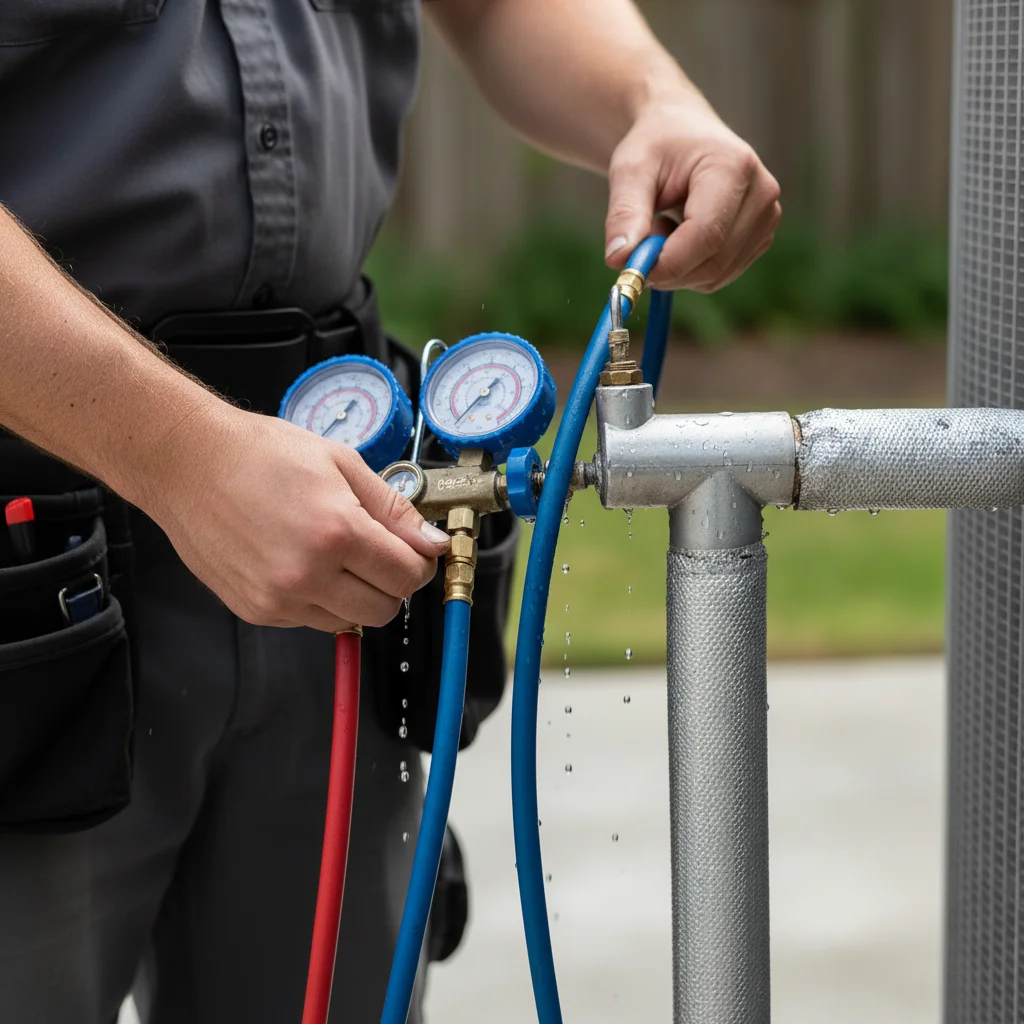
An AC refrigerant leak is not a DIY job. Handling refrigerant requires EPA certification, specialized recovery machines, vacuum pumps, and gauges. Attempting to work on it yourself is dangerous and illegal.
For a proper diagnosis, an honest estimate, and a repair that actually solves the problem, you need a licensed and insured HVAC professional. Call (442) 777-6440 to get matched with a licensed company. Climate Pros SD does not dispatch a truck, does not offer a free diagnosis, and does not promise same-day arrival.