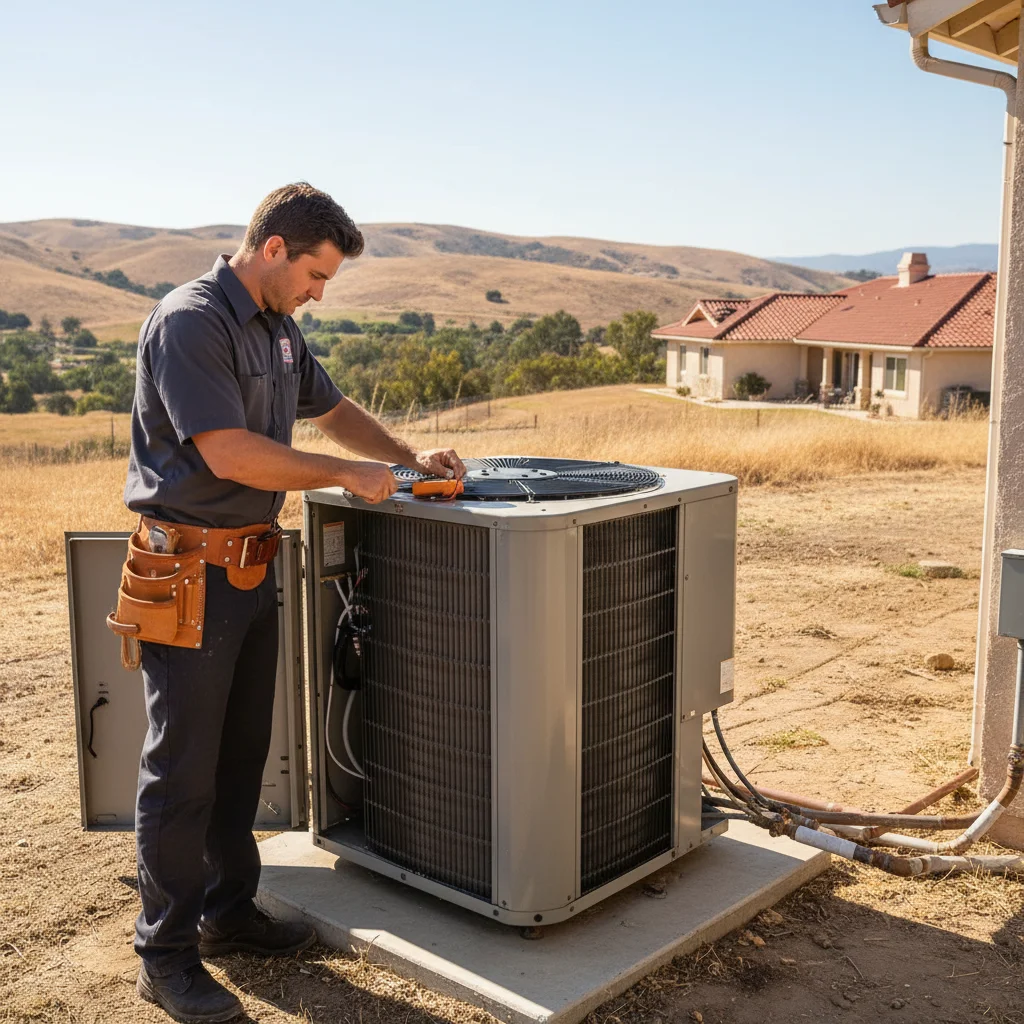
Rancho Bernardo summers run 95-105°F for stretches in July and August, and the housing stock is mostly 1970s-1990s tract homes with undersized return ducts and aging R-22 systems. If your AC is struggling in 92127 or 92128, the issue is rarely just the unit. It’s usually duct sizing, refrigerant loss, or a capacitor that’s been cycling 14 hours a day for three summers. Below is what actually breaks, what it costs in 2026, and how to handle the HOA architectural review before you replace the condenser.
Why Rancho Bernardo ACs fail earlier than coastal ones
RB sits in an inland valley with no marine layer relief most summer days. The 92127 and 92128 ZIPs regularly post 15-20°F warmer afternoons than Del Mar or La Jolla. That means your AC runs longer cycles, more hours per day, and more total hours per season. A coastal Encinitas condenser might log 400 hours a summer. A Rancho Bernardo condenser logs 900-1,200.
Compounding that, most homes here were built between 1972 (when the Bernardo Heights area opened up) and the late 1990s build-out around 4S Ranch. The original ducts were sized for the lower cooling loads of that era, and a lot of homeowners later upgraded to 3-ton or 4-ton systems sitting on top of 2.5-ton ductwork. The system can’t move the air it’s making, so it short-cycles, freezes the evaporator coil, and burns out compressors years early.
The most common 92127 and 92128 failures we see
Capacitor failure is number one by volume. Long run-times in 100°F-plus weather cook the dielectric inside the start and run capacitors. Symptom: AC hums but the fan doesn’t spin, or the system clicks on and immediately off. Replacement runs $200-$450 in 2026, parts and labor.
R-22 refrigerant leaks are number two in homes built before 2010. R-22 has been phased out, so a recharge alone now costs $90-$180 per pound, and most older systems hold 6-10 pounds. A full recharge plus leak repair on an R-22 unit lands $900-$1,800. At that price point, replacement math gets real fast.
Burnt condenser fan motors show up after multiple summers of long cycles. The motor itself is $250-$450, plus 1-2 hours of labor for $400-$700 total.
Undersized return ducts aren’t a failure exactly, but they cause every other failure. If your bedrooms are 8-10°F warmer than the thermostat reading, your return air path is bottlenecking the whole system. Adding a second return or upsizing the trunk runs $1,500-$3,500 depending on access.
Compressor failure is the last-resort diagnosis. A new compressor on a 12-year-old system is $1,800-$3,500 installed. Almost never worth it. See the decision framework below.
Real 2026 repair costs in Rancho Bernardo
These ranges reflect what local techs in the dispatch network charge in RB this year, including the inland fuel surcharge most companies add for 92127/92128 calls:
| Repair | Typical 2026 cost (parts + labor) |
|---|---|
| Diagnostic / service call | $99-$149 (often credited toward repair) |
| Capacitor replacement | $200-$450 |
| Condenser fan motor | $400-$700 |
| Contactor replacement | $180-$320 |
| Clogged drain line | $150-$300 |
| Refrigerant recharge (R-410A) | $300-$600 |
| Refrigerant recharge (R-22) | $900-$1,800 |
| Evaporator coil replacement | $1,400-$2,800 |
| Compressor replacement | $1,800-$3,500 |
| Full system replacement (3-ton) | $9,500-$15,500 |
After-hours and weekend calls add $150-$300 in RB because most techs route from Mira Mesa or Poway and inland response burns drive time. If your AC dies at 9pm on a Saturday and it’s not 100°F outside, sleeping with fans and calling first thing Monday saves real money.
The HOA architectural review trap
Most of Rancho Bernardo sits inside an HOA. Bernardo Heights, Rancho Bernardo Country Club, Westwood, Oaks North, Eastview, and 4S Ranch all have architectural review committees that govern outdoor condenser replacements. The rules vary, but the common requirements are:
- Submit a request before installation, not after
- New condenser must match the existing pad footprint or be screened
- Some HOAs require the unit be no taller than the existing fence line
- Sound rating below 75 dB is standard, below 70 dB in stricter associations
- No relocation to side yards facing neighbor windows without approval
Review typically takes 10-30 days. If your existing condenser died in July and you want immediate replacement, you’ll need to either install in the existing footprint (usually preapproved) or pay for a temporary portable unit while review runs. Most replacement contractors will not pull a permit or order equipment until you have written HOA approval, because they’ve all eaten the cost of rip-outs when reviews came back denied.
If you bought the home recently and don’t know which committee you’re in, the HOA management company is listed on your CC&Rs. The submittal form is usually one page plus a site plan.
Repair or replace: the decision framework for RB homes
Use this with the cost table above. The math is different here than coastal SD because run-hours are roughly double.
Repair if all of these are true:
- System is under 10 years old
- Refrigerant is R-410A or newer
- Single repair under $800
- No prior compressor or coil work
- Ducts are properly sized for current tonnage
Replace if any two of these are true:
- System is 12-plus years old
- Uses R-22 refrigerant
- Repair quote is over 50% of replacement cost
- Already replaced compressor or coil once
- Energy bills jumped 30%-plus in the last two summers
- Bedrooms run hot even when the AC is running
For RB specifically, the break-even age is closer to 12 years than the coastal 15 because of the run-hour difference. A 13-year-old 10-SEER unit in Bernardo Heights is costing you $400-$700 a year in extra SDG&E charges vs. a modern 16-SEER replacement, plus a rising probability of a $1,500-$3,500 emergency repair every summer.
If you’re considering replacement, the SDG&E rebate stack and federal tax credit math is worth running before you sign. The 25C federal credit alone is up to $2,000 for qualifying heat pumps.
When to call
If your AC is short-cycling, blowing warm air, tripping a breaker, or making a grinding sound, get a tech out before you keep running it. Compressor damage from operating a low-refrigerant system in 100°F weather can turn a $400 leak repair into a $3,500 compressor swap in a single afternoon.
For Rancho Bernardo-specific pricing, Bernardo Heights and 7 Oaks neighborhood notes, and HOA replacement guidance, see our full AC repair in Rancho Bernardo service page. Call (442) 777-6440 for a same-day diagnostic. Also worth reading: the related Poway AC repair guide since inland conditions and housing stock overlap, and our AC replacement vs. repair decision page for the full math.
FAQs
Is AC repair more expensive in Rancho Bernardo than coastal San Diego?
Yes, by roughly 10-15%. Most service companies add an inland fuel surcharge for 92127 and 92128 calls because techs route from Mira Mesa, Poway, or Escondido. Refrigerant recharges on older R-22 systems are also more common here, and R-22 itself is now $90-$180 per pound, which inflates the total ticket compared to coastal homes that more often have R-410A systems.
My Rancho Bernardo AC was installed in 2008. Is it worth repairing?
Probably not for anything over $800. A 2008 system is 18 years old in 2026, almost certainly running R-22, and has logged something like 16,000-20,000 run hours given RB summers. The compressor is on borrowed time, the coil is likely corroded, and a new high-efficiency replacement will cut your summer SDG&E bill 25-40%. Repair only if the fix is cheap (capacitor, contactor, drain line) and use the time to get replacement quotes.
Do I really need HOA approval to replace my outdoor condenser?
If you’re in one of RB’s HOAs (most of the area), yes. Replacing without approval can result in a forced rip-out at your expense, and most local contractors will not order equipment without seeing the written approval. Same-footprint replacements are usually fast-tracked. Relocations or larger units almost always require full review. Allow 10-30 days.
What size AC does a typical Rancho Bernardo home need?
A 1,800-2,400 square foot single-story RB tract home typically needs a 3-ton unit. Two-story homes from 2,500-3,200 square feet usually need 3.5 to 4 tons. But sizing should be confirmed by a Manual J load calculation, not square footage alone. Oversizing causes short-cycling, humidity problems, and premature compressor wear. RB’s lower humidity helps, but the high summer heat load still has to be calculated against your specific insulation, windows, and orientation. See our Manual J sizing guide.
Why is my upstairs always 8 degrees warmer than downstairs in my RB two-story?
Three common causes in RB homes specifically. First, undersized return ducts that bottleneck airflow to upstairs registers. Second, attic ducts that have lost insulation and are dumping cool air into a 140°F attic before it reaches the bedrooms. Third, no upstairs zoning, meaning the thermostat downstairs satisfies before upstairs catches up. Fixes range from adding a return ($1,500-$3,500) to installing a zoned damper system ($2,500-$5,000) to sealing and reinsulating ducts ($1,800-$3,500).
Can I run my Rancho Bernardo AC 24/7 during a heat wave?
You can, and many homeowners do during July and August stretches. But on a system over 10 years old, continuous 100°F-plus run conditions are when compressors fail. Set the thermostat to a steady reasonable target (78-80°F) rather than overcooling, change the filter monthly during heat waves, and have the system serviced before summer rather than after a failure. A pre-summer tune-up runs $129-$199 and catches most issues before they break in 105°F weather.
We service every Rancho Bernardo neighborhood, Bernardo Heights, 7 Oaks, Westwood, Rancho Bernardo Community Park area, with same-day response on most calls. For full pricing and HOA replacement guidance, see our AC repair in Rancho Bernardo service page. Call (442) 777-6440 to book.