When the Escondido summer hits, the inland heat can be relentless. If your old air conditioner is struggling to keep up, or if you’re building a new home, understanding the unique demands of our climate is the first step toward smart AC installation. Getting it right means enduring comfort and efficient cooling, even when the inland heat peaks.
Escondido rule of thumb: most inland homes need 0.5 to 1 ton MORE capacity than the standard square-footage rule suggests. The national “600 sq ft per ton” shortcut was built around milder design temperatures. Escondido’s design day runs well above the coastal normals with low humidity and intense radiant load, so a 2,000 sq ft home that would size to a 3-ton unit on the coast often needs 3.5 to 4 tons here. Skip this adjustment and the new system runs wide open through July and August, short-cycles, and wears out years early.
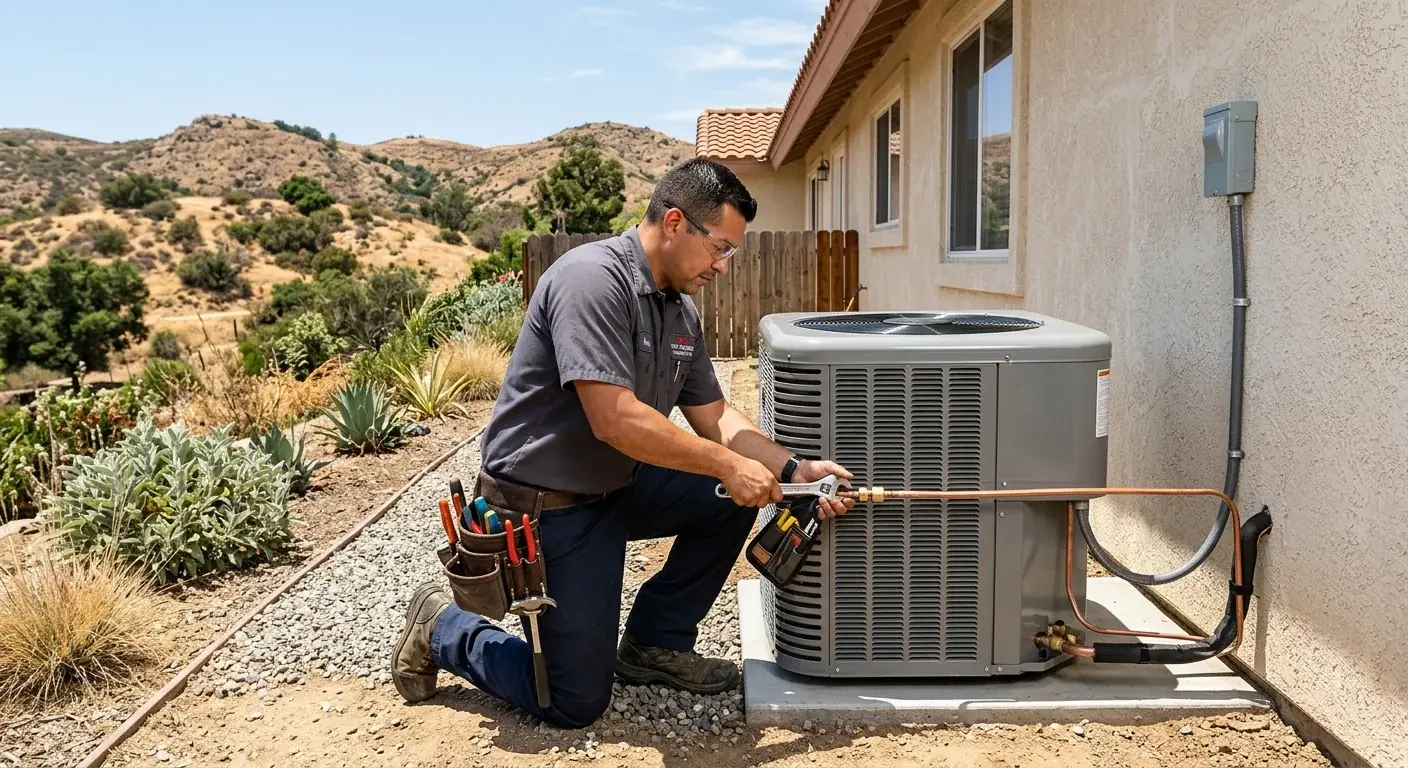
Why Escondido’s heat means you can’t undersize your AC
Living in Escondido means experiencing significantly higher temperatures than our coastal San Diego neighbors. Our dry, inland climate, especially in neighborhoods like Hidden Meadows, Old Escondido, and Felicita, means AC systems work harder and run longer. This isn’t just about a few hot days; it’s about sustained heat that can quickly overwhelm an undersized or inefficient unit. When your AC unit is too small for your home’s cooling load, it constantly struggles to reach the thermostat setting. This “short cycling” leads to several problems: your home never truly feels comfortable, your energy bills skyrocket, and the system wears out much faster, leading to premature breakdowns and costly repairs.
Undersizing isn’t just an inconvenience; it’s a critical mistake that undermines the investment. Unlike a mild coastal breeze, Escondido’s intense heat demands an air conditioner that’s matched to the house. A properly sized system cycles efficiently, removes humidity, and holds the setpoint without extra runtime. Climate Pros SD matches you with licensed companies that run that sizing before they quote.
Proper sizing for older homes vs. new construction
Accurate AC sizing is a science, not a guess. It involves a detailed calculation known as a Manual J load assessment. This process considers every factor that contributes to heat gain or loss in your home, ensuring your new system isn’t too small (which leads to inefficiency and discomfort) or too large (which causes short cycling, poor dehumidification, and higher energy bills).
For older homes in Escondido, particularly those built before modern energy codes, the sizing process often reveals unique challenges. These homes might have less insulation, older single-pane windows, air leaks through cracks and gaps, or inefficient ductwork. A comprehensive Manual J calculation will identify those inefficiencies, so the company can recommend the right size AC and, if needed, duct sealing or insulation as separate lines. A home in Old Escondido with mature trees and original construction will have a very different heat load profile than a newer build.
New construction homes, by contrast, generally adhere to stricter energy efficiency standards. They often feature better insulation, dual-pane windows, and tighter building envelopes. Precise sizing is still critical. Even a well-built new home can suffer if the AC isn’t matched. Regardless of age, the matched company should factor square footage, ceiling height, window types, sun exposure, and occupancy. A precise AC installation is a quoted job after that assessment.
What moves the quote in 92025, 92026, 92027, 92029
Climate Pros SD does not install equipment and does not publish $6,000 to $18,000. The matched company quotes after Manual J. What moves that bid:
- System type and SEER2. Higher SEER2 usually means higher equipment price. Whether it pays back depends on inland run hours and your SDG&E plan.
- Tonnage. A larger unit for a bigger or hotter house costs more equipment. Manual J prevents paying for unused tons or suffering an undersized unit.
- Brand and features. Smart thermostats, zoning, and extra filtration are separate lines.
- Ductwork. Leaky, undersized, or damaged ducts should be priced as repair, sealing, or replacement, not hidden in the condenser line.
- Electrical. Older homes may need panel work. That is an electrician quote, not a Climate Pros SD band.
- Access and labor. Relocating a condenser or running new lines takes more time.
- Permits. City of Escondido or San Diego County fees belong on the bid.
A new, efficient system can lower bills when it is sized and commissioned correctly. That is not a published Climate Pros savings figure. For later breakdowns, see AC repair in Escondido.
When a heat pump makes more sense than just an AC
For many Escondido homeowners, a heat pump system offers a superior alternative to a traditional AC-only unit, especially with our mild winters. A heat pump works much like an air conditioner during the summer, moving heat out of your home to keep it cool. However, in cooler months, it reverses the process, extracting heat from the outdoor air and transferring it indoors for efficient heating. This dual functionality means you get both cooling and heating from a single, highly efficient system.
The biggest advantage for San Diego County residents is energy efficiency. Heat pumps are incredibly efficient at heating, often costing less to operate than a gas furnace, particularly when considering the rising cost of natural gas. They don’t generate heat by burning fuel; instead, they move existing heat, making them an eco-friendly choice. The California Energy Commission actively promotes heat pump technology for its environmental benefits and energy savings potential.
While a heat pump can have a higher sticker than a conventional AC plus furnace, incentives only change the math when they are actually open for your equipment. Confirm that with the matched company. For year-round comfort with one outdoor unit, a heat pump is often the better equipment choice in Escondido. It is not a blog “$12,000 minus TECH” story.
Incentives in 2026: check live programs, not a blog discount
TECH Clean California single-family HVAC reservations stopped November 14, 2025. That is not a live $3,000 to $6,000 stack you can subtract from a 2026 Escondido bid. Confirm what is actually funded at sdge.com/rebates. HEEHRA publishes design caps (including up to $8,000 for a qualifying space heat pump when funds exist). Those caps are not what is being paid on a typical Southern California single-family job today. Do not stack TECH and HEEHRA.
The federal 25C Energy Efficient Home Improvement Credit does not apply to property placed in service after December 31, 2025. A 2025 install could still involve 25C on the 2025 return. The IRS annual limit for qualified heat pumps was $2,000. That is not a 2026 Climate Pros bid.
Climate Pros SD does not publish a heat pump of $12,000 minus $6,000 of TECH. Ask the matched company for the live stack on your equipment. See our San Diego heat pump rebate stack guide for 2026.
Decision table: when AC wins vs. when a heat pump wins in Escondido
| Your situation | Better choice | Why |
|---|---|---|
| Gas furnace is 5 years old or newer and works fine | AC-only replacement | No reason to scrap a working furnace; AC alone is the cheaper path |
| Furnace and AC are both 15+ years old | Heat pump | One system replaces both; rebate stack tips the math |
| 92026 / Hidden Meadows home over 2,500 sq ft with high summer load | Heat pump (variable speed) | Variable-speed inverter handles long Escondido cool-down runs more efficiently |
| Older 92027 home with no existing gas line or capped gas service | Heat pump | Avoids running new gas; full electrification is a different rebate conversation than a like-for-like AC |
| Home runs heat only 10-15 nights a year (typical 92029) | Either, lean heat pump | Little heat. Check live programs. HEEHRA design caps are not a bid. TECH single-family HVAC reservations stopped November 14, 2025. |
| Brand-new gas furnace plus failed AC mid-summer | AC-only replacement | Match the existing furnace; revisit heat pump when furnace dies |
| Solar PV array already installed | Heat pump | All-electric heating can run on your solar production, not SDG&E winter rates |
| Tight budget, equipment wouldn’t have met TECH’s efficiency tier | AC-only replacement | No federal 25C credit for 2026 in-service dates. Do not subtract a closed TECH reservation from the sticker. |
Permitting and what to expect on install day
Any major HVAC replacement or new installation in Escondido requires proper permitting. This isn’t just red tape; it’s a crucial step that protects you, the homeowner. Permits ensure that all work complies with local building codes and safety standards, guaranteeing your system is installed correctly and safely. The licensed C-20 company pulls the permit with the City of Escondido so the project can clear inspection. Climate Pros SD is not the crew. Working only with a qualified HVAC contractor is the first line of defense for a compliant installation.
Once permits are secured, here’s a general overview of what to expect on installation day:
- Preparation and Removal: The crew protects your home’s interior and begins carefully disconnecting and removing your old AC unit, including the outdoor condenser, indoor evaporator coil, and potentially the furnace.
- New System Placement: The new condenser unit will be placed outside, and the new evaporator coil will be integrated with your existing furnace or air handler (or a new one, if it’s a full system replacement).
- Ductwork Inspection and Modification: The crew inspects your ductwork for leaks or damage and makes any necessary repairs or modifications to ensure optimal airflow and efficiency for your new system. This can be particularly important in older Escondido homes where original ducting may not be up to modern standards.
- Electrical and Refrigerant Lines: The technicians connect the new electrical wiring and refrigerant lines, ensuring everything meets code and manufacturer specifications.
- System Commissioning and Testing: Once everything is connected, the crew charges the system with the correct amount of refrigerant and performs thorough testing to verify proper operation, airflow, and cooling capacity. This includes calibrating the thermostat and checking all safety controls.
- Walk-Through and Clean-Up: The crew walks you through your new system’s operation, explains maintenance tips, answers any questions, and ensures your home is left clean and tidy.
Most standard replacements finish in one to two days. Ask the company if ducts or panel work add a day. We strive to keep you informed. Climate Pros SD does not run the install calendar.
FAQs
How much does AC installation cost in Escondido in 2026?
The matched company sets the installed price. Climate Pros SD does not publish $6,000 to $18,000, and TECH is not a live $3,000 to $6,000 stack. Single-family TECH HVAC reservations stopped November 14, 2025. 25C does not apply to 2026 in-service dates. The IRS $2,000 figure is the 2025 qualified heat-pump credit cap, not this bid.
What size AC do I need for my Escondido home?
Most Escondido homes need 0.5 to 1 ton more than the national square-footage rule suggests because of inland heat. A 2,000 sq ft home that would size to 3 tons on the coast usually needs 3.5 to 4 tons here. Always get a Manual J load calculation rather than a tonnage guess.
Is a heat pump worth it in Escondido?
Sometimes, if a live program actually applies to your equipment. Do not count $3,000 to $6,000 of TECH from a blog. Single-family reservations stopped November 14, 2025. 25C is not for 2026 in-service dates. Escondido winters are short, so heating savings versus gas are real but small.
Do I need a permit for AC installation in Escondido?
Yes. An HVAC replacement or new install in Escondido normally needs a mechanical permit from the City of Escondido (or San Diego County if unincorporated). The permit covers refrigerant lines, electrical, and final airflow inspection. A reputable contractor pulls the permit on your behalf; ask for the permit number before the install starts.
How long does AC installation take?
Most standard replacements finish in one to two days. Add a day if ductwork needs to be sealed or resized, or if an electrical panel upgrade is required to handle the new condenser’s amperage. Whole-home heat pump conversions that include removing the gas furnace typically run two to three days.
What SEER2 rating do I need in California?
California’s 2023 minimum is 14.3 SEER2 for split-system central air conditioners installed in the southwest region (which includes San Diego County). Most installs in Escondido now spec above the regional minimum to balance equipment price with inland run hours. Higher SEER2 can unlock better rebate tiers on heat pumps when a program is open. See our SEER2 explainer for San Diego homeowners for the full breakdown.
When to call us
If you’re considering a new AC unit for your Escondido home, or if your current system is showing signs of age, connect with a licensed HVAC company. Call us at (442) 777-6440 for a match. For ZIP-by-ZIP sizing notes and the live rebate checklist on a heat pump conversion, see our AC installation in Escondido service page.