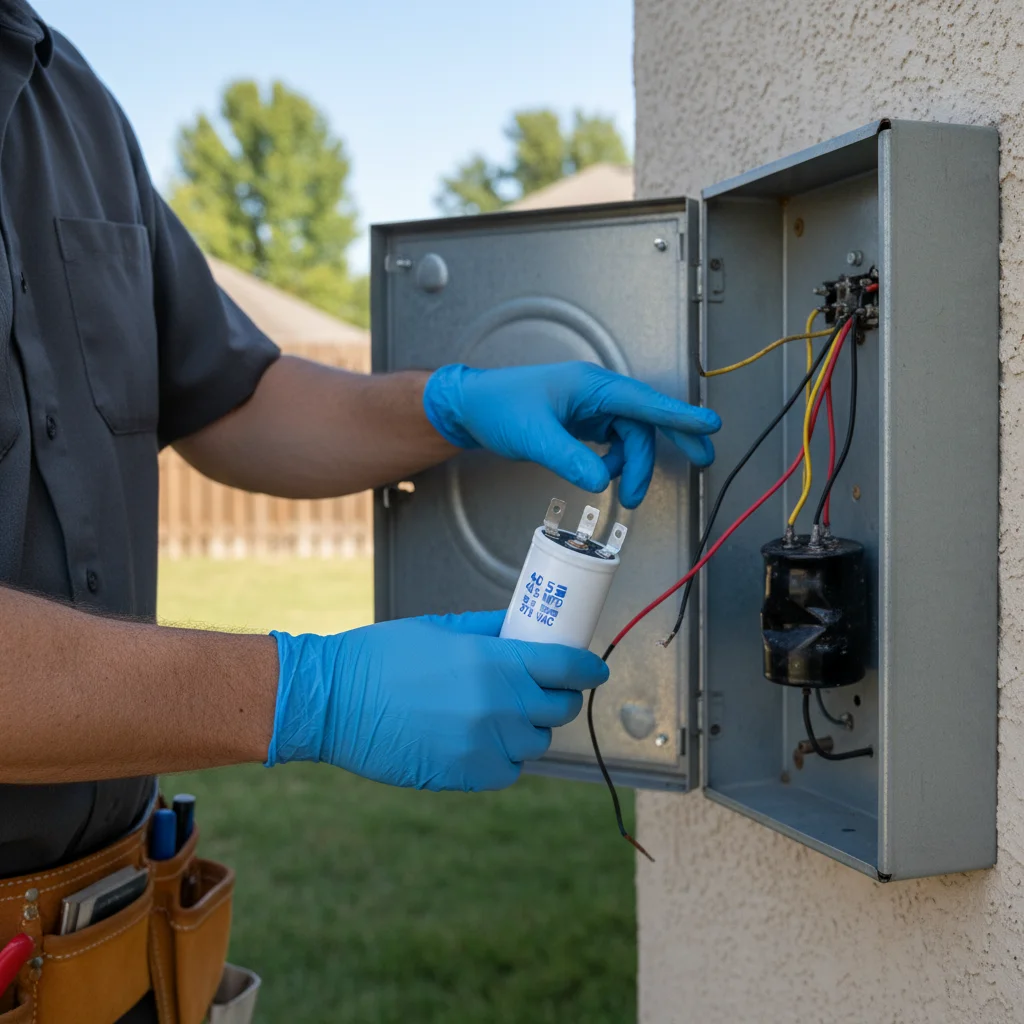
It’s one of the most common sounds of a San Diego summer: your outdoor air conditioner unit hums, buzzes, and tries to start, but the fan never spins up. That frustrating noise often points to a single, small, and surprisingly vulnerable component—the AC capacitor. This small metal can is responsible for a huge job, and when it fails, your entire cooling system grinds to a halt.
What an AC capacitor actually does
Think of an AC capacitor as a small, temporary battery. Its job is to store up a powerful electrical charge and release it in a concentrated jolt to get your AC’s motors running. Your air conditioner has two major motors in the outdoor unit: the compressor (which circulates refrigerant) and the condenser fan motor (which dissipates heat). These motors need a big kick of energy to overcome inertia and start spinning—much more energy than your home’s standard electrical circuit can provide on its own.
The capacitor delivers that kick.
There are a few types, but most modern residential units in San Diego use a dual-run capacitor. This single component serves both the compressor and the fan motor. It provides the initial starting jolt and then continues to supply a smaller, steady amount of energy to keep the motors running efficiently. Because it does two jobs at once and is constantly working whenever your AC is on, it’s under a lot of stress. When it fails, one or both of those critical motors can’t start, and your house starts to heat up.
Symptoms of a failing or failed capacitor
A bad capacitor is usually easy for a trained technician to diagnose because the symptoms are so distinct. If your system is acting up, you’ll likely notice one or more of these signs.
- A humming or buzzing sound: You can hear the outdoor unit trying to work. Electricity is flowing to the motors, but without the “kick” from the capacitor, they can’t start turning. They are essentially stalled, which creates a loud hum.
- The outdoor fan isn’t spinning: You might hear the compressor hum, but if you look at the top of your outdoor unit, the fan blades are still.
- The AC tries to start, then shuts off: Your thermostat calls for cooling, the unit hums for a few seconds, and then everything goes quiet. This cycle may repeat every few minutes. The system’s safety circuits are shutting it down to prevent the motors from burning out.
- AC is blowing warm or cool (but not cold) air: Sometimes a capacitor will weaken before it fails completely. It might have enough power to start the fan but not the much larger compressor. Since the compressor is what makes the air cold, you’ll just have a system that circulates room-temperature air.
If you’re experiencing these issues, a good first step is our AC not cooling checklist to rule out simple problems like a tripped breaker or a dirty filter. But if those check out, a failed capacitor is the most likely culprit.
Why San Diego heat kills capacitors first
We replace more capacitors than any other single component during San Diego’s cooling season. There’s a simple reason for this: heat is the mortal enemy of electronic components. And capacitors are particularly sensitive.
Inside that metal can is a material called a dielectric, which is rolled up with conductive foil. This material is what allows the capacitor to store a charge. High temperatures cause this dielectric material to break down chemically over time, reducing its ability to hold a charge until it eventually fails completely.
Your outdoor condenser unit already operates at high temperatures. Add in a classic San Diego summer day, with the sun beating down directly on the metal cabinet, and the internal temperature can easily exceed 150°F. This constant thermal stress accelerates the degradation of the capacitor. In inland areas like El Cajon, Santee, and Escondido, where summer temperatures are consistently higher, capacitors fail even more frequently. It’s not a matter of if it will fail, but when. For most systems in our climate, a capacitor’s lifespan is typically 3-7 years, much shorter than in cooler parts of the country.
Fair pricing in 2026 and what to watch for
One of the biggest points of confusion for homeowners is the cost of an AC capacitor replacement. You can find the part online for $20-$50, so why does the professional repair cost so much more?
In San Diego County, a fair price for a standard run capacitor replacement in 2026 is between $150 and $350. A dual-run capacitor, which is more common, may be slightly higher. This price reflects much more than just the part itself.
Here’s what’s included in a professional replacement fee:
- Trip & Diagnostic Charge: This covers the technician’s time, fuel, and vehicle maintenance to get to your home and properly diagnose the issue. Confirming the capacitor is the only problem is a critical first step.
- The Part: A professional-grade capacitor, not a cheap online knockoff. We stock our trucks with a wide variety to fit most systems.
- Labor & Expertise: You’re paying for a trained, insured technician to safely handle high-voltage components, perform the repair correctly, and test the system afterward.
- Warranty: We stand behind our work. If the new capacitor we install fails within the warranty period, we replace it at no cost to you.
Be wary of quotes that seem excessively high. If a company quotes you $600 or more for a simple capacitor replacement, they are likely overcharging. Always ask for a detailed breakdown of the cost and ensure the company is licensed and insured. You can verify any contractor’s license on the CSLB website. For a more complete look at service costs, see our guide to AC repair cost in San Diego for 2026.
When the capacitor is the symptom, not the problem
This is where hiring a true professional matters. Sometimes, a failed capacitor isn’t the root cause of the problem; it’s a symptom of something more serious.
As a fan motor or compressor ages, its internal windings can start to wear out. When this happens, the motor has to work harder and draw more electrical current (amps) to do its job. This extra amp draw puts a massive strain on the capacitor, causing it to overheat and fail prematurely.
An inexperienced technician might just replace the capacitor, collect payment, and leave. Your AC will work again… for a while. But a few weeks or months later, the new capacitor will fail for the same reason.
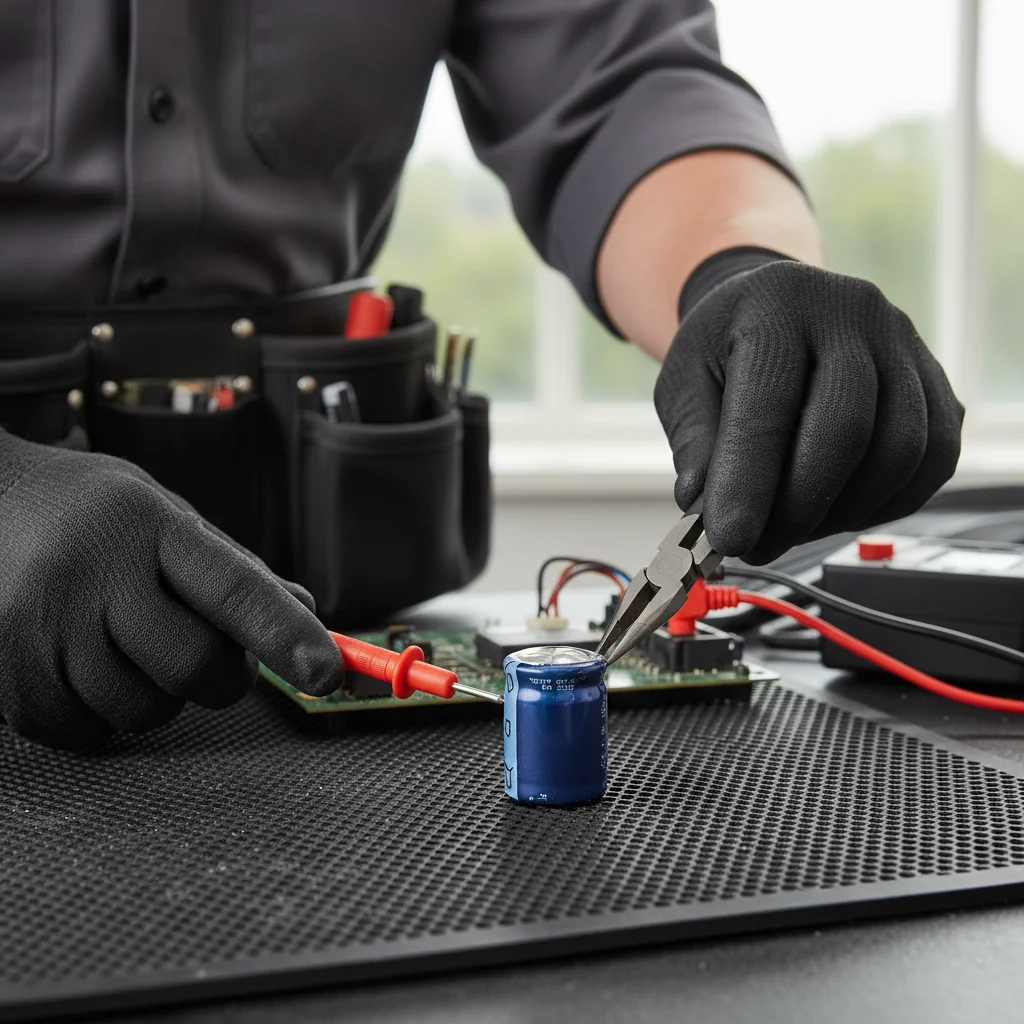
A thorough technician will always use a multimeter to check the amp draw of the fan motor and the compressor after installing a new capacitor. If the readings are higher than the manufacturer’s specifications, it’s a clear sign that the motor itself is failing. This allows you to make an informed decision about a more significant repair or replacement, rather than getting stuck in a cycle of repeated, ineffective “band-aid” fixes.
When to call us
Working with AC capacitors is dangerous. They store a powerful electrical charge even when the power to the unit is off. Mishandling one can result in severe electrical shock. This is a job that should always be left to a qualified, licensed HVAC professional.
If you suspect your AC has a bad capacitor, don’t risk injury. The team at Climate Pros can safely diagnose the issue, check for underlying problems, and get your cool air running again quickly.
Call us at (858) 925-5546 for a same-day estimate.