TL;DR
- Check 7 things before calling a tech: thermostat settings, both breakers, outdoor disconnect, air filter, frozen coil, outdoor unit airflow, and condensate drain line.
- A clogged air filter is the single most common cause of “AC not cooling” calls, replace it if you can’t see light through it.
- A failed run capacitor is the most common failure technicians find when homeowner checks don’t solve it. Ask for the named part.
- If the breaker trips a second time after resetting, stop, something is wrong and forcing resets causes more damage.
An AC that runs but blows warm or weak air is most often a dirty air filter, a tripped breaker, a clogged condensate drain, frozen evaporator coils, or low refrigerant, in that order. The first three you can check yourself in minutes. The last two need a technician. A clogged filter is the single most common cause. About half of these calls get solved by the homeowner in 90 seconds.
The outdoor unit is humming. The thermostat is calling for cool. Warm air is coming out of the vents anyway. Before you pay a diagnostic, run this checklist. Climate Pros SD matches licensed companies. We do not publish a repair menu.
If anything on this list makes the AC feel dangerous, sparking, burning smells, water dripping into light fixtures, stop and call. Otherwise, read on.
Ranked causes: most common to least
Here are the causes we see most often, ranked, with whether you can fix it yourself and what it costs in San Diego. The first three are free or near-free homeowner fixes. The bottom four need a tech.
| Rank | Cause | Fix it yourself? | What to ask |
|---|---|---|---|
| 1 | Dirty air filter (freezes the coil) | Yes | Filter size and MERV |
| 2 | Thermostat set wrong (mode, setpoint, fan on) | Yes | Free |
| 3 | Tripped breaker or pulled outdoor disconnect | Yes, reset once | Free |
| 4 | Failed run capacitor | No | Named part and diagnostic fee |
| 5 | Clogged condensate drain (trips float switch) | Sometimes, wet-dry vac | Cleaning vs pan |
| 6 | Low refrigerant from a leak | No | Leak search vs recharge |
| 7 | Failed compressor or contactor | No | Contactor vs compressor are different tickets |
In coastal San Diego, salt air corrodes outdoor condenser fins and contactors faster, so capacitor and contactor failures show up earlier here than inland. Inland homes from El Cajon to Escondido run their systems harder in summer heat, which pushes refrigerant leaks and frozen coils up the list. SDG&E’s high summer rates mean a system that runs constantly without cooling is also burning money, fix it fast.
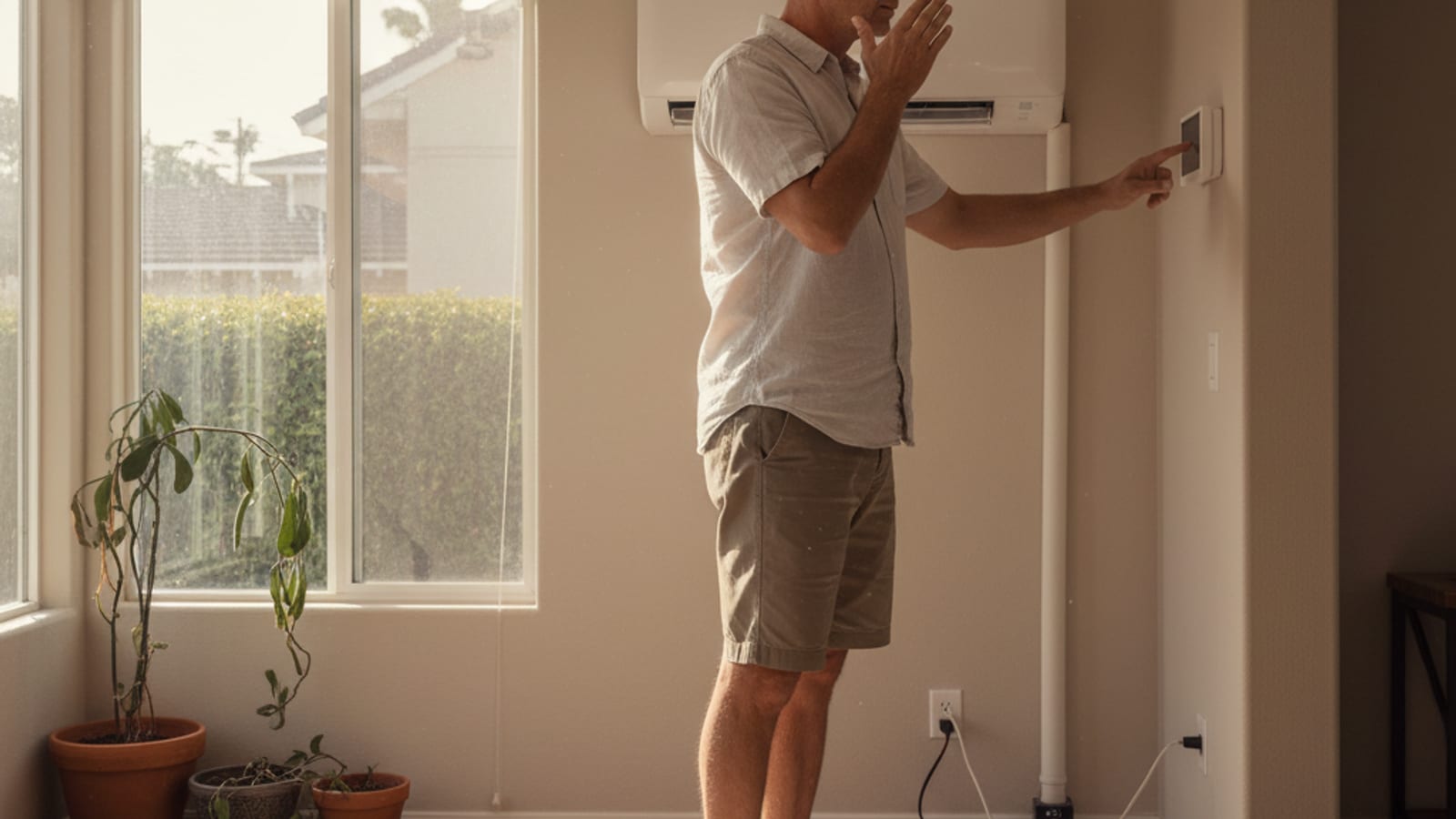
1. Check the thermostat. All of it.
This sounds dumb. It’s the single most common “fix.” Check:
- Mode. Set to COOL, not OFF, FAN, or AUTO (AUTO switches to heat when room is cool). If somebody bumped it, nothing else matters.
- Setpoint. Set to at least 3°F below current room temperature. The system won’t start if setpoint is already met.
- Fan setting. AUTO means the fan runs when cooling. ON means the fan runs constantly (which pushes warm air when the compressor isn’t running, a common “why is warm air coming out?” cause).
- Batteries. If your thermostat is battery-powered, dead batteries mean no signal to the AC. Swap them.
- Breaker to the thermostat. Some smart thermostats are wired to a furnace circuit. If that breaker tripped, the thermostat looks dead.
2. Check the breakers. Both of them.
Your AC has two breakers: one for the indoor blower (usually labeled “furnace” or “air handler”) and one for the outdoor condenser (usually 30–50 amp, double-pole).
Go to your main panel. If either breaker has tripped, it will be slightly out of line with the rest, usually a middle position between ON and OFF. To reset: flip it fully to OFF, then fully to ON.
If a breaker trips a second time within minutes of resetting, stop. Something is wrong with the electrical or the equipment, and forcing repeated resets can damage both. If the issue turns out to be the breaker or wiring rather than the AC unit itself, a licensed electrician we work with can handle the electrical diagnosis and repair. Either way, that’s a call.
3. Check the disconnect at the outdoor unit.
Next to your outdoor condenser, there’s a small metal box mounted to the wall. That’s the disconnect. Open it. There should be a pull-out block or a switch inside, in the ON position. Sometimes during yard work, someone accidentally pulls or flips this, or the block gets dislodged.
If it’s pulled out, push it back in (right-side up, there’s an orientation). If it’s a switch, flip it to ON.
4. Replace the filter.
A clogged air filter restricts return airflow, which causes the indoor coil to freeze, which blocks airflow further, which ends with a system that runs but produces zero cool air. (For a deeper dive on filter timing and MERV ratings, see our HVAC filter guide.)
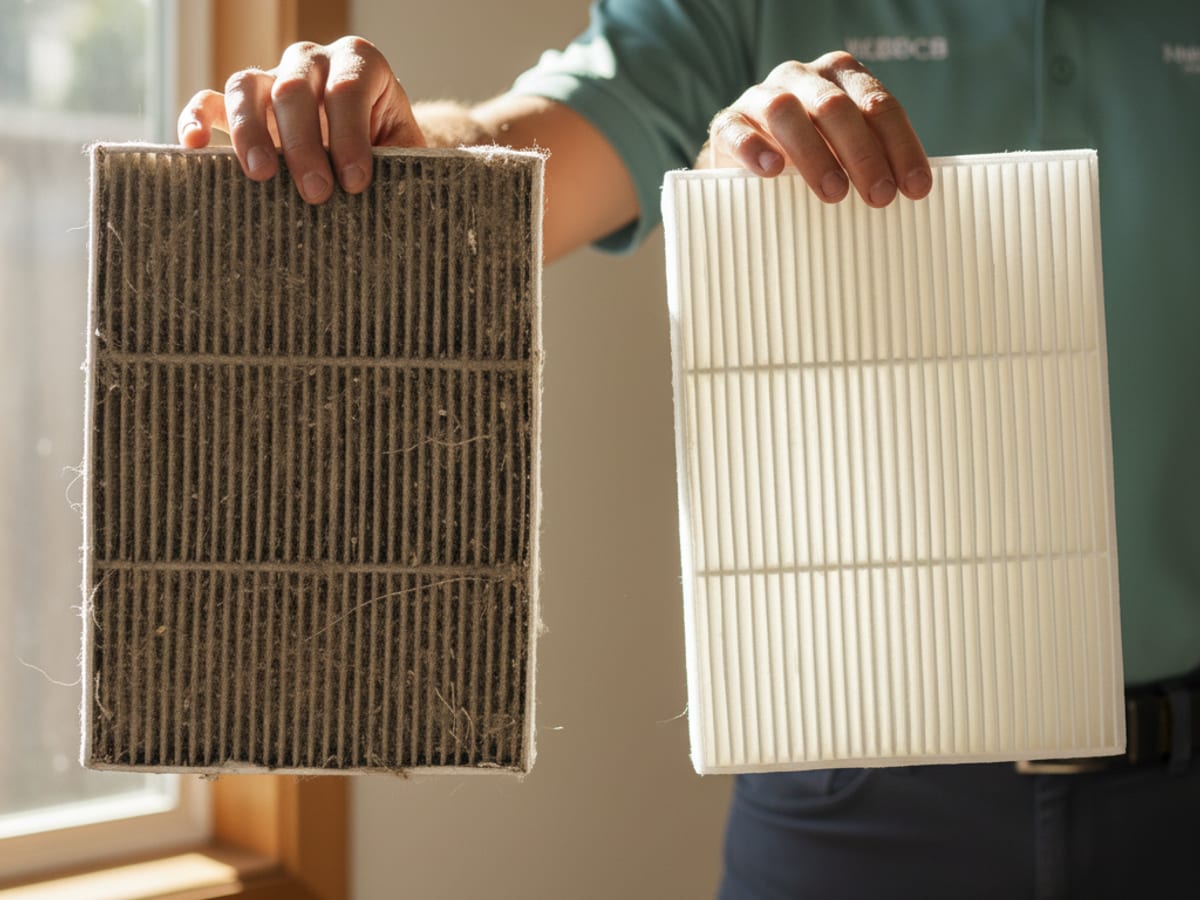
Find your filter slot (usually at the return air grille on a wall or ceiling, or in a slot on the side of your furnace/air handler). Pull the filter. If you can’t see light through it, it’s too dirty. Replace with a MERV 8 to MERV 11 filter of the exact same size.
If you haven’t changed it in 6+ months, it’s the problem.
5. If the indoor coil is frozen, turn the system OFF and wait.
Open the access panel on your indoor unit (the furnace or air handler, usually in a closet, garage, or attic). If you see ice on the copper tubing or on the coil itself, the system has frozen. Running it frozen will burn out the compressor.
Shut the AC off at the thermostat. Switch the fan to ON (to help it melt). Wait 2–4 hours. Once the ice is completely gone, try running cooling again. If it freezes again within 30 minutes, something’s wrong, usually low refrigerant, a failed blower, or a dirty coil, and you need AC repair.
6. Check the outdoor unit is getting airflow.
Walk around your outdoor condenser. Is grass, dryer lint, cottonwood fluff, or leaves caked against the coil fins? Is anything sitting on top of the unit? Is a tarp or cover still on from winter?
The outdoor unit needs at least 2 feet of clearance on all sides and clear airflow through the fins. If the fins are dirty, spray them gently with a garden hose (low pressure, straight down the fin direction, not against it). Let it dry for 30 minutes before restarting.
7. Check the condensate drain line.
Many systems have a float switch in the condensate drain pan that shuts down cooling if the drain backs up (to prevent water damage). A clogged condensate drain is the second most common reason modern systems “won’t cool.”
Find your indoor unit’s drain line, a white PVC pipe, usually ¾”. If you can see the drain pan under the coil, check if it’s full of water. If it is, the drain is blocked.
A wet-dry vacuum on the outdoor end of the drain line (where it exits the house) usually clears it. Suction hard for 1–2 minutes.
What if you’ve checked everything and the AC still won’t cool?
At this point you’ve ruled out the common homeowner-fixable causes. Remaining possibilities include a failed run capacitor, a bad contactor, low refrigerant (a leak somewhere), a failed compressor, or a bad control board. These are tech jobs, you need gauges, a multimeter, and in some cases recovery equipment. A spring AC tune-up catches most of these before they strand you on a hot day.
Call us. The pro sets the diagnostic fee and confirms it with you before the visit. No-cool calls get worked into the schedule ahead of routine maintenance across most of San Diego County.
A failed run capacitor is far and away the most common failure we find, a small part and a 15-minute fix when caught early. Left to fail completely in a heat wave, the same neglect often takes out the compressor too. Regular HVAC maintenance catches weak capacitors before they fail.
Frequently asked questions
Why is my AC running but not blowing cold air?
The most common cause is a clogged air filter restricting airflow, which freezes the evaporator coil. Other possibilities include a tripped breaker, a pulled outdoor disconnect, a failed run capacitor, or low refrigerant from a leak. Start with the 7-item checklist above before calling a tech.
How much does an AC diagnostic cost in San Diego?
Most San Diego contractors charge a flat diagnostic fee, credited to the repair if you proceed. Beware of “free diagnostic” offers, they’re usually a sales pitch for a full system replacement, not an honest troubleshooting visit.
What is the most common AC repair?
A failed run capacitor. It’s a small part and a 15-minute fix when caught early. Left too long, a bad capacitor can take out the compressor, turning a quick repair into a replacement.
Should I reset my AC breaker if it trips?
Reset it once: flip fully to OFF, then fully to ON. Our step-by-step AC reset guide covers the full safe sequence, including the 30-minute wait that protects the compressor. If the breaker trips a second time within minutes, stop. Repeated resets on a tripping breaker can damage the equipment and the wiring. That’s a call for a technician.
Why won’t my AC cool to the set temperature in San Diego summer?
If the AC runs but never reaches the setpoint, the system is undersized for the load, low on refrigerant, or fighting a dirty coil or filter. In San Diego, inland homes from El Cajon to Escondido see this most during 90°F+ stretches. A properly working system should drop indoor temps about 1°F every 15 to 20 minutes when it’s 85°F+ outside. If it can’t keep up after the checklist, you likely have low refrigerant or a capacity problem. That needs AC repair.
How long should I wait before calling a tech if my AC isn’t cooling?
If you’ve gone through the 7-step checklist and the system still isn’t cooling within 30 minutes of full operation, it’s time to call. The most expensive mistake is running a struggling system for hours hoping it’ll catch up, that’s how a failed capacitor turns into a compressor. In San Diego summer heat (85°F+ outside), most properly functioning systems should drop indoor temps 1°F every 15-20 minutes.
Why is my AC working in some rooms but not others?
That’s usually a duct or airflow problem, not a system failure. Closed registers, blocked returns, leaky ducts in the attic, or undersized ducting for a remodeled room are the most common causes. Run the fan only and feel each register, if airflow is weak in problem rooms, the issue is in the ducts. A blower-door and duct-leakage test pinpoints the loss. Adding a return-air pathway often fixes the worst rooms. Ask for those scopes in dollars.
If the AC is freezing up rather than just not cooling, that’s a different diagnosis, see why your AC freezes up and how to fix it. Want to prevent these calls entirely? A spring tune-up checklist catches most failures before they strand you. And if your system is older, a maintenance contract may be worth the math.
Need a match? Call (442) 777-6440. Climate Pros SD does not dispatch a truck, does not offer a free diagnosis, and does not promise same-day arrival. The matched company confirms timing. After-hours work is emergency HVAC if the assigned company offers it.
We serve Oceanside, San Marcos, La Mesa, Santee, Encinitas, and all of San Diego County. Not sure this is your symptom? Our HVAC symptom finder matches what the system is actually doing to the likely cause.