Here’s how to reset an AC unit the right way. Turn the thermostat to off. Go to your electrical panel and flip the AC breaker off, then wait a full 30 minutes. Flip the breaker back on. Set the thermostat back to cool. That’s the whole sequence, and the 30-minute wait isn’t optional filler, it’s the time the compressor’s internal overload switch needs to cool down and reset, and the time the refrigerant pressure needs to equalize between the high and low sides of the system. A reset is safe when the system just needs a clean restart after a power blip or a thermostat glitch. It’s not safe, and it won’t hold, when something inside the system is actually failing. If your AC trips again right after you reset it, that’s a fault, not a fluke.
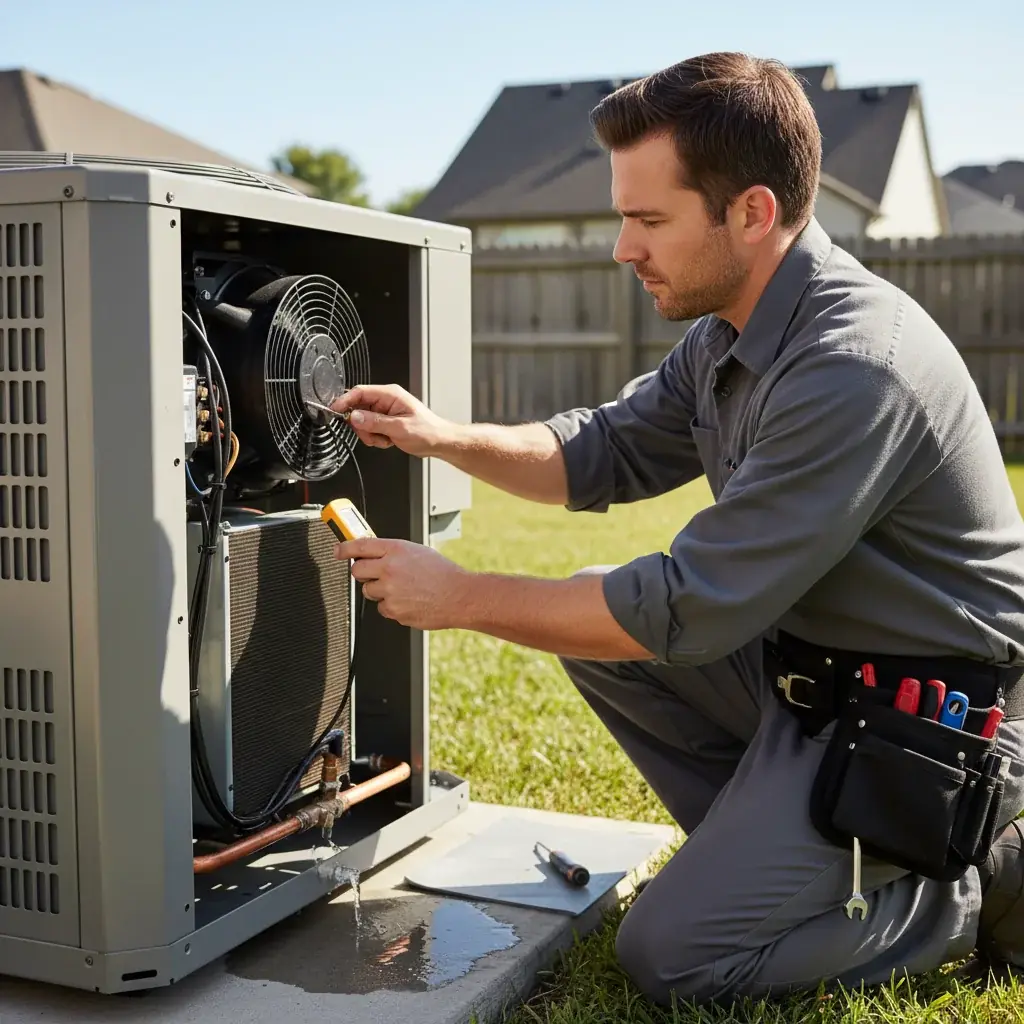
Reset sequence that protects the compressor
Thermostat Off, AC breaker Off for 30 minutes, breaker On, thermostat Cool. One attempt. Inland heat-wave outages and PSPS events in Ramona, Alpine, and Julian are the usual legitimate reset cases. A reset that trips again is a fault. Climate Pros SD does not diagnose in one visit. The matched C-20 contractor does.
Checklist
- Do not tape a safety switch.
- Wait the full 30 minutes on split systems.
- If you smell burned plastic, stop.
- See AC after power outage.
- See AC tripping breaker.
Related: AC repair and emergency HVAC.
When is it safe to reset your AC?
A reset is worth trying when the cause is something external and temporary. A short power blip during a heat-wave afternoon when SDG&E grid demand spikes. A brief outage from an SDG&E Public Safety Power Shutoff event in a fire-weather area like Ramona, Alpine, or Julian. A thermostat that froze up after a firmware update or a dead battery. In all of these cases, nothing inside the AC itself is broken. The system just needs a clean power cycle to clear whatever confused state it landed in.
A reset is not the answer when the AC was running fine, then stopped on its own with no outage, no thermostat issue, and no obvious trigger. That pattern points to something inside the unit, a capacitor, a refrigerant problem, or a compressor under stress. Resetting in that case doesn’t fix anything. It just delays the diagnosis while the underlying problem gets worse.
How do you reset an AC at the breaker?
This is the version that actually works, not the “flip it and hope” version.
- Set the thermostat to off. This stops the system from calling for cool the instant power comes back, which protects the compressor from a hard restart under load.
- Find your electrical panel and locate the AC breaker. It’s usually labeled and rated 30 to 60 amps, larger than your lighting circuits.
- Flip the breaker off and wait 30 minutes. This is the step people skip, and it’s the one that matters most. The compressor has an internal overload switch that trips when the motor runs hot. That switch needs time to cool and reset on its own. The refrigerant charge also needs time to equalize pressure between the high side and low side of the system, which protects the compressor from trying to start against unequal pressure.
- Flip the breaker back on.
- Set the thermostat back to cool, a few degrees below the current room temperature so it calls for cooling right away.
- Listen and watch for the next 5 to 10 minutes. The outdoor unit should hum on, the fan should spin, and cold air should start moving from the vents within a few minutes. If it trips again during this window, stop. Don’t do a second reset.
Does your AC have a reset button?
Most residential split-system condensers don’t have a dedicated reset button. What people usually mean when they ask this is one of two things. Some outdoor units have a high-pressure safety switch, sometimes called a high-limit switch, with a small red manual-reset button on the switch itself, usually near the refrigerant lines inside the condenser cabinet. If your system has one and it’s tripped, you’ll see the button popped out. Pushing it back in resets that specific safety, but if it trips again, the system is running high head pressure and needs a real diagnosis, not another push of the button.
The other thing people call a “reset button” is actually just the breaker at the electrical panel, which is the sequence above. A few smart thermostats also have a software reset in their settings menu, useful for a frozen display, but that only resets the thermostat, not the AC itself.
Never bypass, tape down, or hold in a safety switch to keep the system running. Those switches exist to stop the compressor before it destroys itself or starts a fire in the disconnect box.
What if the AC trips again after a reset?
That’s your answer. A system that trips once, from an outage or a thermostat glitch, and then runs fine for weeks was a fluke. A system that trips again within minutes or hours of a reset has a real fault, most commonly a weak capacitor, a dirty condenser coil making the compressor work too hard, or a compressor that’s shorting internally. We cover all three causes with real San Diego repair costs in AC keeps tripping breaker: causes and fixes. Read that next if your reset didn’t hold.
One reset attempt is the limit. Resetting a breaker over and over on a system with a real fault risks welding the contactor contacts shut, cooking the compressor’s start winding, or damaging the electrical panel itself.
When should you stop resetting and call?
Stop and call for service if any of these are true:
- The breaker trips again within minutes of the reset
- You smell burning plastic or hot metal near the outdoor unit or the disconnect box
- You see scorch marks on the breaker, the disconnect, or any wiring
- The high-pressure safety switch trips a second time after you reset it
- The system runs but blows warm air, which means the trip wasn’t the real problem
Any one of these means the reset already told you what you needed to know. The system has a fault. The next step is a licensed diagnostic, not another 30-minute wait. Request AC repair or emergency HVAC through Climate Pros SD. Availability is set by the matched contractor, not a same-day promise from this site.
Climate Pros SD is a referral service. It matches you with a licensed C-20 contractor. That company diagnoses and quotes. Climate Pros SD does not repair or install. Call (442) 777-6440.
Frequently asked questions
How long should I leave my AC breaker off before resetting?
30 minutes minimum. That’s the time the compressor’s internal overload switch needs to cool and reset, and the time refrigerant pressure needs to equalize. Resetting sooner, even after 5 or 10 minutes, can send the compressor into another hard start against unequal pressure and trip the breaker right back.
Can I reset my AC without turning off the breaker?
Turning the thermostat off and back on resets the thermostat, not the AC unit itself. If the AC tripped its breaker or its internal safety switch, cycling the thermostat alone won’t clear that. You need the breaker cycle described above.
Is it bad to reset my AC too many times?
Yes. One reset is reasonable to rule out a fluke. Resetting repeatedly on a system with a real fault risks welding the contactor shut, burning out the compressor’s start winding, or damaging the panel. If it trips twice, stop resetting and schedule a diagnostic.
Why does my AC keep shutting off after a power outage?
Coastal and inland San Diego both see brief outages during heat waves when SDG&E grid demand peaks, and fire-weather areas see planned PSPS shutoffs. Either can leave the AC in a tripped or confused state that a proper reset clears. If it keeps shutting off after multiple outages, or shuts off with no outage at all, that’s a separate issue worth a real look.
Will resetting my AC fix it if it’s not cooling?
Only if the underlying cause was a power blip or thermostat glitch. If the AC resets, runs, and still blows warm air, the reset wasn’t the fix, you have a cooling problem underneath it. Our AC not cooling checklist walks through those causes in order of likelihood.
Do window or portable AC units reset the same way?
Mostly, yes. Unplug the unit at the wall outlet instead of the breaker, wait 5 to 10 minutes (these smaller compressors don’t need the full 30), then plug back in and power on. If a window unit trips a GFCI outlet, reset the GFCI as well as the unit’s own power switch.
Related service: AC installation. Not sure this is your symptom? Our HVAC symptom finder matches what the system is actually doing to the likely cause.