If your AC won’t run after a power outage, do three things first. Reset the tripped breaker once, wait five full minutes before you restart the system, and check that the thermostat still has power and is set to cool. Most units come back on their own after a clean outage. If the power flickered, browned out, or came back in surges, the odds of real damage go up, and a compressor or capacitor that took a voltage hit needs a technician.
Power went out in the heat, came back an hour later, and now the AC just sits there. That’s one of the most common calls we get in a San Diego summer, especially during a heat wave when SDG&E is straining and outages roll through neighborhoods. This guide walks through why it happens, the checks that fix it safely, and the signs that mean the outage cost you a part.
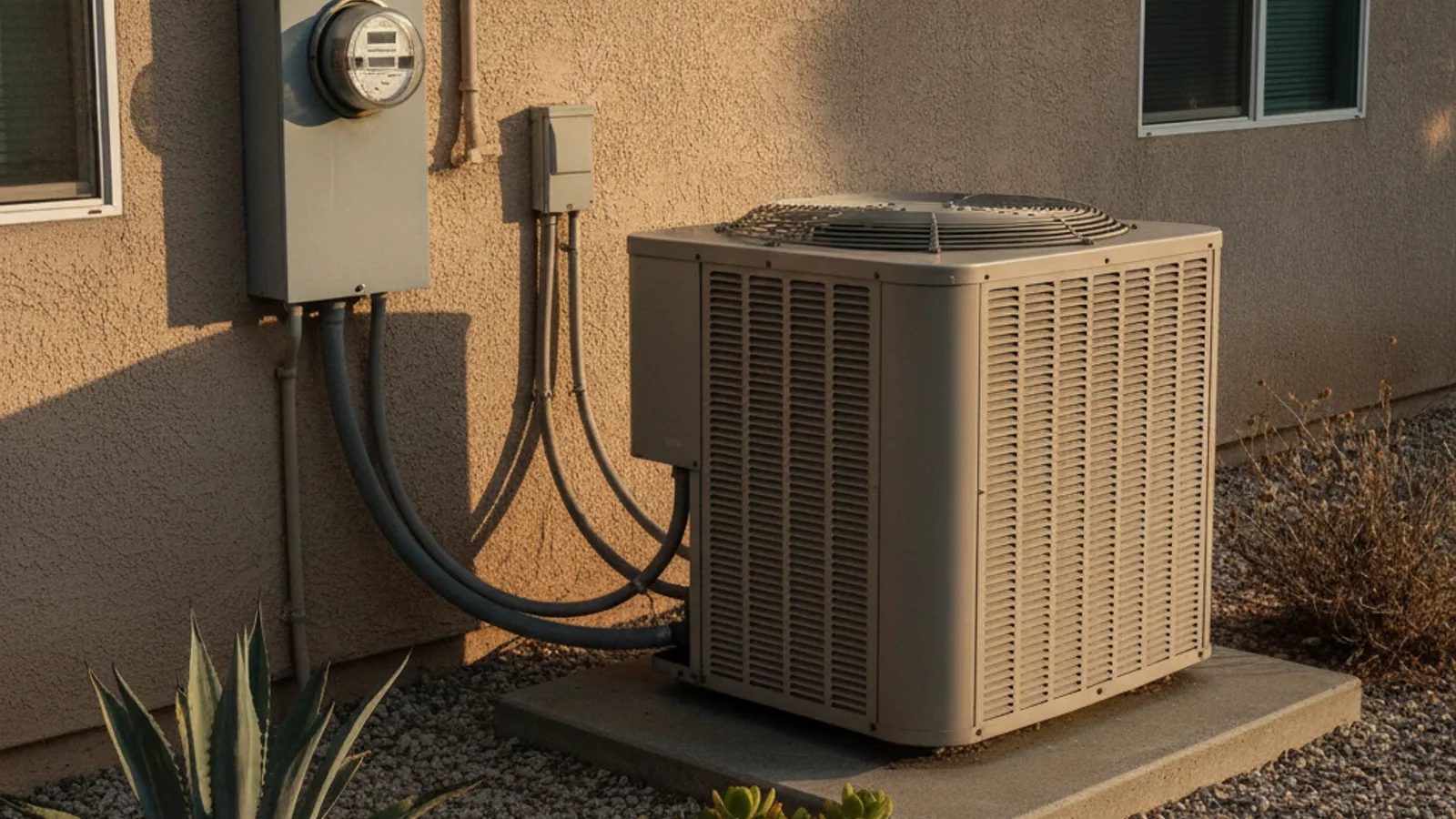
After an SDG&E outage, do this once
Reset a tripped AC breaker one time, wait five minutes before calling for cool, and confirm the thermostat still has power and is set to Cool, not Off or Heat. Heat-wave afternoons and PSPS events in fire-weather areas both leave compressors on overload. A second reset while the breaker is still hot can damage the compressor.
Checklist
- Photograph the breaker position before you flip it.
- Wait the full cool-down if the outdoor unit was running when power died.
- Check the outdoor disconnect is pushed fully on.
- Smell for burned plastic at the disconnect before restarting.
- If it trips again, stop and use the AC tripping-breaker guide.
Related: How to reset an AC and emergency HVAC.
Why won’t my AC turn on after a power outage?
An outage stops your AC for one of three reasons. The simplest is a tripped breaker. When power drops and returns, the surge can flip the AC’s breaker, and the system stays dark until you reset it. The second is the thermostat. Battery models can lose their settings or their charge during an outage, and a blank screen reads as a dead AC. The third, and the one that costs money, is a damaged component. A hard restart or a voltage spike can take out the capacitor, the contactor, or in a bad case the compressor.
Start with the easy two. They fix most outage calls in under ten minutes and cost nothing.
Quick checks to run before you call
Work these in order. Stop the moment the AC comes back on.
Wait five minutes before you do anything. This is the step people skip, and it matters most. Your compressor needs internal pressures to equalize before it restarts. Restarting too fast makes it work against high pressure, which trips it off or damages it over time. Many modern systems have a built-in delay for exactly this reason. Give it five minutes.
Reset the breaker once. Find your electrical panel. Look for the AC breaker sitting between on and off, or flipped fully to off. Push it all the way off, then firmly back on. If it holds, set the thermostat and wait for the system to start. If it trips again right away, stop. That’s a fault, not a fluke, and repeatedly resetting it is unsafe. Our guide on an AC that keeps tripping the breaker covers what that usually means.
Check the thermostat. Confirm the screen is lit and set to cool, with the target a few degrees below the room temperature. If it’s blank, replace the batteries. A smart thermostat may need a minute to reconnect to WiFi after power returns, but it should still call for cooling without it.
Look for the condenser reset switch. Some outdoor units have a small reset or disconnect near the condenser. If yours has a pull-out disconnect by the outdoor unit, make sure it’s seated fully. A jolt can loosen it.
If all four check out and the AC still won’t cool, the outage likely damaged a part. Our AC won’t turn on troubleshooting guide walks through the rest before you book a visit.
Can a power outage damage your AC?
Yes, though a clean outage rarely does. The real damage comes from what happens around the outage, not the outage itself.
A surge is the dangerous one. When power snaps back after a line fault, it can return as a spike well above normal voltage. That spike can fry the capacitor, weld the contactor closed, or stress the compressor windings. If your lights flickered hard or bulbs popped when power returned, suspect a surge.
A brownout is the quieter threat. Instead of going fully dark, voltage sags below normal for a stretch. This happens across San Diego during peak heat, when the grid is maxed and everyone’s AC is running. Low voltage forces the compressor to pull more current to do the same work, which overheats the motor and cooks the capacitor. Brownout damage often shows up as an AC that hums but won’t start, which usually points to a failed start capacitor.
Why brownouts hit San Diego AC units harder
San Diego’s grid gets pushed to its edge on the exact days you need AC most. During a heat wave, demand climbs, SDG&E manages load, and neighborhoods see rolling outages and voltage sags. Inland cities like Escondido, El Cajon, and Santee run hotter and see it worse than the coast.
A common pattern: an afternoon outage during a heat event, power returns, and a worn capacitor finally quits. The outage exposed the weakness. After an outage the repair is often that part on an older system, which is why a unit that already limped through summer is the one that dies when the grid hiccups. You can track live outages on your street at SDG&E’s outage map.
How to protect your AC from the next outage
You can’t stop San Diego outages, but you can keep them from taking out your system.
Turn the AC off at the thermostat when the power goes out. This is the single best habit. With the system off, it can’t try to restart into a surge the moment power returns. Turn it back on five minutes after power is stable.
Add a surge protector. A whole-home surge protector at the panel, or a dedicated HVAC surge unit at the condenser, absorbs the spike before it reaches your compressor. It’s an inexpensive add compared to a compressor, and worth it on any system you plan to keep.
Consider a hard-start kit on an older unit. If your AC struggles to start after outages or in the heat, a hard-start kit gives the compressor a stronger initial jolt. It’s a fix for a symptom, not a cure, but it buys time on an aging system.
Keep up with maintenance. A capacitor tested and replaced before it’s on its last legs won’t be the part that fails during an outage. Most brownout casualties are parts that were already weak.
Not sure this is your symptom? Our HVAC symptom finder matches what the system is actually doing to the likely cause.
When to call a pro
Call for emergency AC repair if the breaker trips again after one reset, if the unit hums or clicks but won’t start, if you smell burning near the condenser or panel, or if you see scorch marks. Those all point to electrical or compressor damage that isn’t safe to keep testing.
At Climate Pros SD, we connect you with vetted local HVAC pros across San Diego County who prioritize active outages and heat-event no-cool calls ahead of routine scheduling. Call (442) 777-6440 for AC repair. If your house is already dangerously hot while you wait, our guide on what to do when your AC dies in a heat wave covers how to stay safe. For extended-outage planning, Ready.gov’s power outage guidance is a solid checklist.
Frequently asked questions
Why won’t my AC turn on after the power came back?
Usually a tripped breaker or a thermostat that lost power during the outage. Reset the AC breaker once, replace the thermostat batteries if the screen is blank, and wait five minutes before restarting so the compressor can equalize. If it still won’t run, the outage may have damaged the capacitor or contactor, which needs a technician.
Should I wait before turning my AC back on after an outage?
Yes. Wait at least five minutes after power is stable before restarting the AC. The compressor needs its internal pressures to equalize, and restarting too soon forces it to start against high pressure. That can trip the system off or shorten the compressor’s life. Many newer units build in this delay automatically.
Can a brownout damage my air conditioner?
Yes, and in San Diego it’s a common cause of summer failures. During a brownout, voltage sags below normal, so the compressor pulls extra current and overheats. That’s hard on the motor and the capacitor. A brownout that leaves your AC humming but unable to start usually points to a failed start capacitor, which a pro can replace quickly.
How do I protect my AC from power surges?
Turn the AC off at the thermostat during an outage so it can’t restart into a surge, and add a surge protector. A whole-home unit at the electrical panel or a dedicated HVAC surge device at the condenser absorbs spikes before they reach the compressor. On an older system, that protection costs far less than the parts it saves.
Who do I call if my AC won’t work after an outage in San Diego?
Call Climate Pros SD at (442) 777-6440. We connect you with vetted local HVAC pros across San Diego County who prioritize heat-event outages over routine scheduling. If the breaker keeps tripping, you smell burning, or the unit hums without starting, don’t keep testing it. Those are signs of electrical or compressor damage that needs a technician.