The San Diego sun can be relentless, and few things are more frustrating than flipping your thermostat to “cool” only to hear… absolutely nothing. Your AC isn’t just blowing warm air or short cycling; it’s completely unresponsive, leaving you to wonder if a costly repair is inevitable. Before you reach for the phone, there are several common, quick checks you can perform that often resolve the issue without needing a service call.
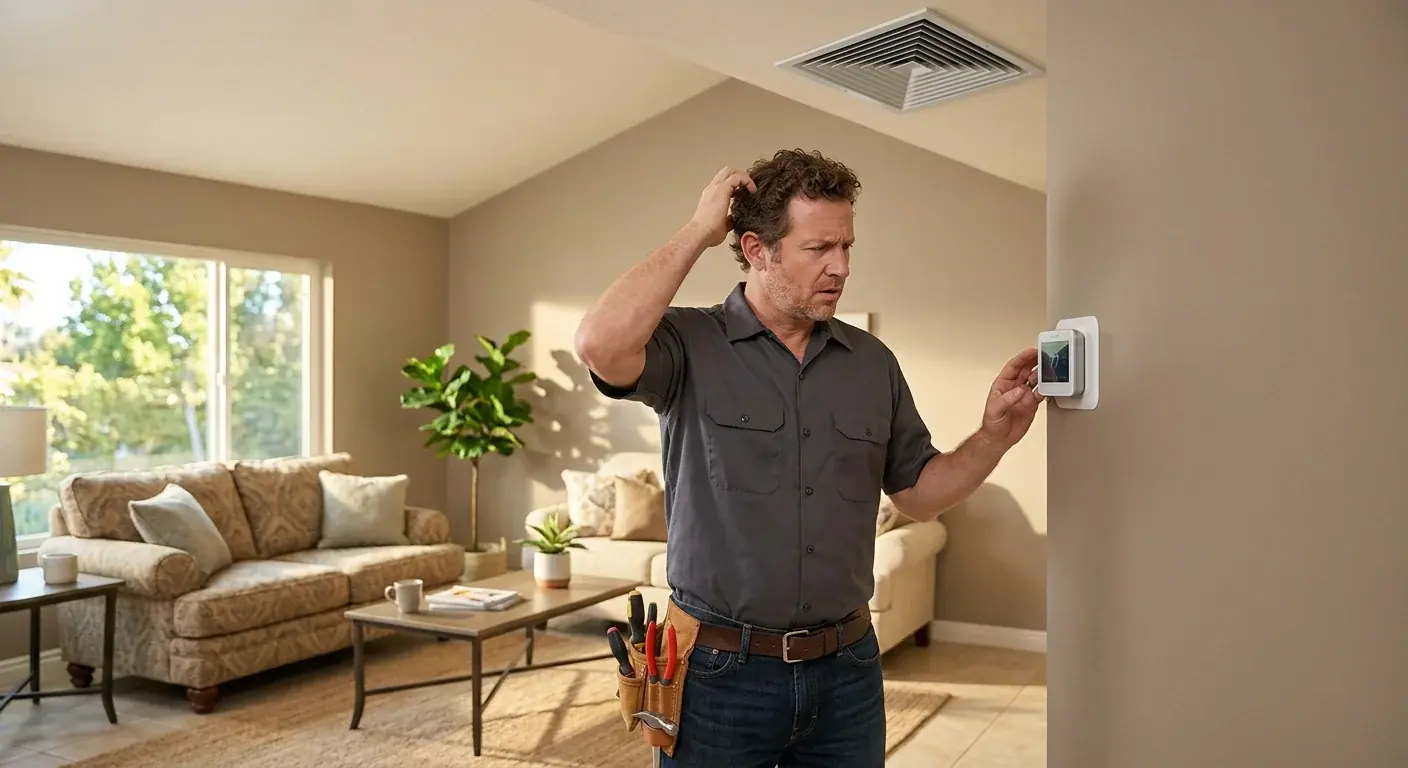
Thermostat and breaker checks that solve half of these calls
It’s amazing how often the simplest solutions get overlooked when you’re dealing with a silent air conditioner. Your thermostat and electrical breaker are the first places to investigate. They’re quick, easy, and require no tools or special skills.
Your thermostat: the brain of your AC
First, walk over to your thermostat. It’s the command center for your entire cooling system.
- Check the batteries: Many thermostats, even hardwired ones, use batteries for power or to retain settings. If the screen is blank or dim, try replacing the batteries. Make sure they’re inserted correctly.
- Confirm settings: Is your thermostat set to “cool” and not “heat” or “fan only”? Is the temperature setting below the current room temperature? Sometimes a family member accidentally switches modes or raises the set point.
- Look for a delay: Some smart thermostats have a built-in delay (often 5 minutes) after you adjust settings to protect the compressor from rapid cycling. Give it a few minutes after making changes.
Your electrical breaker: the system’s safety net
Next, head to your electrical panel, usually located in a garage, basement, or utility closet. Your AC system typically has two breakers: one for the indoor unit (furnace/air handler) and one for the outdoor unit (condenser).
- Locate the AC breakers: They’ll often be labeled “AC,” “furnace,” “air handler,” or “condenser.” They might also be large, double-pole breakers.
- Check for tripped breakers: A tripped breaker will be in the “off” or middle position, not fully “on.” Sometimes it’s subtle, so if you suspect one, gently push it all the way to “off” and then firmly back to “on.” Don’t just push it back to the “on” position if it’s already in the middle. Resetting it might restore power to your system.
- Understand why it tripped: A breaker trips to prevent electrical overload. While a one-off trip can be random, repeated trips might indicate a more serious electrical problem or a fault within your AC unit. If it trips immediately after resetting, don’t keep flipping it back on. This is a sign you need a professional to inspect the system.
The condensate float switch homeowners always miss
This is a clever little safety device that most homeowners don’t even know exists, yet it’s a very common reason for an AC system to completely shut down. Your air conditioner removes humidity from the air, and that moisture (condensate) drips into a drain pan. If this pan overflows, it can cause water damage. To prevent this, a float switch detects high water levels and automatically shuts off the entire AC system.
- Locate your condensate pan: This pan is usually beneath your indoor air handler or furnace, often in your attic, crawl space, or a utility closet. It’s designed to catch overflow water if the primary drain line gets clogged.
- Check the pan for water: If you see standing water in this auxiliary pan, it’s likely tripped the float switch. The system won’t turn on until the water is removed.
- Clear the pan and drain line: Carefully remove any standing water from the pan. You might need a wet/dry vac or a towel. Once the pan is clear, the float switch should reset itself, allowing your AC to turn back on. However, the standing water indicates a clogged primary condensate drain line. You might be able to clear a minor clog with a mixture of vinegar and hot water poured down the drain line (if accessible), or gently clearing any visible debris from the opening. For stubborn clogs, a professional can clear it safely and effectively. Failing to address the clog means the pan will just fill up again.
Outdoor unit silent: capacitor, contactor, or compressor
If your indoor unit (blower fan) is running, but the outdoor unit (condenser) isn’t kicking on at all, it usually points to a problem with one of three key components: the capacitor, the contactor, or in worse cases, the compressor itself. These parts are critical for getting the condenser fan and compressor motor to start and run.
- The start capacitor: This component provides the initial burst of electricity needed to start the compressor and condenser fan motor. If it fails, the outdoor unit simply won’t get the “kick” it needs to get going. A common symptom is a silent outdoor unit, or sometimes a faint humming sound without any fan movement. A swollen or leaking capacitor is often a visual indicator of failure. We detail this component more in our blog post on AC capacitor replacement in San Diego.
- The contactor: This is an electrical switch that allows high voltage to flow to the compressor and condenser fan when the thermostat calls for cooling. If the contactor is faulty, it won’t close properly, preventing power from reaching the outdoor unit. It can become dirty, pitted, or simply fail due to wear and tear.
- The compressor: The heart of your AC system, the compressor, circulates refrigerant. If the capacitor or contactor isn’t the problem, a silent outdoor unit could unfortunately mean a seized or otherwise failed compressor. This is the most serious and often most expensive repair, sometimes leading to an AC replacement if the unit is older.
These issues require diagnostic tools and specialized knowledge to pinpoint and repair safely. It’s not something we recommend tackling as a DIY project due to the high voltage and specific refrigerant handling requirements involved.
Indoor blower running but no cooling, what that means
This scenario is distinct from your AC not turning on at all. If your indoor unit’s blower fan is actively pushing air through the vents, but that air isn’t cold (or isn’t cold enough), your system is indeed running, but it’s not cooling effectively. This indicates a different set of problems than a complete power failure.
Here’s what it typically means:
- Low refrigerant: Your AC system might have a refrigerant leak, which reduces its ability to absorb heat from your home. This often leads to the system running continuously but failing to cool properly.
- Frozen evaporator coil: A dirty air filter, restricted airflow, or low refrigerant can cause the evaporator coil (inside your indoor unit) to freeze over. The ice acts as an insulator, preventing heat exchange and blocking airflow, making the system ineffective. You might see ice on the refrigerant lines or hear a dripping sound as it melts.
- Compressor issues (again): While a completely silent outdoor unit points to a compressor start issue, sometimes a compressor can run but still not be effectively compressing refrigerant. This would result in the indoor fan running but no cooling.
- Dirty coils: Over time, both the indoor evaporator coil and the outdoor condenser coil can get covered in dirt and grime. This buildup drastically reduces the coils’ ability to transfer heat, leading to poor cooling performance even if everything else seems to be running.
- Ductwork leaks: Leaks in your ductwork can allow cooled air to escape into unconditioned spaces (like attics or crawl spaces) before it reaches your living areas, making it feel like your AC isn’t cooling properly.
While a running fan but no cooling isn’t a “no power” scenario, it still indicates a significant problem that needs professional diagnosis and AC repair. If your unit runs but just won’t cool, give Climate Pros SD a call.
When it’s safe to keep trying and when to stop
Knowing when to keep troubleshooting and when to call in a professional is key to both your safety and avoiding further damage to your AC system.
It’s generally safe to perform the initial checks we discussed:
- Thermostat adjustments: Changing batteries, checking mode settings, and adjusting temperature are all completely safe.
- Breaker reset: Resetting a tripped breaker once is acceptable. If it immediately trips again, stop. This indicates a persistent electrical fault or an internal component failure that needs expert attention. Repeatedly resetting a tripping breaker can cause serious electrical issues or damage.
- Condensate pan check: Clearing water from a condensate pan is safe. Just be mindful of electrical components near the pan and avoid touching them.
However, once you move beyond these basic steps, it’s time to bring in the pros. Here’s why you should stop trying to fix it yourself:
- Electrical hazards: Working with high voltage components like capacitors or contactors without proper training and tools is extremely dangerous and can lead to severe injury or electrocution.
- Refrigerant handling: AC systems contain refrigerants that require specialized equipment and EPA certification to handle. Improper handling can release harmful chemicals and damage the environment.
- Complex diagnostics: Many AC issues, especially those involving the compressor or intricate electrical systems, require diagnostic tools and a deep understanding of HVAC mechanics to accurately identify the root cause. Guessing and replacing parts can be costly and ineffective.
- Warranty protection: Attempting DIY repairs on major components can void your manufacturer’s warranty.
For peace of mind and effective solutions, especially as San Diego’s cooling season ramps up, trust a licensed HVAC technician.
Related service: AC installation. Local coverage: all 67 cities we cover in San Diego County.
Not sure this is your symptom? Our HVAC symptom finder matches what the system is actually doing to the likely cause.
When to call us
If your AC still won’t turn on after checking the thermostat, resetting the breaker, and clearing the condensate pan, call Climate Pros SD. We will match you with a licensed local company for emergency HVAC or AC repair. We do not dispatch a truck, do not offer a free diagnosis, and do not promise same-day arrival. Call (442) 777-6440.