TL;DR
- When inland San Diego hits 95–105°F, AC failure rates run roughly 4x normal. Most of those failures were detectable a month earlier.
- Run this 9-point checklist by mid-June, before the first multi-day heat event (typically late June or early July).
- The single biggest predictor of heat-wave failure: a weak run capacitor reading 10–20% below nameplate. $40 part. $850 emergency call if it fails at 4 p.m. on a 102°F Tuesday.
- Have an emergency plan written before you need it. If the AC fails mid-event, you have 4–6 hours before the house gets dangerous for kids, elderly, and pets.
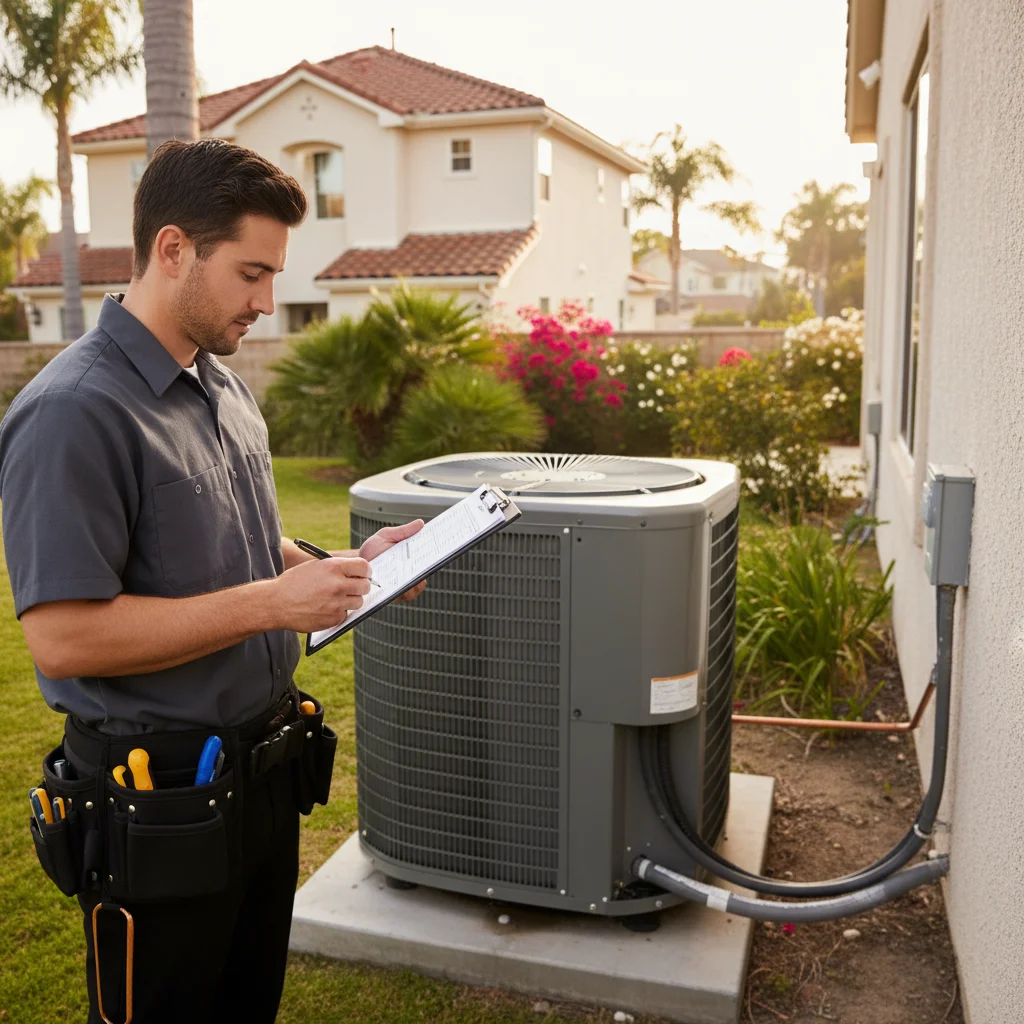
San Diego heat waves don’t last all summer. They come in 3–7 day bursts where inland zones hit 95–105°F and coastal zones hit 85–90°F. Those bursts are when ACs that have been limping along finally quit. Our emergency-call volume runs 3–5x normal during heat waves, and the failures are almost never random, they’re failures that were detectable in May.
This is the checklist to run in June, before the first event. It’s the summer counterpart to our spring AC tune-up checklist and pairs with our fall and winter versions.
Why heat-wave prep is San Diego-specific
Most national “summer AC prep” content assumes 90°F summers and central-state humidity. San Diego doesn’t have that pattern. We have:
- Inland zones (Escondido, El Cajon, Ramona, Lakeside) hit 95–105°F during 3–5 heat-wave days, then drop back to 80°F. The AC sits idle, then runs flat-out, then sits idle again.
- Coastal zones (Encinitas, Carlsbad, Coronado, Imperial Beach) rarely top 88°F, but humidity climbs to 65–75% during onshore-flow heat events. Comfort suffers more from latent load than sensible load.
- SDG&E peak rates (Time-of-Use 4–9 p.m.) are 3–4x off-peak. The heat-wave electric bill from a poorly programmed thermostat can be 2.5x the same week with smart pre-cooling.
- Multi-day events with overnight lows above 75°F mean the house never fully cools down. That stacks compressor runtime higher day-over-day and stresses already-weak components.
A national AC checklist won’t address smart thermostat pre-cooling for TOU rates or have a real emergency plan for “the AC died at 5 p.m. and it’s still 102°F outside.” This one does.
The 9-point heat-wave prep checklist
Run this by June 15. Most years the first heat event arrives between June 20 and July 10.
1. Book a proper AC tune-up (or verify spring’s still good)
If you didn’t do a spring tune-up, do it now. If you did, you’re probably fine, but verify two things:
- The tech measured and recorded the run capacitor microfarad reading (not just “looked at it”)
- Refrigerant pressures, superheat, and subcooling were measured and within spec
A real summer tune-up includes capacitor microfarad measurement, refrigerant pressures with superheat and subcooling math, condenser coil wash, blower amp draw, static pressure across the coil, and a filter change. It takes 60–90 minutes and runs $129–$199. See our tune-up cost breakdown for what’s a fair price versus a $79 special.
The single best heat-wave prediction: a run capacitor reading 10% or more below nameplate. That’s a $40 part replaced now vs. a $850 emergency call on a Tuesday afternoon when 12 of our trucks are on other emergency calls.
2. Verify refrigerant charge with measured pressures
Low refrigerant doesn’t show up at 80°F. It shows up at 95°F when the system can’t keep up. Symptoms during a heat wave:
- House holds 78°F but won’t get below 75°F no matter how long the AC runs
- Long runtimes with no actual cooling progress
- Frost forming on the suction line outdoors (yes, frost in a heat wave, the indicator of a starved evaporator)
A spring tune-up should have measured pressures. If it didn’t, or if you have any of those symptoms now, get a refrigerant check before the heat hits. Diagnostic + minor top-up runs $185–$385.
3. Change the air filter
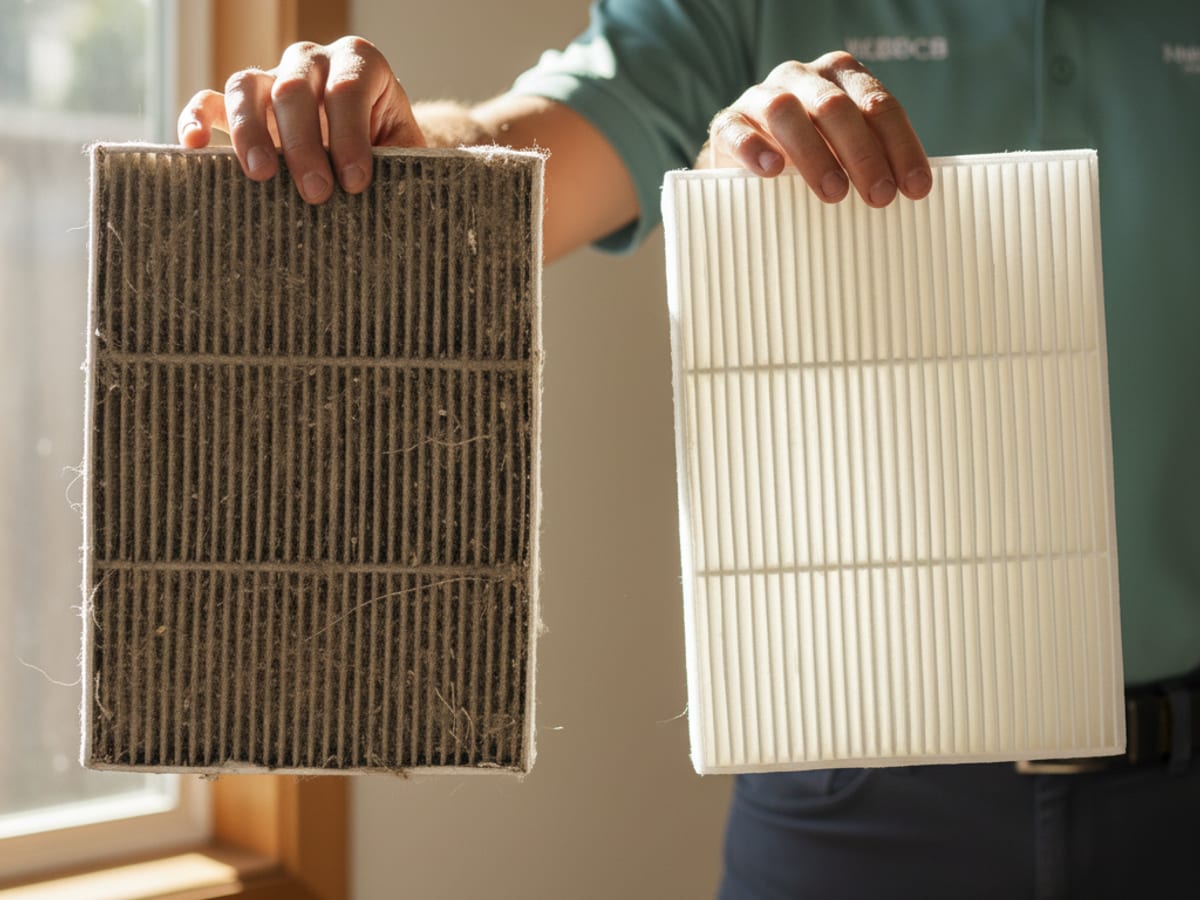
Cheapest item, biggest impact. A clogged filter cuts cooling capacity by 15–30% and forces the blower to draw 20–35% more amps to compensate. During a heat wave, that’s the difference between holding 76°F and running 24/7 at 82°F.
Use a MERV 8 to MERV 11 filter for summer (lower restriction than MERV 13). If you have allergies or a smoke event overlaps the heat wave, swap to MERV 13 temporarily. See our MERV guide for which to pick.
4. Wash the condenser coil
The outdoor unit’s coil is what dumps heat. If it’s coated in pollen, jasmine flowers, dust, and lawn debris, it can’t dump heat efficiently. That elevates head pressure, raises amp draw, and shortens compressor life.
How to clean it yourself (the basic version):
- Turn off power at the disconnect
- Remove debris from inside the cabinet (top fan removed if you’re comfortable, otherwise vacuum from outside)
- Spray with a garden hose, low pressure, from the inside-out (top-down if you can lift the fan)
- Let dry 30 minutes before re-energizing
If you don’t want to open the cabinet, hose the outside thoroughly. Won’t get the deep grime, but removes the surface layer that does most of the damage.
Professional version: chemical coil cleaner + low-pressure rinse + fin straightening. Usually included in a tune-up. Runs $95–$185 standalone.
5. Clear 2 feet around the outdoor unit (and check shading)
Standard item. Then check shading. A condenser in direct afternoon sun runs 5–10°F hotter at the coil than one in shade, which translates to 5–8% lower efficiency on the worst day of the year.
If your outdoor unit faces west or south with no shade, consider planting a deciduous tree 6–8 feet away (close enough to shade by July, far enough that roots aren’t a worry). Until that grows, a free-standing shade structure helps. Don’t tarp or wrap the unit, it needs airflow.
6. Program smart thermostat pre-cooling for TOU rates
This is the highest-savings move on the list. SDG&E’s Time-of-Use rate has on-peak (4–9 p.m.) at 3–4x the off-peak rate. During a heat wave that’s the most expensive 5 hours of the day.
The play:
| Time | Setpoint | Why |
|---|---|---|
| 10 AM to 2 PM | 70°F | Pre-cool during off-peak when grid is cheap |
| 2 PM to 4 PM | 71°F | Continue cooling on the shoulder rate |
| 4 PM to 9 PM | 76–78°F | Coast through peak; thermal mass holds you |
| 9 PM to 10 AM | 74°F | Recover and rest |
Done right, this cuts heat-wave week SDG&E bills 30–45% with no comfort loss. Nest and Ecobee both support this pattern (Ecobee has it as a built-in “Eco+” feature). See our smart thermostat installer guide for setup help.
Skip this if your home is poorly insulated, the thermal mass doesn’t carry through 5 hours of coast-mode.
7. Check supply registers, returns, and damper positions
Walk the house. Are all supply registers open? Returns unobstructed by furniture? If you have a zoned system, are the dampers in the right summer position?
One closed return in the master bedroom can cut total system airflow 15–25% and cause the rest of the house to overheat. Cheap fix, high impact.
8. Verify the float switch (condensate safety) actually works
The condensate float switch shuts the AC down if the indoor coil’s drain pan overflows. During a heat wave, indoor coil produces 1–4 gallons of condensate per day. If the drain line is clogged, the pan fills, and the float switch trips to prevent water damage.
Two failure modes:
- Float switch fails closed: AC keeps running, pan overflows, drywall damage. $1,200–$5,000 of repair.
- Float switch fails open: AC won’t start, but no water damage. $135–$275 to diagnose and clear.
Lift the float manually. The system should shut off within 30 seconds. If it doesn’t, the switch or wiring has failed. Easy fix in June, ugly fix in late July.
9. Write the emergency plan (do this now, not when the AC dies)
If your AC fails at 4 p.m. during a heat wave, you have 4–6 hours before the house gets dangerous for kids under 2, elderly residents, or pets. Have a written plan before you need it.
The plan should include:
- Phone numbers: HVAC contractor (us), pediatrician or doctor’s after-hours, neighbor with working AC who’d take in pets or kids if it’s a Saturday and we can’t reach you for 4+ hours.
- Where to cool off: Nearest indoor public space with AC. San Diego County opens designated cool zones at libraries and senior centers during declared heat events. Map them now, before you need them.
- Fans + ice: At minimum keep 2 box fans and 3 frozen 2-liter bottles in the freezer at all times during June through September. Cross-ventilation with fans + ice in front of them buys 3–4 hours of survivable indoor temp.
- Hydration: Adults need 1 liter every 1–2 hours during prolonged 95°F+ exposure. Kids and elderly need closer monitoring. Avoid caffeine and alcohol during a heat event.
- Window strategy: Close windows and curtains on the sun-facing side of the house from 10 a.m. to 6 p.m. Open everything once outdoor temp drops below indoor temp (usually 9–11 p.m. inland).
- Bathing/sponging: Cool (not cold) baths or wet washcloths to wrists, ankles, neck. More effective than people think.
- When to leave: If indoor temp climbs above 82°F and you have anyone under 2, over 70, pregnant, or with cardiovascular conditions, leave. Don’t wait it out.
Print that plan and tape it to the inside of a kitchen cabinet door. Don’t trust your memory at hour 4 of a 102°F day.
Heat-wave failure: caught now vs. failed mid-event
| Fault | Caught in June | Failed during heat wave |
|---|---|---|
| Weak run capacitor | $40 + $85 labor | $385–$850 emergency |
| Low refrigerant | $185–$385 | $385–$650 + same-day rate |
| Dirty condenser coil | $95–$185 | Compressor strain, possible $1,800+ damage |
| Clogged condensate drain | $135–$275 | $135 + drywall damage |
| Worn contactor | $125–$245 | $245–$425 emergency, sometimes with compressor damage |
| Failed blower motor | $385–$650 | $485–$1,200 emergency |
The dollar gap is real but the calendar gap matters more. In June, we’re there next day. During a declared heat event, every HVAC contractor in the county is booked 3–5 days out for non-emergency calls and prioritizing households with health risks.
What to do if the AC quits during a heat wave
Quick triage before you call (saves $135 diagnostic if it’s something simple):
- Check the thermostat: Batteries dead? Screen blank? Mode set to “Cool”? Setpoint below indoor temp?
- Check the breaker: Walk to the panel. Any breaker tripped? Reset once. If it trips again, stop and call.
- Check the air filter: If it’s solid black with dust, that’s the cause. Change it.
- Check the outdoor unit: Is the fan spinning? Cabinet humming but fan not turning? That’s a failed capacitor or motor.
- Check the indoor coil for ice: If frost or ice is visible on the suction line or indoor coil, turn the system OFF (cooling) and leave the fan ON for 30–60 minutes to thaw. Then call.
If none of those identify it, call. Don’t keep running the system, it’ll just damage more parts.
Frequently asked questions
When should I prep my AC for heat waves in San Diego?
Mid-June. The first multi-day heat event usually hits between June 20 and July 10. Prepping by June 15 catches the issues before they fail under load, while contractor availability is still normal. Once a heat wave is declared, emergency-only scheduling pushes routine work out 1–2 weeks.
Is a tune-up enough, or do I need to do more before a heat wave?
A spring tune-up handles 70% of it. The remaining 30% is homeowner tasks: filter change, condenser clearance, smart thermostat programming for TOU pre-cooling, float switch test, and writing the emergency plan. None of those is done by the technician.
How long can a house stay safe if the AC fails during a heat wave?
In inland zones during a 100°F event, a well-insulated house gains roughly 2–4°F per hour with the AC off. From a 76°F starting indoor temp, you have roughly 3–5 hours before indoor temp hits 85°F (the threshold where heat exhaustion risk climbs for kids and elderly). Older or less-insulated homes lose ground faster.
Should I close vents in unused rooms during a heat wave?
No. Closing more than 20% of supply vents raises static pressure on the system, reduces total airflow, and can freeze the evaporator coil. Counterintuitive but proven, modern AC systems are designed for full airflow. Use zoning or smart vents if you want room-level control.
What’s the best smart thermostat setting for heat-wave week with SDG&E TOU rates?
Pre-cool to 70°F by 4 p.m. (during off-peak hours), then let the house drift to 76–78°F during 4–9 p.m. peak. The thermal mass holds you through peak hours with the compressor mostly off. Net result: cooler at the start of peak, slightly warmer at the end, 30–45% lower week-over-week bills, no real comfort loss.
Are San Diego heat waves getting worse?
Yes. Multi-day events above 95°F inland used to average 2–3 per summer in the 1990s. The 2010s and 2020s have averaged 5–7. Overnight lows during heat events are also climbing, which is the bigger HVAC stressor (systems can’t cool off and reset between days). Heat-wave prep that was optional in 1995 is operational maintenance now.
Want a full June tune-up before the first heat event hits? Call us. Mid-June bookings are still 5–7 days out. Once the first heat wave is declared, that window closes fast.
We serve Escondido, El Cajon, Poway, Chula Vista, Vista, and all of San Diego County.