TL;DR
- San Diego fall is mild on average but ambushes homeowners with the year’s first cold mornings (low 40s inland), Santa Ana wind events, and late-season wildfire smoke, often in the same week.
- The 9-point fall checklist below catches what April’s spring tune-up doesn’t: heating-side faults that have been dormant for 6 months.
- Skipping a fall heating test costs $185–$650 in emergency repair markup if the system fails on the first cold morning instead of in October.
- Best window to run this: late September through mid-October, before the first Santa Ana event.
San Diego’s fall is sneaky. The afternoons stay 75°F into November, then one Tuesday morning the inland valleys drop to 43°F and your heat pump or furnace has to run for the first time in six months. If something’s broken, that’s when you find out.
This is the checklist to run in October, before the first cold morning, before the first Santa Ana wind event drives smoke through the county, and before furnace repair calendars fill up. It’s the fall counterpart to our spring tune-up checklist.
Why fall matters in San Diego specifically
Most national HVAC content assumes you’ve been heating since September. In San Diego, the system sits idle from late April through early October. Six months of dust, spider webs, rodent activity, and rubber components drying out. Then we ask it to run flawlessly the morning the marine layer breaks and an inland valley hits 41°F.
Three San Diego-specific risks stack in October and November:
- First cold morning: Inland zones (Escondido, El Cajon, Ramona, Julian) hit the low 40s overnight. Coastal stays milder. Climate Pros gets the call when the heat pump won’t reverse or the furnace won’t ignite, usually between 5:30 and 8 a.m. on a school day.
- Santa Ana wind events: Dry, hot, gusty offshore winds that strip humidity to single digits and elevate fire risk. They also drive dust deep into ductwork and outdoor coils.
- Late wildfire smoke: October is statistically the peak month for San Diego County wildfires (Cedar 2003, Witch 2007, Lilac 2017 all October–December). Smoke-mode HVAC protocol matters.
A fall checklist that ignores those three things is a national checklist with the word “fall” stamped on it. This one doesn’t.
The 9-point fall HVAC checklist
Run this yourself for the homeowner-doable items, and book the technician-side items by mid-October.
1. Run the heat for 30 minutes (homeowner test)
Pick a cool morning. Set the thermostat to “Heat” and raise the setpoint 5°F above the indoor temperature. Walk away for 30 minutes.
What you’re watching for:
- Heat at every supply register within 10 minutes
- No burning-dust smell that lasts longer than the first 15 minutes (initial dust burn-off is normal)
- No grinding, screeching, or rhythmic banging
- No tripped breaker after the cycle
- A heat pump should not be running in emergency-heat or aux-heat mode at 60°F outdoor temperature
If any of those fail, stop and call. Don’t run the system for days hoping it’ll smooth out.
Skipping cost: A cracked heat exchanger or failed igniter caught in October is a $185–$650 repair. The same fault on a 43°F morning in December, when you need same-day service, runs $450–$1,200 with emergency-rate markup.
2. Change the air filter
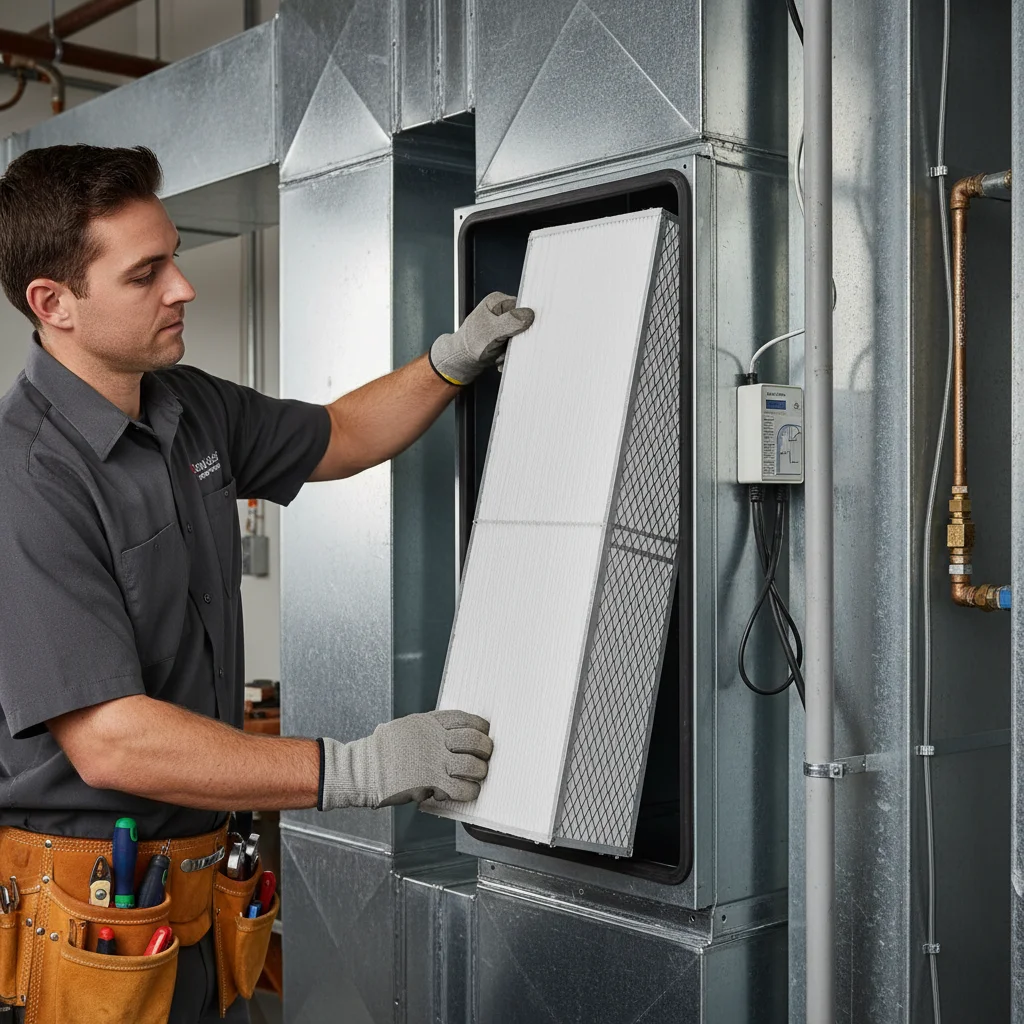
Standard fall item. Six months of summer cooling load fills filters with pollen, dust, and pet dander. Run a fresh filter into heating season so the blower isn’t fighting restriction on day one. See our MERV rating guide for picking the right one.
3. Test every CO detector and smoke alarm
Daylight Savings is your reminder. If you have a gas furnace, gas water heater, or gas range, CO detectors are not optional. Battery test, then a button test. Replace any unit older than 7 years (sensors degrade).
Skipping cost: Nothing, until it’s everything.
4. Schedule the heating-side tune-up
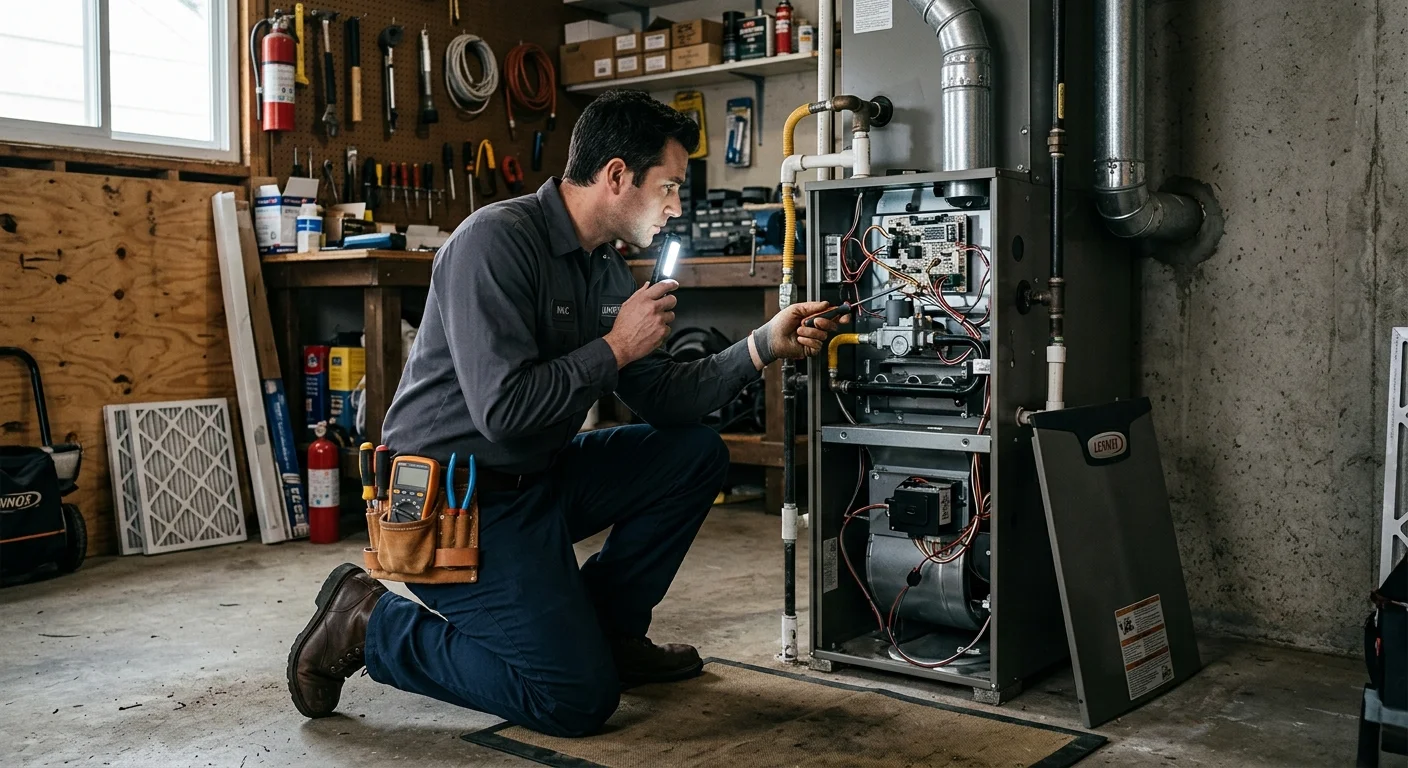
This is the technician item. A fall tune-up is not the same checklist as a spring AC tune-up. It includes:
- Heat exchanger inspection (gas furnace) for cracks, with a combustion analyzer reading CO at the flue
- Igniter resistance test and burner inspection
- Heat pump reversing-valve function test
- Defrost cycle test (for heat pumps)
- Gas pressure measurement at manifold (gas furnace)
- Combustion analysis: O2, CO, stack temperature
- Condensate drain check (high-efficiency 90%+ furnaces produce condensate)
A real fall tune-up runs $129–$199 single-visit, same range as spring. If you’re on a year-round plan, this is the second visit. See our maintenance cost breakdown for what’s a fair price versus a $79 special.
5. Inspect attic insulation (visual)
Pop the attic hatch on a cool morning. You’re looking for:
- Insulation that’s matted, displaced, or visibly thin in spots
- Daylight visible at the eaves (insulation pulled away from baffles)
- Rodent tunnels or nesting material in batts
- Ductwork lying directly on insulation, compressed (kills the R-value where the ducts sit)
San Diego homes built before 1990 frequently have R-19 attic insulation or less. Current Title 24 minimum is R-30 in our climate zone, and R-38 is the practical target. The difference between R-19 and R-38 on a 1,800 sq ft house is roughly 15–25% of heating and cooling load. That’s $200–$450/year on SDG&E.
If you can see joists, you have under R-19. Get it topped up before heating season.
6. Have ductwork inspected before heavy heating use
Summer cooling tolerates leaky ducts better than winter heating. Why? In summer, leaked cold air dumped into the attic just makes the attic less hot. In winter, leaked warm air dumped into the attic is wasted heat plus a moisture source. Same leak, worse winter outcome.
Symptoms that suggest leaks:
- Some rooms heat slowly, others overheat
- Heating bills disproportionately higher than neighbors with similar homes
- Visible duct sag, disconnections, or tape failure in the attic
A duct leakage test (pressurized) takes 60–90 minutes. See duct leak repair costs for current ranges.
7. Set up smoke-mode protocol on your HVAC
When the next wildfire smoke event hits (October is statistically the worst month), this is what should happen in the first 10 minutes:
- Close every window and exterior door
- Set the HVAC fan to “ON” (not “AUTO”) to circulate indoor air through the filter continuously
- If you have a fresh-air intake (some newer systems do), close or block it temporarily
- Use a MERV 13 filter for the duration of the event (a MERV 8 filter passes most smoke particulates)
- Avoid running bath fans or kitchen exhaust unnecessarily, they pull outdoor smoke in through every gap in the building envelope
Write that 5-point plan on a sticky note inside the thermostat panel door so the household knows what to do without thinking. See our wildfire IAQ guide for the full deep-dive.
8. Clear 2 feet around the outdoor unit, again
You did this in April for the AC tune-up. Re-do it in October. Six months of summer means jasmine vine has grown back into the condenser, dead leaves have piled up against the base, and someone’s stored a beach umbrella against it.
Heat pumps work in winter too (they don’t sleep like a straight AC), so this matters.
9. Review and reset the thermostat schedule for heating
Most San Diego homes leave the cooling schedule on through October. Reset it for heating:
- Wake setpoint: 68°F (lower than most assume, but adequate with sweaters and the body heat that builds during sleep)
- Day setpoint while away: 62°F (do not turn off entirely, the system has to work twice as hard to recover)
- Evening setpoint: 68°F
- Sleep setpoint: 62–64°F
Every degree of setback below 68°F saves 2–3% on heating load. The 6°F day setback saves 12–18% on heating bills with no comfort impact.
Fall checklist: homeowner vs. technician items
| Item | Who | Time | Cost |
|---|---|---|---|
| 30-minute heat test | Homeowner | 30 min | Free |
| Filter change | Homeowner | 5 min | $10–$25 |
| CO + smoke detector test | Homeowner | 10 min | $0 (or $20 for new batteries) |
| Heating tune-up | Technician | 60–90 min | $129–$199 |
| Attic insulation visual | Homeowner | 15 min | Free |
| Duct leakage test | Technician | 60–90 min | $125–$275 |
| Smoke-mode plan | Homeowner | 15 min | Free |
| Clear outdoor unit | Homeowner | 15 min | Free |
| Thermostat reset | Homeowner | 10 min | Free |
Total time for the homeowner side: about 90 minutes. Total technician spend: $125–$475 depending on whether you do the duct test. That investment intercepts $450–$1,200 emergency repair bills and 12–18% in winter heating waste.
What skipping the fall checklist actually costs
We track this. Across our service area, the no-heat calls between November 1 and January 31 break down roughly:
- 40% are failed igniters or flame sensors ($185–$385 to repair, $20–$45 if caught in October before they fully failed)
- 22% are blower motor failures that started as elevated amp draw months earlier ($385–$850 to replace, would have shown up as a flagged reading on a fall tune-up)
- 15% are heat pump reversing-valve faults that never got tested ($425–$1,200)
- 12% are thermostat or low-voltage wiring issues that survived summer but failed under heating load ($95–$285)
- 11% miscellaneous (gas valve, draft inducer, control board)
Roughly 80% of those are either caught or prevented by a $149 fall tune-up. The math is not subtle.
Frequently asked questions
When should I do a fall HVAC checkup in San Diego?
Late September through mid-October. You want it done before the first inland morning that drops into the 40s (typically late October or early November) and before Santa Ana season peaks. Booking by October 10 usually gets you into the calendar within a week. By November 1, the calendar tightens.
Is a fall HVAC tune-up necessary if I had one in spring?
Yes, especially if you have a furnace, a heat pump that handles both heating and cooling, or a high-efficiency 90%+ furnace with a condensate drain. The spring tune-up tests the cooling side. The fall tune-up tests the heating side, which has been dormant for six months. They’re different checklists testing different components.
What’s the biggest difference between a fall and spring tune-up?
Fall focuses on combustion (for gas furnaces) and the reversing valve and defrost cycle (for heat pumps). It includes combustion analyzer readings for CO and O2 at the flue, gas pressure measurement, and a heat exchanger inspection for cracks. Spring focuses on refrigerant pressures, capacitor health, and the cooling side. Neither checklist replaces the other.
Do I need a CO detector if I have an electric furnace or a heat pump?
If you have any gas appliance in the house (water heater, range, dryer), yes. A heat pump or electric furnace doesn’t produce CO, but a gas water heater inside a closet absolutely does if the venting fails. CO detectors are about the whole house, not just the HVAC.
How do I know if my attic insulation is enough?
Look at the depth. Modern blown-in fiberglass needs to be roughly 11–13 inches deep for R-38. If you can see the top of the joists (typically 2x10 or 2x12, so 9–11 inches tall) sticking up above the insulation, you have R-19 or less. That’s a 1990s-era build minimum and well below current code.
What’s the cheapest fall task that saves the most money?
Setting the thermostat schedule with a 6°F daytime setback. Costs nothing, takes 10 minutes, saves 12–18% on heating bills with zero comfort tradeoff because you’re not home anyway.
Want a proper fall heating tune-up with combustion analysis and a written report? Call us. Fall tune-up bookings move fast once the first cold morning hits, so book before October 20.
We serve Escondido, Poway, Carlsbad, El Cajon, Chula Vista, and all of San Diego County.