San Diego homeowners get scammed on AC repair more than they realize. Most of it isn’t malicious enough to make the news, it’s just a $200 capacitor that should have been $300 turning into a $4,500 “you need a whole new system” sale. Here are the nine patterns that hit hardest, ranked by how often we see them in second-opinion calls.

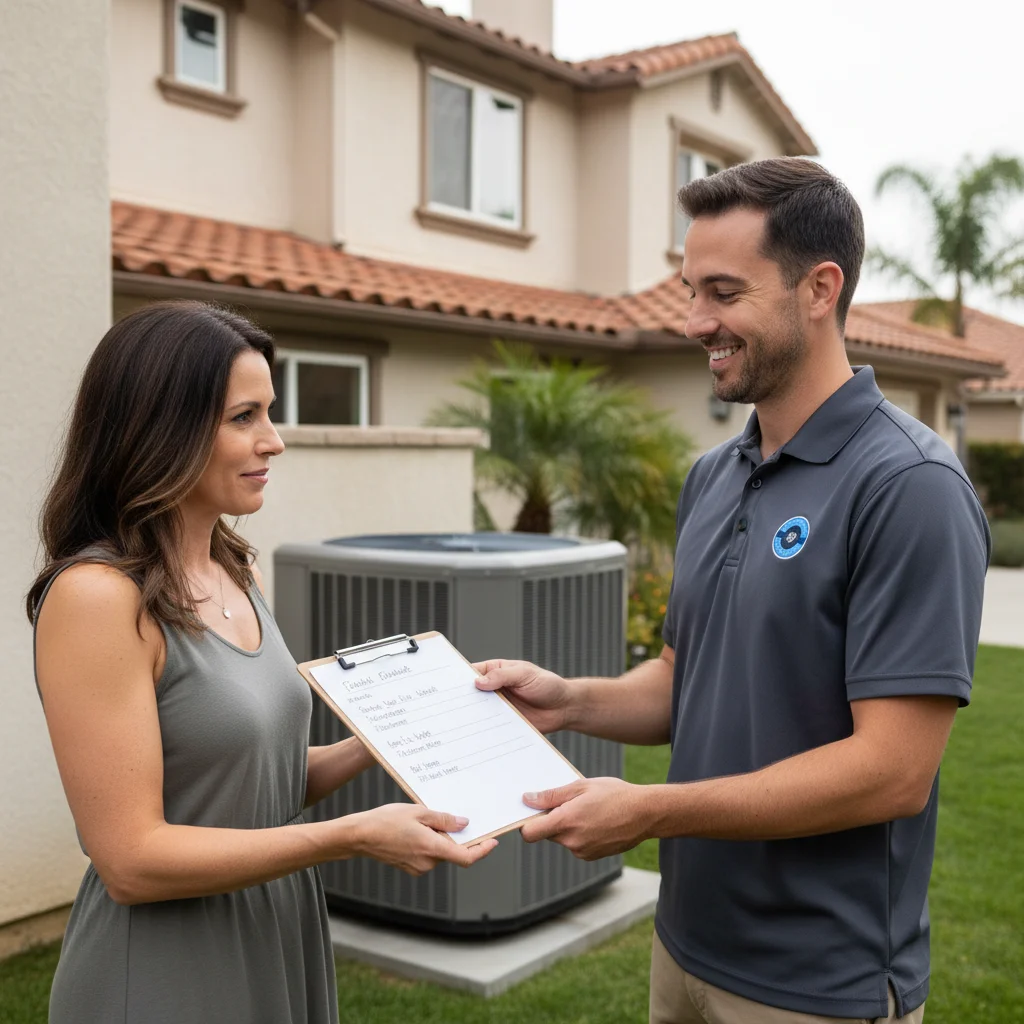
Homeowner reviewing a suspicious HVAC repair quote with marked-up pricing

The fast list

  1. The $29 service call that turns into $200 in “inspection fees”
  2. “Your refrigerant is low” without a leak diagnosis
  3. The compressor “diagnosis” without measurement
  4. “Your warranty requires you to use us”
  5. Replacing parts that aren’t broken
  6. The R-22 panic upsell
  7. The “free estimate” that becomes a $15,000 system replacement
  8. Hard-sell pressure to decide today
  9. The unlicensed tech wearing a uniform

1. The $29 service call trap

The pattern: a contractor advertises “$29 service call!” on their truck or website. Tech shows up. After 10 minutes of “inspection,” you’re presented with a bill that adds $150-$200 of “diagnostic fees,” “trip charges,” or “leak detection fees” that weren’t disclosed.

How to spot it. Ask before booking: “Is the $29 charge the entire diagnostic fee, or are there additional charges?” If they hedge, walk away. Legitimate San Diego contractors charge a flat $69-$149 diagnostic fee and disclose it upfront.

What to do. Don’t pay the surprise charges. The original $29 quote was the contract. If they refuse to leave, call SDG&E or the local police non-emergency line. File a complaint with the CSLB.

2. “Your refrigerant is low, we’ll add a couple of pounds”

If a system is low on refrigerant, it’s because there’s a leak. Refrigerant doesn’t just disappear; it’s a sealed system. A tech who tells you “we’ll just top it off” without finding the leak is:

  1. Knowingly leaving a leak that will cause repeat failures
  2. Setting you up for repeat service calls at $200-$400 each
  3. Possibly damaging the environment (R-410A and older R-22 are regulated under federal law)

How to spot it. Ask “where is the refrigerant going? Have you done a leak detection?” Legitimate techs use electronic leak detectors or UV dye to find leaks before recharging.

What to do. Insist on leak detection before recharge. If the contractor refuses, get a second opinion.

3. “Your compressor is going” without measurement

The compressor is the most expensive single part of an AC system ($1,800-$3,500 to replace). When a contractor pushes you toward compressor replacement, they should be able to show you specific measurements:

  • Compressor amp draw vs rated amps
  • Suction and discharge pressures
  • Superheat and subcooling readings
  • Megohm test of windings

“I can hear it’s going” is not a diagnosis. Neither is “it’s making a noise that means the compressor is failing.” Either show the measurements or the call is a sales pitch.

How to spot it. Ask: “What measurements led to that conclusion? Can you show me the meter readings?” If they get vague or annoyed, that’s the answer.

4. “Your warranty requires you to use us”

No legitimate manufacturer warranty requires you to use a specific local contractor. Manufacturer warranties typically require:

  1. Installation by a licensed HVAC contractor (any one)
  2. Documented annual maintenance (any one)
  3. Use of OEM replacement parts (the manufacturer doesn’t care who installs them)

When a contractor claims “you have to use us or your warranty is voided,” they’re either lying or wildly misrepresenting the terms.

How to spot it. Ask for the warranty document and read it yourself. If their claim isn’t in the document, walk.

5. Replacing parts that aren’t broken

The capacitor swap scam is the most common version of this. A tech “diagnoses” a failed capacitor, replaces it, charges $250-$400, and you never know whether the old capacitor was actually failing.

The honest way: a tech tests the capacitor microfarads against the rated value with a meter. A capacitor reading under 90% of rated value is weakening (worth replacing during a maintenance visit but not strictly broken). Under 80% is failed.

How to spot it. Ask: “What were the microfarad readings on the old capacitor?” Watch them measure it on the meter if possible. Ask for the old part. Read the rated microfarads on the label. Compare to the reading.

6. The R-22 panic upsell

If your system uses R-22 refrigerant (manufactured pre-2010 mostly), some contractors will use the refrigerant-phase-out as a scare tactic: “R-22 is illegal now, you have to replace your system immediately.”

The truth: R-22 production ended in 2020. Recycled and stockpiled R-22 is still legal to use for repairs. It’s expensive ($150-$200+ per pound vs $50-$80 for R-410A), but it’s not illegal.

Should you replace an R-22 system eventually? Yes, the economics are usually bad. Do you have to replace it tomorrow because of “illegality”? No.

How to spot it. Any tech claiming R-22 is illegal is either uninformed or lying. R-22 is being phased out commercially, not banned for residential service.

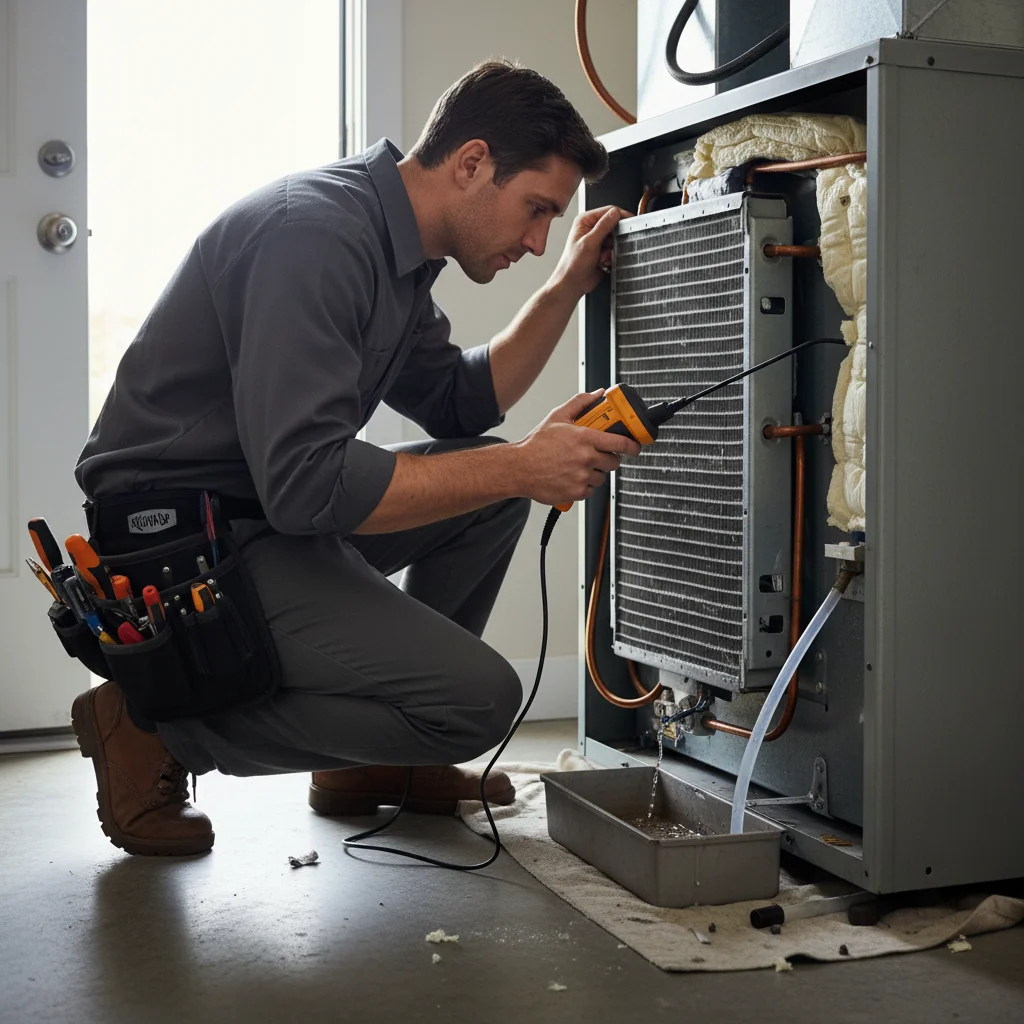
HVAC technician inspecting refrigerant lines during a service call

7. The “free estimate” that becomes a $15,000 sale

The pattern: a “free estimate” company shows up to look at your AC. After 30-60 minutes of “inspection,” you’re told the system has multiple major problems and replacement is the only option. The “free estimate” was the marketing cost for a $12,000-$18,000 sale.

Legitimate contractors charge $69-$149 for diagnostic visits. The fee is credited to the repair if you proceed. Free estimates are loss-leaders that have to be recouped somewhere, usually in inflated replacement pricing.

How to spot it. “Free estimates” combined with “your whole system needs to be replaced” on the first visit is the textbook pattern. Get a paid diagnostic from a contractor who charges normally, and compare diagnoses.

8. Hard-sell pressure to decide today

“This price is only good if you decide today.” “We can’t hold the rebate at this rate.” “If you don’t commit now, you’ll be without AC for two weeks.”

These are sales pressure tactics. Real HVAC quotes don’t have 24-hour expiration dates. Real rebates don’t disappear. Real lead times for installs run 1-3 weeks even in peak season.

How to spot it. Any time-pressure language is a flag. Reputable contractors give you a written quote with a 30-60 day validity window and tell you to compare.

9. The unlicensed tech wearing a uniform

California requires C-20 licensing for HVAC contractors and EPA Section 608 certification for anyone handling refrigerant. Some operations send unlicensed techs in branded uniforms to do work they’re not legally allowed to do.

How to spot it. Ask: “What’s your CSLB license number?” and “Are you EPA 608 certified?” Verify the license at cslb.ca.gov. If the answer is anything other than a number you can verify, walk.

How to protect yourself

Six habits that prevent most scams:

  1. Always get the diagnostic fee disclosed before booking. Flat-rate, credited toward repair, in writing.

  2. Get itemized quotes for anything over $500. Parts and labor listed separately. Vague lump-sum pricing hides markup.

  3. Get two quotes for anything over $1,500. A real second opinion is $89-$149. Worth it on any major repair or replacement.

  4. Verify the license before work starts. cslb.ca.gov. 90 seconds.

  5. Ask to see measurements. Capacitor microfarads, refrigerant pressures, amp draws. Real diagnoses produce numbers; sales pitches produce vibes.

  6. Read negative reviews especially. A contractor with mostly five-star reviews and three angry one-star reviews about overcharging tells you something. Read what the company says in response, that’s the real tell.

What to do if you’ve been scammed

Three steps:

1. File a CSLB complaint. California’s Contractors State License Board investigates unlicensed work, fraud, and consumer complaints. File at cslb.ca.gov/Resources/FilingComplaint.aspx.

2. Dispute the charges with your payment method. Credit cards have strong dispute protection. Most check payments can be stopped if caught quickly.

3. Contact the San Diego County District Attorney’s consumer protection unit. They take HVAC fraud seriously, especially patterns that affect multiple homeowners.

FAQs

Are there common AC repair scams in San Diego?

Yes. Most common: the $29 service call that becomes $200+ in surprise fees, refrigerant top-offs without leak detection, compressor “diagnoses” without measurements, and free estimates that turn into $15,000 system replacements.

How do I know if my HVAC repair quote is fair?

Get two quotes for anything over $500. Compare itemized parts vs labor. A 15-20% spread is normal. A 40%+ spread means at least one quote is inflated or excluding scope.

Should I get a second opinion before major HVAC work?

Yes for anything over $1,500. A real second opinion costs $89-$149 and frequently catches misdiagnoses or unnecessary replacement recommendations.

How do I verify an HVAC contractor’s license?

Look up the C-20 license at cslb.ca.gov. The contractor should be happy to give you the number. The license should be active, no recent disciplinary actions.

Is it normal for HVAC contractors to charge for diagnostic visits?

Yes. $69-$149 flat-rate diagnostic fees are standard in San Diego. The fee should be disclosed before booking and credited toward the repair if you proceed.

What should I do if a contractor refuses to itemize a quote?

Walk. Refusal to itemize is hiding markup. Any reputable contractor will list parts and labor separately on request.

Are “0% APR” HVAC financing offers usually scams?

Not always, but they’re frequently deferred-interest products that become very expensive if not paid off in time. See our HVAC financing in San Diego guide for the details.

Can I trust online reviews of HVAC contractors?

Partially. Cross-reference Google, Yelp, BBB, and Nextdoor. Read negative reviews especially, how the contractor responded tells you more than the five-star average.

When to call us

If you have a quote that feels too aggressive or you’ve been told you need a $5,000+ repair, we’ll do a $89 diagnostic and tell you straight whether the diagnosis holds. We do these second-opinion calls regularly. Call (442) 777-6440.