El Cajon AC systems fail more from run-hours and cabinet heat than from a mysterious brand defect. When indoor air goes warm on a 95-degree East County afternoon, check the filter and whether the outdoor fan is spinning, then match a licensed C-20. Climate Pros SD does not open electrical panels.
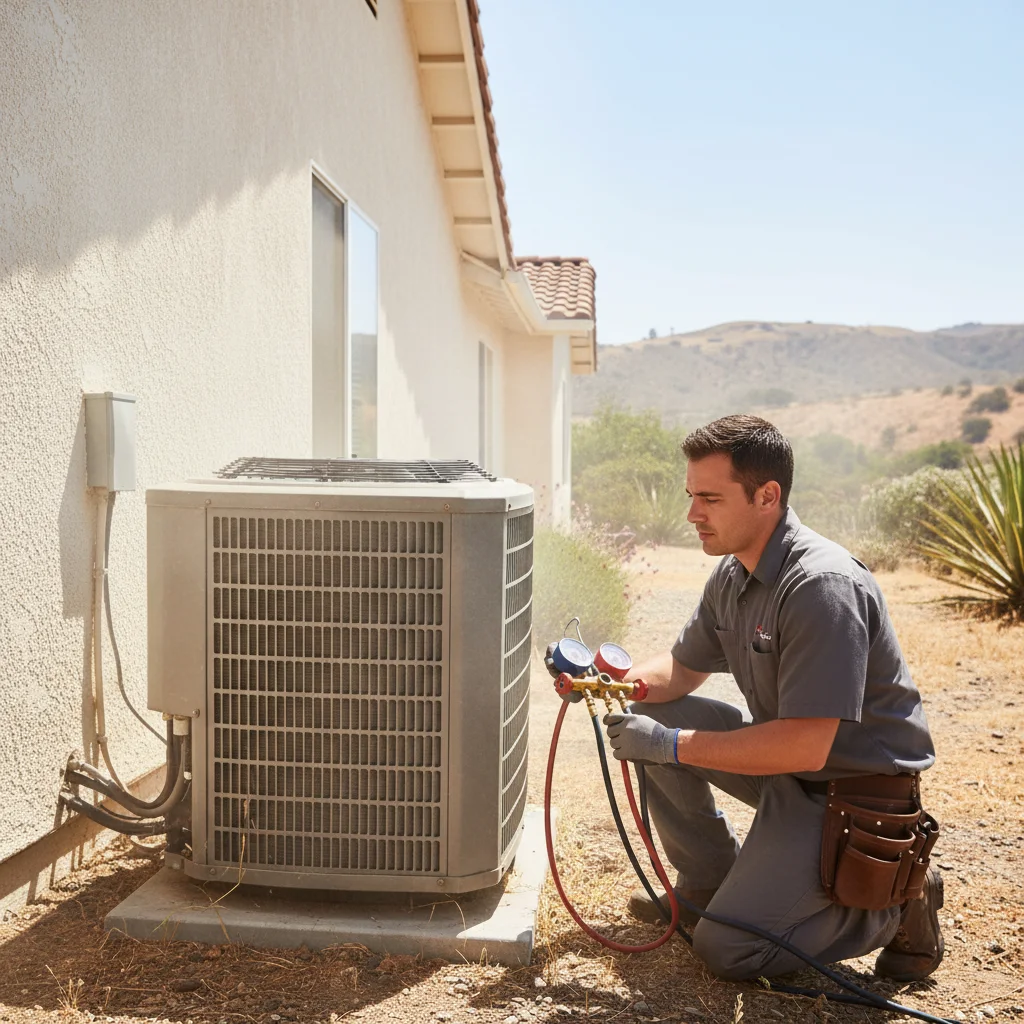
Why El Cajon AC fails on 95-degree days
East County run-hours are longer than coastal hours. Capacitors, contactors, and outdoor fans fail first because they start and run in already-hot cabinets. National Weather Service San Diego describes much warmer valley days than the marine-cooled coast. El Cajon, Fletcher Hills, and Rancho San Diego sit on the hot side of that split.
Checklist
- Write indoor temperature versus thermostat setpoint at 4 p.m.
- Note whether the outdoor fan spins when the compressor hums.
- Photograph a bulged capacitor only from outside the cabinet. Do not open live panels.
- Record how many hours the system ran yesterday.
- Ask for a written diagnosis that names the failed part, not a same-size replacement by default.
Related: El Cajon HVAC and AC capacitor replacement.
National Weather Service climate notes for San Diego describe marine-cooled coasts and much hotter valleys. El Cajon, Rancho San Diego, and Fletcher Hills sit on the hot side. That is longer compressor runtime, not a guaranteed year count.
Why East County summers wear systems out faster
San Diego County’s climate is famously varied. A La Jolla afternoon and a Fletcher Hills afternoon are not interchangeable design conditions. Coastal areas benefit from the marine layer, a natural air conditioner that keeps temperatures mild. Inland, that protection disappears, and your AC unit has to do all the work.
This leads to a critical difference: run-hours. An air conditioner in an El Cajon home simply runs more hours per day, and for more days per year, than one by the coast. Every component, from the compressor to the smallest capacitor, accumulates wear and tear with each cycle. Expect more wear per summer inland. Do not treat a year range here as a warranty or a bid.
The type of heat also matters. It’s not just hotter; it’s a dry, radiant heat that soaks into your home’s roof, walls, and attic. This thermal load means your system doesn’t just have to cool the air inside; it has to fight against the constant heat penetrating your home’s exterior. This requires longer, more intense cooling cycles, pushing every part of your El Cajon HVAC system to its operational limits day after day.
Common El Cajon failures in 92019, 92020, 92021
Independent contractors who service 92019, 92020, and 92021 commonly report heat-related electrical parts: capacitors, contactors, and outdoor fan motors. That is a pattern of physics, not a promise that Climate Pros SD has already diagnosed your house.
Here are a common heat-related failure points in East County:
- Capacitor Failure: This is, by far, the number one reason for emergency AC service calls in El Cajon. Capacitors are like batteries that provide the initial jolt of electricity to start your system’s motors. They are filled with an oil-like dielectric fluid that degrades rapidly under extreme heat.
- Contactor Burnout: The contactor is an electrical switch that sends power to the outdoor unit. The high electrical demand of a system running hard in peak-summer heat causes tiny electrical arcs every time it switches on and off. Over thousands of cycles, these arcs pit and burn the contact points until they fail to make a connection.
- Fan Motor Burnout: The outdoor fan motor’s job is to pull air across the condenser coils to release heat. In El Cajon, it’s trying to dissipate intense heat into already hot ambient air. This forces the motor to work harder and longer, leading to overheating and bearing failure.
- Refrigerant Leaks: While not exclusively a heat-related issue, the constant vibration from a system running for extended periods can weaken the brazed joints in the refrigerant lines over time, leading to slow leaks. Low refrigerant then forces the system to work even harder, creating a vicious cycle of wear.
While our other post on HVAC repair in El Cajon covers costs, this guide focuses on the why. Understanding these common failures is key to recognizing the importance of targeted maintenance.
Heat-soak failures: capacitors, contactors, and compressors
Heat-soak means the outdoor cabinet sits in East County sun even between cycles. Internal parts then start already hot. Do not treat a specific cabinet temperature on this page as a measurement of your unit. When the thermostat calls for cooling, the components must start and run under these already extreme conditions. This heat-soak is what accelerates the failure of key electrical parts.
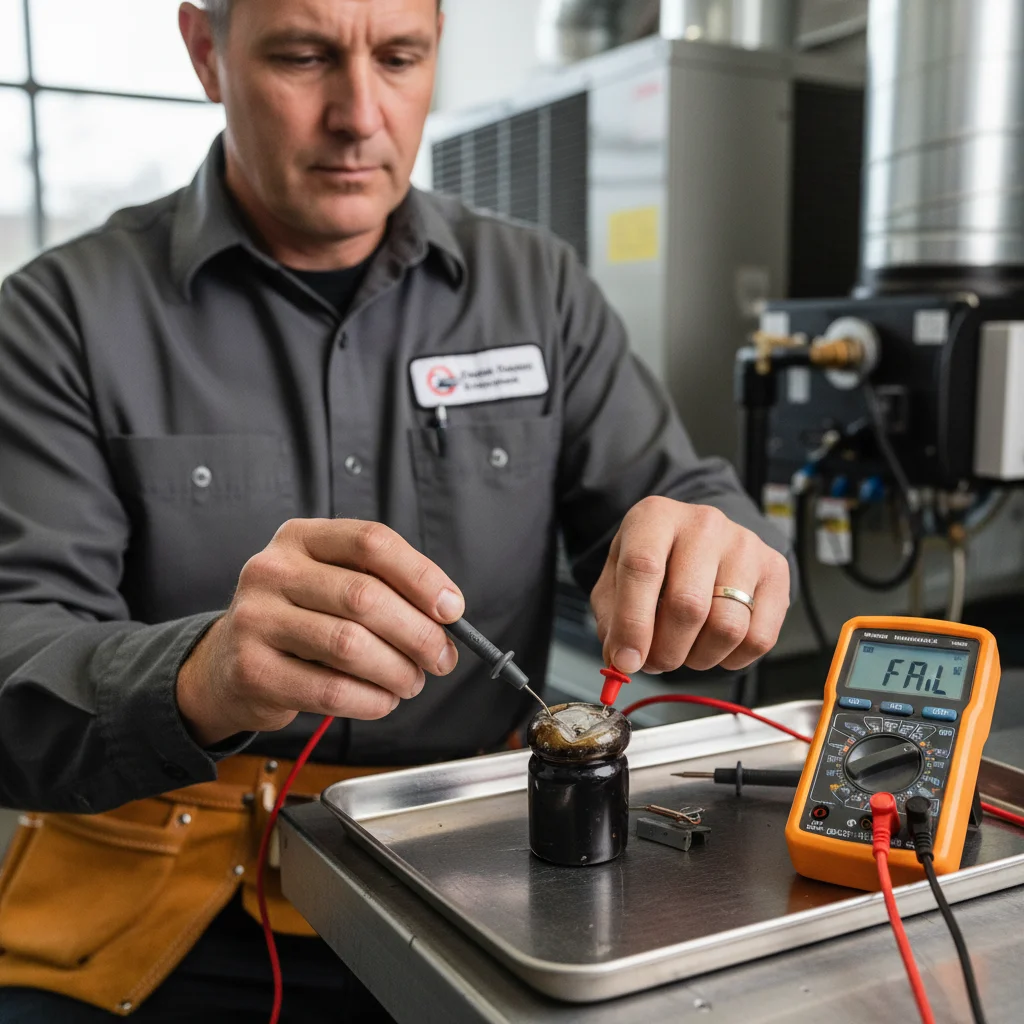
Capacitors
Think of a capacitor as a workhorse. Every time your AC starts, it delivers a powerful burst of energy. Under normal conditions, it can do this for years. But when it’s constantly baked in the El Cajon sun, the fluid inside breaks down. The capacitor’s ability to hold a charge (measured in microfarads) weakens. The top of the capacitor may start to bulge, a sure sign of impending failure. Eventually, it becomes too weak to start the motor, and your AC won’t turn on.
Contactors
A contactor is a simple but vital switch. High heat increases electrical resistance, which means the system draws more amperage to run. This higher current flow intensifies the arcing across the contactor’s points, accelerating their degradation. A licensed tech may find contactors that are blackened, pitted, or welded shut after heavy cycling.
Compressors
The compressor is the heart of your air conditioner and the most expensive component. It’s a pump that circulates refrigerant. Prolonged operation at high pressures and temperatures, a daily reality in East County, causes the lubricating oil inside the compressor to break down. Without proper lubrication, the internal mechanical parts wear down rapidly, leading to a catastrophic failure. This is the breakdown that often leads homeowners to replace their entire system. Timely AC repair for smaller issues is the best way to protect your compressor.
What proactive maintenance saves you in run-hours
You can’t change the weather in El Cajon, but you can fight back against its effects on your AC. Proactive maintenance isn’t just about cleaning filters; it’s a targeted strategy to mitigate the damage caused by extreme heat and high run-hours.
A professional tune-up should address the failure points that inland heat hits first:
- Condenser Coil Cleaning: Your outdoor unit is designed to release heat. If the coils are clogged with dirt, dust, and debris from our dry, windy environment, they can’t do their job. The system’s internal pressure and temperature skyrocket, putting immense strain on the compressor and fan motor. A clean condenser can reject heat. This page does not publish a percent savings.
- Capacitor Testing: During maintenance, a licensed tech can measure capacitor microfarads and recommend replacement before a no-start on a hot Saturday. Climate Pros SD does not set that price or do the measurement.
- Refrigerant Level Check: A licensed tech checks charge against the manufacturer’s specification. Low charge makes the system work harder. This page does not invent a bill impact. A common symptom of low refrigerant is the indoor coil ac freezing up, a problem with its own set of causes and fixes.
- Electrical Connection Inspection: The matched contractor should inspect and tighten electrical connections, including the contactor.
By addressing these small issues annually, you prevent them from cascading into major, expensive breakdowns. You’re not just cleaning the system; you’re actively extending its lifespan in a harsh environment.
When to upsize on the next replacement
Sometimes, frequent repairs are a symptom of a bigger problem: an undersized air conditioner. Many homes, especially in older neighborhoods like Bostonia, were built with “contractor-grade” systems that are barely adequate for the home’s cooling needs. In the punishing heat of El Cajon, an undersized unit will run nearly nonstop on hot afternoons, never reaching the thermostat’s set point and never cycling off.
This constant operation dramatically accelerates wear on every single component. If the system never reaches setpoint on a design-hot El Cajon afternoon, sizing belongs in the next quote. Long cycles can also mean a dirty coil or low charge. Ask the contractor to separate those causes.
When the time comes for a replacement, it’s crucial not to simply install a new unit of the same size. A professional load calculation, known as a Manual J calculation, should be performed. This analysis considers your home’s square footage, insulation levels, window quality, orientation to the sun, and more to determine the precise size of the AC system you need.
Investing in a properly sized unit means it will run in shorter, more efficient cycles. It will cool your home more effectively, use less energy, and its components will last significantly longer because they aren’t being pushed to their absolute limit every single day of summer. It’s the single best long-term strategy for reliable cooling in East County.
Related services: HVAC maintenance and AC installation.
When to call us
Capacitors and contactors are live electrical parts. Do not open the condenser.
Climate Pros SD is a referral service. It matches you with a licensed C-20 contractor. That company diagnoses and quotes. Climate Pros SD does not repair or install. Call (442) 777-6440.