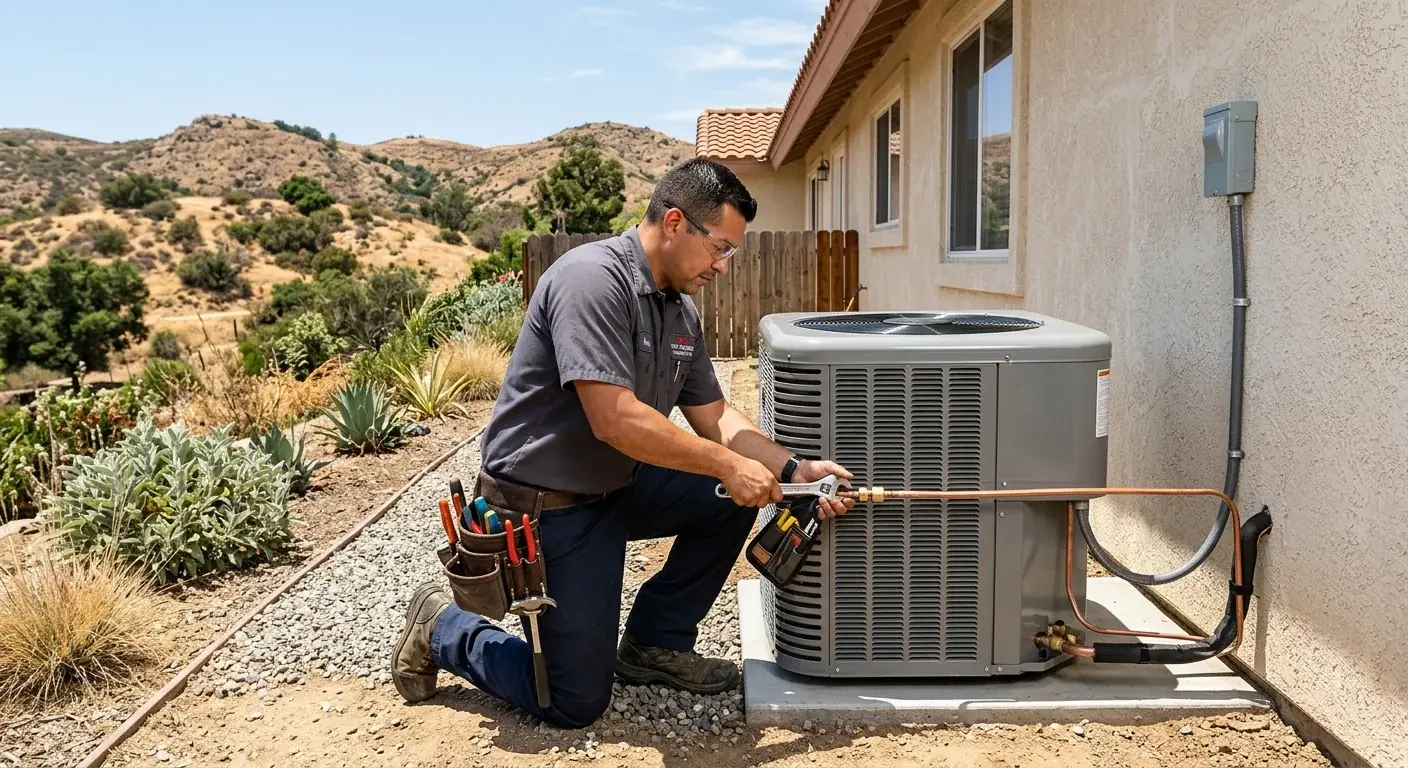
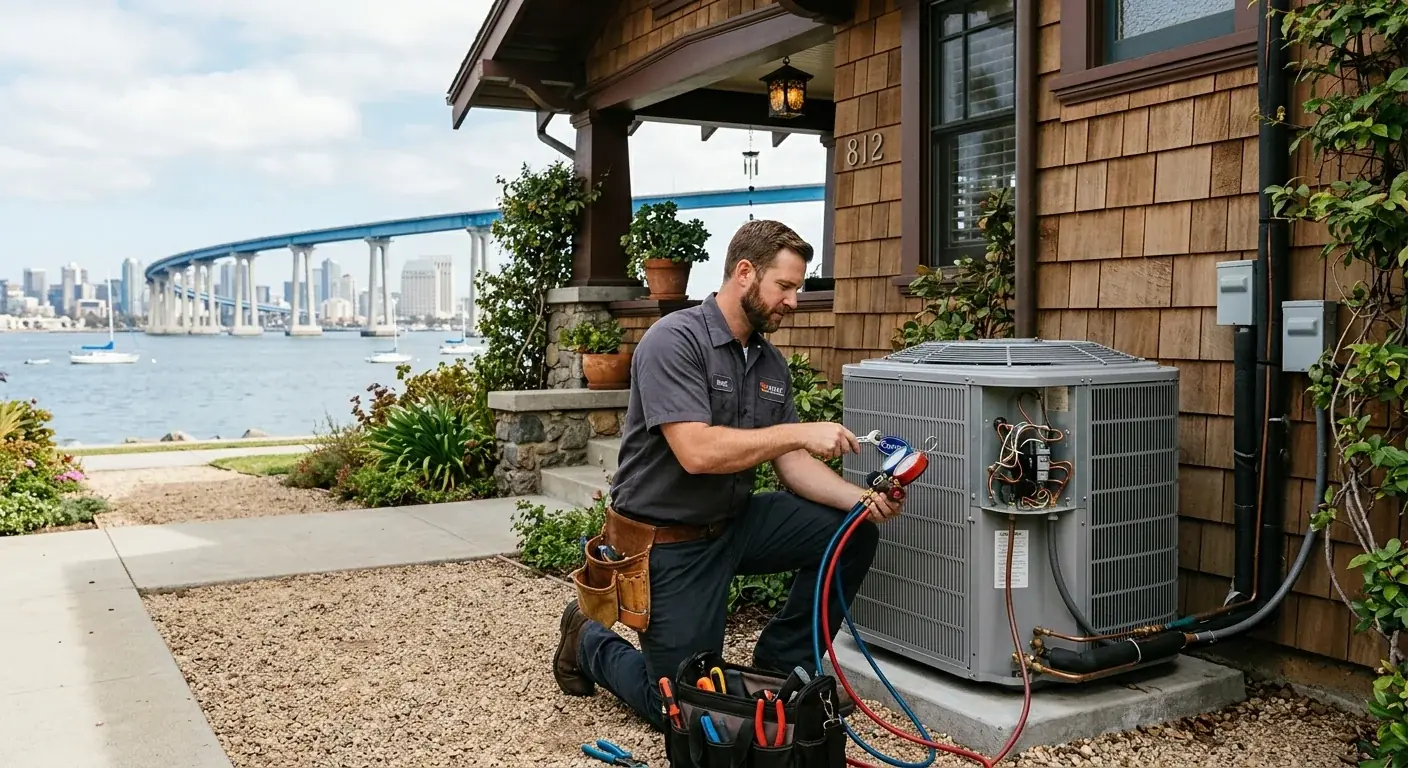
A central AC unit in San Diego lasts 10 to 18 years. Coastal homes under 5 miles from the ocean average 10-13 years because salt-air corrosion attacks the outdoor coil. Inland homes average 14-18 years with good maintenance. Three things decide where yours lands: distance from the ocean, summer runtime, and whether anyone has serviced it.

The honest numbers, by zone:

ZoneTypical lifespanWhy
Coastal (under 5 miles from ocean)10-13 yearsSalt-air corrosion is the dominant factor
Central San Diego13-16 yearsModerate heat, low corrosion
Inland North County (Escondido, San Marcos, Vista)14-18 yearsHeat is hard on it, but no salt; well-maintained units do well
East County (El Cajon, Santee, Lakeside, Alpine)13-17 yearsThe hardest-run systems in the county
Backcountry / mountain (Ramona, Julian, Alpine high)16-20+ yearsLighter use, no salt, often only run a few weeks a year

The national average lifespan most guides quote is 15-20 years. That number is for the middle of the country with moderate use and no coastal exposure. San Diego specifically pulls down the average for coastal homes and rewards the dry inland ones.

Aging outdoor AC condenser unit at the side of a San Diego home with visible weathering

What actually kills an AC system

Five components fail and each has a different lifespan. The system dies when the first one fails badly enough that repair stops making sense.

Compressor (15-25 years). The most expensive part. If the compressor goes and the system is over 10 years old, almost everyone replaces the whole system rather than the compressor alone. Compressor death is usually the trigger event.

Outdoor condenser coil (10-25 years). Salt air kills coastal coils first. Inland units lose coils more often from physical damage, dust accumulation that’s never cleaned, or refrigerant leaks at the brazed joints. A coil replacement is 30-50% of system replacement cost, so coil failure also frequently triggers full replacement.

Indoor evaporator coil (12-18 years). Slow refrigerant leaks at the brazed joints are the most common failure. Replacement requires pulling the air handler apart, which makes it labor-heavy.

Capacitors and contactors (3-7 years). Wear items. Get replaced multiple times over a system’s life. Failing capacitors are the most common single-call repair we do.

Fan motors, control boards, refrigerant lines (10-20 years). Various lifespans, all repairable for a fraction of replacement cost.

A system can lose any of these and still keep running with repairs. The question isn’t “will it die?”, it’s “when do repairs stop pencilling?”

Warning signs your AC is near the end

These are the symptoms that signal a system is winding down. One on its own rarely means much. Two or three together on a 10+ year old unit usually means start pricing a replacement.

Warning signWhat it usually meansUrgency
Warm or weak air at the ventsLow refrigerant, dying compressor, or failing fan motorHigh
Summer SDG&E bills up 25%+ at similar usageLost efficiency from coil corrosion or refrigerant driftHigh
Short-cycling (turns on and off every few minutes)Oversized system, low charge, or compressor strainHigh
Rattling, grinding, or buzzing at the condenserFan motor, contactor, or compressor bearing wearMedium
Water pooling or ice on the indoor coilDrain clog or refrigerant leakMedium
Two or more major repairs in the last 3 yearsBroader end-of-life, repairs will keep comingHigh
Uses R-22 refrigerant (installed before 2010)End-of-life regardless of condition, R-22 is no longer madeHigh
Visible flaking corrosion on the outdoor coil finsCoastal coil near failure, lost heat-transfer capacityHigh

Why coastal systems die first

Coastal San Diego homes within roughly 5 miles of the Pacific lose their AC units 3-5 years earlier than identical homes 10 miles inland. The cause is salt aerosol, fine droplets of seawater that ride the marine layer onshore every night. The salt deposits on the aluminum fins of the outdoor coil, on the copper refrigerant lines, on the steel cabinet, and even on the electrical components inside.

Over years, three things happen:

  1. Fin corrosion reduces heat transfer area. The system has to work harder to dump the same heat, which raises power bills and stresses the compressor.
  2. Pinhole leaks form at the brazed joints where the copper lines meet the coil. These are slow, sometimes years before symptoms appear, but they end with the system unable to hold charge.
  3. Cabinet rot. The sheet metal housing rusts out, particularly at the base where rainwater pools. Eventually the cabinet won’t hold the coil square anymore.

Coastal homes that get yearly coil rinses, protective coatings applied, and bi-annual maintenance get to the 12-13 year mark reliably. Coastal homes that get nothing fail at year 8-10. The difference is real and it adds up to thousands of dollars over a 20-year homeownership period.

We cover the coastal pattern in more detail on our Coronado AC repair page and Encinitas coastal AC blog.

Salt-air corrosion visible on aluminum coil fins of a coastal San Diego AC condenser

Why inland systems die from heat

Escondido, El Cajon, Santee, Lakeside, and San Marcos see the hardest-running AC systems in the county. Triple-digit afternoons through July and August, low marine layer relief overnight, and homes that often have underspec’d condensers from their original build. The systems run 8-10 hours a day for weeks at a time.

That cumulative load surfaces three patterns:

  1. Capacitor death every 3-5 years instead of every 5-7. The heat soaks the outdoor unit at 130-140 degrees Fahrenheit on hot days, which degrades electrolytic capacitors faster than rated.
  2. Compressor wear. Long runtime hours add up. A San Diego coastal compressor with 800 annual runtime hours easily lasts 20 years. An inland one with 1,800 hours is at end-of-life by year 15.
  3. Coil dust accumulation. Dry inland summers throw fine dust into the outdoor coil. Without yearly cleaning, the coil clogs and the system overheats, accelerating compressor wear.

Well-maintained inland systems still hit 15-18 years easily. The difference is they need actual maintenance, not just filter changes.

How to estimate where yours falls

You can roughly forecast remaining life by checking five things:

1. Age. Look at the data plate on the outdoor unit. The serial number usually encodes the year. If you can’t decode it, the install date is often on the indoor air handler.

2. Refrigerant type. R-22 systems (installed pre-2010 generally) are at end-of-life regardless of condition. R-22 is no longer manufactured; recharging a leaking R-22 system costs more than half of replacement and you’re throwing good money after bad.

3. Coil condition. Visual check of the outdoor coil. If you can see corrosion on the fins, the coil has lost capacity. Heavy corrosion that flakes off when touched means the coil is near end-of-life regardless of system age.

4. Repair history. If you’ve replaced two or more major components (coil, compressor, control board, blower motor) in the last 3 years, the system is signaling broader end-of-life. Whack-a-mole repairs almost always cost more than replacement over a 2-3 year window.

5. Efficiency rating. If the data plate shows SEER 10-13, you have a pre-2006 system or a low-end early-2000s unit. A modern 16-18 SEER2 replacement cuts cooling bills 30-40% on its own, which often justifies the replacement on operating cost alone for inland heavy-use homes.

The repair-or-replace tipping point

Two rules of thumb work for San Diego.

The 50% rule. If a repair quote is more than 50% of the cost of a new system, replace. A new central AC in SD runs $5,500-$9,500, so the repair threshold sits at roughly $2,750-$4,750. A coil or compressor on a 12+ year old system usually hits that.

The age × cost rule. Multiply the system’s age in years by the repair cost. If the product exceeds $5,000, replace. A 14-year-old system with a $400 repair scores 5,600, repair is borderline. A 14-year-old system with a $1,200 repair scores 16,800, clearly replace.

Neither rule is the whole answer. The third factor is utility-bill trend. If your summer SDG&E bills have climbed 25%+ over the last 3-5 years with similar usage, the system is losing efficiency and operating cost alone may justify replacement on a 12+ year old unit, even without a major repair pending.

We walk through the decision math in our AC replacement vs repair guide.

How to add years to your system

Here’s the extend-life checklist at a glance, with the rough payoff and how often to do it in San Diego.

ActionHow oftenAdded lifeWhy it matters here
Professional tune-up with measured valuesYearly2-4 yearsCatches refrigerant drift and weak caps before failure
Coil rinseTwice a year coastal, once inland1-3 yearsCuts the salt and dust load that drives most failures
Replace capacitors proactivelyAt year 5-7Protects compressorA $200 cap swap prevents a $1,500 compressor death
Right-size the system (Manual J)At install3-5 yearsOversized units short-cycle and wear 30-50% faster
Smart or programmable thermostatOnce1-2 yearsCuts runtime 20-30%, less runtime means more years
Protective coil coatingCoastal only, once2-3 yearsSlows salt corrosion on the outdoor coil

The detail behind each one:

  1. Yearly maintenance. A real visit with measured performance values catches refrigerant drift, capacitor weakening, and coil load before they become failures. Worth 2-4 years of additional life.
  2. Coil rinse twice a year if coastal, once if inland. Cuts the corrosion and dust load that drives the most common end-of-life failures.
  3. Right-size the system. Oversized systems short-cycle, which wears the compressor 30-50% faster than properly sized units. A Manual J load calculation tells you the actual size you need. Our AC sizing guide walks through it.
  4. Replace capacitors proactively at year 5-7. A $200 maintenance-visit capacitor swap is cheap insurance against a $1,500 compressor that died from running on a weak cap.
  5. Stop running the AC unnecessarily. Programmable or smart thermostats reduce runtime 20-30% in most homes with no comfort loss. Less runtime means more years.

FAQs

How long should a central air conditioner last?

National average is 15-20 years. In San Diego specifically, coastal homes average 10-13 years (salt-air corrosion), central SD 13-16, inland 14-18 with good maintenance.

Why do AC units in San Diego die earlier than other places?

For coastal homes, salt-air corrosion attacks the outdoor coil and electrical components year-round, even when the system isn’t running. For inland homes, hard summer use accelerates capacitor and compressor wear. The middle of the country sees neither extreme.

When should I replace my 10-year-old AC?

Don’t replace based on age alone. Replace if (1) the system uses R-22 refrigerant, (2) a major component fails and the repair costs over 50% of a new system, (3) you’ve made two or more major repairs in the last 3 years, or (4) your summer power bills are climbing 25%+ with similar usage.

Does the brand of AC affect lifespan?

Marginally. The bigger factors are install quality, system sizing, and maintenance. A poorly installed Carrier will fail before a properly installed Goodman. That said, Trane, Lennox, Carrier, and American Standard generally show 1-3 years of additional life over budget brands in San Diego conditions.

What’s the most common cause of AC failure in San Diego?

For coastal homes: outdoor coil leaks from salt corrosion. For inland homes: compressor failure from heat and runtime wear. For everyone: failed capacitors from heat exposure, but these are cheap to replace and don’t end the system unless ignored long enough to take the compressor with them.

Is it cheaper to maintain my old AC or buy a new one?

For systems under 10 years old, maintenance is far cheaper. For systems 12-15 years old, it’s situational, depends on repair history and bills. For systems over 15, especially R-22 units, replacement usually wins on total cost of ownership over a 5-year window.

Should I replace my AC and furnace at the same time?

Often yes, especially if the furnace is also 12+ years old. Combined replacement saves 15-25% on labor versus two separate jobs, and a heat pump replacing both can qualify for SDG&E rebates that close most of the price gap. See our 2026 heat pump rebate guide.

When to call us

If your AC is 10+ years old and you’re trying to figure out whether to repair the next failure or just replace, we’ll give you both numbers honestly. We don’t push replacements that don’t make sense. Call (442) 777-6440 for a free in-home assessment.