A heat pump is an air conditioner that can run in reverse. That’s the whole concept. In summer it pulls heat out of your house and dumps it outside, just like a regular AC. In winter it pulls heat out of the outside air and pumps it inside your house. Same equipment, two jobs.

In San Diego specifically, this matters a lot, because our mild winters mean a heat pump never has to work hard to keep your house warm. The system runs in its efficient range year-round. That’s why heat pump adoption in San Diego County more than doubled between 2023 and 2025, and why SDG&E and the federal government are paying you $3,000-$8,000 to install one in 2026.

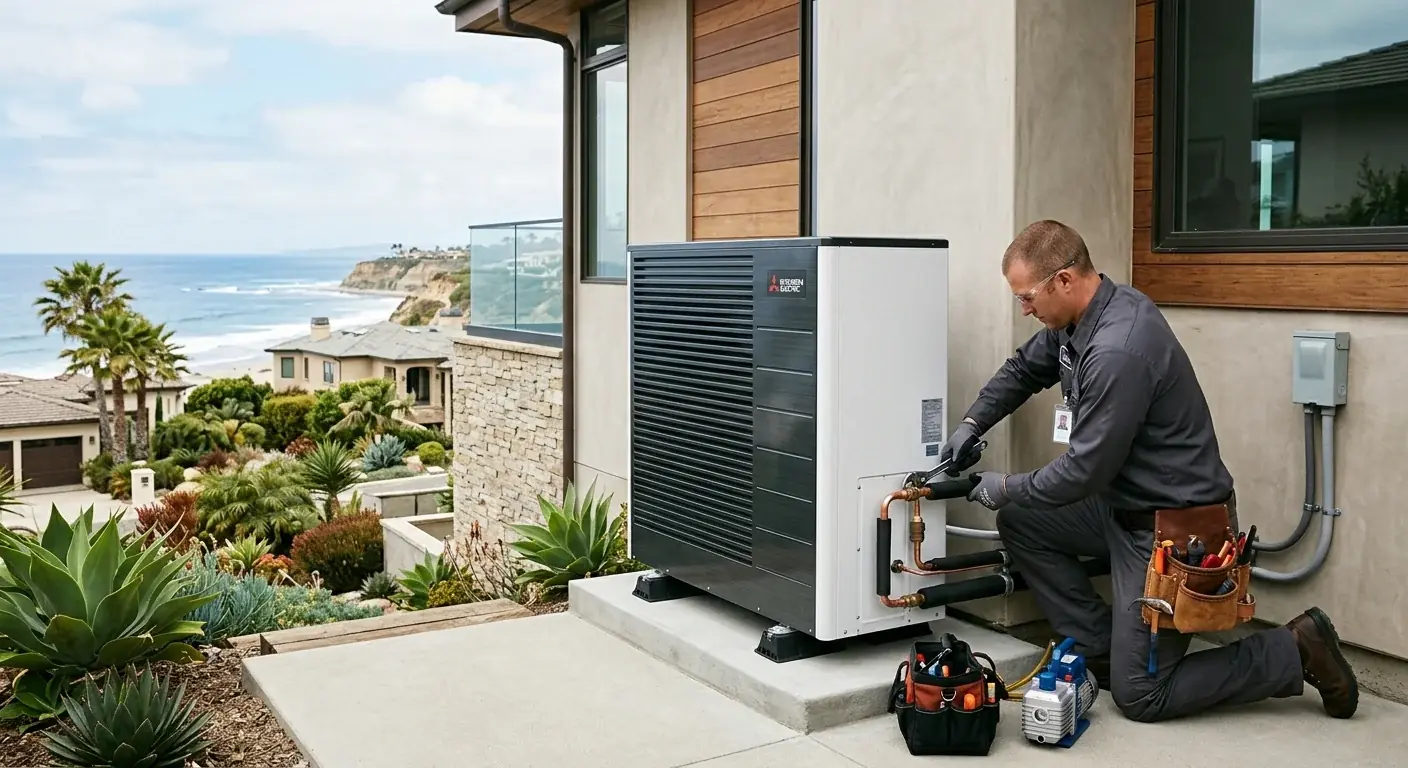
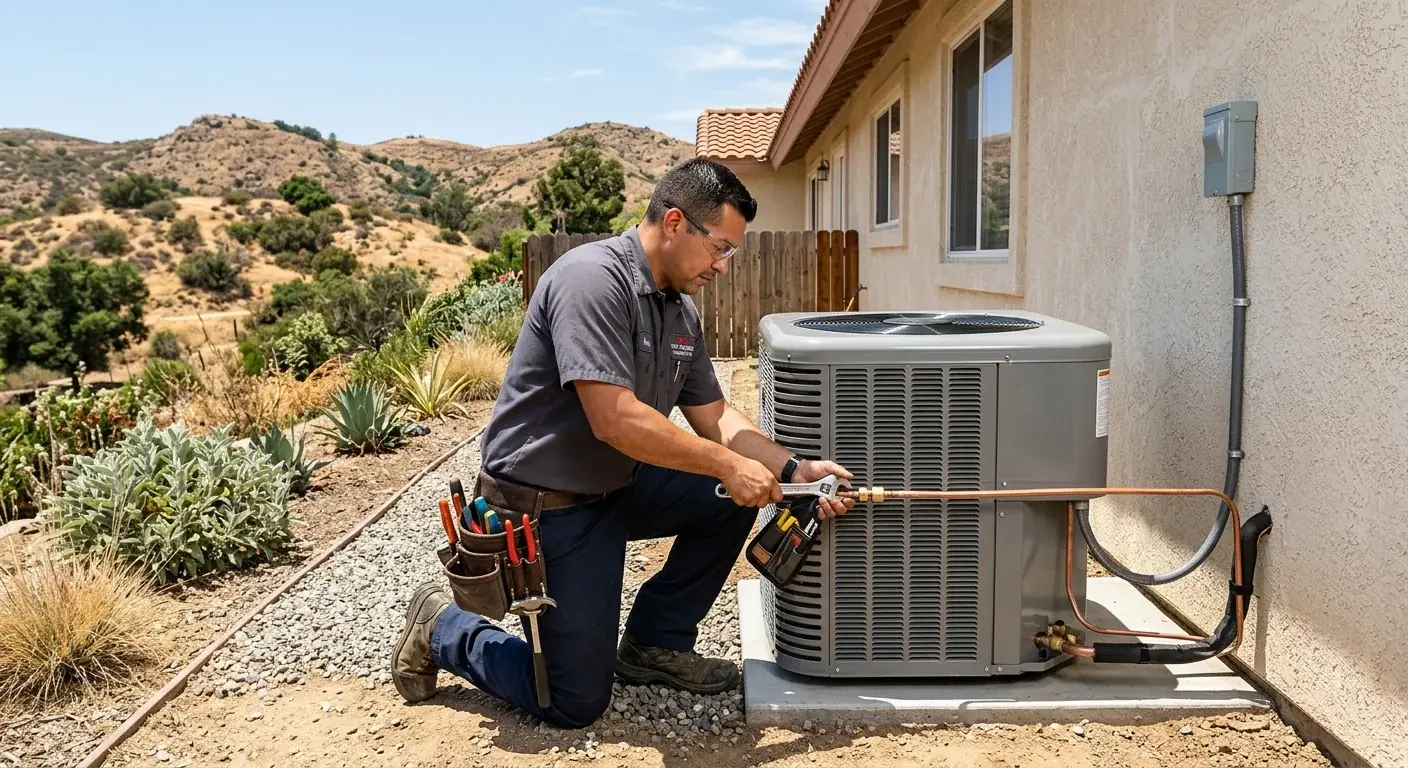
Outdoor heat pump unit installed at the side of a San Diego home

The fast answer

A heat pump:

  • Uses refrigerant to move heat from one place to another
  • Cools your house in summer (just like an AC)
  • Heats your house in winter (the opposite direction)
  • Uses electricity, not gas
  • Costs $9,000-$16,000 installed in San Diego before rebates
  • Costs $4,000-$9,000 after SDG&E and federal rebates for most households
  • Lasts 12-18 years in San Diego with normal maintenance
  • Replaces both your AC and your furnace in one system

If you have an aging gas furnace and a dying AC, a single heat pump replaces both. That’s the use case driving most of the 2026 adoption.

How it actually works (the 60-second version)

Air conditioners work by moving heat. They don’t “make cold.” They pull heat out of your house, run it through compressed refrigerant, and dump it outside. The cold air you feel is just the byproduct of that heat being moved away.

A heat pump does the exact same thing, but it has a part called a reversing valve that can flip the direction of refrigerant flow. Flow one way: heat moves from inside to outside (cooling). Flow the other way: heat moves from outside to inside (heating).

The clever part: even when outside air feels cold to you, there’s still heat energy in it. Modern heat pumps can extract usable heat from outside air down to about 5F. San Diego basically never gets that cold, most coastal areas never see below 38F overnight, and even inland mountain areas rarely hit 20F. The heat pump operates in its efficient range every day of the year here.

Why it’s a big deal in San Diego specifically

Three reasons heat pumps are particularly well-suited to San Diego:

1. Mild winters mean maximum efficiency. Heat pumps lose efficiency when outdoor temperatures drop below freezing. San Diego rarely gets there. The system you install here will run at 250-350% efficiency in heating mode (250-350% means it produces 2.5-3.5 units of heat for every unit of electricity it consumes, gas furnaces top out around 95% efficiency by comparison).

2. NEM 3.0 makes solar-paired heat pumps the math winner. If you have solar, exporting electricity to SDG&E pays much less than it used to. Using that electricity for your own heating and cooling load, exactly what a heat pump does, captures the value. Pairing solar with a heat pump is currently the most economically efficient residential energy configuration in California.

3. Rebates are unusually large right now. SDG&E TECH Clean California rebates run $1,000-$6,000 depending on income tier. Federal 25C tax credit adds up to $2,000. Combined, most households see $3,000-$8,000 off the install. We break the numbers down in our 2026 heat pump rebate guide.

The two main types

Ducted central heat pump. Same form factor as a central AC system. Outdoor condenser unit + indoor air handler + ductwork. Cooling and heating run through the existing ducts. Most homes with existing central AC convert to this when their AC dies. Cost: $9,000-$16,000 before rebates.

Ductless mini-split heat pump. Outdoor condenser + one or more indoor wall- or ceiling-mounted heads. No ductwork needed. Each indoor head can be controlled independently. Most common in older San Diego homes without existing ductwork (Coronado, North Park, Hillcrest, Old Escondido). Cost: $4,500-$22,000 depending on number of zones.

A third configuration, dual-fuel, pairs a heat pump for cooling and most heating with a gas furnace that handles backup heat on the coldest mornings. Useful when you have a working gas furnace under 10 years old that you don’t want to abandon. We cover the choice in our replacing AC with heat pump in San Diego post.

Heat pump indoor air handler installed in a San Diego home utility closet

How a heat pump compares to a regular AC + gas furnace

AC + gas furnaceHeat pump
Equipment cost$5,500-$9,500 (AC) + $3,500-$6,000 (furnace)$9,000-$16,000 (combined)
Rebates availableMinimal$3,000-$8,000 typical
Operating cost (annual, SD)$700-$1,100$610-$940
LifespanAC 12-16 yr / furnace 15-25 yr12-18 years
Heating efficiency80-95% (gas)250-350% (electric)
Refrigerant transitionsR-410A → R-454B already doneR-410A → R-454B already done
Replaces in one systemNo, separate equipmentYes

The heat pump’s heating efficiency number looks weird because it’s the only HVAC equipment that produces more energy than it consumes, it’s moving existing heat from outside, not creating heat from fuel. That math is the whole reason heat pumps make sense.

Where heat pumps don’t make sense

Three situations:

  1. You have a gas furnace under 5 years old that’s working perfectly. Replacing it for a heat pump means abandoning years of remaining life. Consider dual-fuel instead.
  2. Your electrical panel is at capacity. Heat pumps draw more electrical load than gas systems. If your panel can’t handle it, panel upgrades add $1,500-$4,000 to the project.
  3. You’re moving in 1-3 years. Heat pump rebates and operating savings accrue over years. Short ownership windows don’t capture the value.

For most San Diego homes outside these scenarios, heat pumps are now the default recommendation.

What about the cold?

The most common heat-pump skepticism is “but what about when it gets cold?” In San Diego the answer is: it doesn’t get cold enough to matter.

Modern heat pumps are rated efficient down to 5F outdoor temperature. Coastal San Diego (Carlsbad, Oceanside, Encinitas) almost never sees below 40F. Inland (Escondido, El Cajon, Santee) might see 32-35F a few mornings a year. Even Julian, the coldest non-mountain area in the county, rarely hits 20F.

For all of those temperatures, heat pumps operate in their efficient zone. You won’t get the “but it’s freezing outside” failure mode that homeowners in Minnesota or Montana sometimes complain about, because San Diego doesn’t have those temperatures.

FAQs

What is a heat pump in simple terms?

A heat pump is an air conditioner that runs in two directions. In summer it pulls heat out of your house and dumps it outside. In winter it pulls heat out of the outside air and brings it into your house. Same equipment, both jobs.

How is a heat pump different from an air conditioner?

A heat pump has a reversing valve that lets refrigerant flow in either direction. An air conditioner only flows one way (cooling). Mechanically very similar; the heat pump just adds the option to run backwards for heating.

Does a heat pump replace my furnace?

Yes, if you choose to use it for both heating and cooling. A single heat pump can fully replace both your AC and your gas furnace. Many San Diego homes are doing exactly this in 2026 to capture the rebate stack.

Are heat pumps efficient in San Diego?

Very. San Diego’s mild winters mean heat pumps operate in their efficient range almost every day of the year. Heating efficiency runs 250-350% (vs 80-95% for gas furnaces).

How much does a heat pump cost in San Diego?

$9,000-$16,000 installed before rebates. After SDG&E TECH Clean California and federal tax credits, most households pay $4,000-$9,000 out of pocket. We break the numbers down in our heat pump installation cost guide.

How long does a heat pump last?

12-18 years in San Diego, depending on coastal exposure. Coastal homes see 10-13 years due to salt-air corrosion; inland homes see 14-18 years with regular maintenance.

Will a heat pump work in cold weather?

In San Diego, yes, easily. Modern heat pumps are rated efficient to 5F outdoor temperature. San Diego rarely sees below 30F even in inland areas. The system never operates outside its efficient range here.

Do heat pumps qualify for rebates?

Yes, substantial ones. SDG&E TECH Clean California rebates run $1,000-$6,000 depending on income. Federal 25C tax credit adds up to $2,000. Most households see $3,000-$8,000 in total incentives.

When to call us

If you’re trying to figure out whether a heat pump makes sense for your home and what your specific rebate eligibility looks like, we’ll run the numbers honestly. Call (442) 777-6440 for a free in-home assessment.