For most San Diego homes, a heat pump is the heater and air conditioner in one unit. It’s a single piece of equipment that cools in summer and heats in winter by moving heat instead of burning fuel, and it’s the option that fits San Diego’s mild climate best. If a central heat pump isn’t the right shape for your home, three other combo formats cover almost every situation: ductless mini splits for room-by-room comfort, packaged units for homes without attic space for a split system, and through-the-wall units for garages, ADUs, or single rooms that don’t connect to central ductwork.
What system heats and cools in one unit?
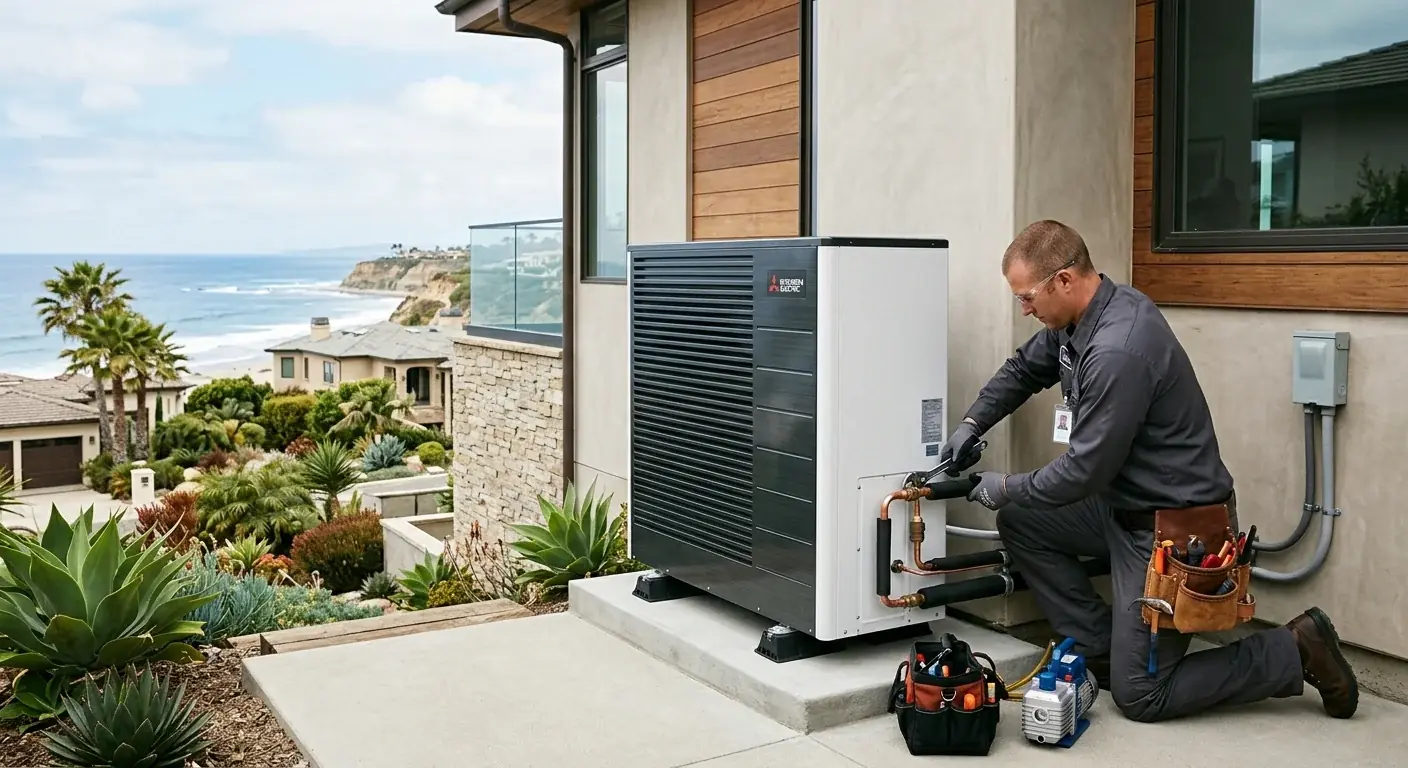
A heat pump is the true one-unit answer. Instead of a furnace that burns gas and a separate AC condenser that only cools, a heat pump uses one outdoor unit and one indoor coil to move heat in either direction. In summer it pulls heat out of your house and dumps it outside, exactly like a standard AC. In winter it reverses the cycle and pulls heat out of the outside air, even air that feels cold to you, and pumps it inside. San Diego’s mild winters, rarely below 45°F even inland, are close to ideal for this. A heat pump here runs at high efficiency almost year round, unlike a heat pump installed in Minnesota that needs backup heat strips on the coldest nights.
Central heat pumps connect to your existing ductwork, so if your home already has ducts from a furnace-and-AC setup, swapping to a heat pump is usually a straightforward equipment change. You keep one thermostat, one set of vents, and one system to maintain instead of two.
Is a mini split a heater and air conditioner combo?
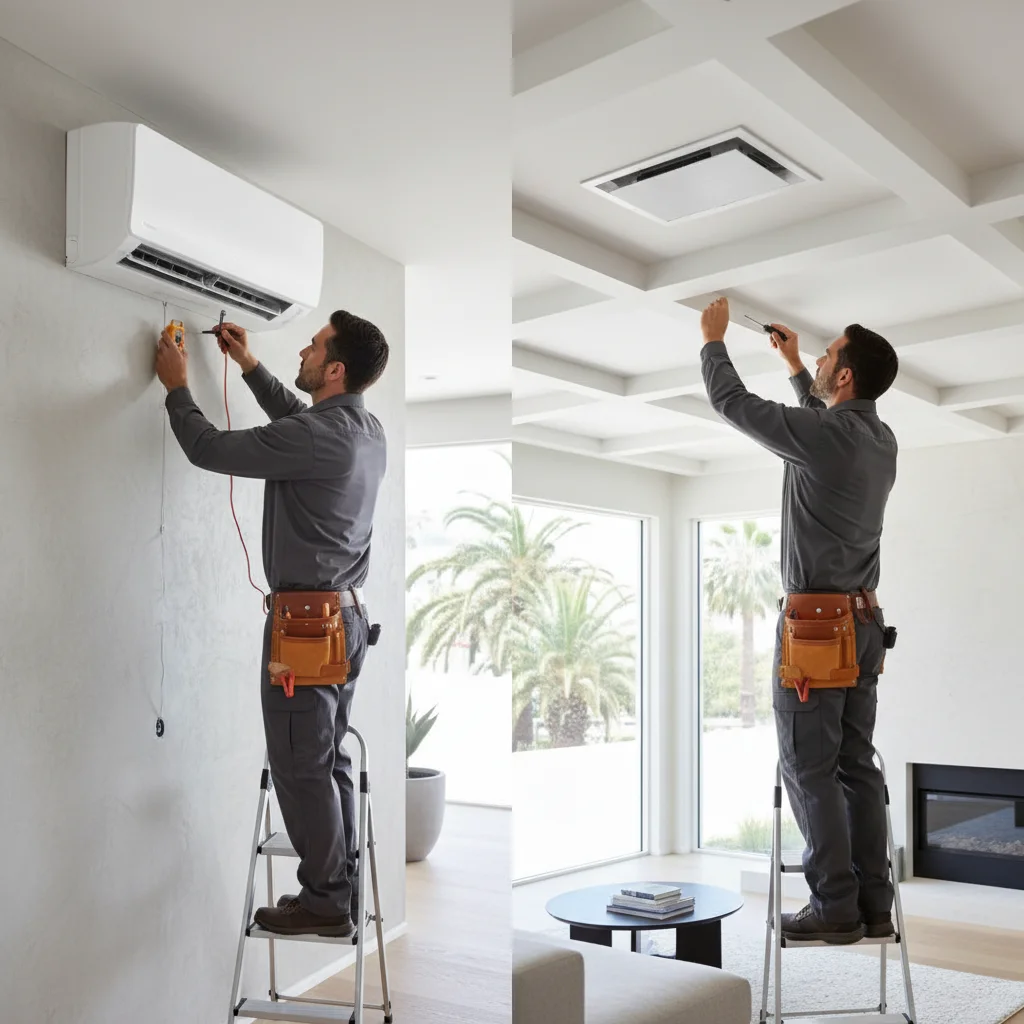
Yes. A ductless mini split is a heat pump built for homes without ducts, or for zoning specific rooms independently. The outdoor compressor connects to one or more indoor wall-mounted or ceiling-cassette heads through a small refrigerant line set, no ductwork required. Each indoor head heats and cools the room it’s in, and multi-zone systems let you run four or five rooms off one outdoor unit with separate temperature control for each.
Mini splits are the right call for room additions, garage conversions, ADUs, older San Diego homes with no existing ducts (common in Coronado, Point Loma, and other older coastal neighborhoods), and anyone who wants to stop conditioning rooms nobody’s using. They’re also the quietest option on this list, since the compressor sits outside and the indoor heads run at a low hum.
What about wall-mounted heater and AC units?
A wall-mounted heater and AC unit, also sold as a through-the-wall AC unit with heat, a PTAC unit (the same style hotels use), or a combination heater and air conditioner, is a single self-contained box installed through an exterior wall. Everything, compressor, coil, and fan, lives in one cabinet, so there’s no separate outdoor unit and no refrigerant line set to run. That makes a wall-mounted AC heater combo the fastest and cheapest combo option to install.
They make the most sense in a few specific spots: a garage that’s been converted to living space, a detached office or studio, an ADU where running a mini split line set isn’t practical, or an older apartment-style unit that already has a PTAC sleeve in the wall. The tradeoff is efficiency and comfort. A through-the-wall AC and heating unit is noisier, less efficient, and doesn’t hold a room temperature as evenly as a mini split or central heat pump. For a single room where it’s the only option that physically fits, they work. For anything bigger, size up to a mini split instead.
Skip window units that claim to heat and cool. They exist, but the heating side is usually a resistive electric strip, not a real heat pump cycle, so they’re expensive to run and don’t hold up on a cold San Diego night the way a proper heat pump or PTAC does.
Best wall-mounted air conditioner heater combo for a San Diego room
Searches for the “best wall mounted air conditioner heater combo” usually come down to two real categories, not one. A heat-pump PTAC (sometimes labeled a wall air conditioning unit with heater or a wall heater and AC unit) moves heat both directions, the same principle as a mini split, just packed into one through-the-wall cabinet. A resistive-heat PTAC only reverses a coil into an electric strip heater when you switch modes, which costs more to run on a cold night. For San Diego’s mild winters, either type will keep a converted garage or ADU comfortable, but the heat-pump version is the better long-term pick if the unit will see regular winter use.
Sizing matters more on these than on a mini split, since a wall unit air conditioner and heater is a fixed-capacity box with no zoning flexibility. An undersized unit in a sunny converted garage runs constantly and still loses the fight on a 95-degree afternoon. A tech should measure the room, not just guess off square footage, before you buy.
Heating air conditioning wall units vs. a mini split: which one actually fits
If the room already has a PTAC sleeve cut into the wall from a prior owner or a commercial buildout, replacing it with a matching air conditioner and heater wall unit is usually the cheaper, faster path. If you’re starting from scratch, a single-zone mini split costs more upfront but runs quieter, holds temperature more evenly, and lasts longer than most heating air conditioning units wall installs. We’ll tell you honestly which one fits your specific room instead of defaulting to whichever is easier to sell.
Which combo option fits a San Diego home?
Match the system to your home’s layout, not the other way around.
| System type | What to put on the bid | Best fit |
|---|---|---|
| Central heat pump | Whole-house changeout, ducts, permit | Homes with existing ductwork |
| Ductless mini split, single zone | One head, outdoor unit, line set | One room, addition, garage, ADU |
| Ductless mini split, multi zone | Head count | Multiple rooms, no ductwork |
| Packaged heat pump unit | One cabinet, pad or roof | Homes without attic space for a split |
| Through-the-wall (PTAC) | Sleeve, unit, electrical | Single room, fastest install |
Climate Pros SD does not publish those installed bands. If your home already has ducts, a central heat pump is usually the better long-term layout over a packaged unit or PTAC. If you’re adding a room, converting a garage, or dealing with a home that never had ducts, a mini split installation gets you the same one-unit heat-and-cool benefit without opening walls for ductwork.
Rebate programs for heat pumps change often and run out of funding. The federal 25C tax credit ended for installs after December 31, 2025, so don’t count on it. SDG&E rebates still exist in some form, but confirm what’s actually available at quote time rather than planning around a number you saw online.
Do heat pumps work well in San Diego’s climate?
Yes, better than almost anywhere else in the country. San Diego rarely sees hard freezes, even in East County or the backcountry, so a heat pump’s efficiency advantage over gas heat holds up nearly every day of the year. Coastal homes see the mildest swings of all, often needing barely any heating past a few weeks in December and January. Inland and East County homes see bigger daily temperature swings and more summer heat load, so sizing matters more there, but the heat pump technology itself performs well across every San Diego microclimate.
How is a heat pump different from a regular AC with a furnace?
A regular setup uses two separate systems: a gas furnace for heat and an AC condenser for cooling, each with its own equipment and its own maintenance schedule. A heat pump replaces both with one system that reverses direction seasonally. You lose the gas furnace’s flame heat (a factor mainly in very cold climates, not San Diego) but gain one unit to maintain, one thermostat mode, and typically lower operating costs since a heat pump moves heat instead of generating it from fuel. For a full side-by-side, see our heat pump vs. AC comparison.
Frequently asked questions
What’s the cheapest way to get heat and AC in one unit?
A through-the-wall PTAC unit is usually the smallest project, since it needs no ductwork and no outdoor line set. Climate Pros SD does not publish a $1,500 to $4,000 PTAC. It’s the right call for a single room, but it’s less efficient and noisier than a mini split or central heat pump, so it’s not the best long-term value for a whole home.
Can I add a heat pump to my existing ductwork?
In most cases, yes. If your home already runs a furnace and AC through the same ducts, a central heat pump typically swaps in using the existing duct system, sometimes with modifications depending on duct sizing and airflow needs. A tech needs to check your specific setup before quoting the swap.
Do mini splits really heat as well as they cool?
Yes, modern mini splits are true heat pumps, not electric-strip heaters, so the heating side works as efficiently as the cooling side. In San Diego’s mild winters, a properly sized mini split heats a room comfortably down to well below any temperature the region actually sees.
Is a packaged unit the same as a heat pump?
Not exactly. A packaged unit houses the compressor, coil, and air handler in one cabinet, usually on a roof or a concrete pad, instead of splitting them between an outdoor condenser and an indoor coil. Many packaged units are heat pumps internally, so they do heat and cool from one box, but the “packaged” part refers to the cabinet layout, not the heating and cooling function.
How long does a heat-and-AC combo system last?
A central heat pump or mini split typically runs 12 to 18 years with regular maintenance, similar to a standard AC condenser. PTAC units tend to run shorter, often 8 to 12 years, because the compressor and fan live in one compact cabinet exposed to more temperature swing and moisture.
Will one heat pump keep my whole San Diego house comfortable?
For most single-family homes with reasonable ductwork, yes, a single properly sized central heat pump handles the whole house. Larger homes, additions with poor duct access, or homes with rooms that always run hot or cold sometimes do better with a multi-zone mini split layered in for the problem rooms.
What’s the difference between an AC heater combo unit and a combination heater and air conditioner?
Nothing, they’re the same thing described two different ways. A/C heater combo, combo heater and air conditioner, and combination heater and air conditioner all describe equipment that both heats and cools from one unit, whether that’s a central heat pump, a mini split, or a through-the-wall PTAC. The format that fits your home depends on whether you have ductwork, a wall opening for a through-the-wall unit, or need zoned room-by-room control.
Whichever combo format fits your home, the sizing and duct questions are worth getting right before you buy. For a quote on a central heat pump service, a mini split installation, or help deciding between the two, call (442) 777-6440. We’ll walk your home and tell you straight which option actually fits.
Related service: AC repair.