Kearny Mesa rooftops and Mission Valley clinics don’t share one HVAC mix. Reliability centered maintenance ranks equipment by function and failure consequence, not by a matching calendar. It’s a planning method, not a promise of uptime, savings, or fewer failures.
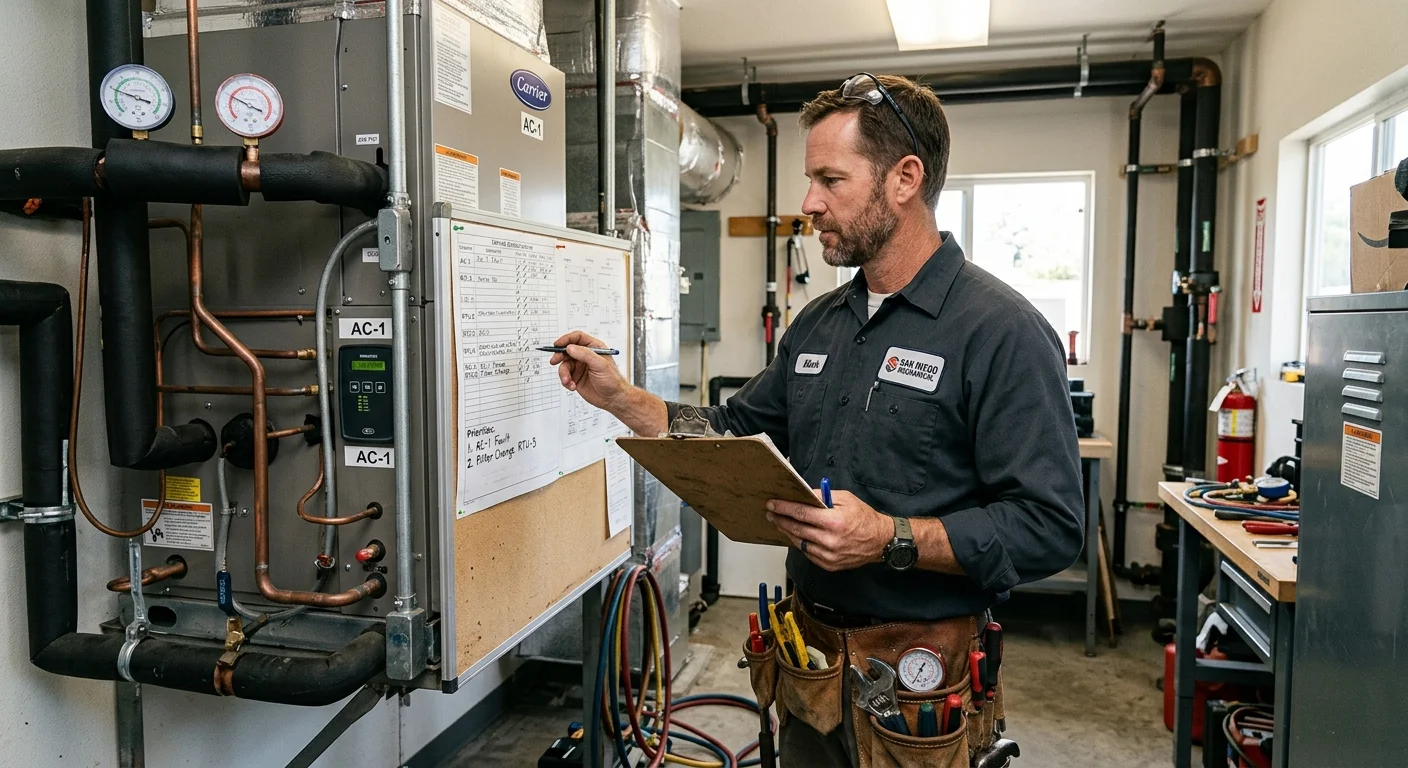
Reliability-centered HVAC ranks by consequence, not by matching calendars
A clinic air handler that serves procedure rooms is not on the same interval as a storage-room exhaust fan. Write functions and failure effects first. Kearny Mesa rooftops mix RTUs of different ages. A single annual date for all of them wastes money on the spare and under-serves the critical unit.
Checklist
- List equipment by what stops if it fails.
- Keep tenant comfort separate from life-safety ventilation.
- See preventive vs predictive.
- See commercial HVAC.
- Use CSLB check on the vendor.
Related: Vista RTU maintenance and HVAC maintenance.
What is reliability-centered HVAC maintenance?
Reliability centered maintenance, often called RCM, is an equipment-priority method. You start with what each HVAC asset is there to do. You name what it looks like when that function stops. Then you rank how bad that stoppage would be for people, product, and the rest of the building. Only after that ranking do you pick a service approach for that unit.
Some equipment stays on a calendar. Some gets closer watching. Some goes on a short list for repair or replacement talk. The method doesn’t lock a building into one schedule. It doesn’t promise a result. It stops you from treating every condenser on the roof as equal.
Kearny Mesa and Mission Valley make the ranking local. Kearny Mesa sits inland of the marine layer. Think Convoy Street, Clairemont Mesa Boulevard, and Montgomery-Gibbs Executive Airport. NOAA’s 1991-2020 normal August high at Montgomery Field is 82.0°F. Mission Valley follows the I-8 corridor along the San Diego River. The San Diego International Airport station has a normal August high of 77.3°F.
The roofs differ too. Kearny Mesa holds light industrial parks, auto shops, restaurants, and low-rise offices. Packaged rooftop units are common on those decks. Mission Valley leans hotels, malls, medical offices, and corporate floors. A waiting room and a parts cage don’t fail with the same consequence.
Climate Pros SD is a referral service. We match you with licensed, independent HVAC professionals. We don’t write your reliability program. We don’t service the equipment. A C-20 contractor is the person California licenses to maintain, service, and repair these systems. Confirm a contractor’s license on the CSLB license check.
How does it differ from preventive maintenance?
Preventive and predictive HVAC maintenance sit next to each other, not in a fight. Preventive work runs on time or on hours. Filters, coils, belts, and drain lines get attention because the calendar says so. Calendar service is a common starting point. It isn’t the same as ranking equipment.
Predictive work watches condition. Temperature trends or error logs can flag a change before someone opens a panel. Predictive HVAC maintenance in commercial buildings is a watching method. Reliability-centered HVAC maintenance is a decision method. It asks which assets deserve the calendar, which deserve watching, and which can wait.
That difference matters on a mixed roof. A Mission Valley hotel corridor air handler and a Kearny Mesa warehouse unit over unused racking shouldn’t share the same service intensity just because both are packaged units. Preventive work can still happen. RCM is the filter that decides how much of it each asset gets.
Don’t treat RCM as a guarantee that failures drop. Don’t treat it as a savings plan. Ranking equipment doesn’t, by itself, cut a bill. RCM also doesn’t erase deferred HVAC maintenance. After you rank, you may still postpone a low-consequence unit. That’s a budget choice. Name it as a delay.
Which equipment belongs in the first review?
Start with function, not with the newest sticker on the cabinet. Commercial HVAC maintenance priorities follow consequence. If one rooftop unit is the only cooling for an occupied suite, it belongs on the first list. If a second unit can carry the same floor, that backup changes the rank. Keep both on the list. Don’t pretend they’re twins.
Put occupied-space equipment near the top. California’s indoor heat standard, Cal/OSHA Title 8 §3396, applies at 82°F. Fuller requirements kick in at an 87°F heat index, or at 82°F with restrictive clothing or high radiant heat. The rule took effect July 23, 2024. It doesn’t require air conditioning. A Kearny Mesa shop office, a Convoy dining room, and a Mission Valley waiting room serve people who have to stay. A storage mezzanine doesn’t.
Then look at refrigerant generation. U.S. production and import of R-22 have been banned since January 1, 2020. Existing systems may still be serviced with recycled or previously produced refrigerant. Older R-410A systems remain serviceable. New equipment manufactured or imported after January 1, 2025, must use refrigerants with a GWP of 700 or less. That doesn’t tell you a unit will fail next summer. It does tell you that an older Kearny Mesa rooftop pack and a post-2025 Mission Valley replacement aren’t the same service problem.
Add single-point assets. One air handler for a whole clinic pod. One condenser for a server closet. One makeup-air unit for a restaurant. If that asset stops, the function stops. Leave unused zones lower unless a record says otherwise. Equipment reliability planning isn’t a tour of every grill. It’s a short list you can walk with a licensed pro.
If the review turns into repair, replacement, or alteration in the City of San Diego, a mechanical permit is required. The matched licensed contractor pulls that permit. Climate Pros SD doesn’t. Confirm the current path with the City of San Diego Development Services Department.
What records should a facility manager collect?
Bring paper and photos, not a theory. A useful first packet is an equipment list with location, what each unit serves, and whether it’s the only unit serving that space. Add model and serial numbers from the nameplate. Add refrigerant type if the label shows it. Add filter sizes. Add the last service date you actually have, and mark gaps as gaps.
Collect complaint history the same way. Tenant calls about a Mission Valley west-facing conference room in August are a function signal. So are Kearny Mesa shop notes about a unit that struggles on hot afternoons. Write what people reported. Don’t turn those notes into a diagnosis. The contractor you’re matched with does that.
Keep thermostat and zone notes. A packaged unit that cools a Convoy showroom and a back office from one thermostat is a different asset than two independently controlled zones. Photos of the roof deck, clearances, and the electrical disconnect help a pro see access. Photos don’t replace a site visit.
If you have invoices, keep them. If you don’t, say so. Invented run-hour totals and guessed install years help nobody. The nameplate and the permit history tell you age when you can find them.
The U.S. Department of Energy’s heating and cooling pages are a fair public primer on how systems are supposed to work. They aren’t a substitute for a C-20 inspection. Hand the packet to the licensed pro who handles your HVAC maintenance. Ask them to correct the function list. Ask which assets they’d watch, service on a calendar, or discuss as repair-versus-replace. Ask what they can’t confirm from records alone. “Not confirmed” is a valid line item.
When should a commercial HVAC pro assess the plan?
Bring a commercial HVAC pro in when the ranking exists on paper and you need eyes on the iron. A spreadsheet can’t see a clogged drain, a sun-baked condenser, or a dirty coil. Reliability-centered HVAC maintenance is the map. The C-20 contractor is the person licensed to maintain, service, and repair the equipment on it.
Ask for that review before you freeze a year’s service around a calendar that treats every unit the same. Ask before you defer a Mission Valley guest-facing unit because a Kearny Mesa storage unit looks older. The pro confirms duration and scope. Climate Pros SD doesn’t.
If the plan includes altering or replacing a system, California Title 24 requires field verification testing by a CEC-certified rater. As of January 1, 2026, the California Energy Commission moved the old HERS field-verification scope into the Energy Code Compliance program. Don’t guess duct-leakage numbers. Ask the rater and the contractor for the current ECC path. The California Energy Commission is the agency that publishes it.
Every HVAC pro in the network is licensed and insured. You contract with that professional directly. Climate Pros SD performs no work, owns no trucks, and sets no prices. Ask the contractor how they’d sequence the first-review list. Then decide, with their written scope, whether the ranking is worth adopting for your building.
When to call us
When a Kearny Mesa or Mission Valley building has mixed HVAC equipment, a licensed C-20 pro should walk the priority list. Climate Pros SD matches you with independent local contractors. Call us at (442) 777-6440 and we will match you with a licensed local pro.