Preventive maintenance uses a calendar or operating interval to organize recurring HVAC work. Predictive maintenance adds condition data, helping a contractor review what equipment readings are doing between planned visits. For a small commercial building, the practical choice is usually a documented preventive baseline, followed by selective monitoring where the records support it.
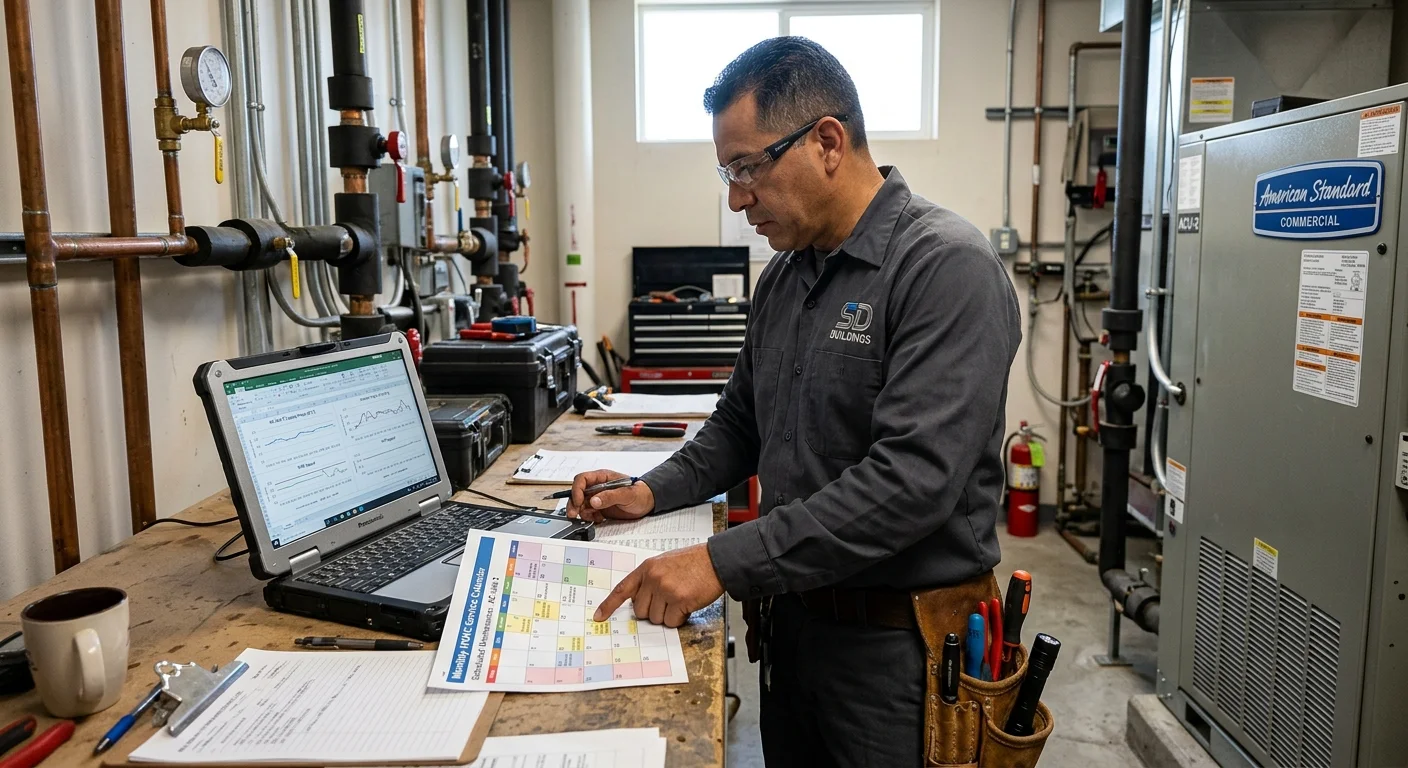
Start with a written preventive scope, then add sensors where records justify them
Calendar visits still do the filter, coil, and drain work. Predictive tools help only on equipment whose failure would stop the building. A Convoy Street flex space and a Friars Road clinic do not share one sensor package. Access and tenant use belong in the proposal.
Checklist
- Separate included tasks from extra-cost repairs.
- Name the monitored equipment.
- See predictive commercial.
- See commercial HVAC.
- Climate Pros SD refers. It does not set your CMMS.
Related: Reliability-centered maintenance and deferred maintenance.
What does preventive HVAC maintenance cover?
Preventive HVAC maintenance is calendar-based. The building owner and contractor agree on planned visits and a written scope. Work follows that plan instead of waiting for a specific sensor trend or equipment complaint.
The exact scope belongs in the contractor’s proposal. It might address filters, accessible coils, drain components, controls, electrical connections, operating observations, and visible equipment condition. Those are possible categories, not a universal checklist. Each system, building, and agreement can differ. Ask the contractor to identify every included task before approving a commercial HVAC maintenance plan.
A useful proposal separates four items:
- Equipment covered by the agreement
- Tasks included during each planned visit
- Findings recorded after the visit
- Work that needs separate approval
That separation prevents vague terms such as “full service” from carrying too much weight. It also gives another contractor enough context to compare the scope later.
Building context matters in San Diego. A Kearny Mesa flex space near Convoy Street may have different access, tenant use, and equipment arrangements than a Mission Valley property along Friars Road. If units sit on a roof, document how the contractor reaches them. If several tenants share equipment, identify the zones served by each unit.
Preventive maintenance is a planning structure, not a guarantee. A contract shouldn’t be judged only by visit frequency. Compare what gets examined, what gets documented, and how additional work is presented for approval. Climate Pros SD can connect owners with independent licensed professionals who provide commercial HVAC services and explain their own maintenance scopes.
What does predictive monitoring add?
Predictive maintenance adds condition information to the calendar. The contractor reviews selected readings or alerts for meaningful changes. Those inputs might include runtime, temperature, pressure, vibration, electrical current, control alarms, or other equipment data.
Not every building collects those inputs. Not every collected value deserves the same attention. The contractor should explain what will be measured, where the data comes from, and how it will be reviewed. Ask whether the source is an equipment controller, building automation platform, separate sensor, or manual reading.
The most useful comparison isn’t “scheduled visits or sensors.” It’s whether condition data adds a clear decision point to the existing plan. A proposal should answer practical questions:
- Which equipment is monitored?
- Which measurements are retained?
- Who reviews the information?
- What happens when a reading changes?
- Does any follow-up require separate authorization?
Don’t treat a single alert as an automatic diagnosis. Ask the contractor to show the related history, operating context, and inspection findings. A trend without dates, units, or equipment identifiers can be difficult to interpret.
Predictive monitoring can also create administrative work. Someone must keep asset names consistent and record changes made to controls or equipment. Replaced sensors, adjusted setpoints, and tenant schedule changes should appear in the same record.
Our guide to predictive HVAC maintenance in commercial buildings explains that method in more detail. The key distinction remains simple: preventive maintenance schedules work by plan, while predictive monitoring adds selected condition data to the review.
Which plan fits a small commercial building?
Start with the building’s actual management problem. A small owner-operated property may need a clear calendar, an asset list, and readable visit reports. A facility manager with several units may also want condition data for equipment that’s difficult to compare through occasional observations alone.
Keep the decision tied to a defined purpose. If nobody can explain how a measurement affects review, approval, or follow-up, that data may not improve the plan. If the preventive scope lacks equipment labels and service records, adding more monitoring can make the paperwork harder to reconcile.
For a Kearny Mesa or Mission Valley property, compare these plan elements side by side:
- Included equipment and excluded equipment
- Calendar-based tasks
- Measurements collected during visits
- Continuous or periodic condition inputs
- Reporting format
- Approval process for added work
- Record ownership and export options
- Contract renewal and cancellation terms
The contractor should also explain which tasks remain scheduled regardless of monitoring. Predictive data doesn’t automatically replace every planned inspection or service item. The proposal needs to say what changes and what stays on the calendar.
Match the plan to the person managing it. A compact report may work for an owner who reviews one building. A facility manager comparing several tenant zones may need consistent equipment names and sortable records. Choose the format your team will actually maintain.
Our small-business commercial HVAC guide offers more planning context for local properties. Use it alongside the contractor’s written scope, not as a substitute for site-specific review. The right plan is the one both parties can explain, document, and compare without relying on vague promises.
What records should San Diego owners compare?
Begin with an equipment register. Give each unit a consistent identifier and location. Include the model information visible in existing records, the spaces served, and any control connected to that unit. Don’t fill missing fields with guesses. Mark them for confirmation during the contractor’s review.
Next, compare service documentation. A useful entry identifies the date, unit, task, observation, and person or company making the entry. If a measurement appears, record its unit and collection method. That keeps later comparisons from mixing unrelated values.
Tenant notes need structure too. Record the affected room or zone, the time the issue appeared, and what occupants noticed. “Office uncomfortable” gives little direction. “West conference room felt warm during the afternoon meeting” preserves more context without pretending to diagnose the cause.
Keep proposals, approved work, and completed work separate. A recommendation isn’t the same as authorization. An approved item isn’t proof that work was completed. That distinction helps owners compare invoices, visit reports, and open follow-up items.
San Diego location details belong in the record where they affect access or planning. Note whether the property is near Convoy Street, Friars Road, I-805, I-15, SR-163, or I-8 when that helps identify the correct site. Record gate instructions, roof access arrangements, tenant contacts, and equipment locations in the owner’s own building file.
Condition-monitoring records need equal discipline. Preserve dates, equipment identifiers, alert descriptions, and related contractor notes. Ask who owns the historical data if a monitoring agreement ends. Also ask which formats can be exported. Good records let owners compare proposals on actual scope and documentation, without depending on memory.
When should an independent licensed pro review it?
Ask for a professional review when creating a first maintenance plan, changing contractors, adding monitoring, or finding gaps between reports and equipment records. A review also makes sense before contract renewal, after equipment changes, or when repeated tenant notes point to the same zone.
Bring the equipment register, previous reports, open recommendations, and any available trend data. Ask the contractor to identify what can be confirmed on site and what remains unknown. Missing information should stay marked as unconfirmed until someone verifies it.
California’s C-20 classification covers the installation, maintenance, service, and repair of warm-air heating, ventilation, and air-conditioning systems. Owners can confirm a contractor’s current record through the California Contractors State License Board license check.
Climate Pros SD is a referral service. It doesn’t perform HVAC work, set service schedules, or decide which monitoring tools a building needs. The independent licensed contractor evaluates the property, proposes the scope, and contracts with the customer directly.
During that review, ask for plain answers. Which tasks are preventive? Which inputs are predictive? Which equipment is excluded? Who reviews alerts? What documentation will the owner receive? A clear commercial HVAC maintenance plan should make those boundaries visible before the parties sign it.
When to call us
Call when your commercial maintenance scope is unclear, your records don’t match, or you need a licensed pro to review preventive and predictive options. Climate Pros SD will connect you with an independent licensed and insured HVAC professional serving San Diego County. Call us at (442) 777-6440 and we will match you with a licensed local pro.