A commercial HVAC unit may keep running while its behavior changes. Predictive maintenance helps facility teams notice those changes and decide what deserves review. It can’t guarantee that equipment won’t fail, but it can support earlier, better-informed decisions.
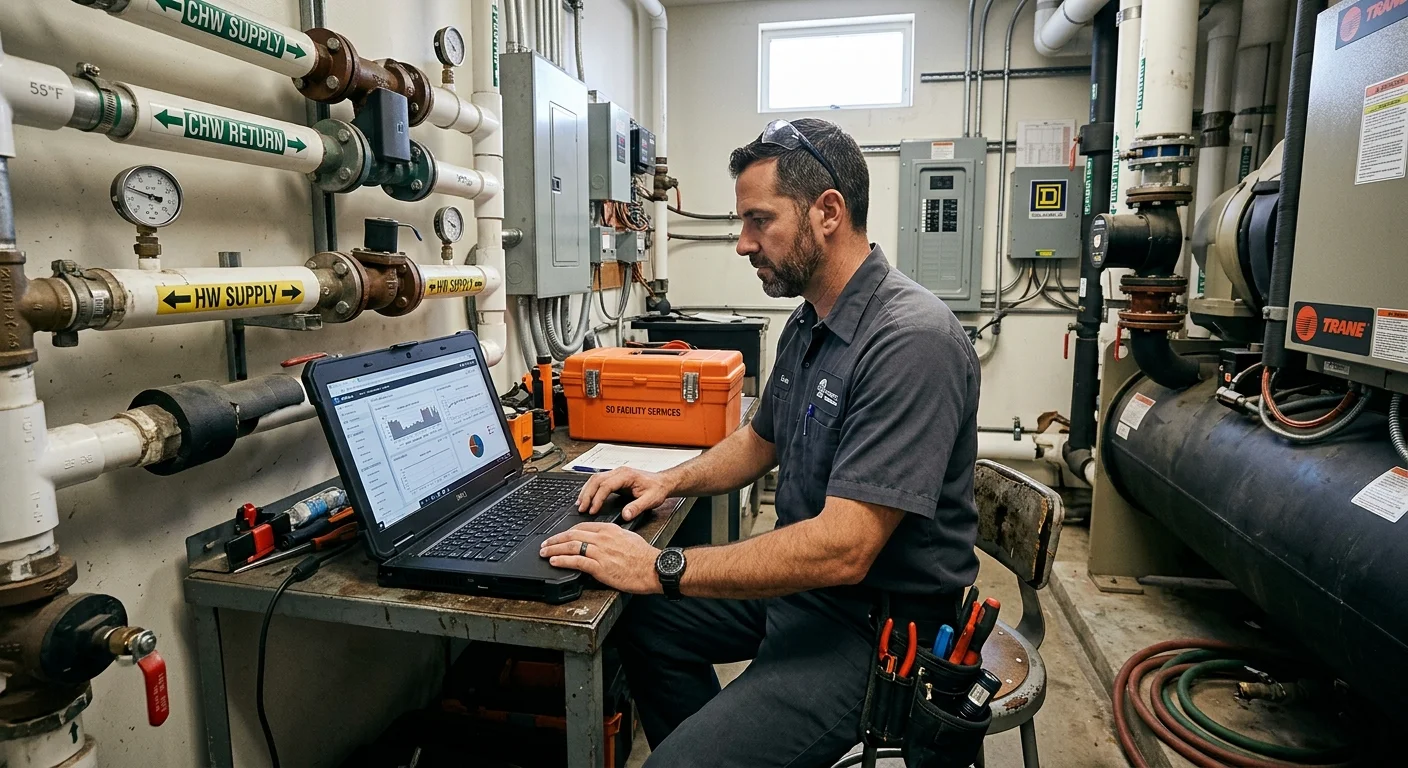
Predictive HVAC maintenance is trend data plus a person who acts on it
Runtime, temperatures, amps, or vibration only help if someone reviews alerts and has authority to approve work. Sensors without a work order process are decoration. Kearny Mesa and Mission Valley small commercial roofs often have no BMS. A contractor-owned logger can still be predictive if the owner gets the export.
Checklist
- Ask who watches the alerts on weekends.
- Require data export if the contract ends.
- See preventive vs predictive.
- See reliability-centered maintenance.
- Use commercial HVAC.
Related: Vista commercial maintenance and HVAC maintenance.
What does predictive HVAC maintenance track?
Predictive HVAC maintenance tracks selected operating data over time. The goal isn’t to collect every possible reading. It’s to create a useful history for each unit or zone.
A facility team might choose to record:
- Equipment start and stop times
- Heating or cooling calls
- Zone and thermostat temperatures
- Supply and return air temperatures
- Fan status and controller alerts
- Filter pressure readings, when available
- Electrical readings from compatible monitoring equipment
- Changes made during maintenance or repairs
Available data depends on the installed equipment and controls. A building automation system may expose several points. A basic thermostat may provide far less. Add-on sensors can create another option, but their placement and compatibility need review.
The most useful comparison is often the equipment against its own established pattern. A Kearny Mesa office inside a mixed-use property may operate differently from a Mission Valley retail suite. Tenant schedules, occupied areas, and control settings also differ. A shared benchmark may hide those details.
Keep context beside the readings. Note which unit served the space, what mode it was in, and whether anyone changed its schedule or settings. Record maintenance work as well. Otherwise, a dashboard change may look mechanical when it came from an intentional adjustment.
Commercial HVAC monitoring is a decision tool. It doesn’t diagnose a component or complete a repair. A licensed professional should interpret unclear patterns before anyone authorizes work. Climate Pros SD can connect facility managers with independent commercial HVAC professionals who can review the equipment and available data.
Which building problems can trend data reveal?
Trend data can reveal that an operating pattern has changed. It usually can’t confirm why that change happened.
For example, a manager might notice longer operation during the same scheduled period. Another unit might start and stop more often than its earlier pattern. A zone temperature may drift farther from its setpoint. An alert may also repeat after staff reset the controller.
Each pattern creates a question for the contractor. It isn’t proof of a specific failure. Changed occupancy, revised settings, airflow conditions, sensor placement, equipment trouble, or inaccurate data may produce similar dashboard results.
That distinction matters. Replacing parts from an alert label alone can turn monitoring into guesswork. A better record shows the pattern, its timing, and the conditions around it. The independent pro can then compare the data with an equipment inspection.
Compare similar periods at the same property. Don’t assume two buildings should produce matching charts. Even neighboring suites can have different uses, schedules, and equipment.
A Kearny Mesa facility may need separate views for warehouse and office areas. A Mission Valley property may need zone-level records for tenants with different operating periods. These are planning examples, not fixed monitoring rules. The pilot should reflect the actual building.
HVAC condition monitoring is most useful when it narrows the next decision. The question might be whether a sensor needs checking, whether a control setting changed, or whether the equipment needs an on-site review. The dashboard should lead to a clear next step, not a confident diagnosis it can’t support.
What equipment needs compatible controls or sensors?
Start with an inventory, not a software subscription. List the equipment, controller, thermostat, and available data points. Record exact model information where possible. Don’t assume compatibility from the unit’s age, appearance, or brand name.
A predictive HVAC maintenance setup needs a usable source for each selected reading. That source might be an existing controller, a building management system, a thermostat platform, or a separate sensor. The correct option depends on the installed equipment.
Ask these questions before choosing a platform:
- Which readings can the current controls provide?
- Can the system store or export historical data?
- Who owns the data and can access it?
- How does the platform identify each unit and zone?
- Can staff document service work beside the trend?
- What happens when a sensor stops reporting?
- Which additions require professional installation?
A controller message isn’t automatically a verified equipment diagnosis. It may identify a condition, a communication issue, or a point needing inspection. Ask an independent commercial HVAC pro to confirm what each data point represents.
This review matters in offices with several zones or shared systems. Our San Diego office HVAC guide explains other building-level questions facility teams should consider. The equipment inventory can also help a pro determine whether monitoring should remain limited to one unit or cover a broader system.
Before hiring anyone for HVAC work, use the CSLB license check to confirm current license details. Climate Pros SD matches customers with licensed, independent local HVAC professionals.
How can a San Diego facility test a small pilot?
A small pilot should answer a specific operational question. Avoid beginning with a plan to monitor every available point across the property.
Choose one unit, zone, or repeated concern. Define the decision the pilot should support. You may want to know whether an alert repeats, whether a zone departs from its earlier pattern, or whether staff can use the dashboard consistently.
Then build the pilot around that decision:
- Identify the exact equipment and space.
- Confirm which readings are available and meaningful.
- Record an initial operating pattern for comparison.
- Note schedule, setting, and maintenance changes.
- Decide who reviews alerts and what they document.
- Have a qualified pro define conditions needing inspection.
- Review whether the data changed any service decision.
Don’t invent a warning threshold because a dashboard requests one. Ask the equipment manufacturer, monitoring provider, or independent HVAC contractor how that point should be interpreted. If a current threshold can’t be confirmed, state that in the pilot record.
The review process matters as much as the hardware. A stream of alerts without an assigned owner can become background noise. The pilot should name who checks the data, who records context, and who contacts the contractor.
For smaller properties, our commercial HVAC guide for San Diego businesses offers a useful planning framework. A pilot can also complement an existing HVAC maintenance relationship. It shouldn’t replace physical inspection or professional judgment.
At the end, ask whether the selected readings were reliable and understandable. Check whether staff could connect alerts with the correct equipment. If the data didn’t support a real decision, adjust the pilot before expanding it.
When should an independent pro review the data?
Bring an independent commercial HVAC pro into the process before the dashboard starts driving repair decisions. The pro can review the equipment list, available control points, and proposed alerts. That keeps the pilot tied to the installed system.
A professional review also makes sense when:
- A change repeats under similar operating conditions
- Several readings appear to move together
- A sensor conflicts with what staff observe
- An alert returns after a reset or setting change
- The dashboard stops receiving expected data
- Staff want to change controls or add sensors
- The data suggests an equipment inspection
Share a clean record. Include the unit identifier, timestamps, displayed readings, controller messages, and recent setting changes. Add relevant maintenance notes. Screenshots can help when a dashboard later updates or clears an alert.
Don’t ask the pro to confirm a diagnosis you already chose. Ask what the data does and doesn’t establish. The answer may point toward an inspection, a sensor check, a control review, or continued observation. The contractor should explain the next step based on the actual equipment.
After any service work, document what changed. That could include a setting, sensor, controller, or mechanical component. Keep the contractor’s notes with the trend record. Future reviewers can then separate a new pattern from an intentional change.
Predictive maintenance works best as a structured conversation between facility staff and the licensed professional. The data organizes questions. The contractor evaluates the system. Neither side should treat a dashboard forecast as a promise against downtime.
When to call us
Call when monitoring shows a repeated change, controls need professional review, or you’re planning a commercial HVAC pilot. Call us at (442) 777-6440 and we will match you with a licensed local pro.