A Vista rooftop unit should be serviced on run hours, not on the calendar, with the economizer checked before the cooling season and the drain pan checked during it. Everything else on a maintenance visit is routine. Those two items are where the expensive failures start.
Vista’s business park and the light-industrial corridor along South Santa Fe Avenue run a different kind of building than the strip retail along Vista Village Drive, and the maintenance plan should not be the same for both.
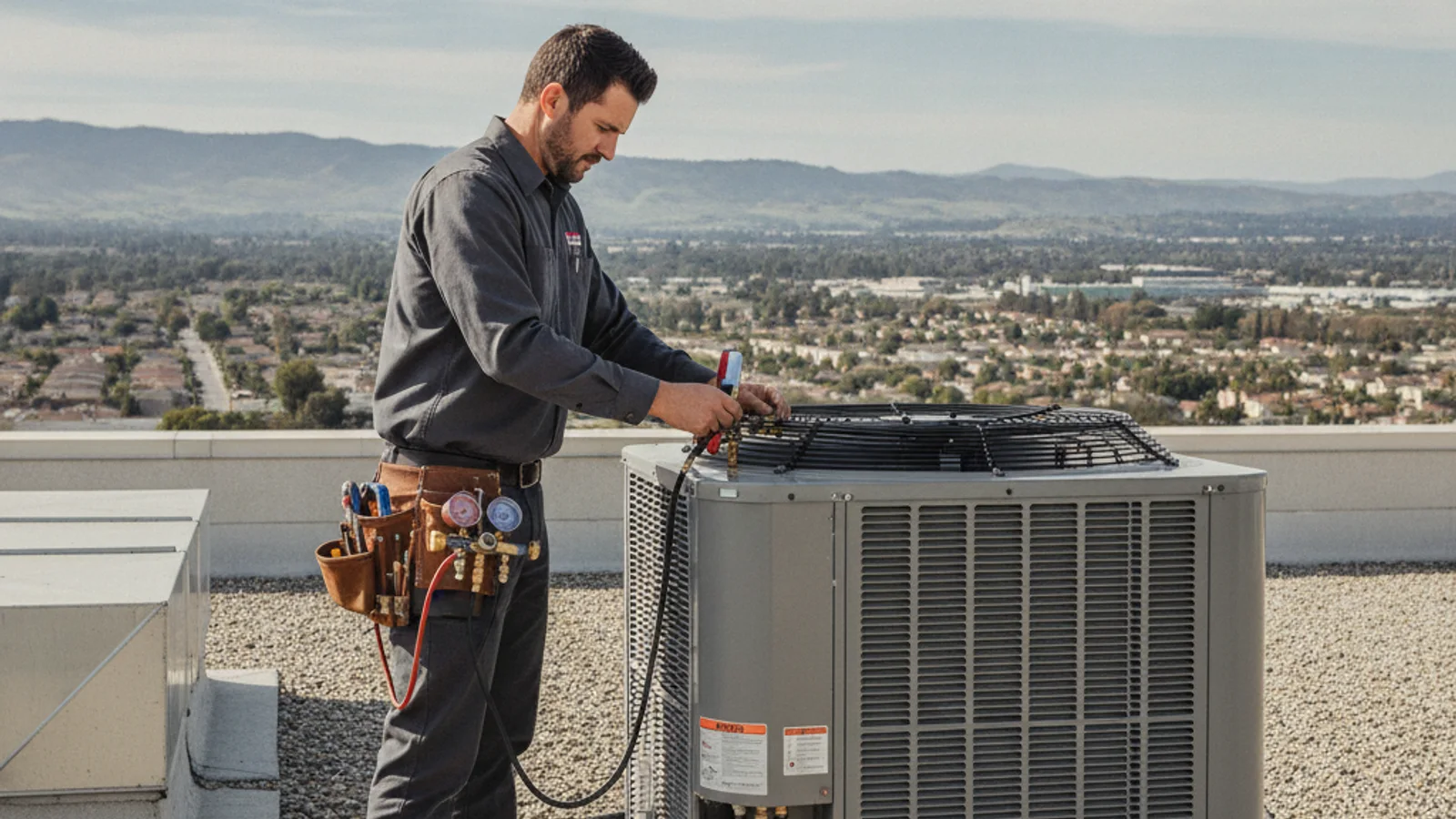
Vista rooftop maintenance follows run hours, not a generic calendar
Service the RTU on operating hours, check the economizer before cooling season, and inspect the drain pan during it. Those two items prevent the expensive water and damper failures. Vista mixed-use and light industrial roofs collect dust from SR-78 corridors. Economizers that stick open dump unconditioned air into tenant spaces.
Checklist
- Log runtime hours from the controller if it has a meter.
- Photograph the economizer damper position.
- Note drain pan rust or standing water.
- Record roof access and hatch keys.
- See commercial HVAC.
Related: Vista HVAC and predictive commercial maintenance.
What’s actually on Vista rooftops
Almost all of it is packaged units. Compressor, coils, blower, heat section, and controls in one cabinet, sitting on a curb, ducted straight down through the roof deck. Split systems are the exception in this building stock.
The light-industrial buildings off Business Park Drive and around the South Santa Fe corridor tend to run smaller units serving front offices and larger ones serving warehouse or production space, and the two have nothing in common operationally. The office unit runs an occupancy schedule. The production unit runs whenever the equipment inside is generating heat, which in a machine shop or a bakery means most of the day, most of the year.
Retail and restaurant tenants in the Vista Village core along Main Street and Broadway sit on older buildings with older curbs. Two things follow from that: the roof structure limits what can replace a failed unit, and access is often through a shared roof hatch controlled by the landlord.
Vista is inland, so the summer load on these units is real in a way it isn’t for the same building in Carlsbad. A unit that spends most of a North County Inland summer at or near full capacity accumulates run hours fast, and run hours are what wears a rooftop unit out. Our general light-commercial HVAC guide for San Diego covers equipment selection and the repair-or-replace decision. This piece is about keeping what you have alive.
Filters and belts on run hours, not months
“Quarterly” is a scheduling convenience, not an engineering interval. Two identical rooftop units on the same Vista roof can need service on completely different cycles because one runs eight hours a weekday and the other runs sixteen hours seven days.
Filters. The right interval comes from what the unit breathes and how long it breathes it. A front office in a clean building holds a filter far longer than a unit pulling air near a loading dock, a woodshop, or a parking lot on a windy inland afternoon. The measurable version is static pressure across the filter bank: the pro records it clean, and the change interval is set by when it reaches the manufacturer’s limit. Absent that, visual inspection every month costs nothing and tells you most of what you need.
Belts. Belt-driven blowers are still common on older packaged units. Belts stretch, glaze, and crack, and a belt that snaps on a July afternoon shuts down a tenant space. The maintenance items are tension, alignment, and sheave wear. A worn sheave will destroy a new belt in weeks, so replacing belts without checking the sheave is a repeat visit waiting to happen. Ask the pro whether keeping one spare belt per unit size on site makes sense for your equipment.
Bearings and motors. Listen for them at every visit. A dry bearing gives audible warning long before it seizes.
Whatever interval you land on, get it in writing from the company doing the work, with the equipment identified and the price stated. Each company sets its own service plan terms and fees, and the same principles apply to routine HVAC maintenance on the residential side.
The economizer is the part nobody checks
Most packaged rooftop units have an economizer: a set of outside air and return air dampers with an actuator and a controller, designed to cool the space with outdoor air when the outdoor air is cool enough.
They fail quietly, and they fail often. The actuator dies, linkage seizes, a sensor drifts, or the controller loses its settings. Nothing alarms. The space still gets conditioned, because the compressor picks up the load the economizer should have carried.
Two failure directions, both expensive in different ways. Stuck closed, the unit runs mechanical cooling on mild mornings when free cooling was available, and the compressor accumulates run hours it didn’t need. Stuck open, the unit drags hot outdoor air into the space through a Vista summer afternoon and never satisfies the thermostat, which reads to the tenant as an undersized unit.
Vista’s inland climate makes both of these matter more than they would on the coast. Mornings and evenings here often sit in the range where free cooling genuinely works, and afternoons punish an open damper.
Ask for the economizer to be exercised through its full travel at the pre-season visit, with the sensors verified and the changeover setpoint confirmed against the controller’s documentation. Ask for it in the written scope. It’s one of the first line items that quietly disappears from a low bid.
Drains, pans, and the roof underneath
Condensate is where a maintenance failure turns into a building repair.
A rooftop unit drains through a trapped line to the roof surface or to a drain. Traps dry out, lines fill with algae and dust, and pans corrode. When the pan overflows, water goes into the curb, through the roof deck, and into the tenant’s ceiling. In older Vista Village buildings that path is short.
The visit items are simple: clear and flush the line, verify the trap holds water, inspect the pan for standing water and rust-through, and confirm the float switch works rather than assuming it does. A float switch that has been jumped out by a previous technician is common and worth looking for.
While anyone is up there, the roof around the curb deserves a look. Curb flashing, pitch pockets around refrigerant and electrical penetrations, and the condition of the roof membrane where the service technician walks are all things that get noticed only during an HVAC visit. Photograph them for the building file.
Tenant improvements change the system, and nobody rebalances it
This is the most common problem in Vista’s light-industrial and flex space, and it isn’t a maintenance failure at all.
A tenant improvement moves walls. The rooftop unit and the duct layout stay exactly as they were. What used to be one open bay becomes four offices and a conference room, all fed by diffusers that were positioned for a different floor plan, with return air paths now blocked by full-height walls. The tenant reports that the HVAC is broken. The HVAC is fine, and the air distribution is wrong.
Adding load does the same thing from the other direction. A server closet, a production line, a commercial kitchen, or a new roll-up door changes the heat load in a space that was sized without them. Cal/OSHA’s indoor heat illness prevention standard, effective July 23, 2024, applies to indoor workplaces where the temperature reaches 82 degrees Fahrenheit, with fuller requirements at an 87 degree heat index or at 82 degrees where employees wear restrictive clothing or work near high radiant heat. The standard does not require air conditioning. It requires engineering controls unless they’re infeasible, and ventilation, high-volume fans, and evaporative cooling all qualify.
So when a Vista tenant improvement adds heat-generating equipment, the right questions are what the new load is, whether the existing unit and duct layout can carry it, and what the space will read on a hot afternoon. Get the answer before build-out, not after.
Who owns the equipment under your lease
Most small commercial leases in San Diego County assign some HVAC responsibility to the tenant, and the language varies enough that it’s worth reading before you sign anything. Routine maintenance is commonly the tenant’s. Replacement is commonly the landlord’s. The gap between them, a major repair, is where disputes live.
Whichever side you’re on, document. Keep dated service records per unit with the model and serial number, the work performed, the readings taken, and the photos. Vista landlords and property managers ask for it at lease end, and it’s the only evidence that a failed unit failed from age rather than neglect.
Confirm any contractor’s license and classification through the CSLB license check. For scope across the county see our commercial HVAC page, and the Vista service area page covers what’s available locally.
When to call us
If you run a Vista office, shop, or restaurant on rooftop units, the work worth booking is a pre-season economizer and belt check and a mid-season drain check, plus a fresh look at air distribution after any build-out. Every HVAC pro in the network is licensed and insured. Call us at (442) 777-6440 and we will match you with a licensed local pro.