Commercial HVAC in San Diego sits in a weird middle ground. The buildings are bigger than residential. The systems are different (mostly rooftop packaged units). The stakes are higher (a restaurant losing AC for 2 days during a heat wave is a real revenue problem). But most “commercial HVAC” companies treat it like residential with bigger tonnage, which is wrong, and expensive, for small business owners trying to do this right.
Climate Pros SD matches you with licensed HVAC companies. We do not publish a commercial diagnostic or RTU replacement table.
Here’s the honest breakdown.
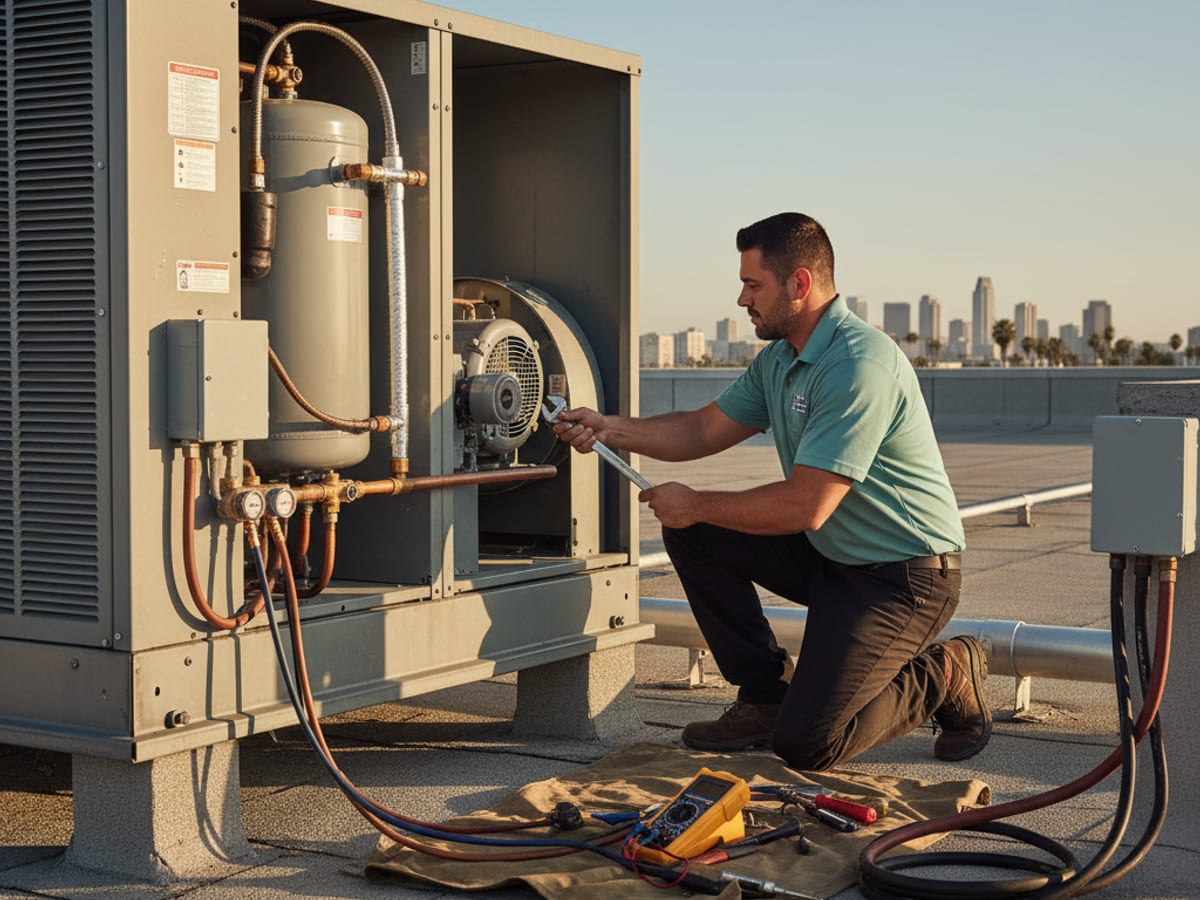
How commercial HVAC differs from residential
Four big differences:
1. Equipment is usually rooftop packaged units (RTUs). Where residential systems split between indoor and outdoor components, commercial systems combine everything into a single rooftop box. Service requires roof access, often after-hours coordination, and different parts inventory.
2. Sizing is by occupancy + equipment, not just square footage. A 1,500 sqft restaurant kitchen needs 3-5x the cooling of a 1,500 sqft office because of cooking equipment heat load and high occupant turnover. A “ton per X square feet” rule of thumb produces undersized commercial systems constantly.
Two building types need their own scope rather than a general commercial quote: kitchens, covered on our restaurant HVAC page, and any room full of equipment that runs all night, covered on our server room cooling page.
3. Use patterns are aggressive. Most commercial HVAC runs 10-14 hours a day, 5-7 days a week, often at maximum capacity. That’s 3-5x the operating hours of residential systems. Components wear faster; maintenance has to be more frequent.
4. Multi-tenant strip mall complications. Many San Diego strip malls have shared HVAC systems where one rooftop unit serves multiple tenants. Failure means coordinating with neighbors, the landlord, and the property management company. Even simple repairs become political.
What belongs on a San Diego commercial quote
Climate Pros SD does not publish 2026 dollar ranges for diagnostics, capacitors, contactors, refrigerant work, compressor jobs, RTU replacements, or quarterly contracts. Ask the matched contractor for a written line for:
- Diagnostic visit (commercial), and whether it credits to repair
- Named parts (capacitor, contactor, leak search, recharge) versus a lump sum
- Full RTU replacement by tonnage, curb adapter, and roof work
- Quarterly maintenance per RTU: visits, filters, belts, coil cleaning, response time
- After-hours rate versus contracted rate
Commercial maintenance contracts make more sense than residential ones because of the higher use rate. A quarterly contract is meant to catch failures before they become emergency calls. It is not a guaranteed savings figure from this site.
The five things small business owners get wrong
1. Buying the cheapest system available. Commercial HVAC is one of the few places where premium brands genuinely pay back. A Trane Voyager or Carrier WeatherMaker often lasts longer than a budget RTU and uses less power. On a system that runs thousands of hours a year, the energy difference can repay a better unit. Ask for a kWh comparison, not a blog payback claim.
2. Skipping preventive maintenance to save the contract fee. RTUs that run 12+ hours daily without quarterly maintenance fail predictably within a few years. The “savings” from skipping maintenance disappears on the first emergency call.
3. Letting the landlord pick the contractor. Most commercial leases assign HVAC responsibility to the tenant. If your lease leaves it to the landlord, the landlord picks the cheapest contractor, which usually means slow response and corner-cutting on parts. Read your lease carefully and consider negotiating contractor selection.
4. Treating after-hours repairs as routine. A restaurant losing AC on a Saturday night faces emergency after-hours charges, plus lost revenue from closing early. A maintenance contract with priority response usually covers after-hours at the contracted hourly rate, not the emergency markup. Get that in writing.
5. Not factoring in roof penetration costs. Some old San Diego strip mall buildings need roof reinforcement to support a larger RTU. New penetrations, curb adapters, and roof patching can add a real line to an equipment replacement. Get this priced upfront.
San Diego-specific commercial patterns
Restaurants in older strip malls. El Cajon, Spring Valley, Lemon Grove, parts of Chula Vista, many older strip malls have 30-40 year old buildings with undersized RTUs that struggle with restaurant kitchen heat loads. Replacement options are limited by structural roof capacity.
Coastal retail (Encinitas, Carlsbad, Oceanside). Salt-air corrosion eats commercial RTUs faster than residential because the units sit exposed on rooftops year-round. Premium brands with treated coils last longer in coastal sites.
Inland office buildings (Escondido, Vista, San Marcos). Summer heat means RTUs run at full capacity for weeks at a time. Capacitor failures and compressor wear show up faster than coastal commercial sites. Quarterly maintenance becomes essential.
Downtown San Diego high-rises. Different equipment entirely, chiller systems, air handlers, and complex controls. Most general commercial HVAC contractors aren’t qualified for high-rise work; you want specialists.
What to look for in a commercial HVAC contractor
Beyond standard licensing and insurance (covered in our how to choose an HVAC contractor guide), four commercial-specific checks:
1. Light commercial vs heavy commercial experience. Most residential HVAC companies handle “light commercial” (5-15 ton RTUs on small buildings). Few handle “heavy commercial” (chillers, complex controls, large multi-zone). Match the contractor’s experience to your equipment.
2. After-hours dispatch capacity. Commercial customers need responsive after-hours service. Ask: “What’s your on-call coverage for commercial accounts, and what does an after-hours call cost?”
3. Equipment relationships. Reputable commercial contractors have direct relationships with Carrier, Trane, Lennox, York wholesalers in San Diego. That means faster parts access and better warranty support.
4. References from similar businesses. A contractor that’s only done residential won’t catch the unique aspects of restaurant or retail HVAC. Ask for references from businesses similar to yours.
Maintenance contracts, worth it for commercial
A typical commercial HVAC maintenance contract in San Diego is priced per RTU per year, with quarterly visits. Climate Pros SD does not publish that annual figure. The contract usually includes:
- 4 scheduled maintenance visits per year (one per quarter)
- Belt, filter, and lubrication services
- Refrigerant level checks and adjustments
- Coil cleaning (inside and out)
- Electrical inspection
- Performance benchmarking against manufacturer specs
- Priority dispatch for repair calls (often hours, not next-day, versus non-contract)
- Discounted hourly rates on repairs
- Documentation for facility records and lease compliance
For a multi-RTU strip mall, compare the annual contract against one emergency callout plus lost operating hours. Reliability is the product, not a savings guarantee.
When to replace vs repair commercial equipment
Three signals it’s time to replace a commercial RTU:
-
A major repair quote that is large relative to remaining equipment life. The repair-or-replace math on commercial equipment is similar to residential but with bigger numbers and tighter margins. Ask for age, refrigerant type, and remaining compressor risk in writing.
-
Power bill increased 25%+ year-over-year with similar use. Commercial RTUs lose efficiency gradually. A large efficiency loss on a system that runs thousands of hours a year shows up on SDG&E charges. Compare like-for-like occupancy, not a blog dollar waste figure.
-
Refrigerant is R-22. R-22 is no longer produced. Commercial R-22 systems are at end-of-life regardless of mechanical condition. Replace before a major repair forces an emergency replacement under bad conditions.
SDG&E commercial rebates
SDG&E offers commercial efficiency rebates for high-efficiency HVAC equipment, with rebate amounts based on tonnage and efficiency rating. Climate Pros SD does not publish a per-ton rebate. Confirm current amounts in the SDG&E business programs. Larger projects can qualify for prescriptive or custom rebate programs.
The TECH Clean California program is fully reserved with a waitlist for single-family heat pumps. Check current eligibility at techcleanca.com before any commercial replacement project.
FAQs
How much does commercial HVAC cost in San Diego?
Climate Pros SD does not publish diagnostic, repair, RTU replacement, or maintenance-contract dollar ranges. Cost depends on failure, tonnage, roof work, and after-hours access. Ask the matched licensed contractor for a written commercial quote.
What’s the difference between commercial and residential HVAC contractors?
Commercial contractors handle larger equipment, work with rooftop systems, have after-hours dispatch capacity, and understand multi-tenant building dynamics. Residential-only contractors typically can’t handle commercial properly even if they accept the job.
Do I need a maintenance contract for my small business HVAC?
Yes if your equipment runs 8+ hours daily. Commercial use rates wear systems 3-5x faster than residential. Quarterly maintenance catches issues before they become emergency calls and typically pays for itself on the first avoided emergency.
How long does commercial HVAC equipment last in San Diego?
Light commercial RTUs: often 12-18 years with maintenance. Coastal sites: shorter due to salt-air corrosion. Inland sites with heavy summer use: also shorter. Premium brands (Trane, Carrier, Lennox) generally outlast budget brands. Those are industry life ranges, not a Climate Pros SD warranty.
Who is responsible for HVAC repair in a commercial lease?
Depends on your lease. Most San Diego commercial leases assign routine maintenance and minor repairs to the tenant. Major repairs and replacements often fall to the landlord, but lease language varies widely. Read your lease carefully and clarify before signing.
How do I find a commercial HVAC contractor in San Diego?
Look for vetted local HVAC contractors with demonstrated commercial experience, after-hours dispatch capacity, and references from businesses similar to yours. Cross-reference reviews on Google, Yelp, and BBB. Verify license status at cslb.ca.gov.
Can a residential HVAC contractor work on commercial systems?
For light commercial (small RTUs, simple controls) some can. For heavy commercial (chillers, complex controls, multi-zone) most can’t. Always verify experience with your specific equipment type before hiring.
How often should commercial HVAC be serviced?
Quarterly minimum for any unit running 8+ hours daily. Monthly for restaurant kitchen exhaust and high-load applications. Less frequent for low-use commercial like seasonal retail.
When to call us
The company you are matched with handle light commercial HVAC across San Diego County, strip malls, restaurants, retail, small offices, and small manufacturing. If you’re trying to decide between repair and replacement on a commercial system, or you need a quote for a maintenance contract, call (442) 777-6440 or check our commercial HVAC service page for the full scope of work we cover.