You’re replacing heat and the quote sheet lists a heat pump or a gas furnace. One uses electricity, one burns gas, and the equipment line is not the same as the annual bill. In San Diego the climate helps a heat pump, but SDG&E’s rate plan can erase that advantage. Run the comparison on your bill and a Manual J, not on invented cents per kWh.
Climate Pros SD matches homeowners with licensed HVAC companies. We do not install equipment or set fuel prices.
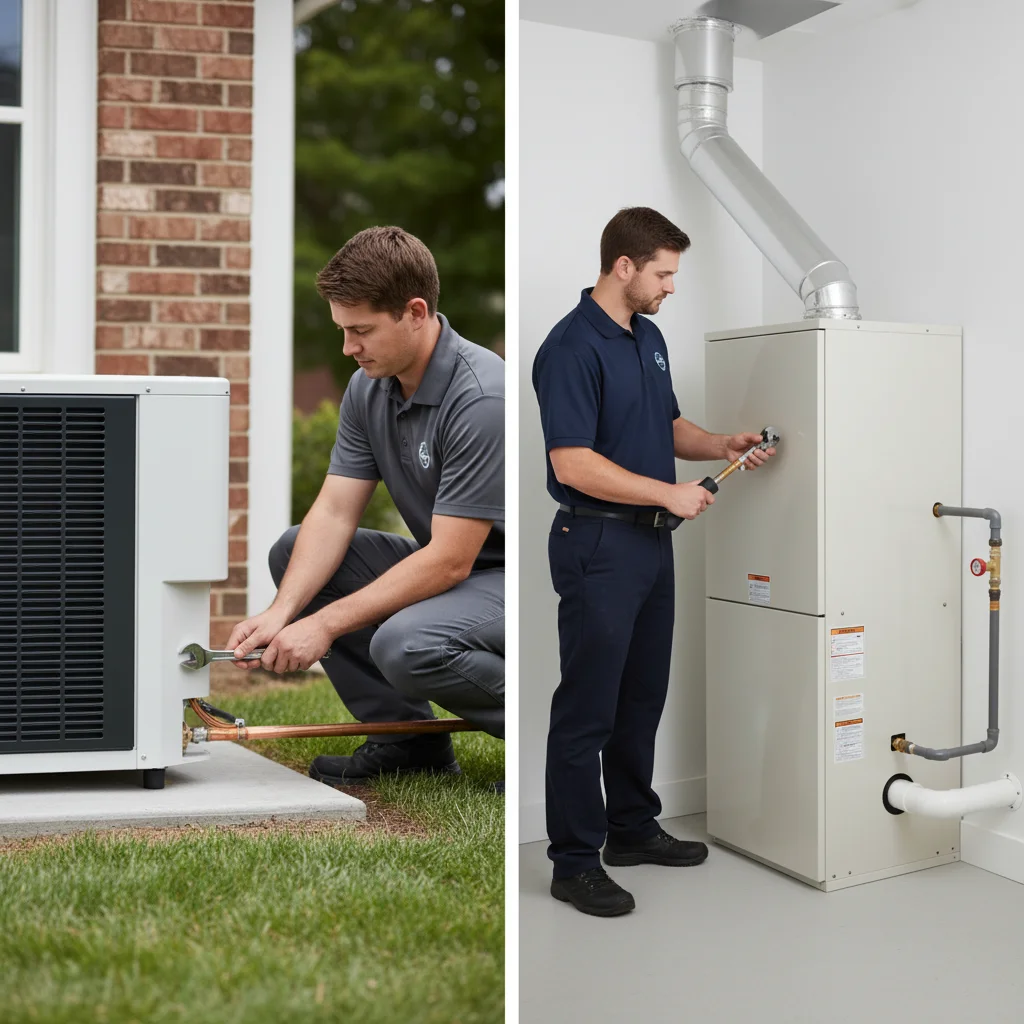
How San Diego’s mild winters change the equipment choice
Many heat-pump comparisons are written for climates that stay well below freezing. There, capacity and backup heat dominate. San Diego is milder. NWS San Diego describes ocean moderation near the coast and warmer summer days in nearby valleys; hot easterly winds can still bring heat to coastal areas. That is a qualitative regional distinction, not a count of heating days for your house.
A heat pump moves heat. In mild outdoor air it can deliver more heat energy than the electricity it uses. A gas furnace cannot convert more than the energy in the fuel (AFUE is the fraction it delivers as heat). That is why heat pumps often look efficient on paper here. The bill still depends on what you pay per kWh versus per therm, when the system runs, and whether the same machine also does your cooling.
The broader cooling comparison is heat pump vs AC in San Diego. This piece is heating fuel and scope.
Operating cost: use your SDG&E plan, not a blog rate
SDG&E residential plans can price electricity by time of use. Current listed residential time-of-use plans have a 4-9 p.m. on-peak period. Confirm your exact plan and current rates on SDG&E pricing plans. On the captured plan page, CCA figures are delivery-only and CCA customers also pay their CCA’s generation price; non-CCA figures combine SDG&E generation and delivery. Displayed energy prices exclude the monthly residential Base Services Charge.
This site does not publish cents per kWh, dollars per therm, or a seasonal heating total. Those numbers change, and they are account-specific.
What to ask the matched company and what to pull from your own bills:
- Last 12 months of gas therms (heating months) and electric kWh, including summer cooling if you have AC today
- Whether you are SDG&E bundled or a CCA customer
- Whether a heat pump would run much of its heating in the 4-9 p.m. peak, or whether you can shift with setbacks and preheating, health permitting
- Whether the heat pump replaces both furnace and AC, so you compare one electric system to gas heat plus a separate AC
SDG&E suggests precooling earlier in the day, then setting the thermostat to 78F or higher from 4-9 p.m., health permitting. That is conservation guidance, not a medical rule. See SDG&E heat-wave guidance.
The California Energy Commission publishes tools and code context if you want to go deeper on equipment efficiency. Your contractor’s load calculation still has to match the house.

Where a gas furnace still makes sense
No existing central cooling and no ducts you want to add. A furnace swap on an existing gas system can be a smaller scope than a full heat-pump changeout plus electrical.
Panel is already at capacity. A heat pump needs a dedicated 240-volt circuit. If service is 100 amp and full, the bid may include a panel upgrade. Ask for that as a line item from the HVAC company or a licensed electrician. A furnace keeps the gas path and avoids that electrical step.
Mountain and high-elevation design days. Places like Mount Laguna see colder nights than the coast. Ask whether a standard heat pump, a cold-climate model, or dual-fuel is what they would actually size. Do not pay for a climate rating you will never use, and do not skip backup heat if the load calculation says you need it.
Short ownership horizon. If you are selling soon, first-cost and inspection simplicity can outweigh long-run fuel math. That is a personal finance call.
Hybrid dual-fuel
A hybrid pairs a heat pump with gas backup. The heat pump handles the load above a balance point the installer sets; the furnace takes colder hours. In much of the county the furnace may run rarely. East County and mountain nights are where backup earns its keep.
Ask for:
- The proposed balance point in writing
- Whether existing furnace age and heat exchanger condition justify keeping it
- Controls, thermostat, and flue or gas work if the furnace stays
Do not assume dual-fuel still pulls open TECH single-family HVAC or HEEHRA single-family money. Recheck TECH incentives, HEEHRA rules, and IRS 25C. Section 25C does not apply to a 2026 install. TECH single-family HVAC reservations stopped November 14, 2025. HEEHRA single-family was fully reserved February 24, 2026.
If you need a new gas line, that is a separate scope. Get it in the bid before you sign.
What an honest install quote should include
Equipment with model numbers. Check SEER2 and HSPF2 in the AHRI directory.
Electrical. New circuit, panel, or subpanel, priced, not a day-two surprise.
Gas work if a furnace stays or is added.
Permit and inspection. The contractor pulls the permit. Verify the license at CSLB.
Incentive handling. Which filings they will submit, with live program names. Do not sign a net that subtracts closed programs.
Warranty. Manufacturer parts versus installer labor, in writing.
Related: AC repair. For what a heat-pump job’s scope looks like, see heat pump cost in San Diego. For an existing system: heat pump service.
Frequently asked questions
Is a heat pump worth it in San Diego?
Often yes on equipment physics, because outdoor air stays milder than continental winters. The bill still depends on your electric versus gas rates and whether one machine also replaces the AC. Ask for a load calculation and a side-by-side operating-cost discussion using your rate plan, not a national average.
What does a heat pump cost in San Diego?
Climate Pros SD does not publish installed prices. Size, ducts, electrical, and access drive the bid. Do not use an after-rebate net for 2026. See heat pump cost in San Diego.
Can I convert from a gas furnace to a heat pump?
Often, if the panel can carry the circuit and the ducts can move the air a heat pump supplies. The line set may need replacement. Get those three answers in writing. See replacing AC with a heat pump.
Will my SDG&E bill go up if I switch off gas?
Electric use goes up; gas use for heat goes down. The total depends on the rate plan and when the heat pump runs. SDG&E rate plans and our rate plan guide cover the TOU structure, not a promised savings figure.
Do heat pumps work when it actually gets cold in San Diego?
On the coast, design days are milder than the mountains. In Julian, Alpine, and the backcountry, ask about dual-fuel or a model sized for those nights. The matched company should show capacity at the design temperature they used.
When to call us
Choosing heat pump, furnace, or hybrid needs load, panel, and duct assessment from a licensed contractor. If the current system is failing, call (442) 777-6440. Climate Pros SD matches you with a local pro for a written comparison, not a guaranteed bill outcome.