Your AC stopped cooling on a warm April afternoon, and you’re not sure whether to call for a repair or brace for a full replacement. If you’re in Carlsbad, that decision is harder than it sounds, because the ocean air here does things to HVAC equipment that inland homeowners never deal with.
Climate Pros SD matches you with licensed HVAC companies. We do not publish a Carlsbad parts menu.
Why coastal corrosion shortens condenser life in Carlsbad
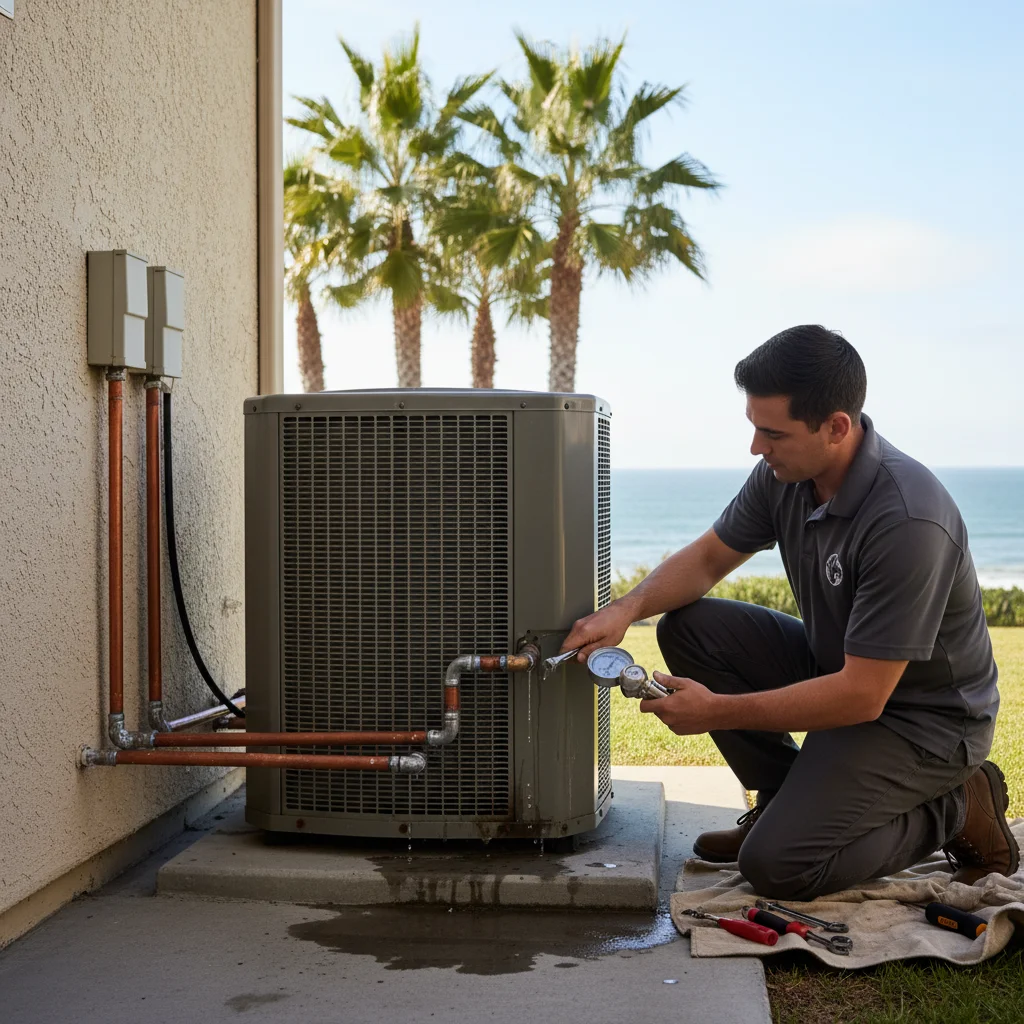
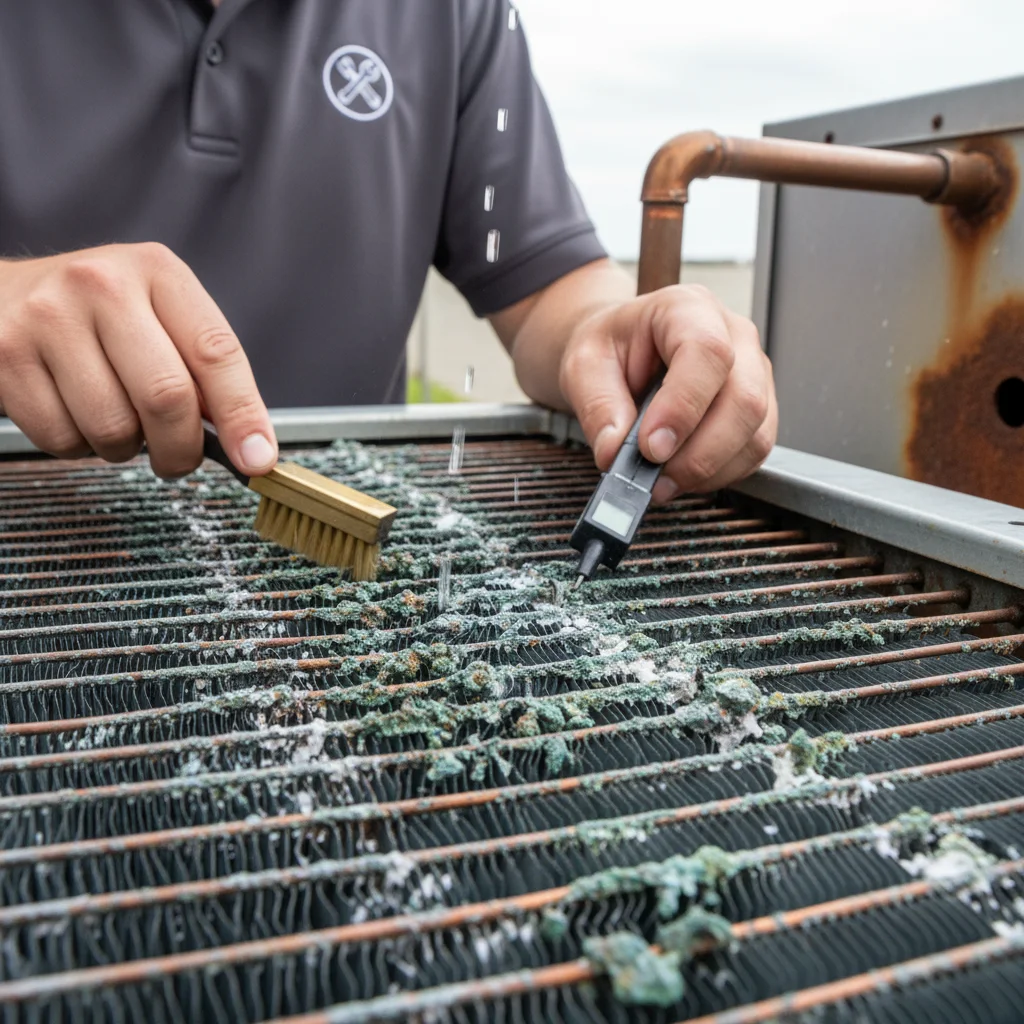
Carlsbad sits right on the Pacific. Even neighborhoods a mile or two inland, La Costa, Aviara, Olde Carlsbad, catch consistent marine layer and salt-laden air every morning. That salt doesn’t just wash off. It settles into the aluminum fins on your outdoor condenser coil, starts an electrochemical reaction, and slowly eats the metal from the inside out.
The technical term is galvanic corrosion. You don’t need to memorize that, but you do need to know what it looks like: white or grayish powder on the coil fins, fins that crumble when you touch them, and refrigerant leaks that seem to appear out of nowhere on a unit that’s only eight or ten years old.
Industry data puts the average condenser lifespan at 15–20 years in dry climates. In coastal San Diego, techs commonly see significant corrosion damage at the 8–12 year mark, especially on equipment that wasn’t installed with any protective coatings. Homes within half a mile of the Carlsbad coastline, think the streets off Carlsbad Boulevard near the Tamarack State Beach parking lot, tend to wear out soonest.
The condenser fan motor and electrical components corrode too, but the coil is usually the first casualty. Once a coil is pitted badly enough to leak refrigerant, you’re looking at a real decision point.
Common Carlsbad-specific AC failures we see
Salt corrosion is the root cause, but it shows up in a few specific ways on service calls across 92008, 92009, 92010, and 92011:
Refrigerant leaks from corroded coil fittings. This is the most common call from Aviara and La Costa homeowners. The system runs but never cools below 78°F. An R-410A recharge helps temporarily, but if the coil itself is leaking, the refrigerant just escapes again. Under current EPA rules, simply topping off a known leak isn’t legal. The leak has to be found and fixed.
Contactor and capacitor failure. Salt and humidity accelerate wear on the electrical components inside your condenser cabinet. Capacitors fail earlier here than they do in Escondido or El Cajon. A bad capacitor is one of the most common reasons an AC won’t start, and it’s also one of the smaller tickets when caught before the compressor strains itself.
Evaporator coil freeze-ups. Carlsbad’s mild summers mean systems sometimes run at low load for long periods. Combine that with a slightly restricted airflow or low refrigerant from a slow coil leak, and you get ice buildup on the indoor evaporator coil. If your system is blowing warm air and you notice ice, our post on AC freezing up causes and fixes covers exactly what’s happening.
Condenser fan motor seizure. Bearings corrode. The fan that pulls air through the outdoor coil starts running hot, draws excess current, and eventually seizes. If you hear a grinding or rattling from the outdoor unit, turn the system off and call. Running a seized fan motor can take out the compressor.
What belongs on a Carlsbad repair quote
Repair costs across Carlsbad zip codes don’t vary much by neighborhood, but they do vary by what’s broken. Climate Pros SD does not publish capacitor, contactor, recharge, coil, motor, or compressor bands.
| Line to insist on | Why it matters |
|---|---|
| Diagnostic fee, in dollars | Ask if it applies toward repair |
| Named electrical part | Capacitor and contactor often fail together in salt air |
| Leak search vs recharge | Top-off without a leak search is not a legal long-term fix |
| Coil vs unit replacement | Corroded coils on older coastal units often repeat |
| Coastal coating | Phenolic or epoxy on a new condenser is a spec, not a blog surcharge |
| Warranty | Part versus labor |
For replacement quotes, see AC installation and new AC cost in San Diego. Those pages also refuse invented county bands.
When to repair vs replace a salt-air-damaged unit
If the repair on the written quote is more than half of a new system’s price on the same visit, replacement is usually the smarter call. In Carlsbad, that threshold gets hit faster than people expect because salt corrosion rarely stops at one component.
A corroded condenser coil on a 10-year-old unit is a warning that the rest of the coil is in similar shape. Fix the leak today, and you may be back in six months fixing another.
Ask yourself three questions before approving a big repair on a coastal unit:
- How old is the equipment? Past 12 years in Carlsbad, replacement math often wins.
- Has it had repeated refrigerant charges in the past three years? That signals ongoing coil degradation.
- Does the compressor show any signs of strain, slow startup, tripping breakers, warm cabinet? A stressed compressor on a corroded system is a ticking clock.
If replacement makes sense, AC installation with proper coastal protection from the start will outlast an unprotected replacement by years. Our post comparing AC repair vs replacement in Chula Vista covers similar decision logic.
When replacement is the call, ask whether the equipment qualifies for current rebates. The California Energy Commission maintains incentive program pages. IRS Section 25C covers qualifying improvements made through December 31, 2025.
How matched installers protect new installs from coastal wear
A standard AC installation isn’t enough in Carlsbad. When a licensed company puts in a new system in Olde Carlsbad near the village, a newer Aviara build, or a La Costa condo, ask for steps that inland-only contractors skip.
Corrosion-resistant coil coatings. Phenolic or epoxy coatings on condenser coils slow galvanic corrosion. Several major manufacturers now offer factory-coated coils specifically for coastal climates. Specify these by default for Carlsbad installs.
Elevated and ventilated pad placement. Pooling moisture around the base of a condenser unit accelerates bottom-panel rust. A properly elevated concrete pad with adequate clearance helps.
UV and marine-rated wire insulation. Coastal UV and salt air degrade standard wire jackets faster than the equipment itself wears.
Annual coil cleaning on a firm schedule. Salt accumulation on fins compounds year over year. A rinse-down during a spring tune-up, consistent with our HVAC maintenance schedule for San Diego, keeps deposits from turning into corrosion pits.
Before hiring any HVAC contractor in Carlsbad, verify their California contractor’s license through the CSLB license lookup. Coastal installs done wrong are expensive to undo.
When to call us
Salt-air AC problems move faster than inland ones. A small refrigerant leak or a noisy fan motor that you put off for a month can turn into a compressor replacement by summer. If your system is struggling, making noise, or simply not keeping up with an 80°F Carlsbad afternoon, get eyes on it now. Call us at (442) 777-6440. Or read the AC repair in Carlsbad service page, which covers neighborhoods from Olde Carlsbad out to Aviara and Bressi Ranch.