Oceanside sits at an unusual crossroads for HVAC work: oceanfront and near-beach homes in South Oceanside and west of I-5 deal with accelerated salt-air corrosion, while older military-era neighborhoods east of El Camino Real have their own problems rooted in decades-old ductwork and undersized equipment. When your AC stops cooling, knowing which side of that divide you’re on changes the diagnosis.
Climate Pros SD matches you with licensed HVAC companies. We do not publish an Oceanside parts menu.
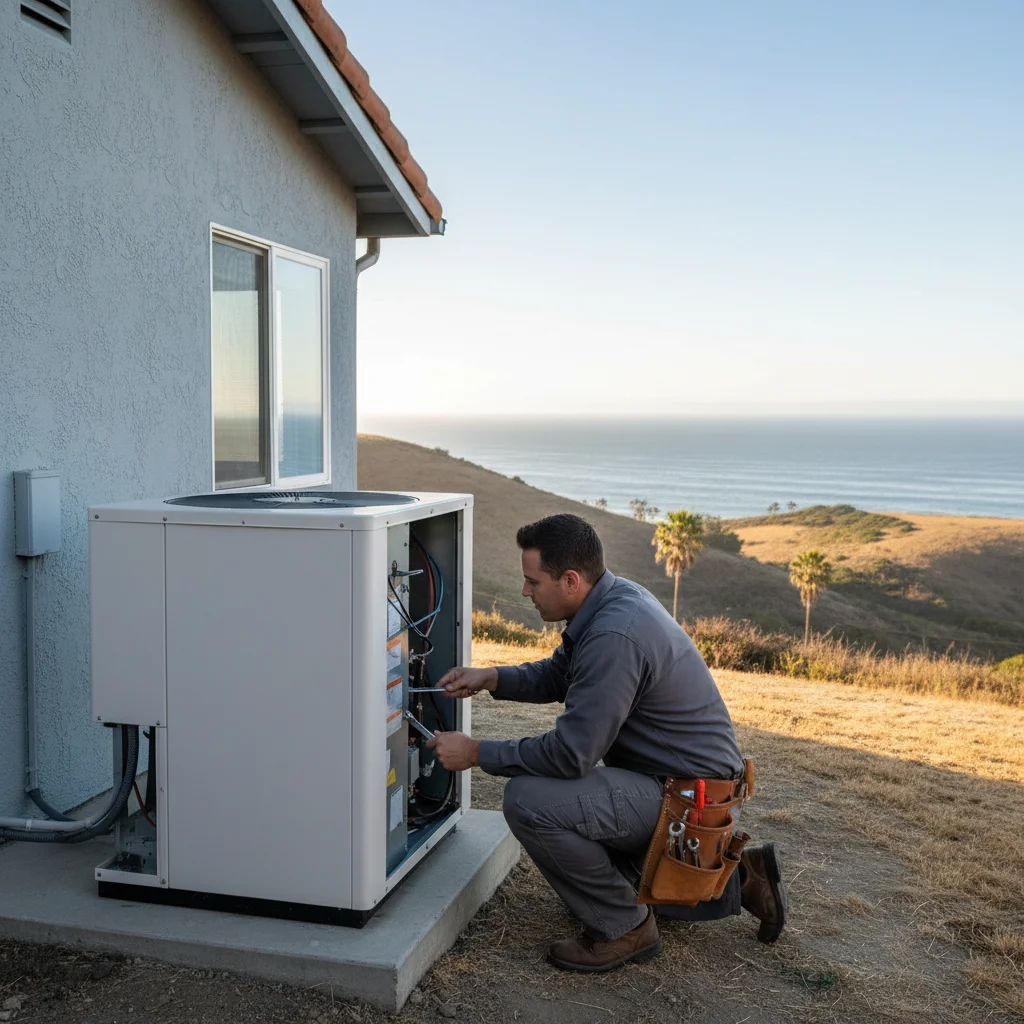
Why Oceanside HVAC systems face two kinds of wear
Most coastal San Diego cities have one primary HVAC stressor. Oceanside has two, and they pull in opposite directions.
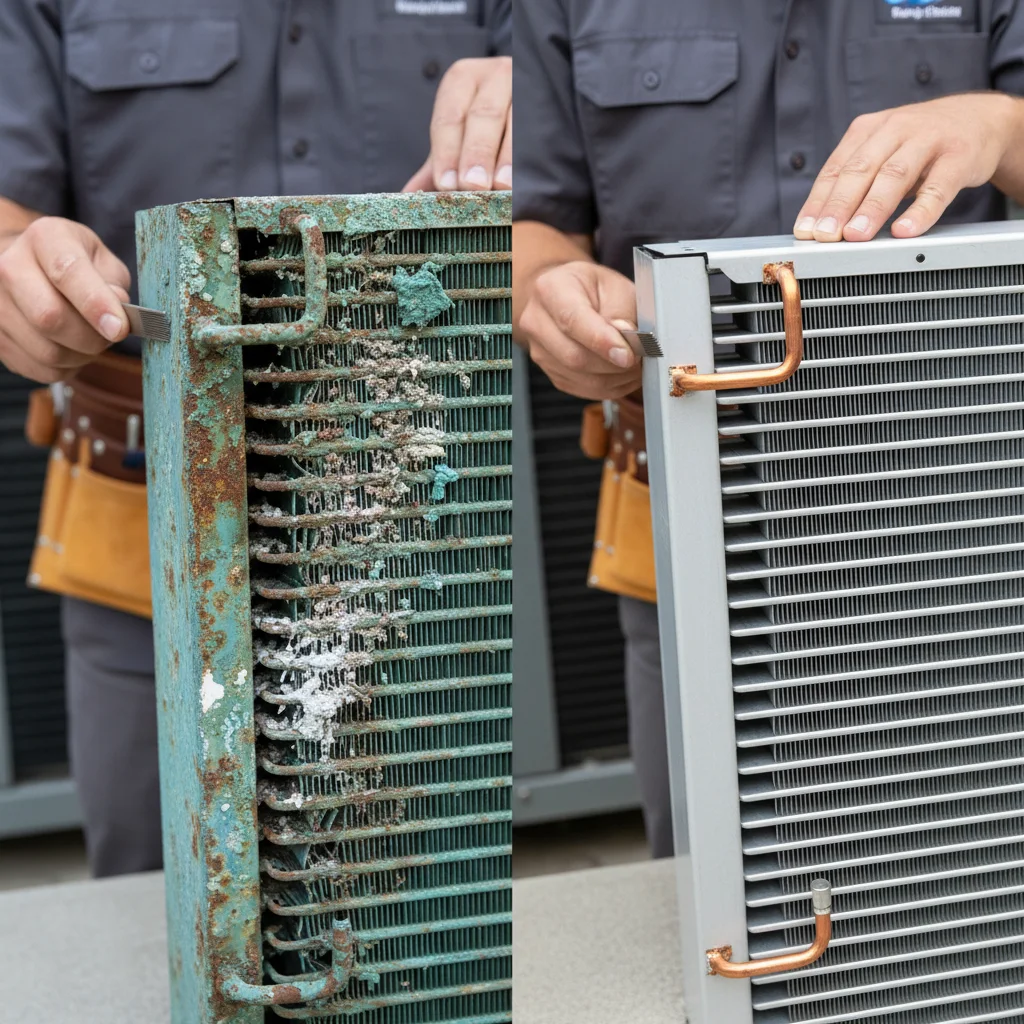
Salt-air corrosion is the dominant issue west of I-5 and throughout South Oceanside’s beachside blocks. Marine air carries chloride particles that settle on condenser coils, electrical contacts, and copper refrigerant lines. Over time, typically three to seven years on an uncoated condenser, those particles cause pitting corrosion on aluminum fins and greenish oxidation on copper fittings. You’ll see it on the coil before you feel it in performance, but by the time cooling drops noticeably, the damage is often significant. Fire Mountain homes, sitting on the mesa above the beach, catch less direct marine spray but still get enough salt fog to shorten coil life compared to inland Escondido or El Cajon.
Age and construction vintage is the dominant issue east of I-5, especially around Camp Pendleton’s south gate corridor and the Rancho Del Oro development. Many homes in the 92058 zip code were built during or just after the major base expansions of the 1950s through 1970s. HVAC equipment from that era was sized for the original, often smaller floor plans. Additions, converted garages, and bonus rooms added square footage without adding airflow capacity. That mismatch shows up as rooms that never cool properly and an AC that runs almost continuously in July.
Understanding which problem, or combination of both, affects your home is the first thing a good diagnostic visit should establish.
Common failures we see in 92054, 92056, 92057, 92058
Corroded condenser coils top the list in 92054 (South Oceanside, beachside streets) and the western edge of 92056. Salt deposits block airflow between fins and reduce heat transfer. The system works harder, refrigerant pressure climbs, and you end up with either a tripped high-pressure switch or a compressor that overheats and shuts down. Sometimes AC repair means cleaning and re-coating the coil. Sometimes the coil is too far gone and needs replacement.
Refrigerant leaks at flare fittings are also more common near the coast. Salt accelerates micro-cracking at the joints where copper lines meet the condenser and air handler. A slow leak might show up as the system blowing slightly warm on hot afternoons, similar symptoms to our guide to AC blowing warm air.
Capacitor and contactor failures happen everywhere in San Diego, but coastal humidity and salt deposits speed up electrical contact degradation. In Rancho Del Oro and the Mira Costa area of 92056, capacitor failures are the single most common repair call in summer.
Frozen evaporator coils come up frequently in older 92058 homes where restricted airflow from undersized return ducts chokes the system. If your AC is freezing up, check our explainer on frozen coils. In base-area homes, the root cause is often the duct system, not the equipment itself.
Duct air leaks in attics and crawlspaces are endemic to the post-war construction era. Original flex duct degrades, connections pull loose, and conditioned air bleeds into unconditioned space before it reaches the living areas.
What belongs on a North County coastal quote
| Line to insist on | Why it matters |
|---|---|
| Diagnostic fee, in dollars | Ask if it applies toward repair |
| Capacitor vs contactor | Often same visit on coastal humidity |
| Leak search vs recharge | Fitting replacement is extra scope |
| Coil replacement vs coating | Coastal exposure drives this ticket |
| Return-duct work | Base-area homes often need airflow, not just a part |
| Refrigerant type | R-22 still turns up in some oldest base-area homes |
Climate Pros SD does not publish those dollar ranges. R-410A systems are still the majority of stock in Oceanside.
Older base-area homes and undersized return ducts
This is the single most misdiagnosed problem in the 92058 zip code and the older streets of 92057 near the south end of Camp Pendleton.
The symptom looks like a failing compressor or low refrigerant: the system runs and runs, the house stays at 78°F when the thermostat says 72°F, and utility bills creep up every summer. When a tech measures static pressure in the duct system, they often find the return is pulling twice the resistance it should. The equipment isn’t broken. It’s suffocating.
Post-war Oceanside homes frequently have a single central return grille feeding an air handler that’s been upsized once or twice over the decades. The return duct was never enlarged to match. Every previous service call focused on the equipment, and the duct problem stayed invisible.
The fix isn’t always a full duct replacement. Adding a second return duct, enlarging the existing return grille, or cutting a transfer grille between rooms can resolve the restriction in straightforward cases. Full duct system replacement is a larger bid and sometimes unavoidable when original ductwork is degraded beyond reasonable repair. Our duct cleaning and inspection page helps clarify when cleaning is enough versus when replacement is the better path. Ask for those scopes in dollars.
When to repair vs replace given coastal exposure
Compare repair cost to replacement on the quotes in your hand. Coastal exposure shifts the calculus. We covered this decision in our repair vs. replacement guide. The short version for coastal homes: if your condenser is more than 12 years old and showing visible coil corrosion, a major repair buys you less time than it would on an inland system. Salt air will keep working on the coil even after you fix the leak or replace the capacitor.
For homes in South Oceanside and Fire Mountain specifically, ask for a coil condition inspection before committing to a large refrigerant repair. If the coil shows moderate-to-severe fin corrosion, putting a large refrigerant repair into a system with two seasons of coil life left isn’t money well spent.
When replacement makes sense, the question shifts to what to replace with. Single-stage central AC is the default, but many Oceanside homes, particularly the smaller post-war footprints in 92058, are good candidates for ductless mini-split systems that sidestep the undersized-duct problem entirely. The Carlsbad AC repair post covers similar coastal replacement logic for the next city south.
The California Energy Commission sets minimum efficiency standards for new equipment sold in the state. Always verify your contractor holds a current CSLB license before signing a replacement contract.
When to call us
If your system is running but not cooling, or you’ve noticed higher bills, musty smells from vents, or ice on the lines, don’t wait until the middle of a hot spell. Coastal corrosion and duct problems both get worse with time.
For Oceanside-specific coastal equipment specs and what to expect on a repair visit in 92054, 92056, or 92057, see our full AC repair in Oceanside service page. Call us at (442) 777-6440.