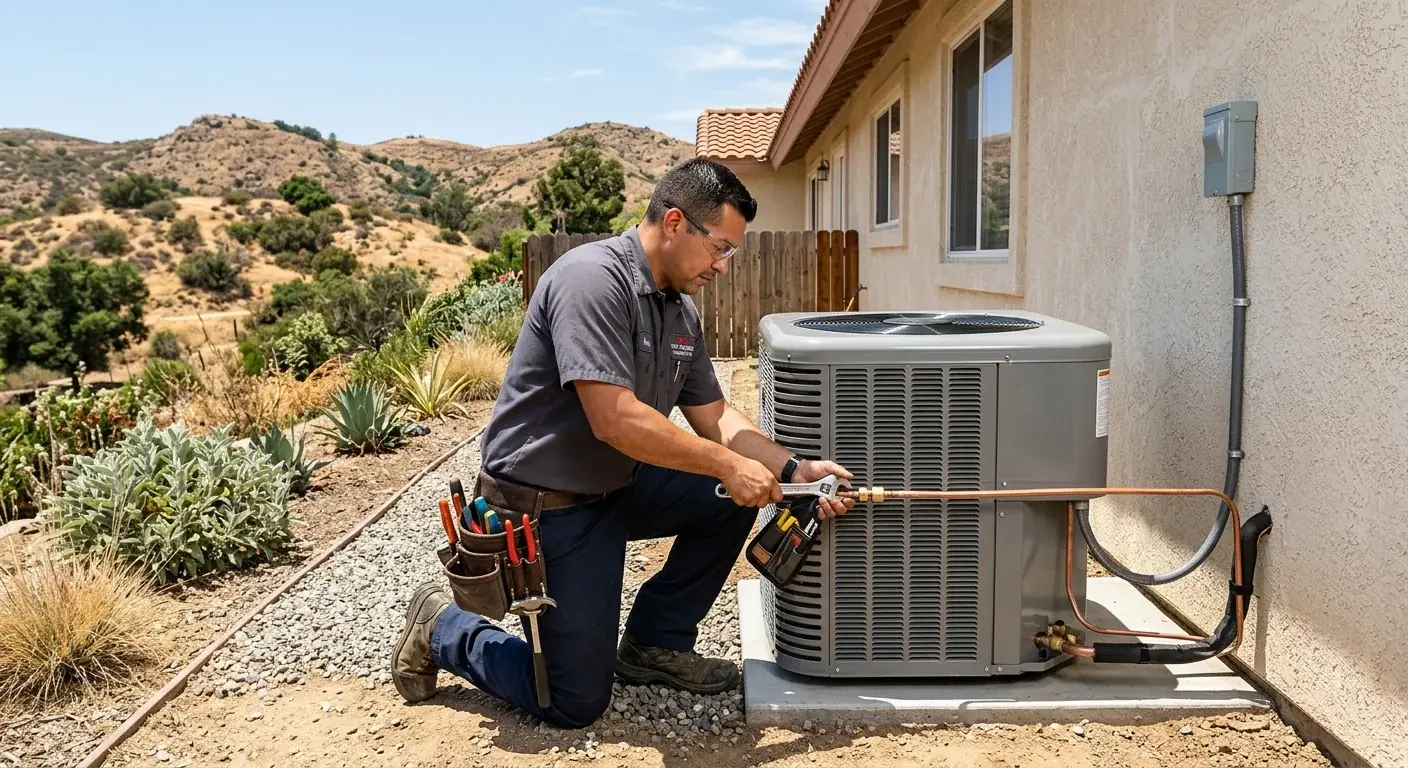
If your HVAC system quit on a hot Escondido afternoon, you’re not alone. Inland North County sees runtime, dust load, and heat-soak conditions that coastal San Diego systems never face. That changes which parts fail and how often. Here’s what shows up in Escondido homes specifically, what a fair visit looks like, and when repair stops making sense.
Climate Pros SD matches you with licensed HVAC companies. We do not repair equipment, own trucks, or publish repair prices.
Why Escondido HVAC breaks differently
Escondido sits about 20 miles inland in a valley ringed by hills. NWS describes ocean moderation near San Diego and warmer summer days in nearby valleys. NOAA 1991-2020 normals at Escondido #2 are about 87F in July and 89F in August, with a January normal low around 45F. Heat waves run well above those normals.
That gap matters because:
- Compressor runtime is longer. A coastal AC might run a few hours on a hot day. An Escondido AC can run most of the afternoon, longer if the home has west-facing walls and original 1970s or 1980s insulation. Compressors, capacitors, and contactors wear out on a clock measured in run-hours, not calendar years.
- West-facing stucco walls heat-soak the unit’s surroundings. Condensers installed against a sun-baked wall on the west or south side of a home in 92025, 92026, 92027, or 92029 see hotter air around the coil than a thermometer in the shade would read.
- Dust, pollen, and ag drift load the coils. Eastern Escondido and the Hidden Meadows / San Pasqual corridor get airborne dust off citrus and avocado groves. Coil fins clog faster than they would in La Jolla or Del Mar.
- Winter heating runs more often than people think. Escondido nights drop into the 40s December through February, with colder snaps. Furnaces that sat unused for months then run for hours a night. Igniters, flame sensors, and inducer motors fail on the first cold snap because they haven’t moved in months.
The Escondido failure list, ranked by frequency
These are the calls that come most often from Escondido ZIP codes, roughly in order from late spring through early fall.
1. Capacitor failure. The dual-run capacitor is the part that fails most often on any AC, and Escondido heat shortens its life. A capacitor that might last a decade elsewhere often dies several years sooner here. Symptom: unit hums but the outdoor fan doesn’t spin, or the system trips a breaker on startup. Ask for the microfarad rating on the quote. If a tech condemns a capacitor without a meter reading, get a second opinion. More: AC capacitor replacement in San Diego.
2. Contactor pitting and burnout. The contactor cycles every time the AC starts. With Escondido compressors short-cycling on extreme heat days, contactors pit and weld shut. Symptom: AC won’t turn off, or won’t turn on, or arcing sound from the outdoor disconnect.
3. Dirty condenser coil causing high-pressure trips. When ag dust and pollen pack the outdoor coil, the system can’t reject heat. It trips on a high-pressure switch and shuts down before damaging the compressor. Symptom: AC runs for 20 minutes then quits, restarts an hour later. A proper coil cleaning is a real repair and it can save the compressor.
4. Refrigerant leak at a Schrader valve or evaporator coil. Older R-22 systems still in service in 1980s and 1990s Escondido homes leak at the connections. EPA banned R-22 production and import as of January 1, 2020; existing systems may still be serviced with recycled or previously produced refrigerant. This page does not publish a per-pound price. Leak repair plus refrigerant on an R-22 system may not last more than a season. Newer R-410A systems leak less often, but evap coil leaks on units over 8 years old are common. Honest answer: if your system is 12+ years old and leaking refrigerant, replacement math usually wins.
5. Blower motor failure. Long runtime burns out the indoor blower motor, especially on systems where the air handler sits in a hot attic or garage. Escondido attics get brutal in summer. Symptom: AC runs outside but little or no air from the vents. ECM versus PSC motors are different parts and different quotes.
6. Furnace igniter or flame sensor (winter). First cold night in November, the furnace doesn’t light. Hot-surface igniter or dirty flame sensor. More on this in furnace repair in Escondido.
7. Thermostat failure or wiring corrosion. Older thermostats die, and rodent damage to low-voltage wiring is more common in homes near the avocado groves and rural east Escondido than people expect. A thermostat replacement is quoted after diagnosis. The matched licensed contractor installs it.
8. Compressor failure. This is the one nobody wants. After enough seasons of high runtime and high head pressure, the compressor itself goes. Under warranty, labor is still a real bill. Out of warranty, replacement is almost always the better call on systems over 10 years old. More: AC compressor replacement cost in San Diego.
Repair or replace: the Escondido decision framework
The standard “5,000 rule” (age × repair cost; replace if it exceeds $5,000) gets you most of the way there, but inland systems need a few adjustments. It is a trade heuristic, not a brand guarantee.
Replace when any of these are true:
- System is 12+ years old and the failure involves the compressor, evaporator coil, or condenser coil.
- System runs on R-22 refrigerant and has any refrigerant-related fault.
- Repair quote is more than 50 percent of a new-system quote and the unit is over 8 years old. Use the actual quotes, not a blog number.
- You’ve had two or more repairs in the last 24 months and a third is on the table.
- SEER rating is 13 or lower. A modern SEER2 heat pump or AC can cut cooling energy use in Escondido, where you actually run the system enough for efficiency to matter. DOE states actual savings vary with usage. This page does not publish a percent bill cut.
Repair when:
- System is under 8 years old and the failure is a capacitor, contactor, blower motor, igniter, or thermostat.
- The unit is still on R-410A, has no refrigerant issues, and the repair is a modest share of replacement.
- You’re planning a remodel or solar install in the next 24 months and want to defer the replacement decision until you can size around the new load.
What an honest Escondido HVAC repair call looks like
Whether you call us for a match or anyone else, the visit should go like this:
- Diagnostic with the gauges, not just the eyes. A real diagnosis means refrigerant pressures, amp draws, capacitor microfarad readings, and static pressure on the duct system. If a tech walks the yard, looks at the unit, and quotes a repair without instruments, push back.
- Written quote before the work starts. Part number, labor hours, warranty terms.
- No upsell pressure on the porch. A replacement pitch on a capacitor call is a sales pattern. See AC repair scams to avoid in San Diego.
- Refrigerant added by the pound with a written log. Not “a top-off.” Pounds and ounces, written down.
Ask what the diagnostic fee is in dollars and whether it applies toward repair if you approve the work. Each company sets that policy. Climate Pros SD does not waive fees.
Common questions about HVAC repair in Escondido
How much does HVAC repair cost in Escondido in 2026? Climate Pros SD does not publish a 2026 price list. Capacitors, contactors, coil cleanings, blower motors, igniters, thermostats, and compressors are different jobs. Ask for line items on the written estimate.
Why does my AC work fine in the morning and quit by 3 PM in Escondido? That pattern almost always means the system is tripping on a high-pressure switch after the outdoor temperature climbs. The most common cause in Escondido is a dirty condenser coil packed with ag dust and pollen. Second most common is an undersized or aging system that can’t keep up once the air around the coil exceeds the design temperature.
Is HVAC repair more expensive in Escondido than in coastal San Diego? Labor rates are quoted by the company, not by this brand. Escondido repairs tend to be larger because the systems run harder. A coastal La Jolla AC might need a capacitor less often. An Escondido AC needs one more often. Total lifetime repair cost on an inland system is typically higher than a coastal one of the same age.
Should I switch to a heat pump in Escondido? For many Escondido homes built after 1990, yes, when the existing AC or furnace dies. Modern heat pumps handle the rare cold snaps and they’re more efficient on the cooling side, which is where you spend most of your HVAC energy here. The federal Section 25C credit does not apply to property placed in service after December 31, 2025. TECH single-family reservations stopped November 14, 2025. HEEHRA single-family applications were not being accepted as of February 24, 2026. SDG&E Golden State retail rebate offerings have ended. Confirm current amounts at quote time.
Can I keep using my R-22 AC? You can keep running it until it leaks. The moment it needs refrigerant, replacement math usually wins on a 12-plus-year-old system. Some companies will not service R-22. Ask before they roll.
How long does HVAC last in Escondido vs the coast? Coastal HVAC often lasts longer. Inland Escondido HVAC often dies sooner. Higher runtime, higher head pressure, more dust load on the coils. Regular maintenance closes some of the gap but not all of it.
When the house is already hot
If your HVAC is down and the house is already uncomfortable, call (442) 777-6440. Climate Pros SD matches you with licensed HVAC pros across Escondido (92025, 92026, 92027, 92029), San Marcos, Vista, and the rest of inland North County. Ask whether a tech is available today, yes or no. Diagnostic is quoted up front, parts and labor in writing.
For deeper reads on specific failures, see AC short cycling causes and fix, HVAC filter guide and MERV ratings, and our Escondido HVAC service hub.
Related services: AC repair and AC installation.