You’ve got a room that’s always too hot, or a casita that needs its own climate control. Someone mentioned a mini split. Now you want to know what it’s actually going to cost before you call anyone. That’s a fair place to start — and we’ll give you the real numbers.
Single-zone vs multi-zone pricing in 2026
The biggest fork in the road is how many rooms you’re conditioning. Everything else flows from that.
Single-zone systems — one outdoor condenser, one indoor head — run $4,500 to $7,500 installed in San Diego County. That range covers equipment, labor, refrigerant line sets, electrical work, permits, and startup. A small 9,000 BTU unit for a 350 sq ft bedroom will land toward the low end. A 24,000 BTU unit for a large open-plan room, or anything requiring a longer line set run, pushes toward the top.
Multi-zone systems — one condenser, two to five indoor heads — run $9,000 to $18,000 installed. A two-zone system in a 1,400 sq ft bungalow typically lands around $10,000–$12,000. A four-zone system covering an entire 2,200 sq ft home — common in older San Diego houses with no existing ductwork — can reach $15,000–$18,000 depending on brand and installation complexity.
These aren’t ballpark guesses padded for comfort. They reflect what our mini split installation jobs actually cost across San Diego County in 2026, including permit fees that vary slightly by city (Chula Vista and Santee both require mechanical permits; unincorporated county areas have their own fee schedules).
If you’ve read our earlier post on whether mini splits are a good fit for San Diego homes, you already know why so many homeowners here are making the switch. This piece is focused on what you’ll actually pay.
What drives the install cost up or down
The equipment itself is only part of the invoice. Here’s what moves the number in either direction.
Line set length and routing
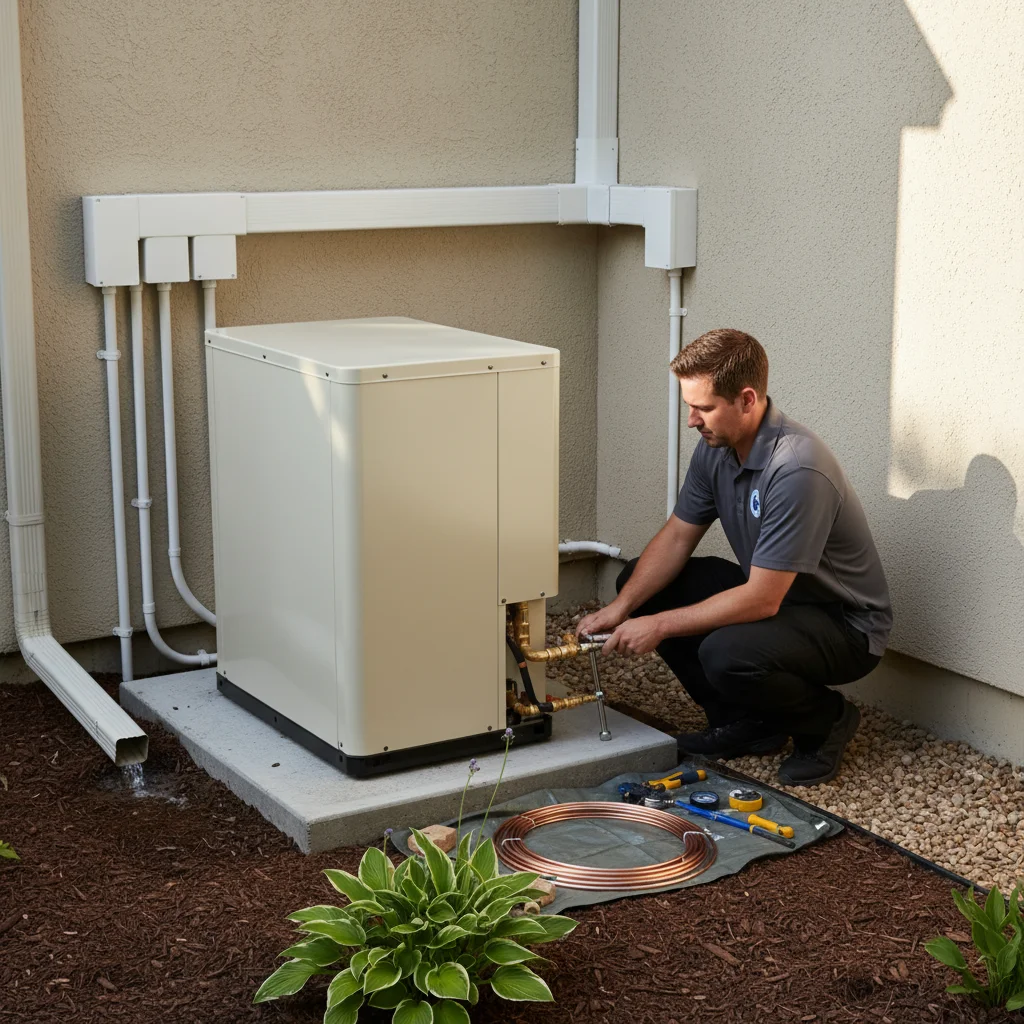
Every foot of refrigerant line between the outdoor condenser and the indoor head adds material and labor. A straightforward run — straight through an exterior wall, 15 feet of line — is cheap. A run that has to go up two stories, around a corner, or through a finished attic adds time and materials fast. Line set covers (the white plastic channel you see on the exterior) add a small cost but look significantly cleaner and protect the lines from UV and birds.
Electrical upgrades
Most mini splits require a dedicated 240V circuit. If your panel doesn’t have an open slot, or if your main panel is older and undersized, you’re looking at panel work before the mini split goes in. That can add $500–$2,000 depending on the scope. We always check panel capacity before quoting.
Access and mounting surface
Stucco is the standard in San Diego — no issue. Old adobe walls, concrete block, or tile-covered walls take longer to penetrate cleanly. Second-story installs require a longer ladder setup and sometimes staging. These factors add labor time, which adds cost.
System size (BTU)
Bigger isn’t always better — and oversizing a mini split causes short-cycling, poor dehumidification, and early wear. We do a proper load calculation for every job. In San Diego’s mild coastal climate, you often need less capacity than you’d expect, which can keep costs down compared to inland Riverside County installs.
Permits
San Diego city and most incorporated areas require a mechanical permit for mini split work. Permit fees typically run $150–$400 depending on jurisdiction. Any contractor who tells you permits aren’t needed is cutting corners — and leaving you exposed if you ever sell or refinance.
Real quote ranges for common San Diego homes
Let’s get specific. These are representative installed costs for common scenarios we see across the county.
700 sq ft studio or ADU, single zone: $4,800–$6,200. One 12,000–18,000 BTU head, straightforward line set, existing electrical capacity.
3-bed, 2-bath 1960s ranch house in El Cajon or La Mesa, no existing ducts, three zones: $12,500–$15,500. Three indoor heads, one multi-zone condenser, three separate line set runs, permit, dedicated circuits for each zone.
Coastal cottage in Ocean Beach or Pacific Beach, single zone for a back bedroom: $5,000–$6,500. Often involves a longer line set to reach the exterior, line cover on stucco, permit.
New construction addition or garage conversion, single zone: $4,500–$5,800. Clean access, no existing walls to work around, fastest install type we do.
Whole-home replacement for a 2,000 sq ft house in Rancho Bernardo, four zones: $15,000–$18,000. Full multi-zone system, panel evaluation, four dedicated circuits, four line set runs with covers, permit.
These ranges assume a standard install without surprises. We give firm quotes — not estimates that balloon — once we’ve seen the house.
Which brands we install and why
We install Mitsubishi, Daikin, and Fujitsu. That’s not a short list for marketing reasons — those three consistently top independent reliability data, carry strong parts availability, and offer manufacturer warranties that actually hold up.
Mitsubishi’s Hyper Heat line performs down to -13°F outdoor temperature. That’s overkill for San Diego coastal weather, but it means the system barely works during our mild winters — which translates to exceptional efficiency and longevity here.
Daikin is our recommendation when budget is a primary concern without sacrificing quality. Their equipment costs less than Mitsubishi at comparable efficiency ratings, and their ENERGY STAR certification means they qualify for the rebates covered in the next section.
Fujitsu’s slim-duct and floor-console options solve problems the wall-mounted head can’t — particularly useful in historic craftsman bungalows in North Park or Kensington where a wall-mounted unit would look out of place.
We don’t install off-brand or direct-import equipment. When a $1,200 condenser fails in year two, there are no parts and no warranty path. You end up buying twice.
Our AC installation team handles mini splits alongside traditional central systems — so if you’re still weighing the options, we can walk you through both on the same visit.
Rebates and tax credits that lower your out-of-pocket
This is where San Diego homeowners leave money on the table. The rebates stack, and they’re significant.
Federal tax credit (IRA Section 25C): Qualifying heat pump mini splits — and most name-brand inverter mini splits qualify — earn a 30% federal tax credit, up to $2,000 per year. This is a credit, not a deduction. It comes directly off your tax bill.
SDG&E rebates: San Diego Gas & Electric runs rebate programs for high-efficiency heat pump systems. Amounts shift as funding cycles open and close, but $200–$800 per qualifying system is typical for residential customers. Check current availability before your install — our team pulls the current SDG&E schedule on every job. Our post on SDG&E heat pump rebates in 2026 breaks down the current structure in detail.
TECH Clean California: The California Energy Commission’s TECH Clean California program offers additional point-of-sale rebates for income-qualifying households. These can reach $3,000 or more on top of the federal credit. You don’t have to do the paperwork yourself — we handle the rebate submissions as part of the install.
Combined example: A $7,000 single-zone install with a qualifying Mitsubishi system could net $2,000 federal credit plus $500 SDG&E rebate. Your effective out-of-pocket drops to roughly $4,500. On a $13,000 two-zone system, the savings get even more meaningful.
Make sure whoever installs your system is licensed by the California State License Board and registered with the rebate programs. Unlicensed installs don’t qualify for SDG&E or TECH Clean California funds — and they don’t qualify for the federal credit either.
When to call us
Mini split installation involves refrigerant handling, high-voltage electrical work, and permits that require a licensed HVAC contractor. It’s not a DIY project, and it’s not something to hand to a handyman to save a few hundred dollars on labor. Getting the load calculation wrong, the line set sized wrong, or the electrical done without a permit creates problems that cost far more to fix than the original savings. Call us at (858) 925-5546 for a same-day estimate.