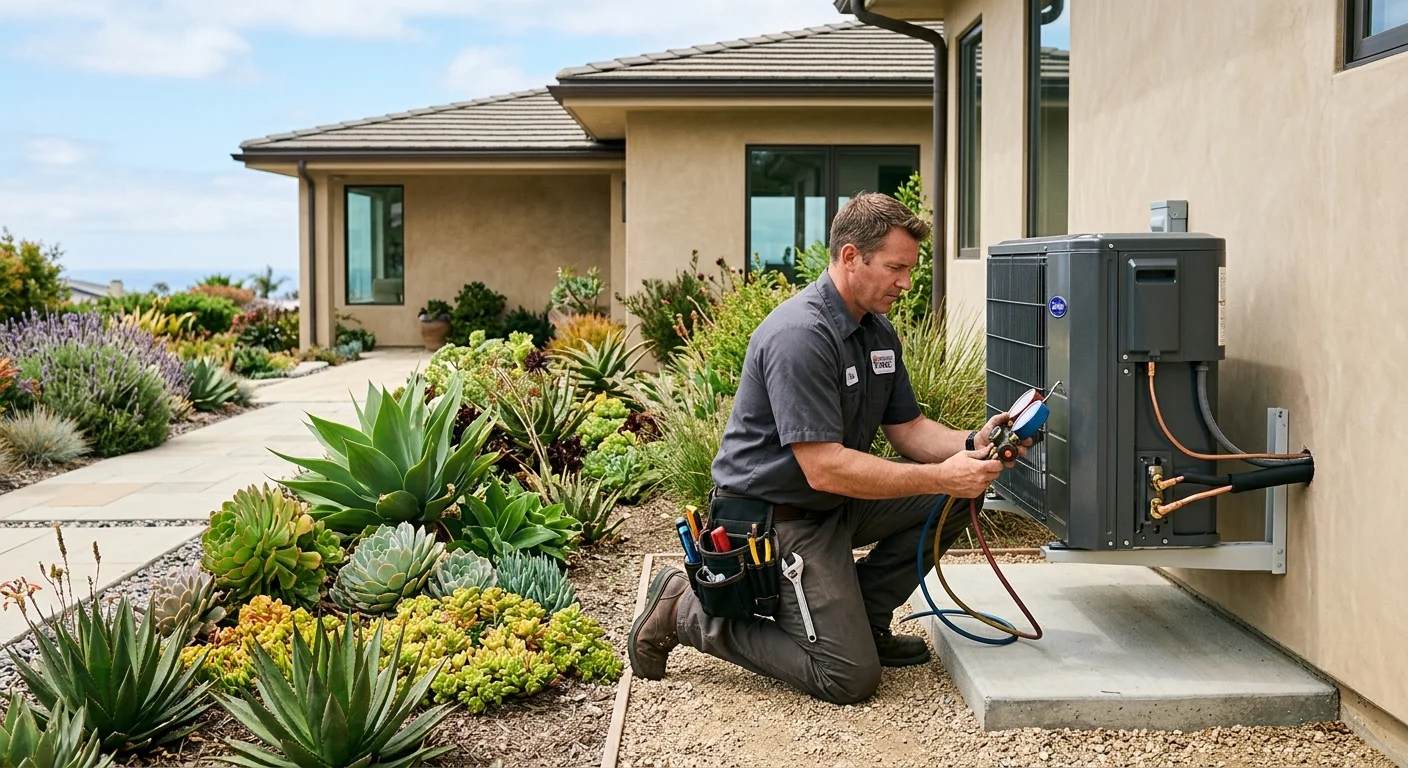
A standard San Diego home inspector often spends a few minutes on the AC. They turn it on, feel the supply air, glance at the condenser, note the age, and move on. That’s not an HVAC inspection. It’s a function check. The gap between those two things can be a five-figure closing fight if a leak, R-22 charge, or failed capacitor shows up after you own the house.
Climate Pros SD is a referral service. We match buyers with licensed, independent HVAC professionals. Those companies set their own inspection scope and fees. Ask what they charge before they visit.
What the home inspector actually checks
A general home inspection typically includes AC under a “major systems” walkthrough. Per common ASHI and InterNACHI practice, the inspector will often:
- Turn the system on at the thermostat and confirm it cools
- Measure the temperature split between supply and return (15 to 20 degrees is a common rule of thumb)
- Note the system age from the data plate
- Check that the condenser is level and not blocked
- Look at visible duct condition in the attic
- Confirm the disconnect is present and accessible
That’s it. They usually don’t pull panels, hook up refrigerant gauges, test capacitor microfarads, scope the evaporator coil, or pressure-test the duct system. Most won’t run the heat on a warm day, and they explicitly disclaim refrigerant, electrical components inside the unit, and anything requiring tools beyond a thermometer.
What a short AC check misses
This is where San Diego buyers get surprised. The system can pass a home inspection and still have any of the following waiting to surface in year one of ownership.
1. Slow refrigerant leaks
A leak losing refrigerant slowly may not show in a short runtime. The split looks fine. The system cools the house. Then summer demand goes up, and the unit can’t keep up. By the time it’s diagnosed, the buyer is paying for leak search, a coil repair, or a replacement conversation.
An HVAC inspector hooks up gauges, reads superheat and subcooling, and can flag a system running outside spec. They can also UV-dye or sniff-test for active leaks at the coil and line set.
2. Failing capacitors
A weak capacitor can still start the system. It just may not last another inland heat stretch. A licensed HVAC inspector measures microfarads against the rating stamped on the cap. Home inspectors typically don’t open the access panel. Capacitor weakness often shows up as a no-cool call in July, when licensed companies are already booked.
3. Hidden duct leaks
San Diego’s older housing stock (1950s to 1970s tract homes in Clairemont, La Mesa, Linda Vista, North Park) often has original metal ductwork with failed mastic at the joints, crushed runs in tight attic spaces, and disconnected boots in vaulted ceilings. ENERGY STAR says a typical forced-air house can lose about 20% to 30% of the air moving through ducts because of leaks, holes, and poorly connected ducts. That is a national typical-house statement, not a measured result for a particular listing.
California Title 24 requires field verification testing when HVAC systems are altered or replaced. Specific leakage percentages belong to the current Energy Code Compliance program, not this page. A home inspector eyeballs visible duct from the attic hatch. An HVAC inspector can run a duct leakage test or at minimum do a smoke test at the registers to spot major losses. Ask what that add-on costs.
4. Undersized or oversized systems
A large inland house with a small condenser can be undersized. A small beach bungalow with a large condenser can be oversized (short-cycle, run humid, and fail early). Home inspectors don’t run Manual J load calculations. They just note the tonnage.
If the listing claims “newer AC” but the load doesn’t match the house, the buyer inherits either ongoing comfort complaints or premature equipment wear.
5. R-22 systems still in service
EPA banned R-22 (HCFC-22) production and import in the United States as of January 1, 2020. Existing systems may still be serviced with recycled or previously produced refrigerant. Systems made before 2010 typically run R-22. The system itself isn’t illegal to operate, but any significant leak often turns into a replacement decision rather than a cheap recharge. Do not treat recovered-refrigerant pricing as a published number here. Ask the matched company.
Buyers picking up homes built before 2010 in established neighborhoods (Kensington, Talmadge, San Carlos, parts of Bonita) should specifically ask whether the AC is R-22 or R-410A. An inspector reads the data plate. An HVAC inspector confirms it and assesses replacement urgency.
6. Hidden mold in the evaporator coil
San Diego’s marine layer keeps coastal homes (Pacific Beach, Ocean Beach, Encinitas, Carlsbad) humid in shoulder seasons. Evap coils that don’t drain properly can grow biological growth inside the air handler.
You don’t see this from a thermostat. An HVAC inspector pulls the blower panel and looks. EPA does not recommend routine duct cleaning on a fixed schedule. It recommends cleaning as needed, with visible mold, vermin, excessive dust, or particles from supply registers among the conditions to consider. Cleaning is not a guaranteed health or bill outcome.
7. Electrical problems at the disconnect
Salt-air corrosion on coastal disconnects is common near the ocean. The home inspector confirms the disconnect exists. The HVAC inspector pulls the pullout, checks for pitting, burnt contacts, and undersized wiring from a previous upgrade.
What a real pre-purchase HVAC inspection covers
Expect a longer visit than the general inspection, often about 60 to 90 minutes for a single system, covering:
- Refrigerant charge verified by gauges (superheat and subcooling)
- Capacitor microfarad reading on compressor and fan motor
- Contactor pitting and condition
- Static pressure across the air handler (high static means restricted ducts or filter, or oversized equipment)
- Temperature split, supply and return
- Blower motor amp draw vs rated
- Visible coil inspection (evap and condenser)
- Drain line and pan condition
- Refrigerant type confirmed (R-22 vs R-410A vs a low-GWP replacement)
- Filter type, size, and last change
- Duct visual and at least one register check
- Thermostat compatibility and wiring
- Age and remaining expected service life estimate
- Heating function check on the same visit when the tech can run it safely
You’ll get a written report. The useful ones include photos and a repair-or-replacement range so you can take it back to the seller. That range comes from the inspecting company, not from this site.
What should you pay for a pre-purchase HVAC inspection?
Ask the matched licensed contractor for their current inspection fee, what is included, and whether a duct leakage test is extra. Climate Pros SD does not set prices and does not waive fees. Some companies credit an inspection toward later work if you hire them after close. Ask up front. That is their policy, not ours.
When to ask for a seller credit
Use the written report, not a generic dollar table:
- System over 15 years old, still functional: ask for a documented replacement allowance or a price reduction, based on quotes
- R-22 system, any age: treat it as a known replacement risk
- Active refrigerant leak: credit should track the inspecting company’s repair-or-replace range
- Failed capacitor, mold in the evap coil, or a corroded disconnect: credit the actual quoted repair
- Duct leakage: ENERGY STAR’s typical-house leakage is context, not your house. Use the test result
- Oversized or undersized system: document for later replacement. It is rarely a simple closing credit
Sellers respond to documented findings from a licensed HVAC contractor more than a one-line note in the general inspection.
When the inspection isn’t worth it
Skip the separate HVAC inspection if:
- The home has a documented full HVAC replacement in the last few years with current warranty and maintenance records
- You’re already planning a full HVAC replacement post-close as part of a renovation
- The home is a teardown or major remodel
For everything else, especially anything about 8+ years old or coastal, a licensed inspection is cheap compared with inheriting a replacement.
FAQs
Is a separate HVAC inspection required when buying a home in San Diego? No. It’s not required by lender, escrow, or by California law. It’s a buyer-discretion add-on. For systems older than about 8 years, in coastal corrosion zones, or in homes where the seller can’t produce maintenance records, it’s usually worth the cost.
Can my home inspector do the HVAC inspection too? Most home inspectors will check function and note age, but they’re not licensed HVAC contractors and won’t pull panels, hook up refrigerant gauges, or do load calculations. The scope and the tools are different. Use a licensed C-20 contractor for the HVAC piece. California requires that license for HVAC work above the B&P section 7048 threshold (aggregate contract under $1,000, with several conditions that typically exclude HVAC).
When should I schedule the HVAC inspection during the buying process? During the inspection contingency period, after the general home inspection turns up anything that suggests deeper investigation (age over 10 years, water staining, unusual noises, mismatched equipment ages). California purchase contracts typically give a limited window. Ask your agent for the exact dates.
Should I get the AC inspected even if I’m buying in winter? Yes. A licensed HVAC tech can run the system briefly in winter, check refrigerant charge, check capacitors, and verify condition. Prolonged winter cooling can be a bad idea. A short diagnostic is a different thing. The matched pro decides what is safe that day.
How long does a pre-purchase HVAC inspection take? Often 60 to 90 minutes for a single-system home. A duct leakage test or a second system adds time. Ask when the written report arrives. Climate Pros SD does not promise turnaround.
What if the seller refuses to credit a documented HVAC issue? You have three options: walk (your inspection contingency protects your deposit), negotiate a price reduction in lieu of credit, or close as-is and budget the repair. The documented report from a licensed contractor strengthens any of these positions.
If you’re under contract on a San Diego home and need an HVAC inspection during your contingency window, read what AC repairs tend to involve and the 5,000 rule for repair-versus-replace framing. Call (442) 777-6440 and we’ll match you with a licensed pro. Ask whether they can visit inside your contingency window. They confirm timing.
Related services: AC repair and AC installation.