If your outdoor unit is humming but the top fan isn’t turning, you’re looking at one of the five most common AC failures in San Diego County. The cause is often a weak capacitor, not a dead motor. Diagnosing the wrong one wastes a large repair, so the order matters. Climate Pros SD matches licensed companies. We do not publish a fan-motor menu.
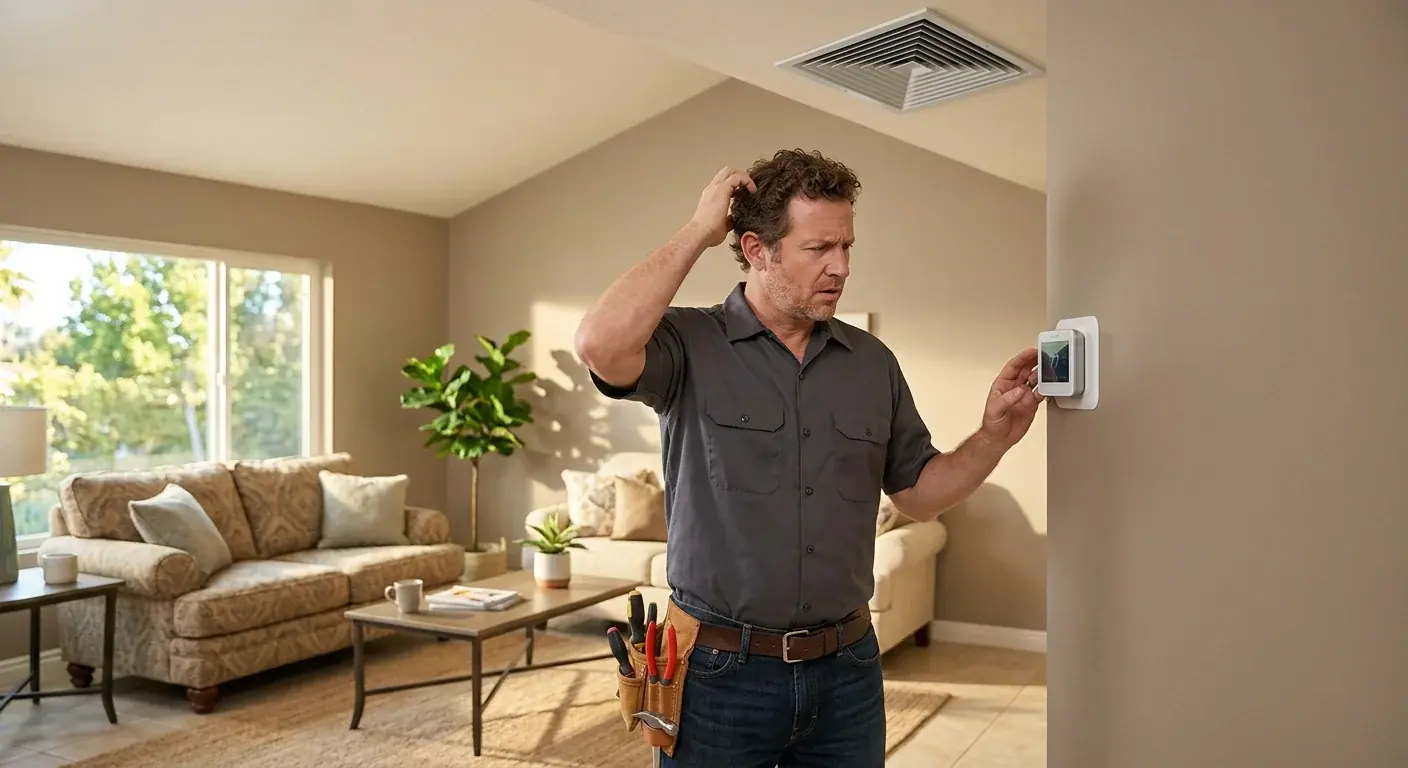
This post walks the diagnostic sequence a licensed tech should run on a San Diego service call, and how coastal salt air changes wear versus anything you’ll read on a national cost guide.
The two motors that fail (and why people confuse them)
Your AC has two motors that can stop spinning. They look similar in price articles, but they fail differently and cost different amounts to replace.
The outdoor condenser fan motor sits at the top of your outdoor unit. Its job is to pull air through the condenser coil so the refrigerant can dump heat outside. When it stops, you’ll hear the compressor humming or buzzing, the top fan blade sits still, and the cabinet gets uncomfortably hot to the touch within about five minutes. If you leave it running, the high-pressure safety switch trips, or worse, the compressor itself overheats and fails. A compressor is a different ticket from a fan motor. This is a clock you don’t want to ignore.
The indoor blower motor sits in your air handler, usually in a closet, attic, or garage. Its job is to push conditioned air through the ductwork. When it fails, the outdoor unit may run fine but no air comes out of your vents, or the airflow gets noticeably weaker over a few weeks before it stops entirely. A failing blower also commonly shows up as a frozen evaporator coil, because without airflow the coil can’t shed the cold it’s making.
The naming is genuinely confusing, and a lot of cost articles lump them together. They shouldn’t be.
What to ask for on the quote (Climate Pros SD does not publish these)
National cost guides give one band for “fan motor” with no breakdown. That number is roughly true for one repair (a basic PSC condenser fan in a dry inland climate) and false for everything else. Ask the matched licensed contractor for named lines:
Capacitor first. A failed capacitor produces almost identical symptoms to a failed motor. The capacitor is a small storage device that gives the motors their starting kick. When it weakens, the motor hums but can’t get rolling. Detail in our AC capacitor replacement guide.
Outdoor condenser fan motor (PSC). Diagnostic, a motor matched to voltage and horsepower, a new run capacitor (always replaced with the motor), labor, and the wiring harness. Most coastal units land here.
Outdoor condenser fan motor (ECM variable-speed). ECM motors are quieter and usually a larger ticket. Carrier Infinity, Trane XV, Lennox XC21 and similar premium systems use them.
Indoor blower motor (PSC). Higher than the outdoor fan because the air handler is harder to access. Attic installs add labor hours.
Indoor blower motor (ECM). Common on systems sold in San Diego since 2018 because of Title 24 fan efficiency rules.
After-hours. If you need emergency HVAC, ask whether that company charges a premium as its own line. This brand does not set it.
The diagnostic sequence (do this before saying yes to a motor)
There’s one mistake homeowners and even some technicians make: replacing a motor when a capacitor was the actual problem. The symptoms overlap almost completely. Here’s the order of testing that prevents that.
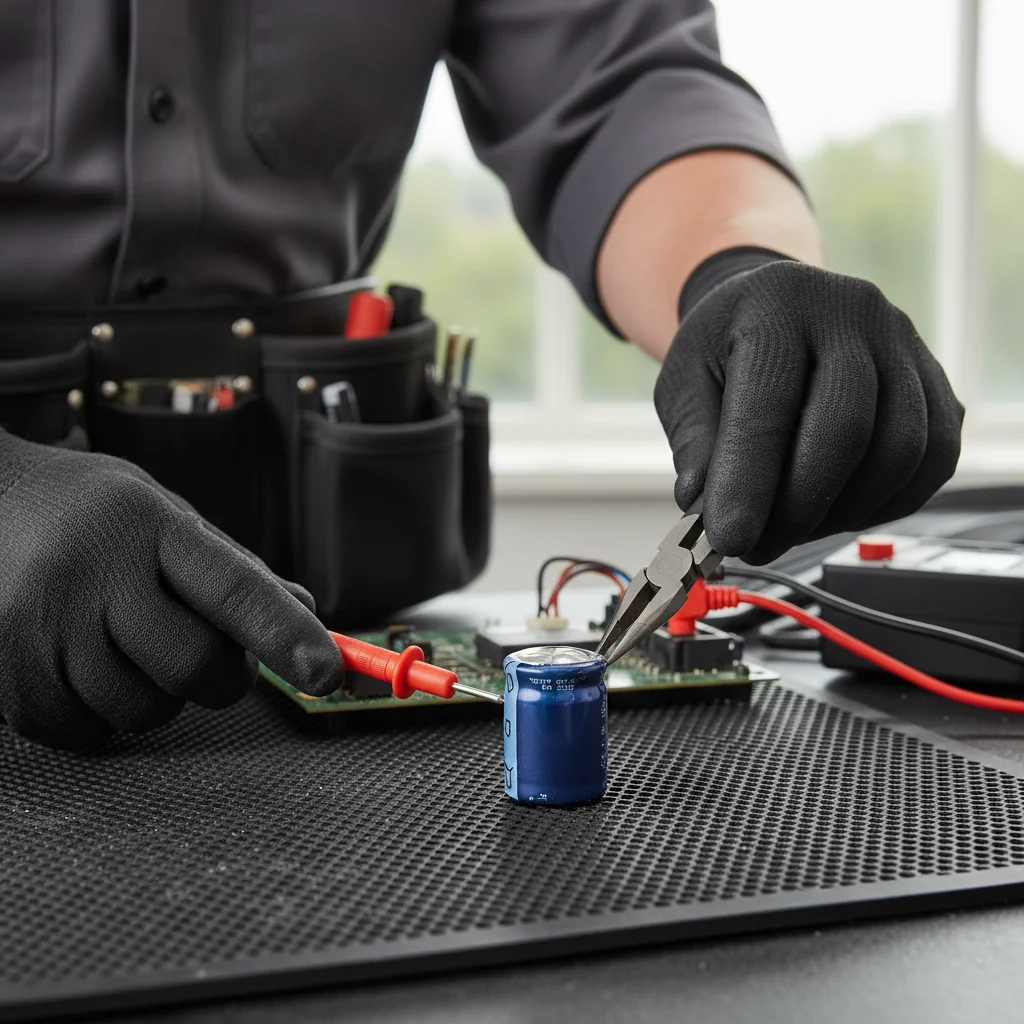
Step one, the capacitor. A multimeter with a capacitance setting reads the part in about 30 seconds. If the rated microfarad value on the capacitor’s side label is, say, 45/5 µF, the reading should fall within 6% of those numbers. A reading 10% or more below spec means a failed capacitor. This single test eliminates roughly 60% of “fan won’t spin” calls in our experience across San Diego County.
Step two, the contactor. The contactor is the relay that sends power to the outdoor unit when the thermostat calls for cooling. A pitted or stuck contactor can keep the compressor humming while the fan motor never gets the signal. Ask for the contactor as its own line. It is easy to spot if you know to look.
Step three, the motor windings. With power off, an ohmmeter reads resistance across the motor’s run and start windings. Open or shorted windings confirm the motor itself is dead. Only at this point should you authorize a motor replacement.
Step four, bearing seizure. Sometimes the motor is electrically fine but the shaft is physically stuck from corrosion. With the breaker off, a technician can hand-spin the blade. If it doesn’t rotate freely, the bearings are gone, motor replacement is the answer.
If a contractor proposes replacing the motor without doing the first two steps in front of you, ask why. Skipping the capacitor test is the single most common reason people overpay for AC repairs in San Diego.
Why coastal San Diego eats fan motors faster
A condenser fan motor in a dry climate like Phoenix typically lasts 12 to 15 years. In coastal San Diego, the same motor often fails at 7 to 10 years. The cause is salt air corrosion, and it doesn’t get talked about in national cost guides for an obvious reason: most of the country doesn’t deal with it.
Marine air carries chloride compounds that settle on the condenser fan motor’s shaft, bearings, and electrical terminals. Over years, the chlorides break down protective coatings, pit metal surfaces, and create resistance in connections that should be clean. Bearings seize. Terminals corrode and create high-resistance hot spots that cook the windings. Capacitors mounted next to the motor get hit by the same air and fail prematurely too.
The pattern shows up clearly when you map service calls. Homes in La Jolla, Pacific Beach, Mission Beach, Coronado, Imperial Beach, Encinitas west of I-5, Cardiff, Solana Beach, and Del Mar see fan motor and capacitor failures at roughly double the rate of inland zip codes. Homes within about 800 feet of the water are the hardest hit. Properties up on the coastal bluffs (Bird Rock, Sunset Cliffs, parts of Carlsbad) take a particularly heavy beating because of constant onshore wind exposure.
If you’re in a coastal corridor, two practical things help. First, rinse the outdoor unit with fresh water two to three times a year (when it’s off at the breaker). Salt that’s been rinsed off can’t keep eating the metal. Second, when you do replace a motor, ask for a unit with a sealed bearing housing and corrosion-resistant terminals. That upgrade is a parts adder, not a blog price. More in our coastal AC maintenance guide for Encinitas and the North County coast.
When to repair the motor vs. replace the whole condenser
This is the decision most homeowners struggle with, and the honest answer depends on three numbers: the age of your system, the cost of the proposed repair, and the SEER rating you’re currently running.
If the system is under 8 years old: repair almost always wins. Most major components (compressor, coil, refrigerant lines) still have a decade of life left, and a motor replacement gets you back to full operation.
If the system is 8 to 12 years old: use the 50% rule against a real replacement quote, or the trade’s age-times-repair heuristic as a thumb rule only. See the $5,000 rule. If current SEER is 14 or below, old SEER 13 units typically use more kWh than current SEER2 16 units in our climate. Ask for both bids on the same visit.
If the system is over 12 years old: replacement often wins. R-22 is phased out of production, so anything that pre-dates 2010 is on borrowed time. Confirm live SDG&E and TECH status at quote time. The federal 25C credit ended for systems installed after December 31, 2025. We break this down in the federal 25C tax credit guide and AC replacement vs. repair decision.
For homes still running well-maintained mid-life systems, a fan motor is a routine repair. For homes nursing an end-of-life unit through one more summer, it’s often money you’d rather put toward a downpayment on a new system.
FAQs
How long does it take to replace an AC fan motor?
A standard outdoor condenser fan motor replacement takes 1 to 2 hours from arrival to a running system. Indoor blower motor swaps run 2 to 3 hours because the air handler usually has to be partly disassembled.
Is it safe to run my AC if the outdoor fan isn’t spinning?
No. The fan exists to keep the compressor from overheating. Running the system with a dead fan for more than a few minutes risks frying the compressor, which turns a motor visit into a compressor bid. Shut the system off at the thermostat and the breaker, and call for service.
Can I replace an AC fan motor myself?
Technically possible, practically risky. The capacitor stores a lethal charge even with power disconnected and must be properly discharged. The replacement motor has to match horsepower, voltage, RPM, rotation direction, and frame size, and wiring color codes vary by manufacturer. Most DIY motor swaps we see arrive as failed jobs that cost more to fix than the original repair. We don’t recommend it.
Why is my new fan motor not spinning either?
Three common causes. One, the replacement capacitor was undersized or installed on the wrong terminals. Two, the motor is correct but wired for the wrong rotation direction (some motors are reversible and have to be set with a wire swap). Three, the underlying problem was actually the contactor or control board, and the original motor was never bad. If a recent repair didn’t fix the symptom, the diagnosis was incomplete.
How do I know if it’s the motor or the capacitor without tools?
You can’t be certain without a meter, but there’s a rough field test. With the system off at the breaker, push the fan blade by hand. If it spins freely for a few rotations, the motor bearings are probably fine and the capacitor is the more likely culprit. If the blade is stuck or rotates with grinding resistance, the motor itself is failing. This isn’t a substitute for proper testing, but it tells you which way the odds lean.
Does homeowner’s insurance cover AC fan motor replacement?
Almost never. Insurance covers sudden accidents like lightning strikes or storm damage, not wear-and-tear failures. Home warranty contracts sometimes cover it, but read the fine print. Many cap the motor and exclude labor.
Get the right diagnosis before you authorize the repair
The difference between a capacitor and an ECM blower motor isn’t a guess. It’s a 10-minute test. If your outdoor fan isn’t spinning or your indoor blower has gone quiet, call (442) 777-6440 and we’ll match you with a licensed local company. Climate Pros SD does not dispatch a truck, does not offer a free diagnosis, and does not promise same-day arrival. Ask the matched tech to test the capacitor and contactor before quoting a motor, walk you through the readings, and only recommend the bigger repair when the smaller one is ruled out.
Related services: AC repair, AC installation and HVAC maintenance. Not sure this is your symptom? Our HVAC symptom finder matches what the system is actually doing to the likely cause.