In San Diego, the ductless vs ducted decision usually comes down to one question: does the house already have ductwork? If yes, ducted is usually the smaller project. If no, ductless is usually the right call. The other factors matter, they just don’t override that one.
Here’s the full picture.
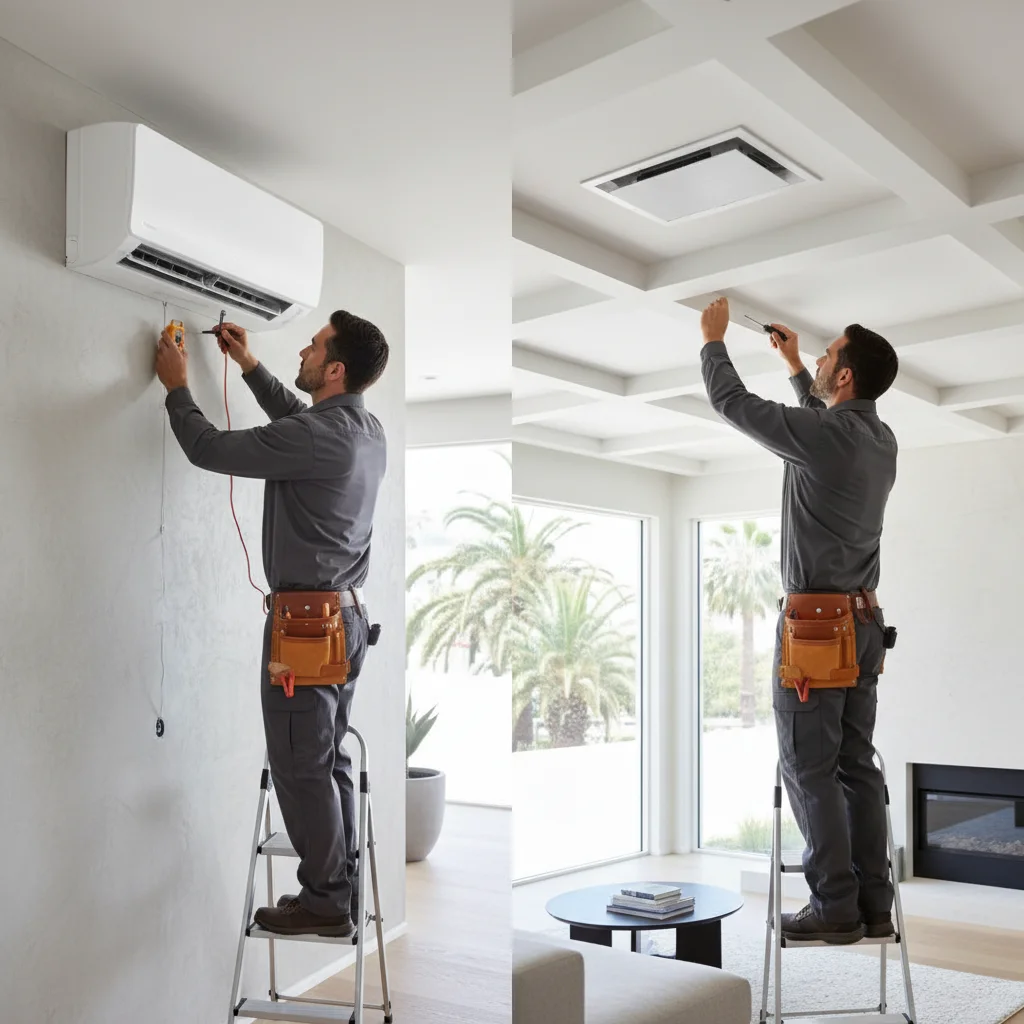
The fast answer
| Your situation | Better fit | Why |
|---|---|---|
| Pre-1970 SD home, no ducts (Old Escondido, North Park, Hillcrest, Coronado) | Ductless | Adding ducts through plaster is its own construction job; ductless avoids it |
| Modern home (post-1990), has existing ducts | Ducted central system | Simpler install and service when ducts are sound |
| Adding cooling to 1-2 rooms only | Ductless mini-split | No need for a whole-house system |
| Whole-house cooling, has ducts but they’re in bad shape | Either | Price duct repair as a separate line if you stay ducted |
| Detached ADU or addition | Ductless | Doesn’t need to integrate with main house system |
| Multi-zone home with very different room needs (sunny west bedroom, cold north office) | Ductless multi-zone | Each head controls its own zone independently |
| Large home over 2,500 sqft, has ducts | Ducted central | Ducted scales more cleanly; multi-zone ductless gets busy past 4 heads |
What the quote should name (not a published band)
Climate Pros SD does not install equipment and does not publish 2026 install ranges. Ask the matched company to price the actual scope:
| System | What to put on the bid |
|---|---|
| Central AC plus furnace, existing ducts | Coil, condenser, labor, permit, commissioning |
| Central heat pump, existing ducts | Full changeout lines. Recheck live rebates. |
| Central AC, new ductwork required | Equipment plus the duct construction as its own job |
| Single-zone ductless mini-split (one room) | One head, outdoor unit, line set, condensate |
| 2-zone, 3-zone, or 4-zone ductless | Head count, outdoor capacity, line-set runs |
| Ducted mini-split (hybrid, small ducts) | Hybrid layout. Quote separately from wall heads. |
If you already have ducts, ducted is usually the smaller whole-house project. If you don’t, ductless avoids the duct-construction job. That construction can exceed the equipment itself. Climate Pros SD does not publish either number.
Why so many older SD homes don’t have ducts
A lot of San Diego’s housing stock predates central AC. Most pre-1960 homes were built without forced-air systems entirely. Heat was a wall furnace or floor furnace; cooling didn’t exist because the climate didn’t need it. Coronado, Old Escondido, North Park, Kensington, Normal Heights, Mission Hills, Hillcrest, La Mesa Village, Lemon Grove, much of South Park, these neighborhoods often have homes with no ductwork at all.
Adding ducts to these homes is expensive and disruptive. Plaster walls, original wood floors, and the absence of attic or crawl space access all make it hard. Ask for the duct-only line before you compare it to ductless. Climate Pros SD does not publish a plaster-home duct band.
Where ducted still wins
Three situations push the answer toward ducted even in older homes:
- You’re already replacing the furnace. If you’re swapping out a wall furnace anyway and the project includes some demolition, adding ducts at the same time is usually less disruption than doing it later as a standalone project.
- You want a single thermostat and consistent whole-house cooling. Ducted systems average air across the whole house; ductless multi-zone systems treat each room independently. For homes where the whole family wants the same temperature, ducted is simpler.
- You’re cooling more than 2,500 sqft. Ductless multi-zone layouts get busy at 4+ heads. Past that point ducted often scales more cleanly and runs quieter.
Where ductless still wins
Five situations push the answer toward ductless even in homes that have ducts:
- Existing ducts are in bad shape. Leaky, undersized, or running through hot attics can lose a large share of conditioned air. ENERGY STAR says a typical house can lose about 20% to 30% of the air moving through ducts because of leaks, holes, and poorly connected ducts. That is a national typical-house statement, not a measured result for your attic. Price sealing or replacement as a separate line. Sometimes the honest bid is to abandon the ducts and go ductless.
- You only want to cool 1-2 rooms. A single-zone ductless covers a master bedroom or living room. A whole-house central system to do the same job wastes capacity on rooms you don’t need to cool. Climate Pros SD does not publish either install band.
- You have an ADU, addition, or converted garage. These spaces are often a long duct run from the main system. A dedicated ductless head is usually more efficient and doesn’t drag down main-house performance.
- Your home has very different room needs. A west-facing room that bakes in the afternoon needs different cooling than a shaded north-facing office. Ductless multi-zone gives each room its own thermostat.
- You want maximum efficiency. Ductless systems avoid the 15-30% efficiency loss that ducts introduce. Modern inverter-driven mini-splits run at SEER2 ratings of 18-25, well above the 15-18 typical of ducted central systems.

The hidden costs people miss
Ductless gotchas:
- Wall-mounted indoor heads are visible. Some homeowners hate the look in formal rooms.
- Condensate drainage requires a small line to the outside; in some wall locations this means visible white piping.
- Multi-zone systems with 3-4 heads need a single large outdoor unit, which can be a sound concern in tight setbacks (Coronado, downtown bungalows).
- Indoor heads need to be cleaned every 6 months; the filters and coils accumulate dust differently than ducted systems.
Ducted gotchas:
- Duct leakage in attics costs you 15-30% of cooling capacity if ducts weren’t sealed.
- Ductwork in unconditioned attics gets hot in summer, reducing system efficiency further.
- If supply ducts are undersized for a new high-efficiency system, you’ll get airflow and noise complaints.
- Adding ducts to plaster walls in older homes can require significant repair work.
Heat pump compatibility
Both ductless and ducted systems can be configured as heat pumps for combined heating and cooling. In San Diego where heating loads are light, heat pumps make excellent sense for either configuration. An open SDG&E offer, where one applies, covers both.
A small detail that matters: ductless mini-splits are usually heat pumps by default. Almost every modern mini-split sold today is a heat pump unit. Ducted central systems traditionally come as separate AC plus gas furnace, with heat pump as a specific option.
For homes adding cooling for the first time, ductless heat pumps are an efficient way to electrify both heat and cool in a single project. See our heat pump rebate guide for the current incentive math.
San Diego patterns we see most
Three patterns drive most of the ductless vs ducted decisions we work through with homeowners:
-
Old coastal home, no ductwork, retired couple, wants comfort without major construction. Two-zone ductless (master bedroom plus living room). Often a one-day install. They never run anything else. Ask for that scope in writing.
-
Older inland home with central AC failing, ductwork tired but functional. Replace central system, reseal main trunk and feeders, upgrade thermostat. Same install footprint as the old system.
-
Mid-century home in central San Diego, has ducts but they’re 60 years old and undersized. Honest math: get a full ducted retrofit including new ductwork as one bid, and a 3-head ductless multi-zone as the other. Ductless often wins on disruption and comfort. Central wins on aesthetics if visible heads are a deal-breaker. Climate Pros SD does not publish those two totals.
FAQs
Is ductless cheaper than ducted?
For whole-house cooling in a home that already has ductwork, no, ducted central is usually the smaller project. For homes without ductwork (especially pre-1970 SD homes), ductless usually wins because adding ducts is its own construction job. Climate Pros SD does not publish a duct-add-on band.
Are mini-splits more efficient than central AC?
Yes, usually. Modern inverter-driven mini-splits run SEER2 18-25 and avoid the 15-30% duct loss of central systems. A new central system at 16 SEER2 with leaky old ducts can effectively perform at 11-12 SEER. A mini-split delivers what its rating says.
Can I cool my whole house with a ductless system?
Yes. Multi-zone systems with 3-4 heads cover most San Diego homes. Past 4 heads or 2,500 sqft, ducted often becomes the cleaner layout.
How long does a mini-split last?
12-18 years in San Diego with normal maintenance. Coastal homes see slightly shorter coil life due to salt-air corrosion, similar to central AC.
Do mini-splits work in cold weather?
Yes. Modern cold-climate mini-splits are rated efficient down to 5F outdoor temperature. San Diego rarely sees below 38F overnight, so cold-weather performance is never the limiting factor here.
Are mini-splits noisy?
Indoor heads are very quiet, generally 25-35 decibels (whisper level). Outdoor units run 50-60 decibels at full load, comparable to central AC condensers. For close setbacks (tight side yards), placement matters.
Can I add a mini-split to my house if I already have central AC?
Yes, and matched companies do this often for hot upstairs bedrooms or sunrooms that the main system can’t keep up with. A single-zone ductless on a problem room can avoid a duct redesign. Climate Pros SD does not publish that add-on band.
Does adding ductwork increase home value?
Modestly. Buyers pay for working cooling, not for whether the air travels through ducts. A clean ductless install can add similar marketability at less construction disruption. Climate Pros SD does not publish a resale premium.
Related services: AC installation, AC repair and HVAC maintenance.
When to call us
If you’re deciding between adding ducts or going ductless, the matched company should walk both options with written scopes for your house. No published Climate Pros price table. Call (442) 777-6440 or read our ductless mini-split vs central AC comparison for more depth on the equipment side.