Your AC stops on a hot afternoon in Santee, and you search “HVAC repair near me.” Twenty pins appear. The problem is not finding a name. It is knowing who holds a C-20, who will not bait you with a token diagnostic, and who can actually return if a part has to be ordered.
Climate Pros SD is a referral service. We connect you with licensed local HVAC pros. We do not perform the repair. Verify the matched contractor at cslb.ca.gov.
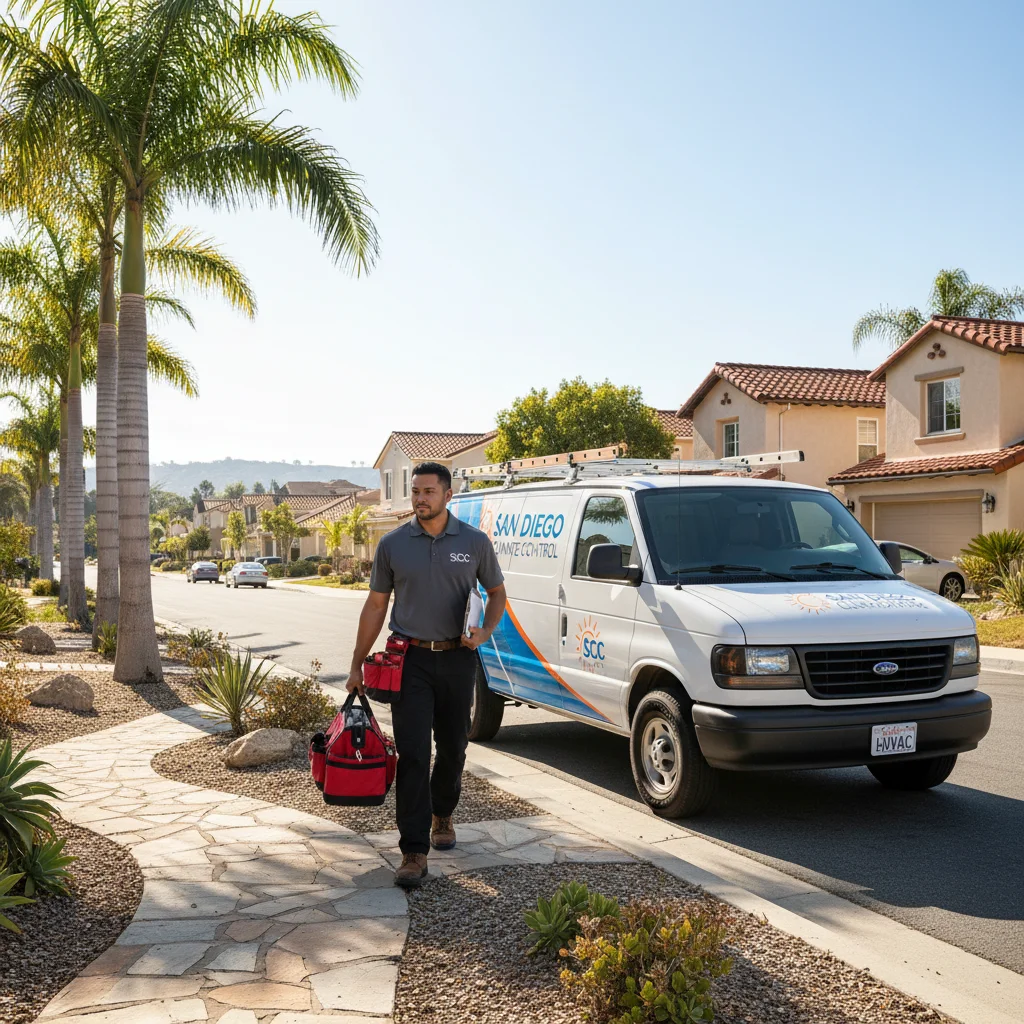
What does “near me” mean in a county this large?
San Diego County is about 4,200 square miles. A company based in Escondido is “near you” on Google. If you are in Chula Vista, that is a long freeway before anyone is in the driveway.
Ask: “Where do you dispatch from, and how does that sit relative to my address?” A corridor answer (“we work the I-8 east”) is more useful than “all of San Diego.”
Distance matters twice: first visit, and the return trip if a part is on order. Warranty callbacks from a company that hates your ZIP are a second project.
For true emergencies (no cooling at night, breakers tripping, gas smell), emergency HVAC is the matching path. Not every shop runs nights. Find that out on the phone, not at 11 p.m. See who to call for AC repair in San Diego. The matched pro owns arrival time. We do not promise same-day service.
Which license and insurance checks take a minute?
California HVAC work needs a C-20 (warm-air heating, ventilating, and air-conditioning) or, for some refrigeration scopes, C-38. Anyone adding or recovering refrigerant needs EPA 608 on the tech, not only on a shop wall.
On the CSLB license check:
- Status should be Active
- Classifications should include C-20 or C-38 for the work you need
- Workers’ comp should show coverage, or a lawful sole-owner exemption you understand
If they will not give a license number before you book, stop. Legitimate shops put it on the site, the truck, and the invoice.
General liability is what pays if a tool goes through a ceiling. Ask for a certificate. A professional shop emails one.
What phone-quote behavior is a red flag?
A common San Diego pattern is a tiny advertised diagnostic, then a large repair starting with a refrigerant top-off.
Refrigerant is not a fuel. If the system is low, it leaked. Adding charge without a leak search is either incompetence or a sales move. The charge leaves again. EPA 608 also forbids knowing venting. A reputable shop looks for the leak first.
Other red flags:
- A repair price before anyone has seen the system
- Pressure to book because a “rate expires today”
- No named diagnostic fee, or a fee that is suspiciously token
- Waiving the diagnostic only if you approve repairs on the spot
Ask for the diagnostic fee, what it covers, and whether it credits toward repair if you proceed. That is the matched pro’s policy. Get it in writing.

What should a fair diagnostic visit include?
A real AC repair visit is a systematic look, not a glance and a price sheet.
The tech should check:
- Thermostat and settings
- Disconnect, fuses, capacitor readings
- High- and low-side refrigerant pressures
- Condenser and evaporator coils
- Blower and filter
- Condensate drain
That usually takes a good half hour. Then they should explain the failure in plain language and put the repair quote in writing. If refrigerant is low, the next sentence is leak search, not “we will add some.”
If you want to rule out simple causes first, AC not cooling checklist is the homeowner pass. It does not replace gauges.
California Business and Professions Code section 7159 requires a written home-improvement contract above a dollar threshold that HVAC repairs often cross. If they will not write the scope, walk.
What should you ask before anyone rolls?
CSLB number. Write it down. Check it.
Diagnostic fee and credit. Ask why if it does not credit.
EPA 608 on the tech. Should be an easy yes.
Labor warranty on the repair. Ask for a number of days. Anything vague is information.
Written estimate before work. Required for larger home-improvement jobs.
When can you actually be here? If the next slot is days out and you have no cooling, you need that fact before you wait on one company. That is a scheduling question, not a same-day promise from Climate Pros SD.
When to call
Distance also changes what “near me” should mean in North County. Fallbrook and Bonsall sit inland on SR-76 and I-15. A Carlsbad pin on Google Maps is not a rural gate on Reche Road. Julian is farther still, via SR-78 or SR-79, with snow-day delays in winter. Ask the company whether they already run those routes. If they hesitate, keep searching.
A fair diagnostic in inland heat also looks different from a coastal leak search. Escondido and San Marcos no-cool calls in August are often capacitors, contactors, and dirty condensers. Encinitas and Carlsbad calls are more often slow refrigerant leaks and corroded fins. The CSLB number does not tell you which of those the tech actually sees every week. Their ZIP-code reviews do.
Refrigerant, capacitors, and air-handler electrical are licensed work. A YouTube clip is not a substitute.
City-specific matching if you want neighborhood notes:
- AC repair in San Marcos
- AC repair in Escondido
- AC repair in Vista
- Furnace repair in San Marcos
- Emergency HVAC
Call (442) 777-6440. We match you with a local pro. They confirm the diagnostic fee and their own arrival window. Bring the CSLB number, the equipment model, and a photo of the outdoor unit if you have them.