A mini-split (also called a ductless mini-split) is an air conditioner, or more commonly now a heat pump, that conditions individual rooms without using ductwork. It is the same refrigerant cycle as central AC, but instead of one big indoor coil in an air handler pushing air through ducts, the indoor coil sits in a wall-mounted head in the room you want to cool.
Climate Pros SD matches you with licensed HVAC companies. We do not install mini-splits, set prices, or promise a free in-home assessment.
Here is how the whole system actually works, without the marketing fluff.
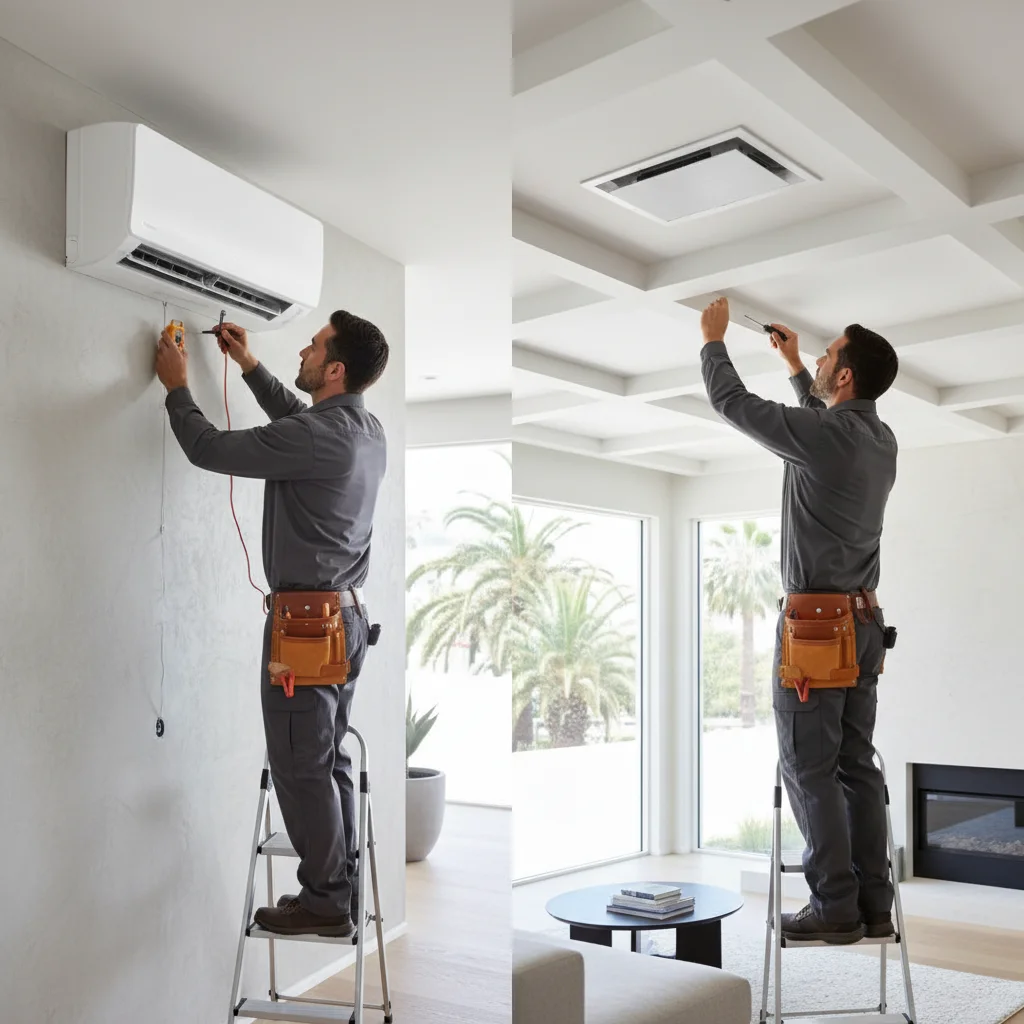
What is the 60-second version?
A mini-split has three main parts:
- One outdoor unit containing the compressor and outdoor coil
- One or more indoor heads mounted on walls (sometimes ceilings or floors), each containing an indoor coil and a fan
- Refrigerant line set, small insulated copper pipes running between outdoor unit and each indoor head
When you turn the system on, the outdoor compressor circulates refrigerant through the line set to whichever indoor head is calling for cooling. The indoor coil gets cold, the fan blows room air across it, and cold air enters the room. Heat absorbed from your room is carried back to the outdoor unit and released to the outside air.
No ductwork. No central air handler. The indoor head is the air handler for that room.
Why “mini” and why “split”?
Mini refers to the size of the indoor unit compared to a traditional central air handler. Most mini-split indoor heads are compact enough to mount on a wall.
Split refers to the fact that the system is divided between an outdoor compressor/condenser unit and a separate indoor air-handling unit, connected by refrigerant lines. Standard central AC is also technically a split system (outdoor condenser plus indoor air handler), but “mini-split” specifically refers to the ductless version.
How does the cooling cycle work?
Same refrigerant cycle as any other air conditioner:
-
Cold liquid refrigerant flows through the indoor coil. The fan in the indoor head blows warm room air over the cold coil. The refrigerant absorbs heat from the air and turns into gas. The cooled air enters the room.
-
The gas refrigerant flows through the line set back to the outdoor unit.
-
The outdoor compressor squeezes the gas, which makes it very hot.
-
The hot gas flows through the outdoor coil. The outdoor fan blows ambient air across the coil. The refrigerant releases its heat to the outdoor air and condenses back into liquid.
-
The liquid flows back to the indoor coil through the line set, and the cycle starts again.
The visual difference from central AC: instead of one huge indoor coil in an air handler in a closet or attic that connects to ducts running all over the house, you have one small coil in a wall-mounted head in each room. Same refrigerant, same cycle, different distribution.
How do heat pump mini-splits work in heating mode?
Most modern mini-splits sold in 2026 are heat pumps. They can run the refrigerant cycle in either direction. In heating mode, a reversing valve flips the flow:
-
Cold liquid refrigerant flows through the outdoor coil. Even cool outdoor air has enough heat energy that the refrigerant absorbs it and turns into gas.
-
The gas flows to the compressor, which squeezes it hot.
-
The hot gas flows through the indoor coil. The indoor fan blows room air over the now-hot coil. Heat transfers from the refrigerant to your room air. Your room warms up.
-
The refrigerant condenses back to liquid, returns to the outdoor coil, and the cycle continues.
This is the same refrigerant cycle as in cooling, just running backwards. The reversing valve is the mechanical part that makes a heat pump different from a cooling-only AC.
What is the difference between single-zone and multi-zone?
Single-zone mini-split: one outdoor unit serving one indoor head. Common for a master bedroom, living room, sunroom, or ADU. Climate Pros SD does not publish an installed price.
Multi-zone mini-split: one larger outdoor unit serving several indoor heads. Each indoor head has its own thermostat and runs independently. Common for homes without existing ductwork. Ask for zone count, line-set length, and electrical as line items.
The multi-zone outdoor unit is bigger, but it is still one outdoor unit instead of multiple smaller ones, which can save yard space and electrical runs.
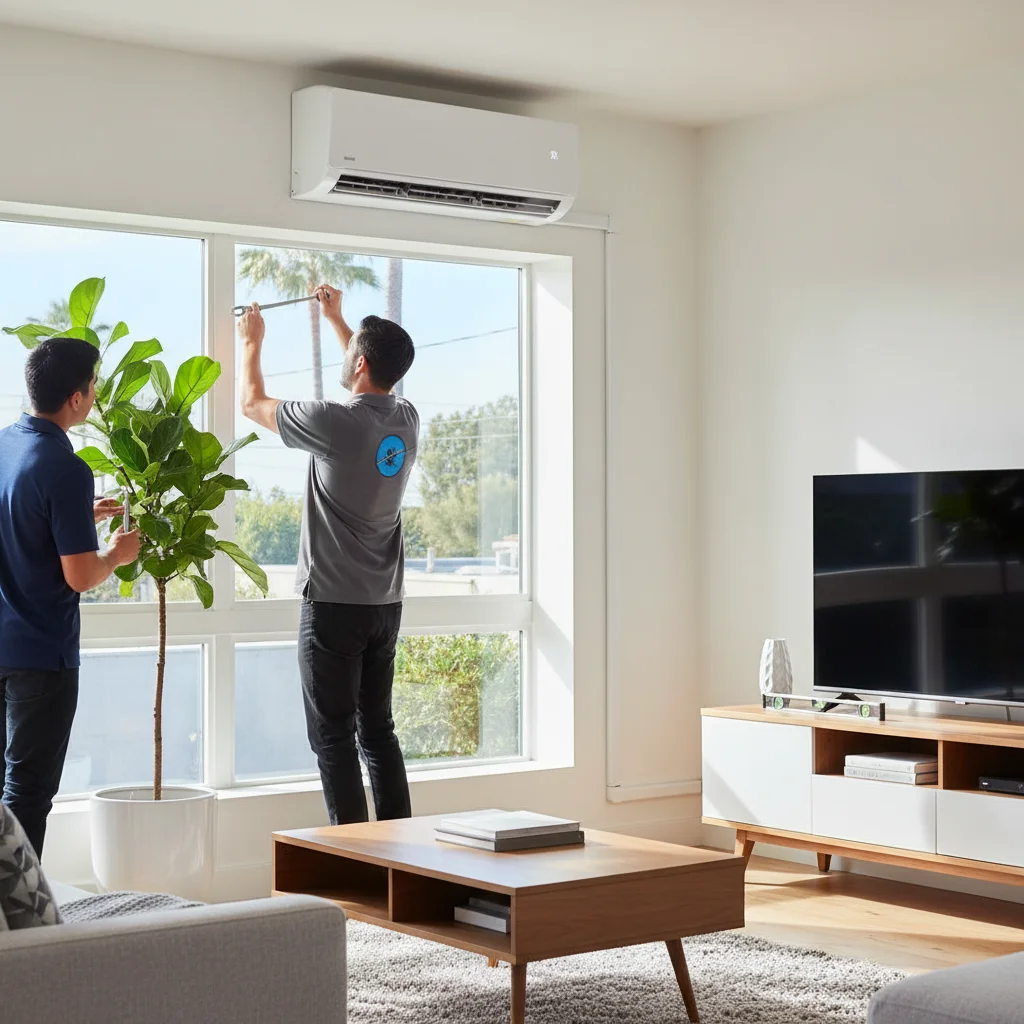
Why do inverter compressors matter?
Almost every modern mini-split uses an inverter compressor. A traditional AC compressor runs at full speed when it is on and off when it is not, like a light switch. An inverter compressor modulates speed continuously rather than only on or off.
The practical effect: mini-splits can hold temperature more precisely (they ramp up and down instead of cycling hard), they often run quieter at low speed, and they can use less energy because they avoid constant startup cycles.
This is one reason mini-split SEER2 ratings are often listed higher than many central AC ratings. The inverter is a technology difference, not proof your bill will drop a stated percent.
What indoor head types exist?
Most San Diego mini-split installs use wall-mounted heads, the rectangular boxes you have seen on walls. Other options:
- Wall-mount. Most common. Easier install, visible.
- Ceiling cassette. Recessed into the ceiling with a flat grille. Cleaner look, more invasive install. Ask as a separate line, not a blog add-on dollar figure.
- Concealed duct (slim-duct). Hidden in a ceiling cavity, connected to a small section of ductwork for the room. Looks more like central AC.
- Floor console. Mounted near the floor. Useful for older homes where high wall mounting does not fit the room.
Wall-mount is the default for cost and access. The other options work for specific design situations.
What can you not do with a typical residential mini-split?
Three things to know:
1. You cannot cool one zone while heating another with most residential systems. The system is in heating mode or cooling mode at any moment. Commercial variable refrigerant flow (VRF) systems can do simultaneous heating and cooling, but they are uncommon in typical houses.
2. You cannot run heads in opposite modes from one outdoor unit. All heads share the same compressor. They can have different temperatures and turn on and off independently, but they cannot all be heating while different ones are cooling.
3. You cannot easily heat or cool a huge house with one small outdoor unit. Each indoor head covers a limited area. Past several heads, central HVAC often becomes the cleaner whole-house design. Use a load calculation, not a square-foot rule from this page.
How do mini-splits compare to central AC?
Covered in more depth in our ductless vs ducted HVAC guide, but the short version:
Mini-split wins when: you do not have existing ductwork, you only want to cool specific rooms, you have very different room needs, you have an ADU or addition.
Central AC wins when: you have existing ductwork in decent shape, you want consistent whole-house cooling, you want a single thermostat.
ENERGY STAR says a typical forced-air house can lose about 20% to 30% of the air moving through ducts because of leaks. That is a national typical-house statement, not a measured result for your San Diego attic.
What is particular to San Diego mini-splits?
1. They are an obvious answer for many pre-1970 homes. A large share of San Diego’s older housing stock (Coronado, North Park, Hillcrest, Old Escondido, Lemon Grove) has no ductwork. Adding ducts is a separate, often large, project. Mini-splits avoid it. Climate Pros SD does not publish a duct-add price.
2. Coastal corrosion still applies. Mini-split outdoor units corrode in salt air just like central AC condensers. Coastal remaining life is often shorter than inland. Use condition on site, not a year table.
3. They can qualify for the same heat pump programs that are actually open. Most mini-splits sold today are heat pumps. Section 25C does not apply to property placed in service after December 31, 2025. If you mention 25C for 2025 property, the IRS annual limit for qualified heat pumps and heat pump water heaters was $2,000. TECH Clean California single-family HVAC reservations stopped November 14, 2025. HEEHRA single-family was fully reserved February 24, 2026. Design caps are not live money. Do not stack TECH and HEEHRA. Confirm sdge.com/rebates. See our 2026 heat pump rebate guide.
FAQs
How does a ductless mini-split work?
Same refrigerant cycle as central AC. An outdoor compressor circulates refrigerant through small copper lines to one or more indoor wall-mounted heads. Each head has its own coil and fan. The indoor coil absorbs heat from room air (cooling) or releases heat into room air (heating).
What is the difference between a mini-split and central AC?
Central AC uses a single large indoor air handler that distributes conditioned air through ductwork. A mini-split puts smaller indoor coils directly in each room, eliminating ductwork. Same refrigerant cycle, different distribution method.
Do mini-splits work without ducts?
Yes, that is the entire point. Mini-splits are designed for homes without ductwork. The indoor heads serve as the air distribution points themselves.
Can a mini-split heat and cool?
Most modern mini-splits (heat pump versions) can do both. A reversing valve switches the refrigerant flow direction, allowing the same system to cool in summer and heat in winter. Cooling-only mini-splits exist but are increasingly rare in new installs.
How many rooms can a mini-split cool?
One outdoor unit can serve one or several indoor heads depending on the model. Single-zone systems are for one room. Multi-zone systems can cover several rooms. Past a handful of heads, central HVAC often becomes more practical. The matched contractor sizes it.
How long does a mini-split last?
There is no published Climate Pros SD lifespan. Coastal homes often see shorter remaining life due to salt-air corrosion. Inland homes often last longer. Maintenance and install quality matter more than a year range.
Are mini-splits efficient?
They can be. Many modern mini-splits list higher SEER2 numbers than typical central AC. The efficiency advantage often comes from inverter-driven compressors that modulate speed. Actual bills depend on your house and your SDG&E or CCA plan, including 4 p.m. to 9 p.m. on-peak.
Are mini-splits noisy?
Indoor heads are typically quiet on low. Outdoor units are comparable to central AC condensers at full load. Inverter-driven systems run quieter at partial loads, which is most of the time. Ask the installer for manufacturer sound ratings if that is a deciding factor.
Related services: AC repair, AC installation and HVAC maintenance.
When should you call?
If you are trying to figure out whether a mini-split fits your home and how many zones you would need, call (442) 777-6440. Climate Pros SD matches you with a licensed pro for a written quote. This brand does not offer a free in-home assessment.