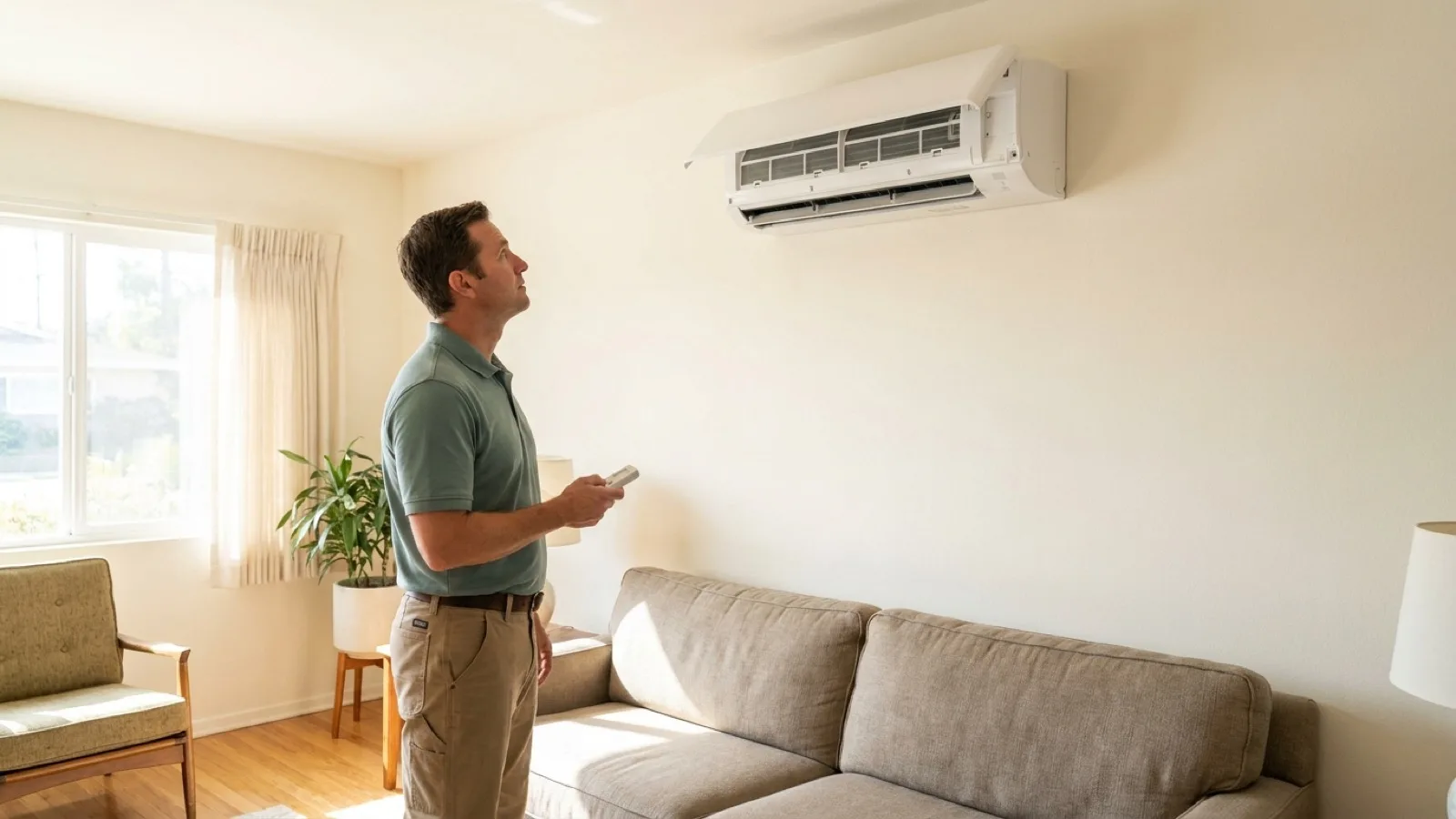
The best wall AC and heater combo unit for most San Diego homes is a single-zone wall-mounted mini-split heat pump: one indoor head that heats and cools with no ductwork required. The other two real options are a through-wall PTAC (the hotel-style box built into a sleeve, common in condos) and a gas wall furnace paired with separate cooling, which is usually the option to avoid unless you already have one and it’s working fine. Here’s how the three compare and which one fits your house.
What is a wall AC and heater combo unit?
A wall AC and heater combo unit is a single piece of equipment, or a matched pair, that heats and cools a room or a whole house through a wall-mounted or through-wall unit instead of a central ducted system. The term covers three genuinely different technologies people mean when they search for it. A ductless mini-split heat pump has an indoor head mounted high on an interior wall, connected by a thin line set to an outdoor condenser. A PTAC (packaged terminal air conditioner) is the boxy unit that sits inside a sleeve built into the exterior wall, with the whole system, compressor included, sitting in the room. A gas wall furnace is heat-only and was never designed to cool, so “combo” really means the furnace plus whatever cooling got bolted on later, usually a window unit or a mini-split added afterward.
What are the wall AC and heater combo options for a San Diego home?
The three real options split clearly on cost, comfort, and how much work they save you later. The table below uses typical installed price ranges for San Diego as of 2026, not national averages, since local labor rates and permit requirements move the number.
| Option | Typical installed cost (San Diego) | Heats and cools | Noise | Best for |
|---|---|---|---|---|
| Wall-mounted mini-split heat pump | $4,000 to $8,000 | Yes, one unit does both | Quiet, roughly 19 to 30 dB at the indoor head | Older no-duct homes, ADUs, additions, most whole-house upgrades |
| Through-wall PTAC | $1,500 to $3,500 (unit, sleeve, and electrical) | Yes, but weaker heat output and lower efficiency | Louder, compressor sits in the room | Condos and rentals with an existing wall sleeve |
| Gas wall furnace + separate AC | $2,500 to $5,000 (heat only, cooling priced separately) | Only if you add cooling as a second system | Furnace is quiet, but you’re now running two systems | Homes keeping working gas heat and adding cooling as an afterthought |
A single-zone mini-split installed by the mini-split installation crews in our network usually lands in the $4,000 to $8,000 range depending on the size of the room, how far the condenser sits from the indoor head, and whether the electrical panel needs any work. Our ductless mini-split cost guide for San Diego breaks that range down by zone count and home size if you want the fuller picture. A PTAC swap is cheaper up front because the wall sleeve and electrical run are usually already there from a previous unit. Keeping a gas wall furnace and adding AC separately almost always costs more over time, because you’re maintaining two systems instead of one and losing the efficiency a heat pump gets from moving heat instead of burning gas to make it.
Why San Diego has so many gas wall furnace homes with no ducts
San Diego’s older housing stock is the reason this search cluster exists at all. Neighborhoods like North Park, University Heights, and older pockets of La Mesa and El Cajon are full of houses built in the 1950s, 60s, and 70s with a single gas wall furnace in a hallway and zero ductwork anywhere else in the house. Cooling in those homes has historically meant a window unit propped in a bedroom, because running ducts through a slab-on-grade or a tight attic is expensive and disruptive. The same pattern shows up in beach cottages near the coast, where small floor plans and low attic clearance made ducted systems impractical when the home was built.
The mild coastal climate actually makes this an easy call. A heat pump struggles in genuinely cold winters, but San Diego rarely sees nights cold enough to challenge a modern cold-climate heat pump, so the efficiency case is strong almost everywhere in the county. Inland communities like El Cajon, Santee, and Alpine see more summer heat and a wider day-night temperature swing, which is exactly the condition where a mini-split’s variable-speed compressor earns its keep, running efficiently at partial load instead of cycling on and off like an old window unit. Coastal homes lean harder on the cooling side in summer and rarely need much heat at all, which is why a single mini-split head, sized right, often replaces both the old wall furnace and whatever cooling was jury-rigged in before it. Techs on HVAC service in La Mesa calls see this exact swap constantly: gas wall furnace out, one mini-split head in, done in a day.
SDG&E’s electric rates are high enough that efficiency matters more here than in most parts of the country. A modern wall-mounted heat pump with a strong SEER2 and HSPF2 rating costs less to run per hour of comfort than a resistance-heat PTAC or a jury-rigged window AC, even accounting for San Diego’s summer peak rates. It’s also worth checking whether your install qualifies for a TECH Clean California heat pump incentive before you commit to equipment, since rebate programs shift year to year and a qualifying model can meaningfully change the math.
Which wall AC and heater combo unit should you pick?
The right choice depends on what you’re starting from, not personal preference.
If you own the home and have a gas wall furnace with no ducts, the mini-split heat pump wins almost every time. It replaces both heating and cooling with one system, costs less to run long-term, and it’s the option our heat pump service techs recommend most often for exactly this house type.
If you’re in a condo with an HOA and an existing PTAC sleeve, replacing the PTAC is usually the path of least resistance, since there’s no new wall penetration to get approved. It’s the cheaper, faster fix, even though it’s noisier and less efficient than a mini-split. Our condo HVAC guide for San Diego covers the HOA approval process for anyone weighing a mini-split against a PTAC swap in a building with rules about exterior equipment.
If your budget is tight and the gas wall furnace still works, it can make sense to leave the furnace alone and add a mini-split for cooling only, effectively turning it into a two-system combo without replacing working equipment. That’s a reasonable middle path, not the ideal one, and it’s worth pricing both ways with an AC installation quote before deciding. Our mini-split versus central AC comparison is worth a read if ducting the whole house is even on the table, since a full duct retrofit is rarely cheaper than going ductless in these older floor plans.
If noise is the deciding factor, a mini-split beats a PTAC by a wide margin, since the compressor lives outside instead of inside the room you’re trying to sleep in.
Frequently asked questions
Is there a wall unit that does both heat and AC?
Yes. A wall-mounted mini-split heat pump is the modern version of a wall unit that heats and cools from a single indoor head, with the compressor and condenser sitting outside. A through-wall PTAC also heats and cools from one box, though with weaker heat output and lower efficiency than a mini-split. A standard gas wall furnace is heat only and can’t cool a room on its own.
How much does a wall-mounted heat and air unit cost in San Diego?
A single-zone wall-mounted mini-split heat pump typically runs $4,000 to $8,000 installed in San Diego, depending on room size, condenser placement, and any electrical work needed. A through-wall PTAC replacement, including the sleeve and electrical, usually runs $1,500 to $3,500. Multi-zone mini-splits covering more than one room cost more per additional indoor head.
Can a wall unit replace an old gas wall furnace?
Yes, and it’s the most common upgrade path for San Diego’s older no-duct homes. A single wall-mounted mini-split head, sized to the room or the whole floor plan, replaces the furnace’s heating job and adds cooling the old furnace never had. Removal of the old furnace and gas line capping is usually part of the same job when a licensed HVAC contractor handles the swap.
Are through-wall AC and heat units any good?
They work, but they’re the budget option, not the best one. A through-wall PTAC costs less up front, especially when a sleeve already exists, but it runs louder because the compressor sits in the room, and it’s less efficient than a mini-split over the life of the unit. PTACs make the most sense in condos where HOA rules or an existing sleeve make them the path of least resistance.
Do wall-mounted heat pumps work on cold San Diego nights?
Yes. San Diego’s coastal and inland winter lows rarely drop into the range that challenges a modern cold-climate heat pump, so a wall-mounted mini-split comfortably covers heating for nearly every house in the county. Inland areas like Alpine or Julian that see colder nights are the exception worth a closer look with a contractor before sizing the system.
For a straight answer on which wall AC and heater combo unit fits your specific house, call (442) 777-6440. The HVAC pros in the Climate Pros SD network handle this exact swap across San Diego County, from coastal cottages to inland ranch homes, and they’re available 24/7 for the estimate.