Two air duct cleaning offers may sound alike while covering different work. Compare the written scope, access plan, exclusions, add-ons, and inspection conditions. The advertised offer matters less than what the contractor agrees to inspect and clean.
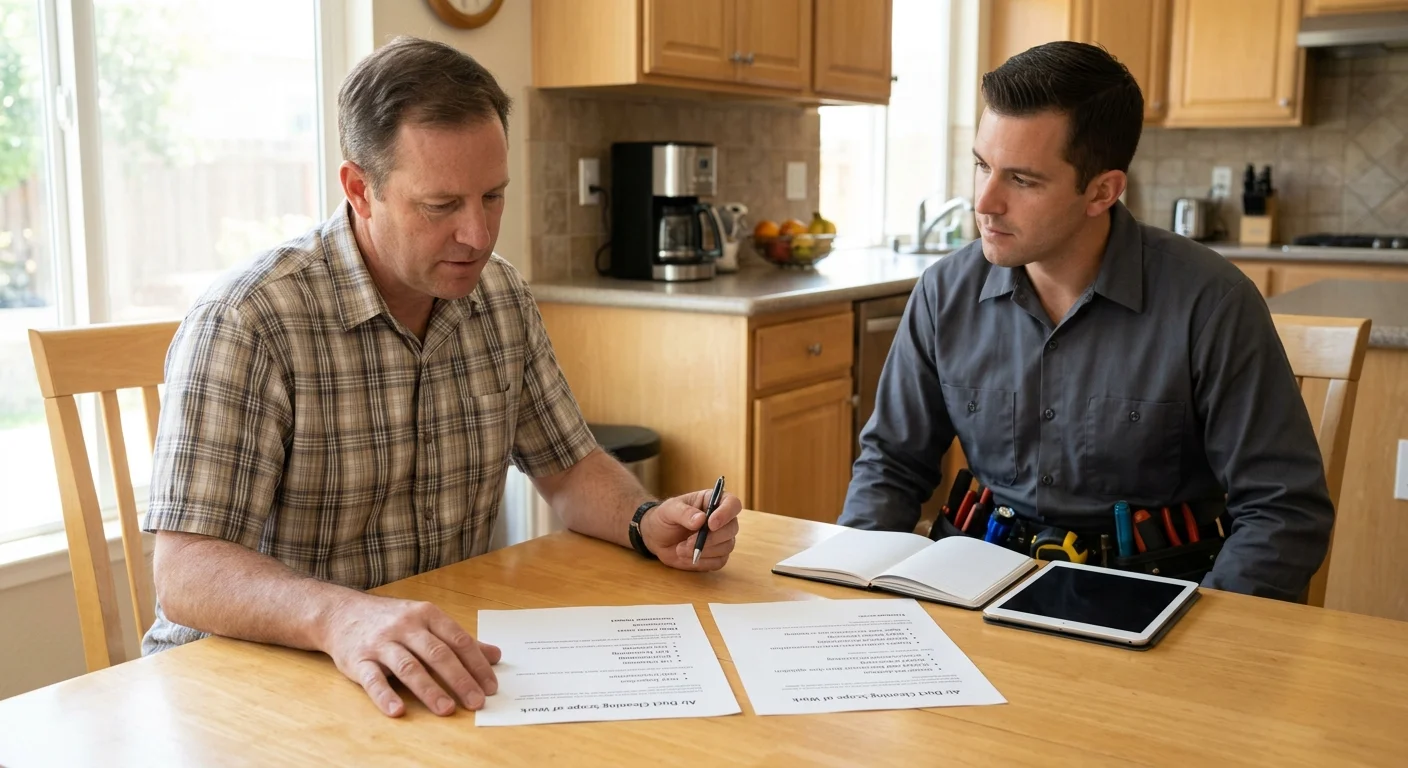
Compare duct cleaning by written scope, not the coupon
A useful offer names which ducts, how they are accessed, what is excluded, and what inspection happens before anyone quotes add-ons. San Diego attics are hot and often cramped. A truck in the driveway does not prove the contractor opened every run.
Checklist
- Ask which supply and return trunks are included.
- Require before photos of openings they will use.
- Reject prices that appear only after they are in the attic.
- See whether NADCA or equivalent methods are described, then verify the claim.
- Read is duct cleaning worth it.
Related: Duct cleaning service and duct leak repair.
What should a written duct cleaning scope name?
Start by asking each contractor to identify the HVAC system covered. A written scope should tell you which components are included. Don’t assume “whole-house duct cleaning” has one accepted meaning.
Ask the contractor to name the proposed work for:
- Supply registers and return grilles
- Supply and return ducts
- Main duct sections and smaller branches
- Accessible plenums or air-handler areas
- Filters, coils, blowers, and other equipment
- Any zones or separate HVAC systems
That list doesn’t mean every component needs cleaning. It gives you matching terms for comparing offers. One contractor might include registers but exclude HVAC equipment. Another might propose equipment work as a separate service.
Have each company list exclusions just as clearly. Ask about inaccessible ducts, damaged sections, enclosed chases, and areas above finished ceilings. The offer should explain what happens if the initial assumptions are wrong. You want written approval before the scope changes.
Keep cleaning separate from duct sealing, repair, replacement, and broader equipment work. If the contractor recommends another service, ask for a separate description. Our duct cleaning service overview explains the basic service category without treating it as duct repair.
Price comparisons only work when the scopes match. Review our San Diego duct cleaning cost guide for questions to ask about quoted work. Climate Pros SD doesn’t set contractor prices or fee policies. The homeowner contracts with and pays the matched professional directly.
How can you compare access and equipment plans?
A useful offer explains how the contractor plans to reach the included areas. Ask where access already exists and whether new openings are proposed. If openings are needed, the scope should say who closes them and what the finished condition will be.
Ask each contractor to describe the equipment and process in ordinary language. A machine name alone doesn’t explain the work. Find out how debris will be collected, which duct sections will be addressed, and how nearby rooms will be protected.
You can also request documentation. Ask whether the contractor will record the condition of accessible areas before work starts. Then ask what documentation you’ll receive afterward. Photos can help you compare the agreed scope with the completed work, but they shouldn’t replace a clear written description.
San Diego homes present different access questions. For a Mission Valley condo, ask who controls mechanical-room access. Confirm any building requirements with the property manager before signing. If your El Cajon home has attic ducts, ask how the contractor evaluated that route. If your Encinitas property has ducts below the floor, ask what portions are reachable.
Those are property questions, not assumptions about an entire neighborhood. An address alone doesn’t reveal the installation.
Compare written answers side by side. If one proposal leaves access, protection, or closure work undefined, ask for revisions. The goal isn’t to choose a universal cleaning method. It’s to understand exactly what each contractor proposes for your system.
Which add-on claims need independent verification?
Treat each add-on as a separate decision. Common proposal language may mention deodorizing products, antimicrobial treatments, coatings, filtration changes, or air-cleaning equipment. Don’t approve those items based only on a package name.
Ask five direct questions:
- What exact product or service is being proposed?
- What observed condition led to this recommendation?
- Where will the product or equipment be used?
- What evidence supports the claimed purpose?
- What future service, replacement, or restrictions come with it?
Request the product name and written manufacturer information when a chemical or device is involved. Read the stated purpose, application instructions, limitations, and warnings. Don’t treat a product label as an independent diagnosis of your home.
Health claims require extra care. An HVAC proposal isn’t personal medical advice. Claims involving allergies, asthma, mold exposure, or other health outcomes should be discussed with an appropriate independent professional. Climate Pros SD doesn’t verify promised health results.
Indoor-air concerns can also extend beyond duct cleaning. Filtration, humidity, ventilation, equipment condition, and building conditions are different subjects. Our indoor air quality service page can help you frame those questions without assuming one product is the answer.
Be cautious when an add-on promises a guaranteed result. Ask the contractor to separate observed conditions from sales language. If you’re still deciding whether cleaning addresses the original concern, read our guide on when duct cleaning may be worth considering. It keeps that decision separate from price and promotional wording.
How can home layout change the proposed scope?
A duct cleaning scope should reflect the actual home, not only its square footage or ZIP code. System count, register locations, duct routes, equipment placement, and physical access can all change the proposed work.
Walk through the home with the contractor. Ask them to identify each included supply register and return grille. If the property has more than one HVAC system, confirm which system each opening serves. A simple marked floor plan can prevent confusion.
For a Chula Vista home with separate upstairs and downstairs systems, the proposal should identify both systems by location. If a garage conversion or room addition has its own equipment, ask whether it belongs in the offer. Don’t assume every visible grille connects to the same system.
Condominiums need their own access review. Ask the contractor and property manager to clarify unit boundaries, shared areas, equipment access, and building restrictions. The contractor should identify anything that can’t be confirmed before the visit.
Detached homes also vary. Ducts may run through attics, floor cavities, garages, chases, or other enclosed spaces. Ask the contractor to mark inaccessible sections rather than quietly omitting them. If an area can’t be reached, the offer should say so.
The useful San Diego distinction isn’t simply coastal versus inland. It’s the installation in front of you. An Encinitas address doesn’t confirm a crawlspace route. An El Cajon address doesn’t confirm attic access. Compare the measured layout and visible conditions, then ask each contractor to update any incorrect assumptions in writing.
When should an independent HVAC pro inspect the system?
Request an HVAC inspection before accepting a cleaning offer when the concern may involve more than loose material inside accessible ducts. Examples include visible damage, disconnected sections, wet materials, pest evidence, equipment contamination, or persistent airflow differences. These observations don’t establish a cause, but they justify a closer evaluation.
Cleaning and repair solve different problems. Cleaning doesn’t reconnect a duct, seal a damaged joint, or correct an equipment fault. Ask the inspecting pro to separate cleaning recommendations from repairs, alterations, and indoor-air-quality work.
The California Contractors State License Board’s C-20 classification includes ventilating systems and connected ducts, registers, controls, and air filters. That scope was verified from the CSLB source in August 2026. Before agreeing to HVAC work, check the contractor’s current record through the CSLB license search.
An independent inspection also helps when competing offers describe the same condition differently. Ask each pro to identify what they observed, what remains uncertain, and what work they recommend. You can then compare the reasoning, not just the package names.
Every HVAC professional in the Climate Pros SD referral network is licensed and insured. The matched contractor controls the inspection, scope, price, and work agreement.
When to call us
Call when an offer includes possible duct damage, inaccessible sections, or changes to HVAC equipment. Climate Pros SD connects San Diego County homeowners with independent, licensed and insured HVAC contractors. Call us at (442) 777-6440 and we will match you with a licensed local pro.